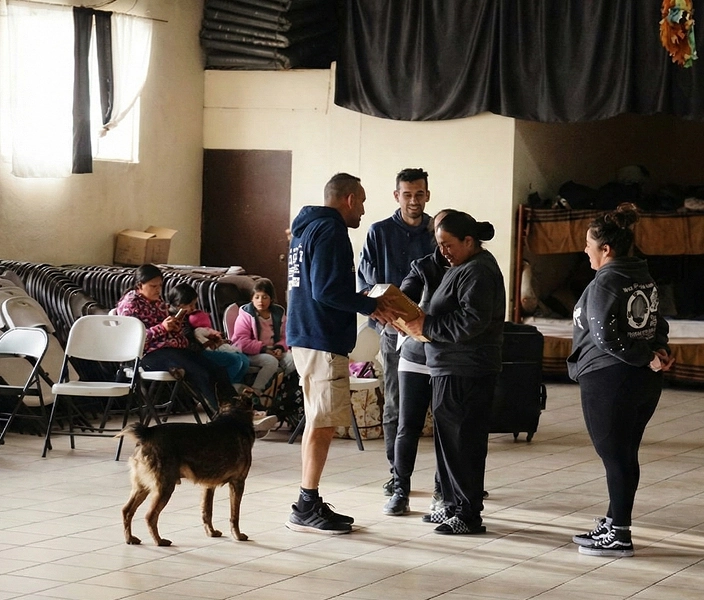






Many ministries lose good volunteers not because the work is too hard, but because the welcome was not enough. A volunteer shows up once or twice, feels unclear about what to do or who to ask, and quietly stops coming back. That pattern is common, and it is preventable.
This guide is for ministry leaders, volunteer coordinators, and program directors who want a process that is clear, safe, and grounded in the ministry's values. Each section covers a specific stage of volunteer onboarding with practical steps and credible data to support the decisions you make.
What Volunteer Onboarding Actually Means
Volunteer onboarding is the full process of integrating a new volunteer, from the first point of contact through screening, orientation, training, and early support. It is not the same as a single orientation meeting. Orientation is one step inside a longer process. A volunteer is still learning, still forming their connection to the team, and still finding their footing well past the first time they show up to serve.
Many ministry leaders use "onboarding" and "orientation" as if they mean the same thing. They do not. Galaxy Digital defines onboarding as a multi-step process that includes vetting, placement, orientation, and training. Orientation gives a volunteer an introduction. Onboarding gives them everything they need to do the work well and to want to keep doing it.
This distinction changes how you plan. If your entire process is a one-hour meeting, volunteers leave feeling welcomed but not equipped. When they face a situation they were not prepared for, frustration follows, and then dropout.
A complete onboarding process generally moves through four phases:
- Pre-arrival: role clarity, application, and screening
- Orientation: mission, values, people, and expectations
- Role training: specific tasks, tools, and supervised practice
- Ongoing support: check-ins, recognition, and growth
Each phase builds on the one before it. Skip one, and gaps appear in places you cannot always predict.
Why Ministry Volunteers Leave (and What Onboarding Can Fix)
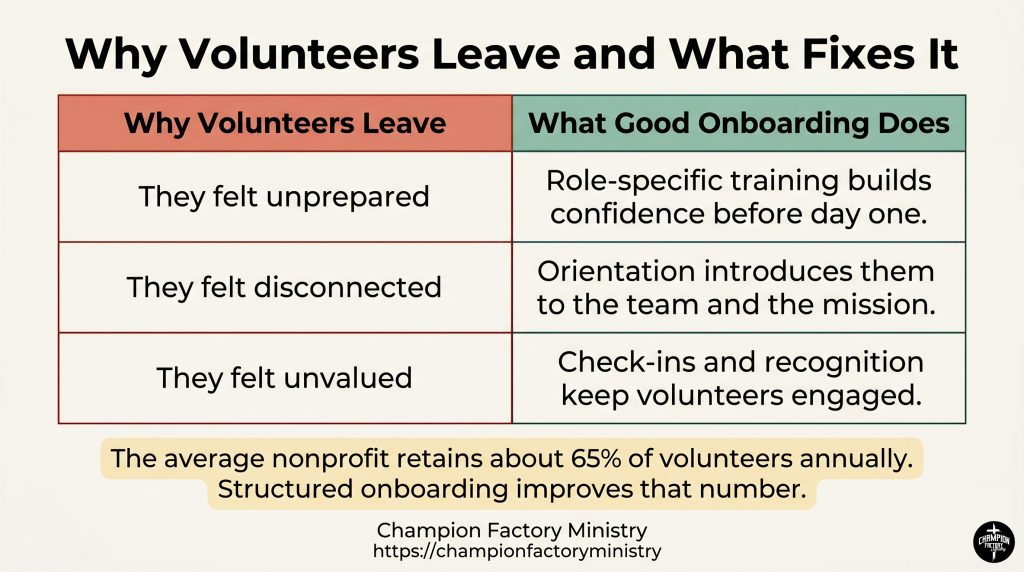
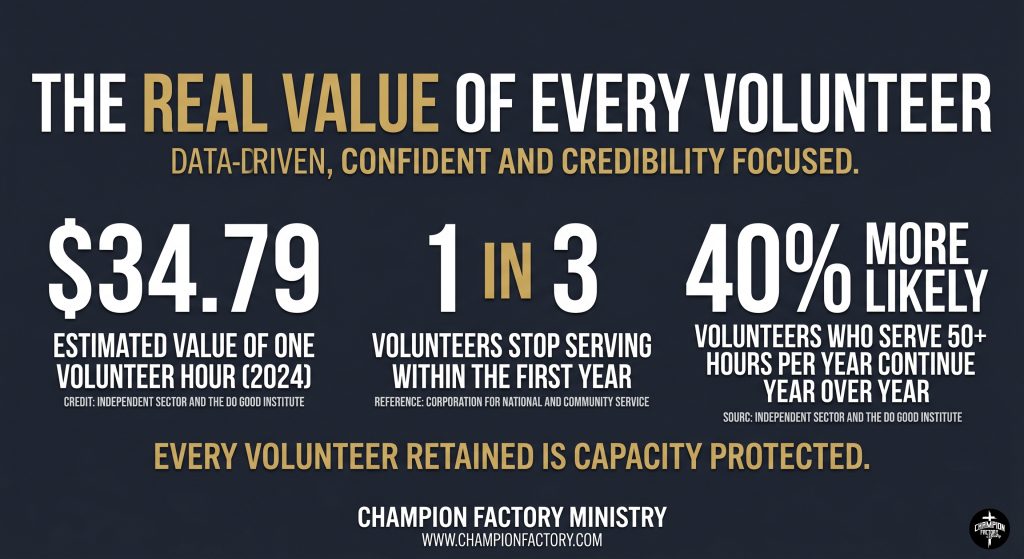
The average nonprofit retains about 65 percent of its volunteers from one year to the next, which means roughly one in three volunteers stops serving within twelve months. Most of them do not leave because the work is too hard. They leave because they felt unprepared, disconnected, or unvalued. Structured onboarding directly addresses all three of those reasons.
Lifeway Research's Greatest Needs of Pastors study found that 77 percent of Protestant pastors say developing volunteers is a difficulty they face in ministry, and 68 percent struggle with training the volunteers they already have. Ministry leaders are not failing because they do not care. They are failing because they are trying to lead without a system.
According to Corporation for National and Community Service data shared by VolunteerHub, volunteers who serve 50 or more hours per year are 40 percent more likely to continue serving year over year compared to those who serve fewer than 15 hours. Volunteers who find a meaningful, consistent role stay. Volunteers who never quite find their footing leave.
The factors that drive volunteer satisfaction are straightforward. The 2023 Time Well Spent report identifies recognition, a respectful and trustworthy culture, and a sense of belonging as the top three drivers. Good onboarding builds all three from the very beginning.
How to Build Your Volunteer Onboarding Process Step by Step
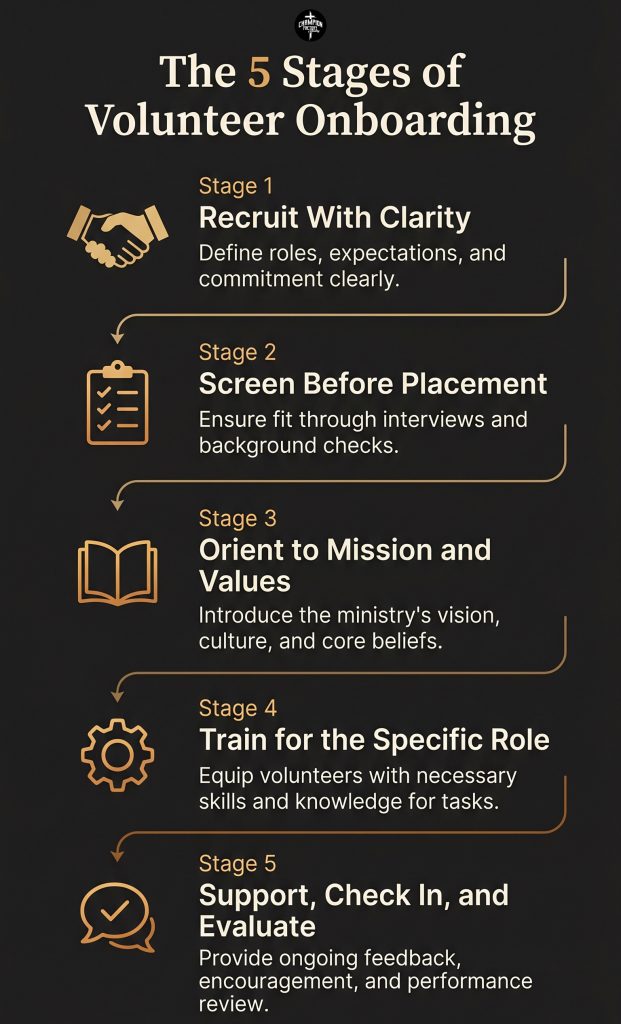
A strong volunteer onboarding process moves through five stages: recruit with clarity, screen before placement, orient to mission and values, train for the specific role, and support through the early weeks. Each stage has a purpose. Rushing through one creates gaps that show up later as confusion, frustration, or early dropout. Design the process with the volunteer's experience in mind, not just the ministry's schedule.
Step 1: Recruit With Clarity
Before a volunteer signs up, they should know exactly what they are signing up for. That means a clear role description with the time commitment, the setting, who they report to, and what a typical serve looks like.
Do not minimize the role to make it easier to fill. Think Orange's ministry volunteer guide makes this point directly: leaders who downplay a role to lower the barrier end up with volunteers who feel misled. Honest recruitment leads to better-fit volunteers who are more likely to stay.
Ask new volunteers to complete a short application. Include space for:
- Their reason for wanting to serve
- Any relevant experience or skills
- References from a previous ministry or organization
- Availability and scheduling constraints
Step 2: Screen Before Placement
Every ministry that serves children, youth, families in crisis, or individuals in recovery should require a background check before placing any volunteer. This is not a sign of distrust. It is a basic duty of care.
Background checks are recommended or legally required for volunteers working with vulnerable populations, depending on state law and the nature of the role. Organizations like Protect My Ministry and MinistrySafe specialize in faith-based screening and provide tools designed for ministries of all sizes.
Ask your insurance provider what screenings they require. Consult your legal counsel if you are unsure about your state's obligations under laws governing work with minors or vulnerable adults. The Fair Credit Reporting Act also governs how background checks must be conducted and what steps must be taken if a concern arises.
Screening protects the people your ministry serves. It protects the volunteer. It protects the organization.
Step 3: Orient to Mission, Values, and People
Orientation is the first time a new volunteer experiences the ministry as a team member. A good orientation covers:
- The ministry's history, mission, and core programs
- Who the people served are and why dignity-centered care matters
- The ministry's values and how they show up in day-to-day service
- Key staff contacts and communication channels
- Policies, confidentiality expectations, and a volunteer covenant if applicable
Keep orientation focused and relational. Introduce the volunteer to at least one other team member who can be a familiar face during their first few weeks. ServeHQ recommends that a ministry leader reach out to a new volunteer within 24 hours of sign-up. That first contact communicates that their time matters and that there is a real place for them to serve.
Robert Crouse, Community Liaison at Champion Factory Ministry, puts it this way: "When a volunteer feels genuinely welcomed and prepared, they do not just show up once. They become part of the community they are serving."
Step 4: Train for the Specific Role
Orientation covers the ministry. Role training covers the work.
As Todd Adkins of Lifeway Research notes, ministry leaders cannot effectively train volunteers until they have first clarified the systems and expectations of the role itself. Build that clarity before putting anyone in front of the people you serve.
Role training should include:
- Specific tasks and responsibilities
- Tools, materials, and spaces involved
- Supervision structure and who to report concerns to
- Common scenarios and how to handle them
- An opportunity to observe before leading
An apprenticeship model works well in ministry settings. The pattern moves from "I do, you watch" to "we do together" to "you do, I watch." This gradual handoff builds confidence and reduces mistakes during those first critical weeks.
Step 5: Support, Check In, and Evaluate Together
Plan intentional check-ins at one week, one month, and three months. Ask the volunteer what is working, what feels unclear, and where they might want to grow. Recognize their contribution specifically and genuinely.
Independent Sector and the Do Good Institute estimate that each volunteer hour is worth $34.79, based on 2024 data. Losing a volunteer who was showing up consistently is a real loss in capacity. Regular check-ins and recognition are not optional extras. They are stewardship.
How to Screen and Safeguard Volunteers in Ministry Settings
Any ministry that serves children, individuals in recovery, or families facing hardship has a responsibility to screen volunteers before they begin. Background checks, reference conversations, and a clear code of conduct protect the people the ministry serves, the volunteer, and the organization. Screening is not a barrier to service. It is a foundation for trust.
Why Safeguarding Matters More in Ministry Contexts
Ministries serving vulnerable populations operate in a space where the stakes of placing the wrong person in a role are high. Insurance providers often require background checks as a condition of coverage for ministries serving minors or at-risk adults. Failing to screen can expose the organization to serious legal and ethical risk.
For faith-based nonprofits, safeguarding is also a reflection of the ministry's values. Champion Factory Ministry's work with children, families, and individuals in need is rooted in the belief that every person deserves dignity and care. Volunteer screening honors that belief from the very first step. You can learn more about how to get involved on the volunteer and partner page.
Preparing Volunteers for Trauma-Informed Service
Volunteers who serve alongside individuals affected by difficult life experiences need more than a background check. They also benefit from brief preparation that helps them:
- Understand that some of the people they serve carry experiences that shape how they receive care
- Respond with patience and calm when something unexpected comes up
- Recognize the limits of their role and when to refer concerns to a program leader
- Practice confidentiality and avoid sharing outside appropriate channels
This is not about burdening volunteers with clinical training. It is about giving them enough context to serve with care and to protect the dignity of the people they walk alongside.
If your volunteers will regularly serve in settings connected to recovery, family crisis, or support for survivors, add a short orientation module on trauma-informed communication. If a volunteer has serious concerns about their emotional readiness for a role, encourage them to speak with your program director or a pastoral contact before beginning.
How to Train Volunteers for Different Ministry Roles
A volunteer distributing food at an outreach event needs different training than someone mentoring a child or facilitating a discipleship group. Generic onboarding fails specialized roles. Every position in the ministry deserves a clear training plan that covers the specific tasks, the right way to interact with those being served, and what to do when something unexpected comes up.
Not every role carries the same weight or complexity. A greeter or logistics volunteer needs clarity about schedules, safety, and communication. A mentor or program facilitator needs deeper preparation about how to build trust, maintain appropriate boundaries, and serve people who may be carrying real hardship.
Build a simple role-specific training outline for each major volunteer position. A one-page summary covering the role's purpose, key responsibilities, relevant boundaries, and a contact for questions is a practical starting point.
A few approaches that work well in ministry settings:
- Pair new volunteers with an experienced team member for their first two to four serves
- Create short written or video overviews for each role that volunteers can review at their own pace
- Hold brief huddles before a serve day so new volunteers feel connected and informed
- Debrief with volunteers after their first few weeks to surface questions they were hesitant to ask earlier
Platforms like Ministry Grid offer pre-built training pathways and mobile-accessible content for faith-based teams. Planning Center is a widely used church and ministry management tool that supports scheduling, communication, and volunteer coordination.
Why Faith and Calling Shape the Volunteer Experience
Volunteers at a faith-based ministry are doing more than filling roles. They are responding to a sense of purpose and calling. Onboarding that skips the spiritual dimension misses something important. When a volunteer understands how their specific service connects to the ministry's mission and to their own faith, they show up with more commitment, more care, and more resilience over the long run.
Ephesians 4:12 speaks of equipping the saints for works of service, so that the body of Christ may be built up. This is a charge not only for pastors but for every ministry leader who prepares volunteers to serve.
Art Montgomery, who provides board-level governance guidance for Champion Factory Ministry's global outreach work, reflects on this dimension directly: "Volunteer onboarding is the first act of discipleship in a volunteer's journey with your ministry. How you welcome and prepare someone shapes how they understand their calling."
Part of onboarding at a faith-based nonprofit is helping volunteers see their role as meaningful, not administrative. During orientation, take time to:
- Share why the ministry exists and the values that guide it
- Tell stories of impact, with care for the dignity of the people involved
- Explain how this specific volunteer role contributes to the whole
- Invite the volunteer to reflect on their own motivation for serving
You do not need a formal spiritual gifts assessment to do this well. You need a genuine conversation and a willingness to see the volunteer as someone responding to something real.
1 Peter 4:10 offers a straightforward frame: each person should use whatever gift they have received to serve others, as faithful stewards of God's grace in its various forms. Helping a volunteer find the right role is an act of care, not just staff management.
How to Keep Volunteers Engaged After Onboarding Ends
Most volunteer dropout happens in the weeks after the first serve, not on day one. Volunteers disengage when they feel unrecognized, underused, or disconnected from the team. Ongoing communication, intentional check-ins, and genuine recognition are the most reliable tools for keeping volunteers active. Onboarding extends through the first months of service and beyond.
Volunteers are not paid. Their motivation comes from feeling useful, welcomed, and confident in their role. When that connection fades, the schedule fades with it.
Practical ways to support long-term engagement:
- Make a personal follow-up call or send a message after a volunteer's first serve
- Share impact updates that show volunteers how their contribution made a difference
- Offer low-pressure opportunities to try new roles or take on small leadership responsibilities
- Celebrate milestones, such as a first serve, a year of service, or a specific contribution
- Hold regular volunteer gatherings where people can connect as a team, even informally
For ministries serving in emotionally demanding contexts, create space for volunteers to process what they experience. A brief debrief at the end of a serve day, or a regular check-in with a program leader, helps volunteers feel supported and reduces the risk of quiet burnout.
Tools That Help Ministry Leaders Manage Onboarding at Scale
Running onboarding through email and memory works when a ministry has a handful of volunteers. As the team grows, that approach breaks down. Volunteer management software helps ministry leaders track applications, automate follow-up, store training records, and communicate consistently with new volunteers. The right tool does not replace relationships. It protects them by freeing leader time and reducing things that fall through the cracks.
Tools commonly used by faith-based ministries:
- ServeHQ: Built specifically for churches and ministries, with onboarding automation and follow-up workflows
- Ministry Grid: Volunteer training platform with a library of pre-built training content and mobile-friendly pathways
- Planning Center: Church management system that handles scheduling, communication, and volunteer coordination
- Galaxy Digital: Nonprofit-focused volunteer management platform with tracking and onboarding support
- Protect My Ministry: Screening service designed for faith-based organizations, with integrations for major church management platforms
Digital access matters for the next generation of volunteers. Donorbox's 2025 volunteer research notes that 73 percent of Gen Z volunteers look for easy ways to get involved online. If your process requires multiple in-person trips before someone can serve, you may be losing motivated volunteers before they ever begin.
Start with what you need most. If follow-up is inconsistent, an automated email sequence can help. If training varies by who is in the room that day, a shared training hub solves that. You do not need to digitize everything at once.
Build a Volunteer Team Your Ministry Can Count On
Volunteers are people responding to a call to serve. The way a ministry welcomes, trains, and cares for them communicates something real: whether their time matters, whether the mission is serious, and whether this is a community worth returning to.
A structured onboarding process is one of the most practical investments a ministry leader can make. It reduces turnover. It improves the quality of care given to the people the ministry serves. It builds a team that does not just show up once but grows into something stable and committed over time.
The work does not require a large budget or a dedicated full-time coordinator. It requires clarity, consistency, and the decision to treat every new volunteer as someone worth equipping well.
If you are looking for ways to serve with purpose, visit the get involved page to learn how to connect with Champion Factory Ministry's work. You can also explore our programs to see where volunteers make a difference, or support this work financially if that is how you feel called to contribute.
FAQ
What Is the Difference Between Volunteer Orientation and Volunteer Onboarding?
Orientation is a single event that introduces a volunteer to the organization and their role. Onboarding is the full process, which includes screening, orientation, role training, and ongoing support. Volunteers need all of these stages, not just the first one.
How Long Should Volunteer Onboarding Take?
It depends on the role and context. A simple role in a low-complexity setting might take two to three weeks to move through the full process. A role involving direct contact with children or vulnerable individuals may take four to six weeks to allow time for screening, training, and supervised observation.
Do Volunteers at Faith-Based Nonprofits Need Background Checks?
Yes, especially for any role involving contact with children, youth, or vulnerable adults. Requirements vary by state and role. Ministries should consult their insurance provider and legal counsel. Organizations like Protect My Ministry and MinistrySafe offer screening services designed for faith-based organizations.
Why Do Ministry Volunteers Leave So Quickly?
The most common reasons are feeling unprepared, disconnected from the team, or unclear about expectations. Most early dropout is preventable through consistent follow-up, clear role training, and early recognition. The average nonprofit retains about 65 percent of its volunteers annually, but well-designed onboarding can meaningfully improve that number.
How Can a Small Ministry Build an Onboarding Process Without a Big Team?
Start with a one-page role description for each volunteer position, a short application, a background check process, and a follow-up message within 24 hours of sign-up. Add a brief orientation and a check-in after the first serve. These five steps alone will improve your onboarding significantly without requiring additional staff.