






Most Christians have heard words like humility, patience, and self-control and felt drawn to them while remaining uncertain how to actually grow in them. They have also heard words like pride and envy and recognized something uncomfortably familiar. The gap between knowing what these qualities are and knowing what to do about them is where many people get stuck.
This article explains what the Bible teaches about virtues and vices, where those categories come from in Scripture, and how everyday Christians can begin moving in the right direction. It is written for real people at any stage of faith.
What Are Biblical Virtues?
A biblical virtue is a good character habit that shapes how a person lives, relates to others, and reflects the nature of God. Virtues are not one-time actions. They are formed patterns of thought, feeling, and choice that deepen over time. Scripture names close to thirty of them, including faith, hope, love, humility, patience, generosity, self-control, and hospitality. They describe the kind of person God is shaping every believer to become.
The word virtue comes from the Latin word for strength of character. In Christian use, it points to the qualities that make a person genuinely good rather than simply outwardly compliant. In Mere Christianity, C.S. Lewis argued that doing the right thing for the wrong reasons does not build genuine virtue. What matters, he wrote, is the internal quality of character formed through right motivation, not the external action alone.
Virtues are not a performance checklist. They are evidence of real transformation taking root from the inside.
The Theological and Cardinal Virtues
Christian tradition organizes virtues into two primary categories.
The theological virtues, named by Paul in 1 Corinthians 13, are faith, hope, and love. They are called theological because they are directed toward God, come from him, and lead back to him. Without them, other virtues lose their foundation.
The cardinal virtues, present in both Scripture and early church teaching, are prudence, justice, fortitude, and temperance. These shape how a person thinks, makes decisions, treats others, and manages desire.
Both categories appear throughout the Bible. Neither requires advanced theological study to understand or to pursue.
The Fruit of the Spirit
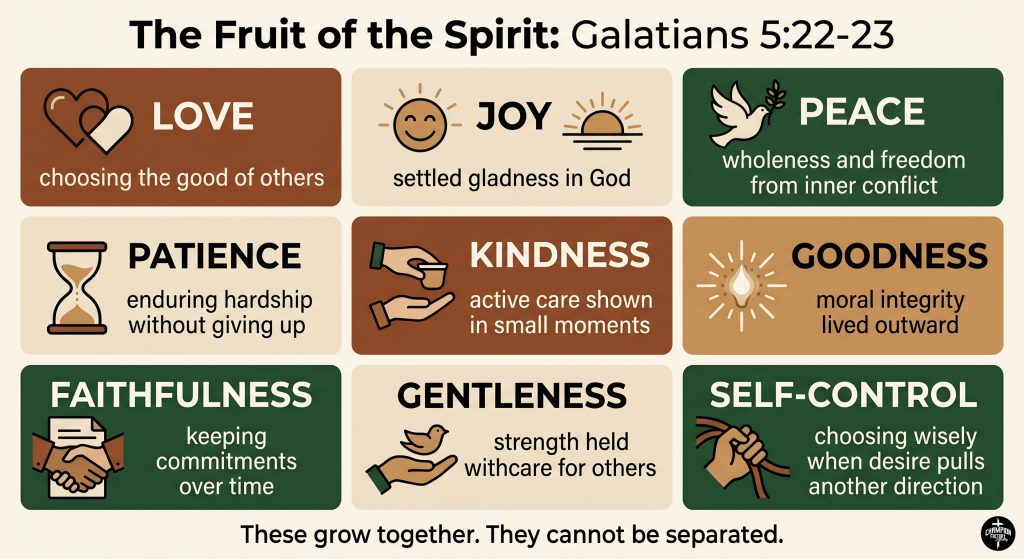
The most widely recognized biblical virtue list comes from Galatians 5:22-23. Paul writes that the fruit of the Spirit is love, joy, peace, patience, kindness, goodness, faithfulness, gentleness, and self-control.
Notice that Paul uses the singular word fruit, not the plural. He treats these qualities as a unified expression of the Spirit's work in a life. They grow together over time and they grow best in relationship.
What Are Biblical Vices?
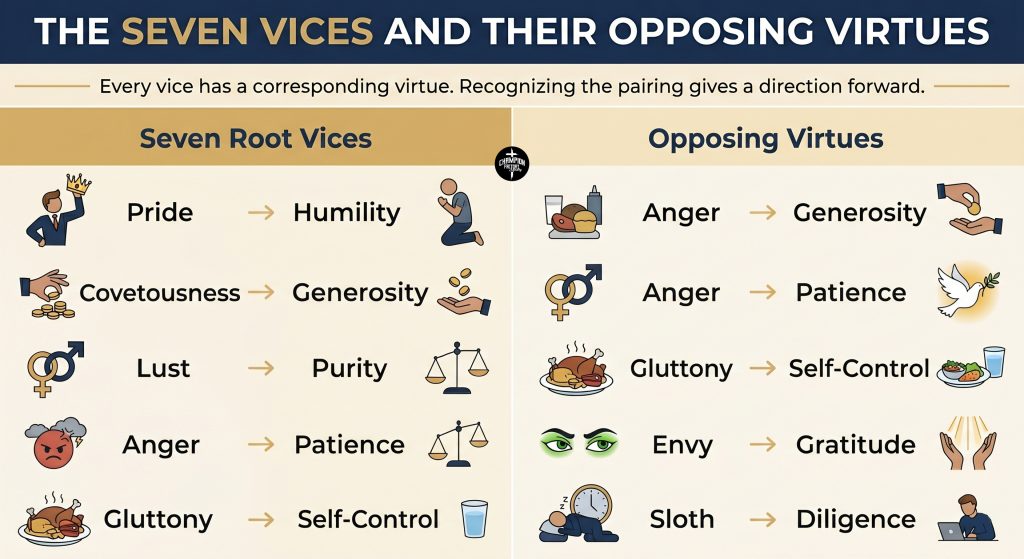
A biblical vice is a sinful pattern of character that moves a person away from God and from genuine care for others. Christian tradition has long identified seven root vices, sometimes called the seven deadly sins: pride, covetousness, lust, anger, gluttony, envy, and sloth. They are called deadly because each one tends to produce bondage to sin over time. Left unaddressed, they cause real harm to the person and to those around them.
These seven were not invented to produce guilt. They were developed as a pastoral tool, a framework to help believers name what they are actually struggling with so they can address it honestly and seek real change.
Every vice has a corresponding virtue. Pride is countered by humility. Anger by patience. Envy by gratitude. Greed by generosity. Sloth by diligence. Recognizing the pairing helps people see a clear direction forward rather than a list of behaviors to simply suppress.
Where Vices Appear in Scripture
The Bible addresses vices directly and consistently. In Galatians 5:19-21, Paul lists the works of the flesh, including hostility, jealousy, selfish ambition, and envy. He places these in direct contrast to the fruit of the Spirit.
In Proverbs 6:16-19, Scripture names seven things the Lord finds detestable, including pride, dishonesty, and sowing discord within families. The seven deadly sins tradition draws on this passage and many others across both testaments.
Vices extend beyond personal failure. They damage relationships, weaken community, and pull people away from the life God intends for them.
Is Being a Good Christian Just About Following Rules?
No. Biblical character formation is not primarily about rule-following. The goal is not outward compliance but genuine transformation from the inside out. Virtue is about who you are becoming, not simply what you do. A person can follow religious rules from fear or social habit and still carry a heart shaped by pride, bitterness, or self-interest. Scripture calls Christians to something far deeper than behavior management.
Dallas Willard, a philosopher and theologian whose writing shaped generations of Christians, described discipleship as the process of becoming, in your specific relationships and circumstances, who Jesus himself would be. That framing shifts the question from "what do I need to do" to "who am I becoming."
Todd Medina, President and Founder of Champion Factory Ministry, has observed this pattern firsthand: "What I have seen over years of ministry is that people do not need to be told to try harder. They need to see that genuine change is possible and that they do not have to pursue it alone."
Rules and commands matter in Scripture. But they point toward character rather than replacing it. The goal is Christlikeness, growing into someone whose choices, habits, and relationships increasingly reflect the character of God.
How Does the Holy Spirit Form Virtuous Character?
The Holy Spirit is the active agent in Christian character formation. Virtue cannot be sustained by willpower alone. Romans 8:13 and Galatians 5:24-25 make clear that the sustained putting to death of sinful patterns requires the Spirit's power, not personal resolve alone. This is honest and hopeful news for Christians who have tried to change through effort alone and found that the change did not hold.
Dallas Willard expressed this well: "Grace is not opposed to effort. It is opposed to earning." Real growth takes practice, honesty, prayer, and consistent engagement with Scripture. But the power behind that growth is not something you produce. It is something you receive and cooperate with.
Growing in virtue is a cooperative process. You bring your willingness and your choices. The Spirit brings the transforming power.
A Growth Sequence Worth Knowing
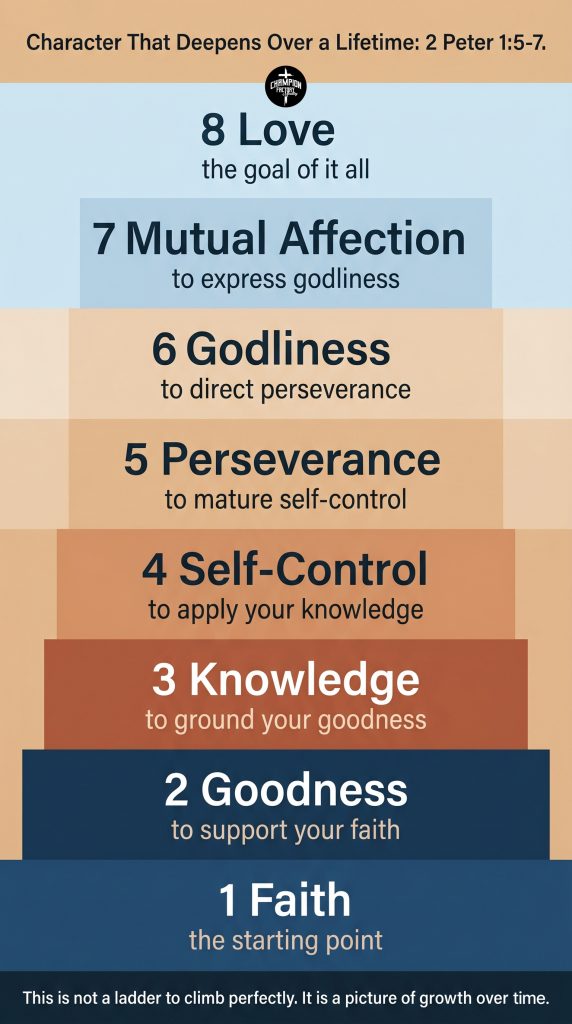
Second Peter 1:5-7 offers one of the most practical virtue progressions in the New Testament. Peter calls believers to build on faith by adding goodness, then knowledge, then self-control, then perseverance, then godliness, then mutual affection, and finally love.
This is not a rigid checklist. It is a picture of character that deepens over a lifetime, each quality strengthening the next. It gives a direction without demanding perfection.
Why Virtue Grows Best in Community
Virtue is not a solo project. According to the Christian Research Institute, except for self-control, every quality named in the fruit of the Spirit requires other people to develop fully. You cannot grow in patience without situations that test it. You cannot grow in kindness without people to extend it toward. You cannot grow in faithfulness without commitments that call for it. Character forms in relationship, not in isolation.
Christian philosopher and theologian Paul Copan has described it clearly: Christian virtues are relational by nature. They are learned in relationship with God and with others and cannot be developed apart from those relationships.
Art Montgomery, global evangelism strategist and board advisor, puts it this way: "When a community genuinely grows in patience, honesty, and care for others, that community becomes a credible witness to the world around it. Virtue formation and outreach are not separate conversations."
This is why the local church, the small group, and the discipleship relationship carry such practical importance. These are not optional extras for serious Christians. They are the environment where genuine and lasting character growth happens.
At Champion Factory Ministry, the Nourish discipleship program exists for precisely this reason. Lasting growth rarely happens alone. You can learn more about how we walk alongside people in ongoing community.
Practical Ways to Cultivate Virtue in Everyday Life
Growing in virtue is available to any Christian at any stage of faith. It does not require a dramatic starting point or ideal circumstances. It requires honest self-awareness, consistent engagement with Scripture and the Spirit, and the willingness to keep moving forward even after setbacks. The following steps give a grounded starting place.
- Name what you are working toward. Identify one or two specific areas of growth. "I want to grow in patience with my children" is far more actionable than "I want to be a better person."
- Engage Scripture with intention. Colossians 3:12-14, Galatians 5:16-25, and 2 Peter 1:5-7 speak directly to character formation. Read them slowly and ask what they are calling you toward in your actual life right now.
- Find a person to be honest with. Growth stalls without accountability. A trusted friend, mentor, or pastor who knows your real struggles is a meaningful part of how God designed growth to work.
- Notice your vices, not just your virtues. Honest examination of where pride, envy, or anger surfaces in daily life is not self-condemnation. It is the beginning of real movement in the right direction.
- Ask for support when patterns run deep. Some struggles, especially those connected to trauma, grief, addiction, or significant hardship, benefit from pastoral care or professional support alongside personal practice. Reaching out for that help is wisdom, not weakness.
If you are walking through a difficult season and looking for community and encouragement, explore the programs and support available through our ministry.
Character Grows in the Direction You Keep Choosing
The biblical picture of virtue is not a destination you arrive at after one determined effort. It is a direction you move in, through ordinary days, difficult seasons, real setbacks, and genuine progress.
In Mere Christianity, C.S. Lewis noted that God often begins not by giving us the virtue itself but by giving us the ability to keep trying after we fall short. That is an honest and hopeful description of how growth actually works.
It means no one starts too far behind. Failure is not the final word. Philippians 1:6 reminds us that the same God who began a good work in you is committed to seeing it through.
Scripture does not describe the virtuous life as one without struggle. It describes it as a life where struggle is carried inside a relationship with God, sustained by grace, and shared with others on the same path.
FAQ
What Is the Difference Between a Virtue and the Fruit of the Spirit?
The fruit of the Spirit in Galatians 5:22-23 is a specific New Testament list of nine character qualities the Holy Spirit produces in a believer's life. Virtues is a broader biblical category that includes these nine and many others named throughout Scripture. Every quality on the fruit of the Spirit list is a virtue, but the broader category extends well beyond that single passage.
Are the Seven Deadly Sins Directly Listed in the Bible?
Not in a single passage. The seven, which are pride, covetousness, lust, anger, gluttony, envy, and sloth, were developed by early church leaders as a pastoral framework drawing on multiple biblical texts, including Proverbs 6:16-19 and Galatians 5:19-21. The framework is grounded in Scripture even though no single verse lists all seven together.
Can Someone Grow in Virtue Without Being Part of a Church?
Growth is possible in many contexts, but Scripture consistently places character formation inside community. The relational virtues, including patience, kindness, faithfulness, and love, require other people to develop fully. A trusted mentor, small group, or faith community provides the accountability and relationship that support real and lasting growth over time.
How Do I Know Which Vice I Struggle With Most?
Pay attention to where you feel the strongest and most consistent pull toward sin. Pride often surfaces as a persistent need to be right or recognized. Envy shows up when another person's good news feels like a personal loss. Anger emerges when control is threatened. Honest reflection, prayer, and input from someone who knows you well are the most reliable guides.
Is It Possible to Grow in Virtue After Significant Failure or Hardship?
Yes. Scripture does not describe virtue as the reward for an easy life. Many of the most faithful people in the Bible grew precisely because of difficulty. Patience, perseverance, and hope are often formed through hard seasons rather than around them. Growth after failure is not only possible. It is a central part of the biblical story of redemption.