



Many people know Proverbs 3:5–6 by heart. It shows up on greeting cards, journals, and graduation gifts. But familiarity with the words is not the same as understanding what they mean or knowing how to live them out.
This article walks through each phrase in the passage, explains what the original Hebrew reveals, and offers practical guidance for building trust in God across real, daily situations, including the hard ones.
What Proverbs 3:5–6 Actually Says
Proverbs 3:5–6 is part of a father's instruction to his son in the book of Proverbs, a section of Scripture focused on practical wisdom and daily living. The passage reads: "Trust in the Lord with all your heart and lean not on your own understanding. In all your ways acknowledge him, and he will make your paths straight." (NIV). It is a call to total reliance on God across every area of life, from major decisions to ordinary daily choices.
Proverbs belongs to a category of Scripture known as wisdom literature, alongside Psalms and Ecclesiastes. These books offer practical and instructional guidance rather than historical narrative. Chapter 3 specifically highlights the benefits of valuing God's wisdom and applying it to daily life.
The instruction in verses 5 and 6 is relational in tone. It is not a formula or a contract. It reads more like a father showing a child where to place their confidence when life becomes uncertain.
What "Trust in the Lord with All Your Heart" Really Means
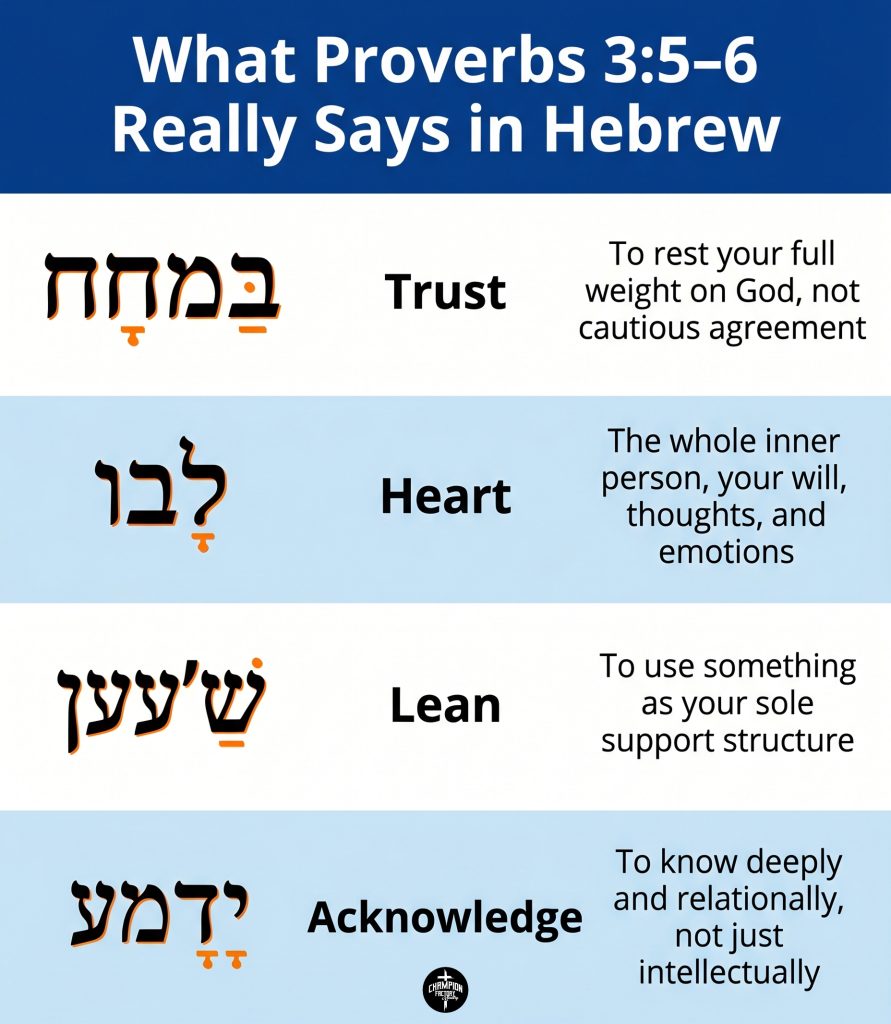
The Hebrew word translated as "trust" in this verse is "batach." It does not simply mean to believe something is true. Old Testament scholar John Oswalt describes batach as "that sense of well-being and security which results from having something or someone in whom to place confidence." Biblical commentator John Kitchen adds that this trust is "the sense of security and safety that comes from being under the care of another more competent than ourselves."
Batach carries the image of resting your full weight on something strong enough to hold you. It means full dependence, not cautious agreement. The difference is between standing near a wall and actually leaning your weight against it.
The Hebrew word for "heart" in this passage is "lev." In ancient Hebrew thought, the heart was more than the seat of emotion. It was the center of a person's will, intellect, and decision-making. To trust God with "all your heart" means aligning your whole inner life with dependence on him: your feelings, your reasoning, your choices, and your deepest assumptions.
This is an active, daily commitment.
What "Lean Not on Your Own Understanding" Means in Practice
"Lean not on your own understanding" does not mean God wants you to stop thinking. The Hebrew word "sha'an" (lean) means to rest your weight on something as a support structure, the way a person leans on a walking stick. The passage warns against using your own limited perspective as the primary support for decisions. Human reasoning is shaped by experience, emotion, and bias. God sees what we cannot.
This does not mean that planning is wrong or that careful thinking is a problem. Solomon, who wrote much of Proverbs, was celebrated for his practical wisdom and intelligence across many areas of life. The point is that human understanding alone is not a strong enough foundation to carry the full weight of important decisions.
A few honest questions can help here:
- Am I making this decision based entirely on what I can see right now?
- Am I using my own conclusions to override what I sense God is asking?
- Is anxiety or fear serving as my primary guide in this situation?
Asking these questions is not weakness. It is part of what it means to hold your reasoning alongside God's guidance rather than letting one crowd out the other.
What "Acknowledge Him in All Your Ways" Looks Like Day to Day
The Hebrew word for "acknowledge" in verse 6 is "yada." It means to know something deeply and relationally, not merely intellectually. "In all your ways acknowledge him" is an invitation to include God in the texture of daily life, beyond formal prayer times. Work, relationships, finances, rest, and small decisions all fall within the scope of this instruction.
"All your ways" sets a wide boundary. It does not mean Sunday mornings only. It means every situation where you think, decide, or act.
Practically, this can look like:
- Taking a moment before a conversation to ask for patience or wisdom
- Pausing before a decision to consider whether it reflects what you believe God values
- Noticing when anxiety is driving a choice and bringing that honestly to God in prayer
- Reading Scripture as a way of knowing God more closely rather than checking a box
These are postures more than practices. The goal is a life where God is present across every area, including the areas that feel ordinary or unremarkable.
"Trust is less about having the right answer and more about returning to God with the honest question. That pattern, practiced consistently, is what faith in daily life actually looks like." Art Montgomery, Global Evangelism Strategy Architect, Champion Factory Ministry
What "He Will Make Your Paths Straight" Actually Promises
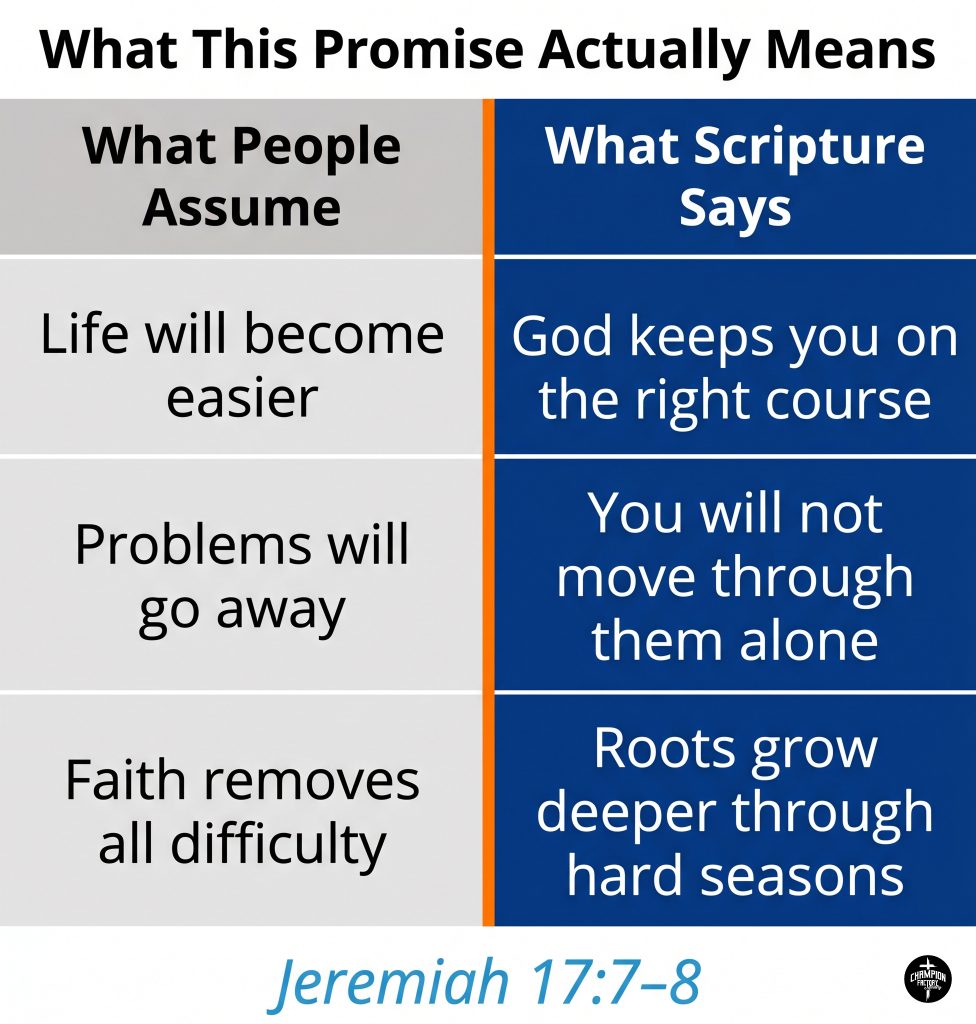
The promise that God "will make your paths straight" means he will keep you on the right course. It does not mean the road will be smooth, comfortable, or free of difficulty. The image is of a path that reaches its destination despite obstacles, not a path without any. Trusting God does not remove hard seasons. It means you are not moving through them alone or without direction.
Many people read this verse and expect that trust in God produces easier circumstances. When difficulty arrives, they can feel confused or as though their faith has failed them.
The Psalms are worth turning to here. David cried out with grief and confusion before returning to trust. Psalm 22 opens with abandonment and closes with praise. Faith and lament coexist in Scripture. Trusting God in a difficult season does not require pretending the difficulty is not real.
Jeremiah 17:7–8 offers a similar picture: "Blessed is the one who trusts in the Lord, whose confidence is in him. They will be like a tree planted by the water that sends out its roots by the stream." Roots grow deep through dry seasons, not in the absence of them.
How Anxiety and Trust Connect
A 2024 joint review by Gallup and the Radiant Foundation examined more than 400 validated research studies and found that a relationship with God is associated with lower rates of anxiety and depression. A 2025 review published through the National Institutes of Health found that higher levels of spirituality are generally linked to lower intensity of anxiety symptoms. Practiced trust, over time, tends to reduce the grip of anxiety, though it does not always eliminate it.
According to data from the American Psychiatric Association, 43 percent of U.S. adults reported feeling more anxious in 2024 than the year before. Anxiety is one of the most common experiences people carry right now, and many readers searching this passage are carrying it.
Angela Redding, executive director of the Radiant Foundation, summarized decades of research plainly: "Our relationship with God heals."
This is not a promise that faith removes all anxiety. For some people, anxiety is a clinical condition that benefits from professional support alongside spiritual practice. If anxiety is significantly affecting your daily life, speaking with a counselor or mental health professional is a practical and healthy step. It is one that faith encourages rather than discourages.
What this passage offers is a place to bring that weight: to a God described throughout Scripture as steady, faithful, and present.
Practical Ways to Build Trust in God Each Day
Trust is built in small, repeated choices long before it is tested in large ones. Most people who walk in steady faith did not arrive there through a single defining moment. They got there through consistent, ordinary decisions to return to God rather than turn away. Building that habit does not require a specific routine or a quiet life. It requires willingness.
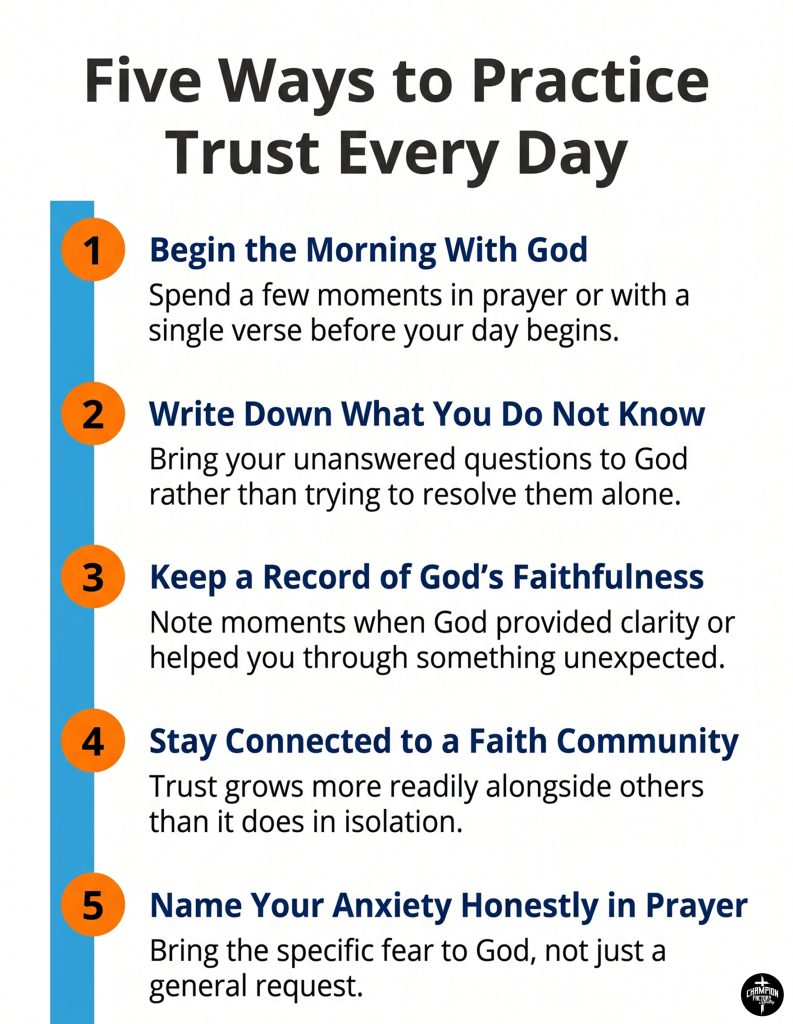
Here are five practical ways to grow in the trust Proverbs 3:5–6 describes:
- Start the morning with a brief acknowledgment of God before beginning your to-do list. This can be a few words of prayer, a single verse, or a moment of quiet attention.
- When facing a decision, write down what you know and what you do not know. Bring the second list to God rather than trying to resolve it entirely on your own.
- Keep a short record of moments when God provided clarity, opened a door, or helped you through something unexpected. Reviewing these builds confidence for what lies ahead.
- Surround yourself with people who are also trying to walk in faith. Trust grows more readily in community than in isolation.
- When anxiety rises, name it honestly in prayer rather than suppressing it. Bring the specific fear, not just a general request.
These are ways of making the posture of this passage part of the rhythm of ordinary days.
Trusting God in Hard Seasons
Trust does not require circumstances to improve before it becomes possible. Many people in difficult situations, including those facing loss, instability, or deep uncertainty, find that trust is a choice they return to rather than a feeling they produce. It is practiced in the presence of difficulty, not only after it resolves.
For people who have experienced loss of safety, trauma, or situations where they had no control, the language of surrender can feel complicated. Releasing control is not always easy when holding on once meant survival. If that is where you are, this passage does not ask you to override what you have learned. It invites you to take one small step toward a God who is described throughout Scripture as safe, faithful, and near to those who are hurting.
Psalm 34:18 says it plainly: "The Lord is close to the brokenhearted and saves those who are crushed in spirit."
"We have walked with people in some of the hardest moments of their lives. What we see is that trust does not begin when the situation improves. It begins when someone takes one honest step toward God in the middle of it." Todd Medina, President and Founder, Champion Factory Ministry
Trust also grows in community. No one is meant to practice faith entirely alone. Being around people who reflect God's steadiness, through mentorship, discipleship, and practical care, can make trust more possible for someone who is struggling to find it on their own.
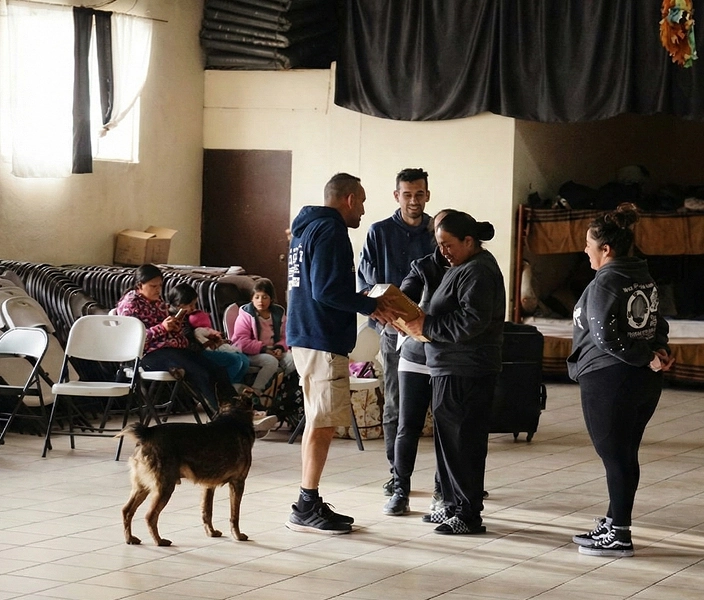
At Champion Factory Ministry, we walk alongside individuals and families in difficult seasons. Our Nourish discipleship program offers a space to grow in faith alongside others on the same journey. If you are looking for support, we encourage you to get connected.
Choosing Trust as a Daily Posture, Not a One-Time Decision
Proverbs 3:5–6 is not a promise you make once and move on from. It is an orientation you return to. A posture of leaning toward God rather than away from him when life becomes difficult or unclear.
The Hebrew roots of this passage describe a trust that is total. A kind of full-weight dependence on a God who is more faithful and more present than human reasoning alone can provide. Acknowledging him in all your ways means bringing every area of life into that posture, including areas that feel ordinary or practical.
If you are in a hard season right now, trust does not require you to have it figured out. It asks for honesty, the willingness to bring what you carry to God, and the openness to be guided rather than only self-directed.
If you want to support people walking through difficult seasons with faith and care, consider making a gift to Champion Factory Ministry.
FAQ
What is the main message of Proverbs 3:5–6?
The main message is that full trust in God, across every area of life, leads to divine guidance and direction. The passage calls readers to rely completely on God rather than depending only on their own limited understanding.
Does trusting God mean I should stop making plans?
No. "Lean not on your own understanding" does not mean abandon reasoning or stop planning. It means recognizing that human perspective is limited and including God in your decision-making rather than relying solely on your own conclusions.
What does the Hebrew word "batach" mean?
Batach means to place full confidence in something and to rest your weight on it completely. It is not casual belief. It carries the image of total dependence and settled security under the care of someone stronger.
What does "he will make your paths straight" promise?
It promises that God will keep you on the right course, not that the road will be easy or free of difficulty. Straight paths in this context means purposeful direction, not the absence of obstacles.
Can trusting God help with anxiety?
Research suggests that a relationship with God is associated with lower rates of anxiety and depression, based on a 2024 Gallup and Radiant Foundation review of more than 400 studies. For those experiencing clinical anxiety, professional support alongside faith practice is a healthy and encouraged step.
How do I acknowledge God in all my ways?
Acknowledging God in all your ways means including him in the texture of everyday life, beyond formal prayer times. It can include pausing before decisions, bringing honest questions to God, reading Scripture regularly, and surrounding yourself with a faith community.