





People want to help others. When choosing where to donate or volunteer, they often compare different organizations to understand their impact. Secular nonprofits and Christian charities both do vital work in our communities. They operate with different motivations, funding models, and long-term goals.
This article explains how faith-based organizations function differently from their secular counterparts. You will learn how Christian charities combine practical relief with spiritual hope to treat the whole person. You will also see why this faith-centered approach supports long-term stability for individuals facing hardship.
The Core Difference in Motivation and Mission
Christian charities and secular nonprofits share a commitment to helping people in need. Their core motivations differ. Secular groups operate out of general goodwill or social responsibility. Christian organizations serve because their faith mandates it. They view caring for the vulnerable as a direct expression of their love for God.
This foundational difference shapes every interaction. A secular nonprofit might view a successful outcome merely as a person receiving a meal or finding shelter. A Christian charity views those practical steps as vital, while also wanting the individual to experience love, dignity, and spiritual renewal.
The Bible provides the framework for this mission. In Matthew 25:40 (ESV), Jesus says, "And the King will answer them, ‘Truly, I say to you, as you did it to one of the least of these my brothers, you did it to me.’" This verse provides the core motivation for why Christian charities serve the vulnerable. The work is an act of worship. It ensures that people in crisis are treated with the utmost respect and compassion.
"When we serve, we do so with the understanding that every person is made in the image of God. That changes how we look at recovery and outreach." Art Montgomery, Global Evangelism Strategy Architect & Board Visionary Luminary.
Holistic Care Addresses the Whole Person
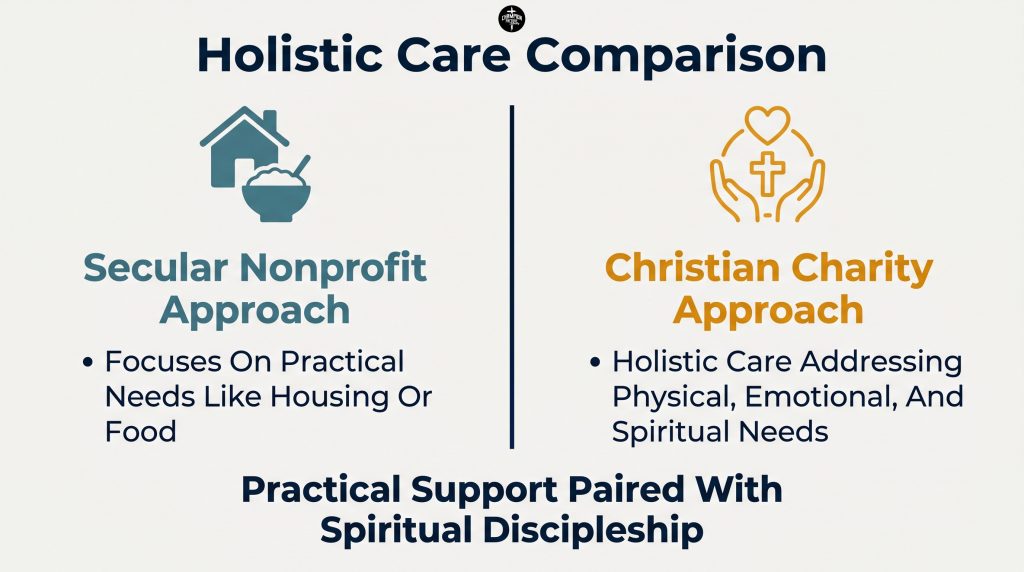
While secular organizations often focus entirely on practical needs like housing or food, Christian charities provide holistic care. This means they address physical, emotional, and spiritual needs together. They believe long-term stability requires practical support paired with spiritual discipleship and restored hope for the future.
Providing a meal solves hunger for a day. Providing mentorship and spiritual guidance builds a foundation for a lifetime. Christian organizations understand that poverty, addiction, and crisis involve deeper human struggles. They work to heal the entire person.
This dual focus is rooted deeply in scripture. James 2:15-16 (NIV) says, "Suppose a brother or a sister is without clothes and daily food. If one of you says to them, ‘Go in peace, keep warm and well fed,’ but does nothing about their physical needs, what good is it?" This passage perfectly illustrates the Christian mandate. Organizations must combine spiritual encouragement with practical, tangible care.
Champion Factory Ministry applies this exact approach. Programs that distribute food and essential care are naturally paired with mentorship and discipleship. This ensures that no one is handed a Bible when they need a meal, and no one is handed a meal without receiving genuine encouragement.
Funding Sources Protect the Spiritual Mission
Funding sources create a major operational difference between these organizations. Secular nonprofits rely heavily on government grants, which often restrict religious expression. Christian charities depend primarily on individual donor contributions. This funding independence allows faith-based groups to maintain their spiritual mission without compromise.
When organizations accept government funding, they must comply with specific regulations. These rules often prevent staff from praying with individuals or offering faith-based counseling. Because of this, academic researchers have found that faith-based groups are significantly more likely than secular nonprofits to depend on individual donor contributions.
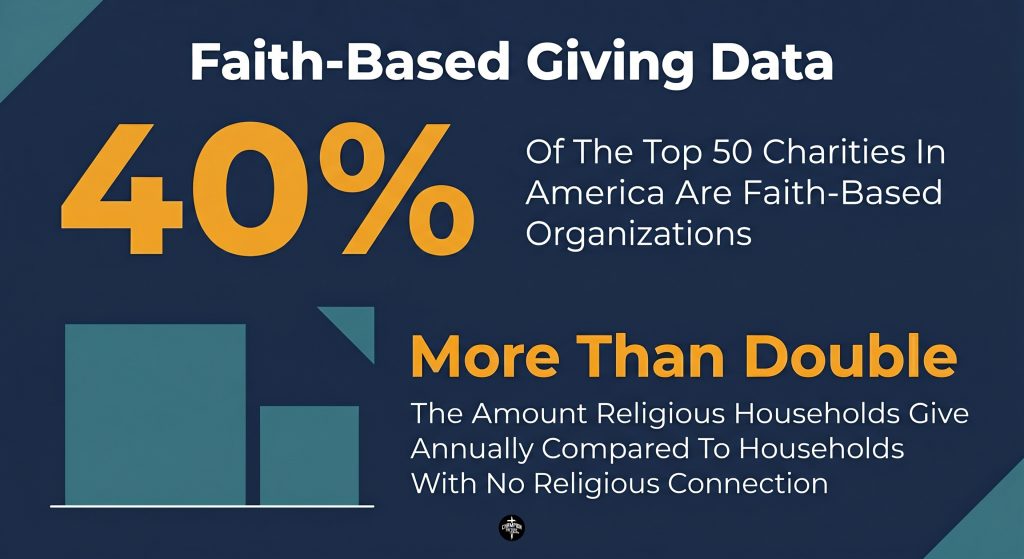
This heavy reliance on private donors is supported by a strong culture of generosity. Research from the Johnson Center for Philanthropy shows that the amount religious households give annually is more than double that of households with no religious connection. Giving USA reports that while 56 percent of charitable donors prioritize the good work of an organization, 27 percent specifically look to support charities that share their faith.
This financial independence is crucial. It guarantees that Christian charities can offer prayer, share the gospel, and run discipleship programs freely. Donors who fund these organizations are directly protecting the spiritual heart of the mission.
Volunteer Networks Expand Community Reach
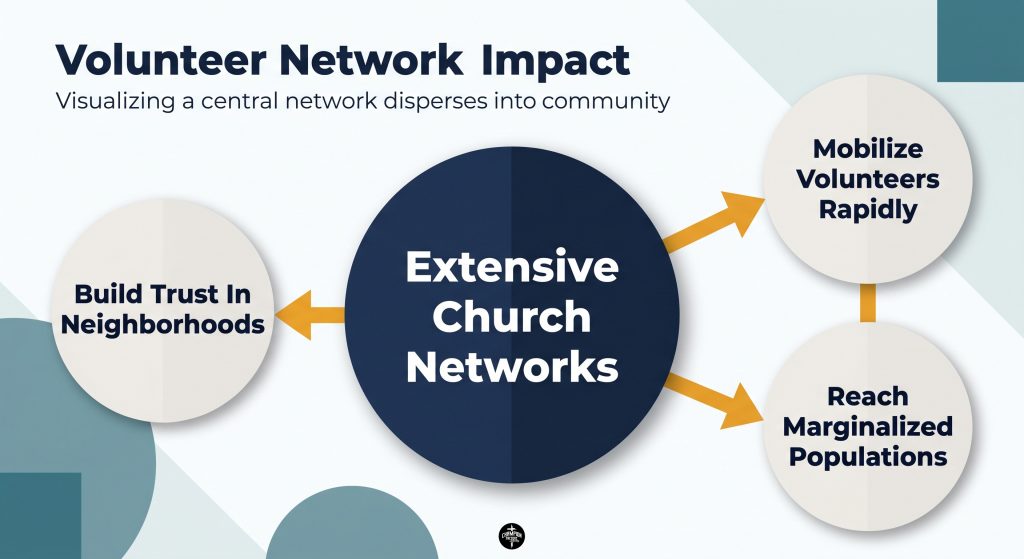
Christian charities rely on extensive church networks to mobilize volunteers rapidly. This built-in community support allows faith-based groups to reach marginalized populations that traditional secular programs might miss. These dedicated volunteers provide the relationship-building necessary for lasting impact and true community connection.
Secular nonprofits often have to build their volunteer base from the ground up. Christian organizations tap into existing congregations. Churches are filled with people who are already committed to serving their neighbors. This allows ministries to deploy large teams for food drives, mentorship programs, and community outreach.
These volunteer networks are incredibly effective. A study from the Network for Nonprofit and Social Impact at Northwestern University highlights that faith-based nonprofits provide essential connections to hard-to-reach populations within the social service system. Researcher Katelyn Zilke notes that these organizations are an essential part of the sector. They build trust in neighborhoods where government agencies might struggle to gain access.
"Our local church partnerships allow us to identify needs quickly and respond with people who genuinely care about their neighbors." Robert Crouse, Community Liaison.
The Enduring Trust in Faith-Based Care
Faith-based organizations have a long history of establishing modern social services. Almost all early hospitals and orphanages began with religious roots. Today, Christian charities remain a trusted pillar in the nonprofit sector because they consistently deliver reliable care grounded in enduring biblical values.
The modern charitable sector owes its existence to religious institutions. According to the M.J. Murdock Charitable Trust, almost all modern social services can be traced back to roots in religious organizations. This historical context builds immense credibility. People trust Christian charities because they have been doing this work for centuries.
This trust remains strong today. Data from the Philanthropy Roundtable reveals that 40 percent of the top 50 charities in America are faith-based organizations. Additionally, the Lake Institute on Faith and Giving confirms that giving to religion and faith-based causes remains the largest recipient category of donations in the United States.
Donors and community partners recognize this track record. They know that investing in a Christian charity means investing in an organization with deep roots, proven methods, and a commitment to the common good.
Commitment to Dignity and Safe Professional Care
Responsible Christian charities prioritize trauma-informed care and dignity for every person served. They integrate faith naturally while maintaining high professional standards. They do not replace medical or psychological professionals. They work alongside them to provide comprehensive support for individuals facing crisis.
There is a misconception that prioritizing faith means sacrificing professional quality. Strong Christian nonprofits prove this false every day. When dealing with complex issues like poverty, exploitation, or family hardship, ministries must use safe and dignified methods.
Ministries prioritize the safety of vulnerable populations. When discussing rescue and recovery, the focus remains on the ongoing support process rather than the trauma itself. This ensures that individuals are never exploited for a story.
Faith-based organizations also recognize their specific role. Spiritual guidance offers deep comfort, but it does not substitute for professional medical care or clinical therapy. Christian charities encourage individuals to seek professional help when appropriate. They partner with local clinics, legal services, and counselors to ensure that every person receives the exact care they need to heal safely. If you or someone you know is in crisis, always contact a licensed mental health professional or medical provider.
Partnering for Long-Term Restoration
The difference between Christian charities and secular nonprofits comes down to treating the whole person. Practical care keeps people alive. Spiritual hope gives them a reason to live. By combining tangible outreach with discipleship, faith-based organizations help individuals move past immediate crisis and build stable futures.
The work requires a community. It takes dedicated volunteers to mentor families. It takes generous donors to fund independent programs. It takes a shared belief that every person deserves dignity and respect.
If you want to support a mission that changes lives practically and spiritually, consider exploring the impact stories at Champion Factory Ministry. You can support this vital work by volunteering your time, making a donation, or keeping the community in your prayers.
FAQ
Do Christian charities only help people who share their faith?
No. Reputable Christian charities serve anyone in need regardless of their religious background. They offer practical help and spiritual encouragement without forcing beliefs on the people they serve.
Why do faith-based charities rely so much on private donations?
Faith-based organizations rely on private donors because government grants often prohibit religious activities. Donor funding allows these charities to remain independent and continue offering prayer, mentorship, and spiritual guidance.
Does spiritual support replace professional counseling?
No. Responsible faith-based ministries view spiritual support as a complement to professional care. They actively encourage individuals facing severe trauma or mental health crises to seek help from licensed medical and psychological professionals.