






The word hypocrite gets used often, and it gets used loosely. Some people ask what it means because they are genuinely wrestling with inconsistencies in their own faith. Others ask because they have been hurt by people who claimed to follow God but behaved very differently in private. Both questions deserve a real answer.
This article looks at what the Bible actually means by hypocrisy, where the word comes from, what Jesus said about it, and what honest Christian faith looks like in practice. Whether you are doing personal reflection or trying to make sense of something you experienced, the goal here is clarity, honesty, and genuine encouragement.
What Does Hypocrisy Mean in the Bible?
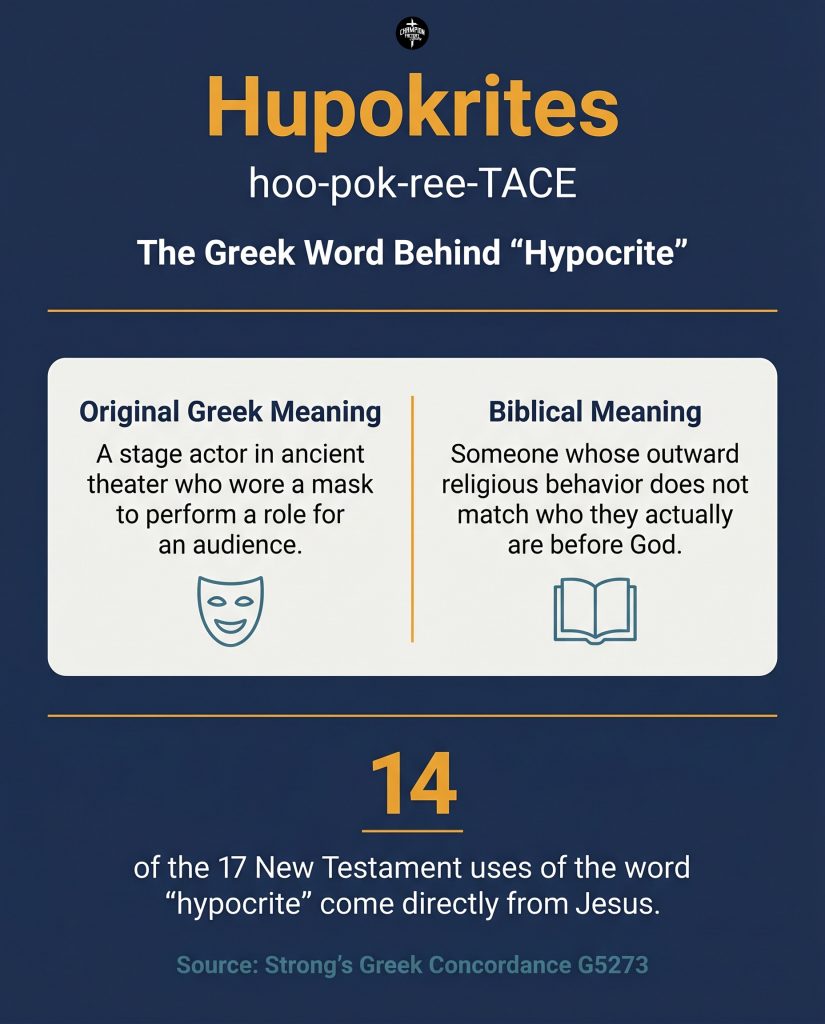
In the Bible, hypocrisy means performing religious behavior for the approval of others rather than out of sincere devotion to God. The Greek word behind it is hupokrites, which originally referred to a stage actor in ancient theater. An actor wore a mask to play a role. The biblical hypocrite does something similar: they present a version of themselves in public that does not match who they actually are before God.
The English word hypocrite traces directly to this Greek theatrical term. In ancient Greek theater, hupokrites described performers who wore masks and played characters. When Jesus used the word, his audience would have understood exactly what he was pointing at: someone whose public religious presentation is a performance rather than a genuine expression of faith.
This distinction matters. Hypocrisy in the biblical sense is not about imperfection or failure. It is about deliberate performance. It is about doing the right things in public while living differently in private, and doing so to maintain an image rather than to honor God.
The Old Testament raises the same concern long before Jesus does. In Isaiah 29:13, God speaks directly: "These people come near to me with their mouth and honor me with their lips, but their hearts are far from me. Their worship of me is based on merely human rules they have been taught." Jesus quotes this exact passage in Matthew 15:8. The problem of outward compliance without inward faithfulness is one God takes seriously throughout all of Scripture.
"In our ministry work, we see this tension regularly. People want to do the right things. But doing the right things for the wrong reasons is its own kind of problem. The Bible is clear: God is after the heart, not the performance." Todd Medina, President and Founder, Champion Factory Ministry
What Did Jesus Say About Hypocrisy?
Jesus addressed hypocrisy more directly and more often than almost any other topic. At least 14 of the 17 New Testament uses of the word hypocrite come from Jesus himself. He was not using the word loosely. He was identifying a specific pattern: religious practice shaped by what others would see and approve of, rather than by genuine love for God.
In Matthew 6, Jesus points to three specific areas where this pattern shows up: giving, prayer, and fasting. In each case, he draws the same contrast. When you give, do not announce it. When you pray, go to a quiet place. When you fast, do not make it obvious. "Be careful not to practice your righteousness in front of others to be seen by them. If you do, you will have no reward from your Father in heaven" (Matthew 6:1, NIV).
In Matthew 23, Jesus addresses the Pharisees in some of the sharpest language in the Gospels. He uses the phrase "woe to you, teachers of the law and Pharisees, you hypocrites" seven times. Scholars note that this language follows a formal Hebrew rhetorical pattern called a woe oracle, which prophets used to announce judgment on specific patterns of injustice or unfaithfulness. Jesus was not making a blanket condemnation of Jewish practice or religious observance. He was confronting a specific pattern: religious leaders whose outward observance of the law had become disconnected from justice, mercy, and genuine faithfulness.
His most vivid image comes in Matthew 23:27-28: "You are like whitewashed tombs, which look beautiful on the outside but on the inside are full of the bones of the dead and everything unclean. In the same way, on the outside you appear to people as righteous but on the inside you are full of hypocrisy and wickedness." The outside looks clean. The inside tells a different story.
In Luke 12:1, Jesus warns his own disciples: "Be on your guard against the yeast of the Pharisees, which is hypocrisy." Yeast spreads through the whole batch of dough. Pretense, once adopted, does not stay contained. It expands and distorts other areas of faith over time.
Is Every Struggling Christian a Hypocrite?
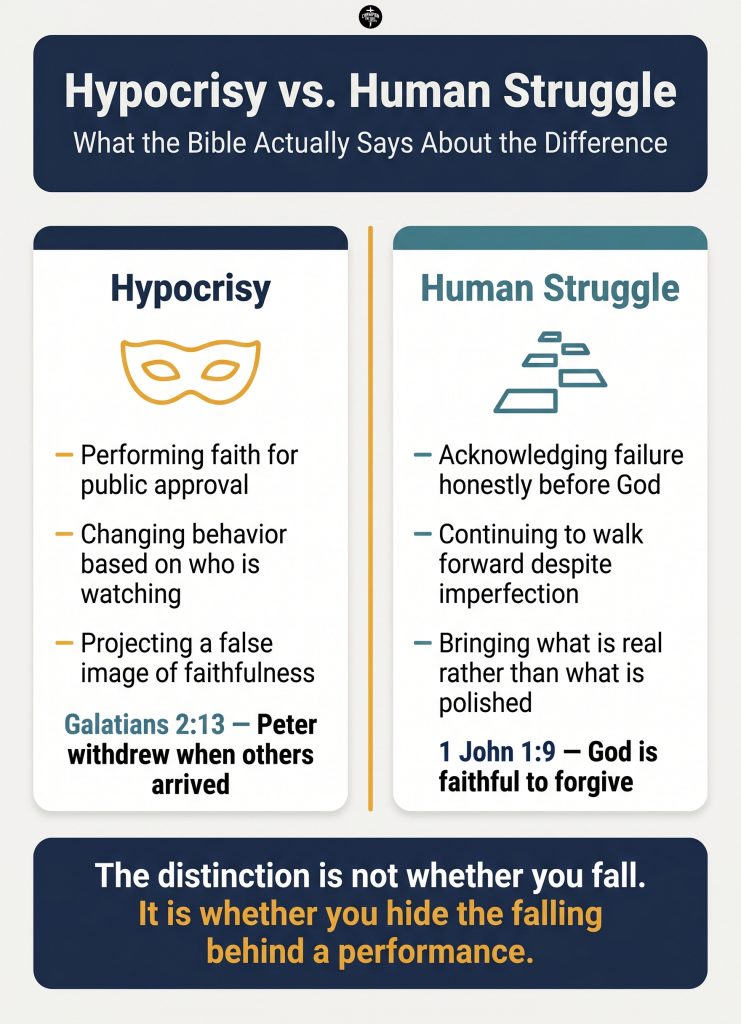
No. Struggling with sin is not the same as being a hypocrite. The difference comes down to honesty. A person who acknowledges their failures, brings them to God, and keeps walking forward is not performing a role. A hypocrite is someone who projects a false image of faithfulness while privately living contrary to what they profess. The distinction is not whether you fall. It is whether you hide the falling behind a performance.
This is one of the most important clarifications the Bible offers, and it is one that most popular articles on this topic do not make clearly enough.
Galatians 2:11-14 gives a concrete example. Paul confronts Peter directly because of a specific act of hypocrisy. Peter had been eating freely with Gentile believers. When certain Jewish Christians arrived, he withdrew and separated himself out of fear of what they would think. Paul names it plainly: "The other Jews joined him in his hypocrisy" (Galatians 2:13, NIV).
Peter's failure was not that he sinned in some general sense. His failure was specific. He changed his public behavior based on who was watching. His actions in front of one group did not match what he actually believed. Paul named it, confronted it directly, and that confrontation became part of Scripture.
What matters just as much is what came after. Peter was not destroyed by this. He was corrected. He grew. The early church was honest about the fact that even its most prominent leaders struggled with this pattern. That honesty is itself a model. Hypocrisy, when confronted with care rather than concealed, does not have to define a person or a community.
The Bible also names a positive counterpart to hypocrisy. The Greek word anupokritos appears in Romans 12:9, 2 Corinthians 6:6, 1 Timothy 1:5, James 3:17, and 1 Peter 1:22. It means without hypocrisy or sincere. "Love must be sincere," Paul writes in Romans 12:9 (NIV). The Bible is not only issuing a warning. It is naming the quality Christians are actively called toward: genuine, unmasked love and faith.
"The most honest thing a believer can do is stop pretending. When someone in our programs admits they have been carrying something they have been hiding, that is the beginning of real growth. The Bible calls that sincerity. We call it courage." Art Montgomery, Global Evangelism Strategy Architect, Champion Factory Ministry
Why Hypocrisy Matters Beyond the Church Walls
The way Christians live in public has a direct effect on how others understand faith. Research from the Barna Group found that 85 percent of young non-Christians described Christianity as hypocritical. This number deserves honest reflection. It does not mean Christianity is failing. It does mean that the gap between stated belief and visible behavior is something people outside the church notice and take seriously.
This is not an invitation to perform better for an outside audience. That would be a more sophisticated version of the same problem. But it is a reason to take genuine integrity seriously. Authentic faith, lived consistently, is one of the most credible forms of witness there is.
A 2022 Gallup survey found that U.S. church membership fell below 50 percent for the first time since Gallup began tracking in 1937. Many factors contribute to that trend. But cultural trust is one of them, and trust is built or eroded through the consistency of how people of faith actually live day to day.
The response to all of this is not self-condemnation or defensiveness. It is an honest reckoning with the gap, and a renewed commitment to walking with integrity. Not because it looks good, but because it is what genuine faith requires. Christian discipleship offers a structure for that kind of consistent, grounded growth.
How Christians Can Avoid Hypocrisy: Practical Steps
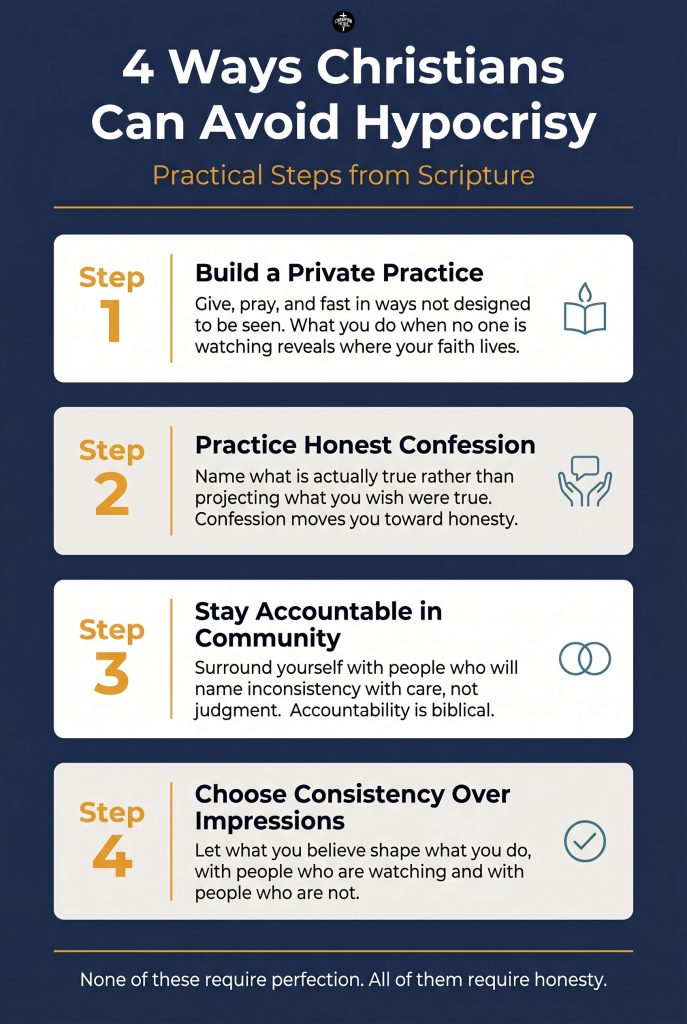
Avoiding hypocrisy is not primarily about trying harder in public. It is about building an honest interior life that does not require a performance. That means cultivating private devotion, practicing honest confession, staying accountable to others, and choosing consistency over image management.
Build a Private Practice That Has No Audience
Jesus's instructions in Matthew 6 all point in the same direction: give, pray, and fast in ways that are not designed to be seen. Private spiritual practice shapes who you actually are, not just who you appear to be. Consider building habits that no one else sees or affirms:
- Pray privately before you post publicly about faith
- Give without telling anyone
- Fast or set aside devotional time without announcing it
What you do when no one is watching reveals where your faith actually lives.
Practice Honest Confession
Confession is one of the most direct antidotes to hypocrisy. It is the practice of naming what is actually true rather than projecting what you wish were true. James 5:16 calls believers to confess their sins to one another. 1 John 1:9 grounds confession in grace: God is faithful to forgive when you bring what is real rather than what is polished.
Acknowledging failure honestly is not a sign of weak faith. It is a mark of sincere faith. Theologian Tim Keller's writing on confession and authenticity makes this point consistently: you can name your sin without being defined by shame. Confession moves you toward honesty. Hiding moves you toward performance.
Stay Accountable in Community
Galatians 2 shows that accountability is biblical. Paul confronted Peter directly and honestly. That is what genuine Christian community does. It names patterns of inconsistency with care and specificity, not to shame, but to restore. When you are surrounded by people who know you and are honest with you, the gap between your public and private self has less room to grow.
Look for community where:
- People speak honestly about their own struggles
- Correction is offered with care, not judgment
- Growth is celebrated over impression management
Choose Consistency Over Impressions
James 1:22 puts it simply: "Do not merely listen to the word, and so deceive yourselves. Do what it says." The person who hears and does not act is like someone who forgets their own face after looking in the mirror. Authentic faith is not about performing the right things in the right settings. It is about letting what you believe shape what you do, with people who are watching and with people who are not.
What to Do If You Have Been Hurt by Hypocrisy
If you have experienced harm at the hands of someone who claimed to live by faith, that experience is real and it deserves to be taken seriously. Religious pretense can cause genuine damage. If you are carrying that kind of wound, naming it honestly is not a rejection of faith. It is an act of honesty that God honors.
The biblical record is clear that hypocrisy inside the church is not a new problem. It was present in the earliest communities. It was confronted directly. And it did not define the whole of what the church is or can be.
Some wounds require more than an article. If you are processing serious harm from a religious environment, speaking with a licensed counselor or a trusted pastor can be an important and healthy step. That kind of support is not a sign of weak faith. It is wisdom. Please do not hesitate to reach out to a qualified professional if you are carrying something heavy.
At Champion Factory Ministry, we believe that dignity-centered, consistent care is what faith looks like in practice. If you are looking for a community committed to honest and practical service, we invite you to learn more about how we serve and who we are.
Living Without a Mask: A Path Toward Genuine Faith
The word hypocrite started in the theater. It described a person playing a role, wearing a mask, performing for an audience. Jesus used it to name a pattern that can take root in any religious life, including yours and mine. It is the pattern of letting what others see shape behavior more than what God sees.
The Bible does not only diagnose the problem. It names the alternative. Anupokritos. Without hypocrisy. Sincere. That is the quality Paul calls Christians toward in Romans 12:9. It is not perfection. It is honesty. It is choosing to bring what is real to God rather than what is presentable.
The path toward genuine faith runs through private devotion, honest confession, real accountability, and consistent action. It does not require a flawless record. It requires a willingness to stop performing and start walking.
If you want to go deeper, consider exploring our discipleship resources or connecting with someone who can walk alongside you in community.
FAQ
What is the biblical definition of hypocrisy?
In the Bible, hypocrisy means performing religious acts for public approval rather than genuine devotion to God. The Greek word hupokrites originally described a stage actor. Jesus used the term to describe people whose outward religious behavior did not match their inward faith.
Did Jesus call all religious people hypocrites?
No. Jesus directed his strongest words to specific leaders who used religious observance to maintain social status while neglecting justice and genuine faithfulness. He was not condemning religious practice itself. He was confronting a specific pattern of performance over sincerity.
Is a Christian who sins a hypocrite?
Not necessarily. Struggling with sin and living as a hypocrite are different things. Hypocrisy involves deliberate performance for an audience. A believer who acknowledges failure, confesses honestly, and keeps walking forward is not playing a role. The distinction is honesty, not perfection.
What does the Bible call Christians toward instead of hypocrisy?
The Greek word anupokritos, meaning without hypocrisy or sincere, appears several times in the New Testament. Romans 12:9 calls Christians to love that is sincere. The Bible is not only warning against pretense. It is naming genuine, unmasked faith as the goal.
What practical steps help a Christian avoid hypocrisy?
Building a consistent private devotional life, practicing honest confession, staying accountable in community, and choosing action over image management all help close the gap between public profession and private reality. None of these require perfection. All of them require honesty.