



Many Christians carry a quiet sense that they should know more about church history, but are not sure where to start. The subject can feel distant, overly academic, or crowded with unfamiliar names and dates. That feeling is common, and it does not reflect a weak faith. It reflects the fact that church history is rarely taught in a way that feels personal or relevant.
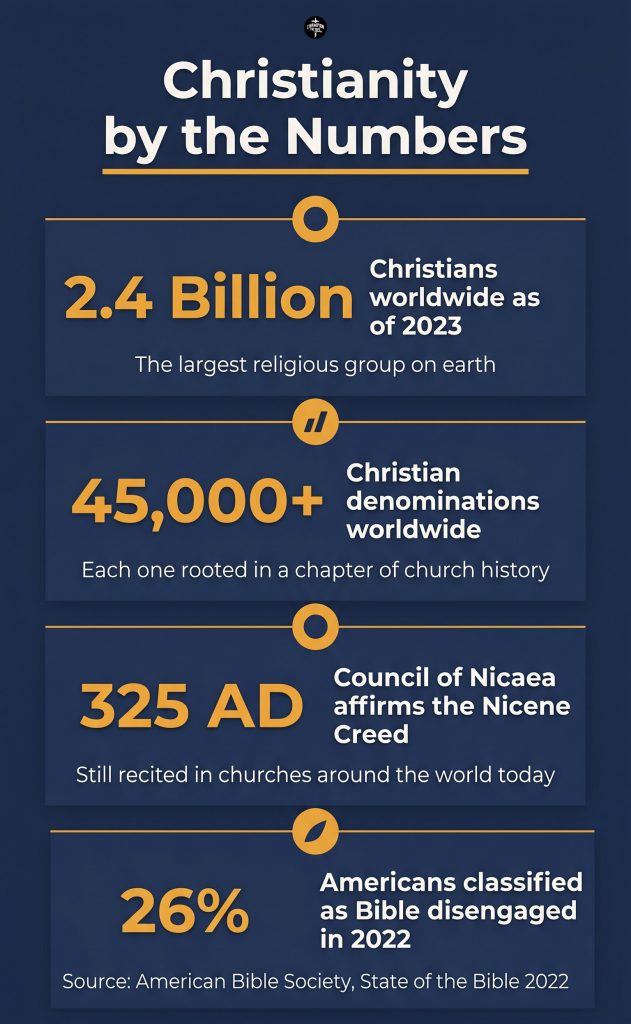
This guide offers a simple, honest overview of how the Christian church developed from its earliest days to the present. It covers the major turning points, the people and movements that shaped the faith, and what that history means for the Christian reading it today. According to a 2022 survey by the American Bible Society, 26 percent of Americans qualify as "Bible disengaged," the highest level ever recorded in the study's history. Accessible faith education, including church history, is one practical response to that growing gap.
What the Early Church Actually Looked Like
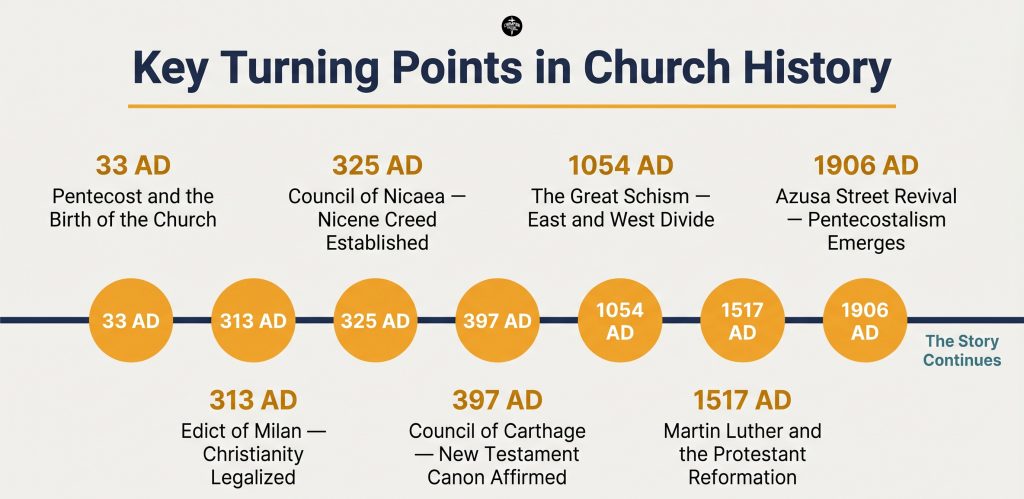
The church began not as an institution but as a community. After Jesus ascended and the Holy Spirit came at Pentecost, the first believers gathered regularly to pray, share meals, learn from the apostles, and care for one another's needs. They were a small group living inside a large empire that did not welcome their message. Their faith held them together.
Acts 2:42-47 (NIV) describes this original community in plain terms: "They devoted themselves to the apostles' teaching and to fellowship, to the breaking of bread and to prayer. Every day they continued to meet together in the temple courts. They broke bread in their homes and ate together with glad and sincere hearts."
This was not an organized religion with buildings, hierarchies, or formal structures. It was people who had encountered Jesus, or heard from those who had, and who reorganized their lives around that encounter.
"When I read about the early church in Acts, I see the same pattern we try to build today at Champion Factory Ministry. People meeting together, sharing what they have, caring for those in need. That is not a program. That is a way of life." Todd Medina, President and Founder, Champion Factory Ministry
How the Church Grew Despite Hardship
Over the next three centuries, the church spread through the Roman Empire despite facing periodic opposition. Roman authorities at various times viewed the movement as a threat to public order, and Christians in some regions faced exile, imprisonment, or death for their faith.
The church grew anyway. It spread through personal relationships, through the witness of ordinary believers, and through communities that welcomed people who were often overlooked elsewhere. Women, enslaved people, merchants, and soldiers all found belonging in early Christian gatherings in ways that were unusual for Roman society.
In 313 AD, Emperor Constantine issued the Edict of Milan, which extended legal tolerance to Christianity across the empire. This was a turning point. The church moved from the margins of Roman life to a position of growing influence and eventually official status. That transition brought new opportunities and new complications that the church has worked through ever since.
Why Councils and Creeds Still Matter
In the centuries following Constantine, church leaders gathered at ecumenical councils to address pressing theological questions. These gatherings produced the creeds that most Christian traditions still use. The Council of Nicaea in 325 AD affirmed that Jesus is fully God and fully human, a belief that remains central to Christian faith across Catholic, Orthodox, and Protestant traditions.
Many modern Christians recite the Nicene Creed or the Apostles' Creed in worship without knowing where those statements came from. They came from real people, in real rooms, working through questions that had genuine consequences for the church's identity and direction.
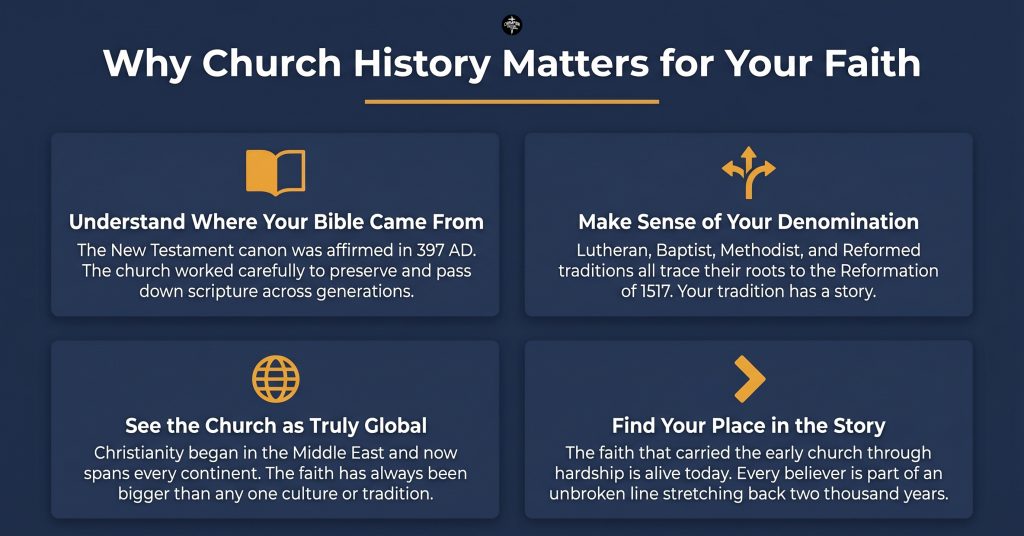
The Council of Carthage in 397 AD formally affirmed the 27 books of the New Testament. The Bible every Christian holds today reflects decisions made at those councils, decisions built on careful discernment about what had been passed down reliably from the apostles. Understanding this does not reduce confidence in scripture. It shows how the church worked carefully to preserve it.
What the Church Fathers Contributed
The theologians who shaped Christian teaching in these early centuries are often called the Church Fathers. Writers like Augustine of Hippo, Athanasius, and John Chrysostom wrestled with how to understand the faith clearly and communicate it faithfully across different cultures. Their work on the nature of God, the meaning of salvation, and the life of the church still shapes Christian thought today.
The monastic movement, beginning with figures like Anthony of Egypt in the third century, added another thread to this story. Monks and nuns committed to lives of prayer and communal study. They preserved manuscripts during unstable periods in Europe, copied scripture by hand, and maintained a rhythm of worship that kept the faith alive through disruption.
"The people who preserved these texts were not famous. They were communities committed to faithfulness in ordinary daily practice. That kind of commitment to consistency is something we see reflected in every long-term discipleship effort." Art Montgomery, Global Evangelism Strategy Architect, Champion Factory Ministry
The Split That Created Two Branches of Christianity
In 1054 AD, the Christian church formally divided into two major branches: the Roman Catholic Church in the West and the Eastern Orthodox Church in the East. This event, known as the Great Schism, resulted from centuries of theological, cultural, and political tensions. It has never been fully resolved. Today these two traditions together represent a large portion of the world's 2.4 billion Christians, according to Pew Research Center.
The split involved genuine disagreements about authority, the nature of the Holy Spirit, and how church leadership should be structured. It was not a sudden rupture. It was the end of a long and complicated separation that had been building for generations.
For modern Christians, this matters because it explains why so many distinct Christian traditions exist today. The church was never a single uniform institution. From early on, different communities emphasized different things, read theology through different cultural lenses, and organized their worship in different ways.
That diversity is not a sign of failure. It reflects how widely and how deeply the faith has taken root across the world.
How the Reformation Changed Everything
On October 31, 1517, a German monk named Martin Luther nailed a list of 95 arguments to the door of a church in Wittenberg. He was not trying to start a new religion. He wanted to start a conversation about reform. What followed was the Protestant Reformation, a movement that reshaped Christianity in the West and produced the denominational landscape most Protestant Christians belong to today.
Luther's central concern was that salvation comes through faith in Christ, not through the purchase of indulgences or other church practices he believed had no biblical basis. His willingness to make that argument publicly, combined with access to the newly invented printing press, meant his ideas spread rapidly across Europe.
Johannes Gutenberg's printing press, developed around 1440, allowed the Bible to be produced in large quantities for the first time. Ordinary people began reading scripture for themselves, in their own languages. That access changed how Christians understood their relationship with the text and with church authority.
The Traditions That Came from the Reformation
The Reformation did not produce one new movement. It produced many. Lutheran, Reformed, Anglican, Anabaptist, and later Baptist and Methodist traditions all trace their roots to this period. Each carried different convictions about worship, baptism, governance, and the relationship between faith and culture.
This is where many modern Protestants find their own tradition in the story. Your denomination has a history. That history connects to particular people who made particular decisions about how to follow Jesus faithfully in their own time and place.
Theologian Alister McGrath has observed that Christianity does not so much conquer culture as transform it from within. The Reformation is one of the clearest examples of that pattern. The church changed, culture changed, and the faith continued.
Christianity's Reach Beyond Europe
Church history is often told as a European story. But Christianity began in the Middle East, took root in Africa within the first generation of believers, spread into Asia along trade routes, and eventually reached the Americas. Today Christianity is a genuinely global faith. Some of the fastest growth in the church is happening in sub-Saharan Africa, Latin America, and parts of Asia.
The book of Revelation points toward this reality. Revelation 7:9 (NIV) describes "a great multitude that no one could count, from every nation, tribe, people and language, standing before the throne and before the Lamb." The global church did not appear suddenly. It grew over centuries through the effort and faith of millions of people carrying the gospel across cultural and geographic boundaries.
This story includes complications. The spread of Christianity in some parts of the world was entangled with colonial systems that caused real harm to indigenous peoples and cultures. Honest church history does not ignore this. Many missionaries brought genuine faith and genuine care. Colonial structures often brought coercion and injustice. Both things are true. Acknowledging that complexity does not undermine the gospel. It reflects the reality that the church has always been made up of imperfect people working within imperfect systems.
The Modern Church and Its Many Expressions
By the 20th century, new movements continued to reshape Christianity. The Azusa Street Revival in Los Angeles in 1906 gave rise to Pentecostalism, now one of the fastest-growing expressions of Christian faith in the world, according to Pew Research Center data on global Christianity. The ecumenical movement brought different traditions into closer dialogue with one another.
Today there are an estimated 45,000 Christian denominations worldwide, according to the Center for the Study of Global Christianity at Gordon-Conwell Theological Seminary. That number can feel overwhelming. History explains it. Each tradition carries a story of people who made choices about how to follow Jesus in their particular time, language, and culture.
The Difficult Chapters Every Christian Should Know About
Church history includes moments that are genuinely hard to reconcile with Christian values. The Crusades were religiously motivated military campaigns that caused widespread suffering. The Inquisition involved the use of coercion and punishment by church authorities. These chapters are part of the record. A serious engagement with church history does not skip them.
For many Christians, encountering the darker parts of church history raises honest questions. How could people claiming faith in Christ do these things? What does that mean for the church today?
These questions are worth sitting with. The church has never been made of perfect people. C.S. Lewis wrote in Mere Christianity that the church exists for nothing else but to draw people into Christ. When the church has failed to do that, or has actively caused harm in Christ's name, that failure matters. Naming it is part of integrity.
What history also shows is that the church has repeatedly faced its own failures, reformed, and continued. That does not erase the harm done. It does show that the faith itself is not destroyed by the failures of its practitioners.
If reading about difficult chapters of church history brings up personal pain or difficult experiences with religious institutions, speaking with a trusted counselor or pastor can be a helpful next step. Faith communities at their best offer support, and professional counseling is a valuable resource for processing deeper wounds.
What Church History Offers the Modern Christian
Knowing church history helps modern Christians understand where their faith came from, why their tradition looks the way it does, and how to hold the church's complicated story with both honesty and hope. It offers real encouragement. The faith has survived persecution, political pressure, internal division, and its own worst moments. That resilience is not accidental.
Jesus said in Matthew 16:18 (ESV): "I will build my church, and the gates of hell shall not prevail against it." Church history is the ongoing record of that promise. Not that the church has always been faithful, but that it has continued.
Understanding this history is part of growing as a disciple. It connects the modern believer to a cloud of witnesses across centuries and cultures. Hebrews 11:1-2 (NIV) speaks of the "ancients" who were commended for their faith. That tradition extends forward. The Christian today is part of that same line.
How to Continue Learning
Church history is a large subject. This article is an introduction. For those who want to go deeper, here are practical starting points:
- Read a short survey book. "Church History in Plain Language" by Bruce Shelley or "The Story of Christianity" by Justo Gonzalez offer accessible overviews written for general readers.
- Explore a particular era. If the Reformation interests you, follow that thread. If the early church speaks to you, read more about the Church Fathers or the monastic movement.
- Talk to your pastor or a trusted mentor. Many churches offer small groups or classes that cover church history in a community setting.
- Engage with questions honestly. If a chapter of church history troubles you, that is worth exploring rather than avoiding.
You Are Part of This Story Too
Church history is not a museum exhibit. It is a living story that every Christian enters when they choose to follow Jesus. The people who preserved the scriptures, gathered at councils, broke from institutions they believed had lost their way, carried the gospel across oceans, and built communities in places where faith was unwelcome were ordinary people doing their best to be faithful.
Modern Christians carry that same call. The same faith that carried the early church through its first centuries, that survived schisms, reformations, and complications, is alive in local congregations, in families, in ministries, and in individual believers today.
If you want to grow in your faith and connect with a community that takes discipleship seriously, learn more about the programs and outreach at Champion Factory Ministry at championfactoryministry.org.
FAQ
How long does it take to learn church history?
You do not need to master it before it becomes useful. Even a basic overview of the major eras gives you a clearer framework for understanding your own tradition. A short introductory book can be read in a few weeks. Deeper study can take a lifetime, and that is fine. Start where you are.
Do I need to agree with everything in church history to be a Christian?
No. Church history is the record of what believers did and believed over time. That record includes faithfulness, insight, failure, and harm. Engaging with it honestly does not require approving of everything. It requires taking the record seriously and letting it inform your faith with more depth and humility.
Why are there so many Christian denominations?
Most denominations trace their origins to genuine theological convictions held by real people at specific moments in history. The Reformation, missions, revival movements, and ongoing theological conversations all contributed to the diversity of Christian traditions. That diversity reflects how widely the faith has spread and how differently communities have worked out what it means to follow Jesus in their particular context.
Is it okay to have questions about the difficult parts of church history?
Yes. Questions about the Crusades, the Inquisition, colonial missions, and other complicated chapters are honest and appropriate. Faith that cannot engage with hard questions is not stronger for avoiding them. Many thoughtful Christians have found that honest engagement with difficult history leads to a more mature and grounded faith.
Where should I start if I want to learn more about church history?
A good starting point is a readable survey book written for general audiences. "Church History in Plain Language" by Bruce Shelley is widely recommended. Your pastor or local librarian may have other suggestions suited to where you are in your faith journey.