






You may have heard the term TULIP in a church, a theological discussion, or while exploring different Christian traditions. If you are trying to make sense of what it means, you are not alone. The acronym is widely referenced but rarely explained in plain language.
This article walks through each letter of TULIP, traces where these doctrines came from historically, and explains how they shape the lives of Reformed Christians today. TULIP belongs to one significant tradition within Christianity. Understanding it well is worth the effort, regardless of where you stand theologically.
Where Did TULIP Come From?
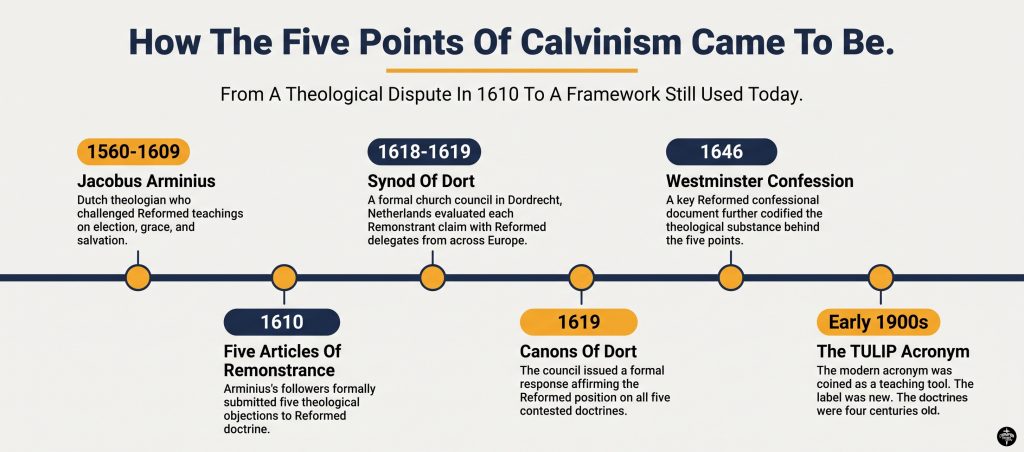
The TULIP acronym is a modern teaching tool, but the theological ideas behind it are four hundred years old. The five points emerged from the Synod of Dort, a formal church council held in Dordrecht, Netherlands, from 1618 to 1619. Reformed delegates from across Europe gathered to evaluate a series of theological challenges submitted by followers of the Dutch theologian Jacobus Arminius.
Jacobus Arminius (1560 to 1609) was a Dutch theologian who disagreed with several key Reformed teachings on salvation, election, and grace. After his death, his followers formally presented five theological objections known as the Five Articles of Remonstrance. The Synod of Dort evaluated each objection and affirmed the Reformed position in a document called the Canons of Dort, which became the direct doctrinal source of the five points.
John Calvin (1509 to 1564) is the theological father of the Reformed tradition and the author of the Institutes of the Christian Religion. Calvin never organized the five points as a formal list, and the TULIP acronym did not appear until the early twentieth century. The label is modern, but the theology behind it has shaped Reformed Christianity for centuries.
The Pew Research Center estimates that Presbyterians, the largest Reformed denomination in the United States, represent approximately 3 percent of American adults. The broader Reformed tradition includes additional denominations such as the Christian Reformed Church, the Reformed Church in America, and various Reformed Baptist associations.
What the Five Points of TULIP Actually Mean
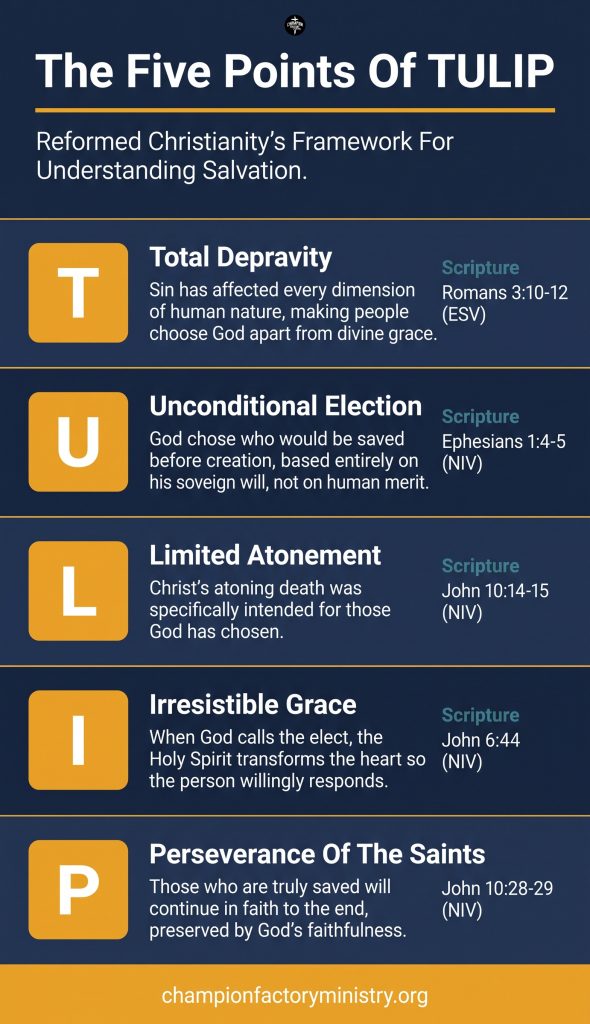
The five points of TULIP address one central question: how does a person come to salvation? Reformed theology answers that question by placing God's sovereign initiative at every stage. Each letter names one doctrine. Together they form a framework built around the conviction that salvation originates with God rather than with human effort or independent decision.
T: Total Depravity
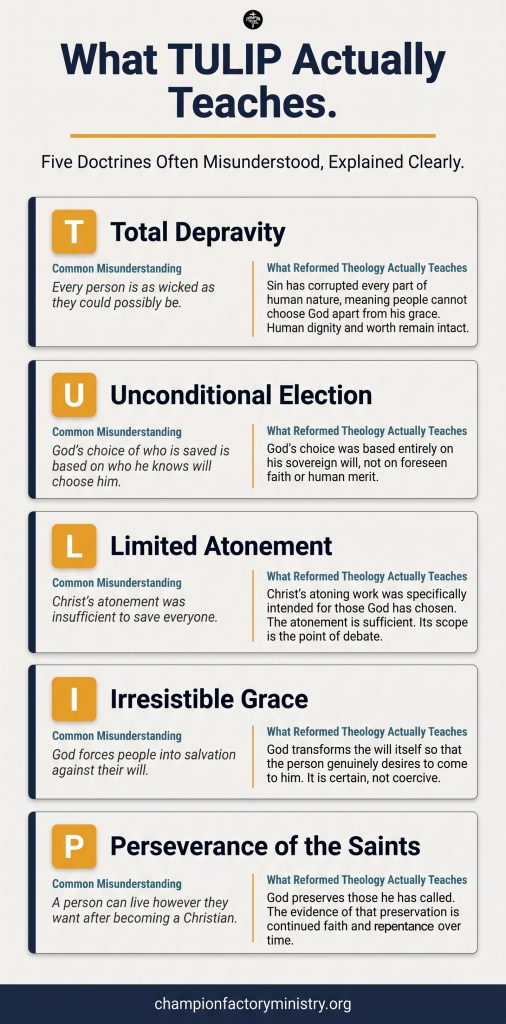
Total Depravity does not mean that every person is as wicked as they could possibly be. It means that sin has affected every dimension of human nature, including the mind, the will, and the emotions. Reformed theology holds that because of this, people cannot choose God on their own apart from divine grace.
Paul writes in Romans 3:10-12 (ESV), drawing from Psalm 14: "None is righteous, no, not one; no one understands; no one seeks for God. All have turned aside; together they have become worthless; no one does good, not even one." Reformed theologians read this as evidence that the problem of sin reaches into the core of human motivation, not only into outward behavior.
One important distinction: Total Depravity is a claim about human capacity apart from God. It is not a statement about human worth or dignity. Every person is made in the image of God and carries inherent value before him.
U: Unconditional Election
Unconditional Election is the Reformed belief that God chose who would be saved before the creation of the world. Reformed theology holds that this choice rested entirely on God's sovereign will rather than on any quality, merit, or faith foreseen in the individual.
Paul writes in Ephesians 1:4-5 (NIV): "For he chose us in him before the creation of the world to be holy and blameless in his sight. In love he predestined us for adoption to sonship through Jesus Christ, in accordance with his pleasure and will."
Christians in the Arminian tradition read this same passage differently. Many understand election as corporate rather than individual, or as God's response to faith he foreknew the person would freely choose. The theological conversation around election has continued for centuries and involves careful reading across many passages of Scripture. Reformed Christians often describe election not as a cause for pride but as a deep source of assurance: God's love for them does not depend on their performance.
L: Limited Atonement
Limited Atonement is the most internally contested of the five points, even within Reformed Christianity. The doctrine holds that Christ's atoning death was specifically intended for those God has chosen rather than for every person without distinction.
In John 10:14-15 (NIV), Jesus says: "I am the good shepherd; I know my sheep and my sheep know me, just as the Father knows me and I know the Father, and I lay down my life for my sheep." Reformed theologians point to the specific relational language here as evidence that Christ's sacrifice was directed toward those the Father gave him.
Many Reformed theologians and denominations prefer the terms Definite Atonement or Particular Redemption. The word "limited" can imply insufficiency, which is not the Reformed intent. Four-point Calvinism, sometimes called Amyraldism after the seventeenth-century theologian Moise Amyraut, accepts the other four points but holds a broader view of the atonement's reach. Not all who identify as Reformed hold identical views on this question.
I: Irresistible Grace
Irresistible Grace, also called Effectual Calling, is the belief that when God calls the elect to salvation, the Holy Spirit works in the heart in a way that produces a willing response. Reformed theology does not mean God forces anyone against their will. The idea is that God transforms the will itself so that the person genuinely desires to come to him.
Jesus says in John 6:44 (NIV): "No one can come to me unless the Father who sent me draws him, and I will raise him up at the last day." Reformed theology reads this as evidence that coming to Christ is ultimately the result of God's initiative rather than unaided human decision.
The word "irresistible" can be misread as coercive. The Reformed intent is not force but certainty: when God calls a person to salvation through the Spirit's work, that call accomplishes what God intends.
P: Perseverance of the Saints
Perseverance of the Saints is the Reformed conviction that those who are truly saved will continue in faith to the end. The popular phrase "once saved, always saved" captures part of this idea but leaves something important out. Reformed theology does not suggest that a person can live without regard to faith after conversion. The claim is that God preserves those he has called, and the evidence of that preservation appears in continued faith and repentance over time.
Jesus says in John 10:28-29 (NIV): "I give them eternal life, and they shall never perish; no one will snatch them out of my hand. My Father, who has given them to me, is greater than all; no one can snatch them out of my Father's hand." Paul adds in Philippians 1:6 (NIV): "being confident of this, that he who began a good work in you will carry it to completion until the day of Christ Jesus."
The Westminster Confession of Faith, a key Reformed confessional document produced in 1646, affirms that those God has called will certainly persevere to the end and be eternally saved. The emphasis falls on God's faithfulness, not on human strength.
"When people understand that God's commitment to them is not conditional on their best performance, it changes how they approach their own struggles. It does not remove the call to faithfulness. It makes it sustainable." Todd Medina, President and Founder, Champion Factory Ministry
How TULIP Shapes Reformed Church Life and Practice
Reformed Christians do not hold these five points as abstract theological positions disconnected from everyday faith. The doctrines directly shape how they worship, pray, and engage with others. The emphasis on God's sovereignty tends to produce humility, a long-term orientation toward faithfulness, and a confidence rooted in what God has done rather than in what a person has achieved.
In practice, this takes several concrete forms:
- Reformed worship tends to center on God's glory and the reading and preaching of Scripture
- Evangelism in Reformed churches is often motivated by obedience and love rather than anxiety about outcomes, since the conviction is that God is the one who saves
- The doctrine of Perseverance encourages believers to remain steady through difficulty, trusting that God's work in them will not ultimately fail
- Long-term discipleship is highly valued, reflecting the belief that God works steadily and faithfully in people across seasons of life
This sustained, faith-rooted orientation shapes ministries like CFM's Nourish program, which walks with people through Scripture and spiritual formation over time, because sustained engagement with God's Word shapes people in ways that a single encounter rarely does.
TULIP and the Broader Christian Conversation
TULIP represents the theological convictions of one significant tradition within Protestant Christianity. It does not represent the universal position of all Christians. Many faithful Christians, including those in Arminian, Anglican, Lutheran, Methodist, and Catholic traditions, hold different views on salvation, grace, and election. This disagreement is long-standing and has not prevented Christians across traditions from sharing core convictions about Jesus Christ.
If you are reading this from outside the Reformed tradition, the goal here is not to redirect your theology but to help you understand this tradition accurately and with respect.
"Understanding what others believe about grace and salvation helps us engage honestly. When we know what a theological tradition actually teaches, rather than a simplified version of it, we are better able to listen well and speak truthfully." Art Montgomery, Global Evangelism Strategy Architect and Board Visionary Luminary, Champion Factory Ministry
If you have deeper questions about these doctrines, a pastor or trusted spiritual director in your own faith community is the best next step. These are substantive questions, and personal guidance from someone who knows your context matters.
Why the Questions Behind TULIP Still Matter
The questions that gave rise to TULIP have occupied serious Christians for centuries: How does a person come to salvation? What is God's role and what is ours? How can a believer have lasting assurance? These questions shape how people pray, how they understand grace, and how they live out their faith in community.
TULIP offers one coherent set of answers, rooted in a particular reading of Scripture and centuries of Reformed theological reflection. Understanding those answers clearly, even if you reach different conclusions, is part of the wider work of engaging the Christian faith with honesty and care.
If you want to explore faith and discipleship in a community that takes questions like these seriously, we invite you to learn more about how to get involved.
FAQ
Did John Calvin Write the Five Points of Calvinism?
No. John Calvin (1509 to 1564) is the theological father of the Reformed tradition, but he did not organize the five points as a list. They emerged from the Synod of Dort in 1618 to 1619, more than fifty years after Calvin's death. The TULIP acronym did not appear until the early twentieth century.
What Is the Difference Between Calvinist and Arminian Theology?
Both traditions are Protestant and affirm salvation through Jesus Christ. Calvinism holds that God sovereignly elects individuals to salvation, that grace is effectual and certain, and that believers will persevere to the end. Arminianism holds that election is based on God's foreknowledge of faith, that grace can be resisted, and that believers can fall away from salvation. Both traditions carry long theological histories and serious biblical arguments.
Is Limited Atonement Accepted by All Reformed Christians?
No. Limited Atonement is the most internally contested of the five points. Some Reformed scholars and denominations prefer the terms Definite Atonement or Particular Redemption. Others, sometimes called four-point Calvinists, accept the other four points but hold a broader view of the atonement's intended scope. It is not accurate to present all Reformed Christians as holding identical views on this doctrine.
Does TULIP Define the Boundaries of Christian Faith?
No. Reformed Christians who hold TULIP do not typically regard agreement with these five points as a test of genuine Christian faith. Christians across many traditions, including those who reject one or more of the five points, are understood by most Reformed believers to be fellow followers of Christ. TULIP is a theological framework within one Protestant tradition. It is not a boundary marker for Christian identity.