






You have likely heard the name of Jesus and know something about Christmas and Easter. But you might not be able to explain how the faith actually started, who carried it forward, or why it spread the way it did. The history of Christianity is more specific and more compelling than most summaries suggest.
This article traces that history from the beginning. It covers who Jesus was, what the early church looked like in practice, how the faith moved across the ancient world, and why that founding story still matters for those who follow it today.
The Historical Setting: Where Christianity Began
Christianity began in first-century Judea, in the region of modern-day Israel and Palestine, within the Jewish religious tradition known as Second Temple Judaism. Jesus of Nazareth was born into a Jewish community, taught within Jewish religious life, and gathered Jewish disciples who carried his message forward. The faith grew directly out of the religious, cultural, and social world of first-century Judaism.
Encyclopaedia Britannica describes Christianity as originating "in the first century AD in the region of Judea" within the context of Second Temple Judaism, the dominant Jewish tradition of the period. Understanding this context matters because it shapes what Jesus taught, how his earliest followers understood him, and why his message resonated as deeply as it did.
The world Jesus entered was marked by Roman occupation, economic hardship, and a deep longing among many Jewish people for restoration and hope. His ministry spoke directly into that world.
Who Jesus Was and What He Came to Do
Jesus of Nazareth is the central figure of Christianity. He was a first-century Jewish teacher who preached across the region of Galilee and Judea, gathered twelve close disciples, and built a following among people the religious establishment often overlooked. Christians understand him as the Son of God. Outside the New Testament, Roman historians Tacitus and Pliny the Younger both referenced Jesus and his followers, confirming his historical existence as a documented figure.
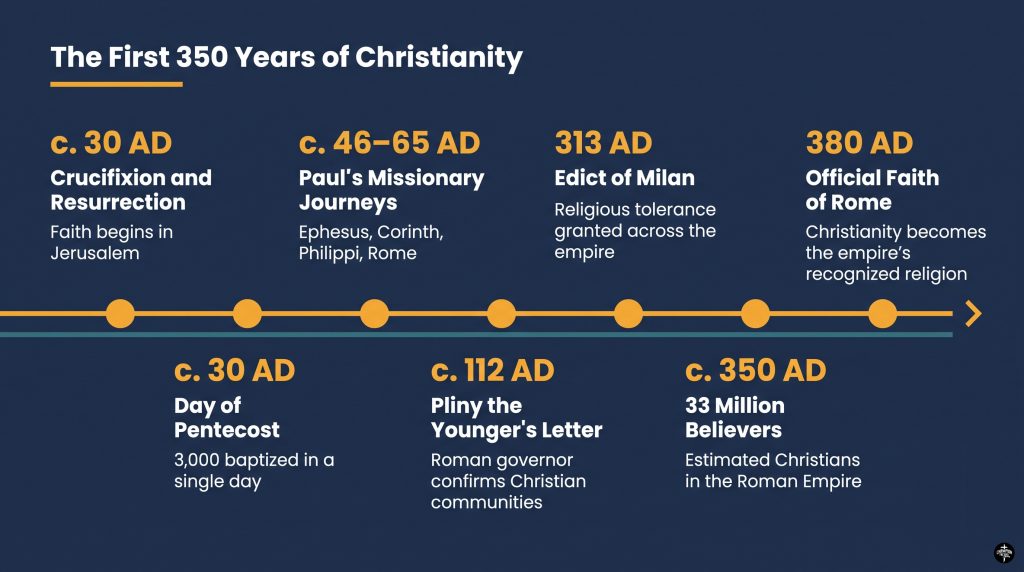
Tacitus, writing around 116 AD, noted that "Christus, from whom the name had its origin, suffered the extreme penalty during the reign of Tiberius at the hands of one of our procurators, Pontius Pilatus." This is among the earliest non-Christian references to the crucifixion of Jesus.
When Jesus began his public ministry, he announced its purpose clearly. Reading from the prophet Isaiah in a synagogue, he said:
"The Spirit of the Lord is on me, because he has anointed me to proclaim good news to the poor. He has sent me to proclaim freedom for the prisoners and recovery of sight for the blind, to set the oppressed free." (Luke 4:18, NIV)
His ministry reflected those words. He healed the sick, welcomed the outcast, and taught with an authority that surprised people who heard him. C.S. Lewis, the literary scholar and Christian writer, captured the challenge Jesus presents directly: "I am trying here to prevent anyone saying the really foolish thing that people often say about Him: I'm ready to accept Jesus as a great moral teacher, but I don't accept his claim to be God. That is the one thing we must not say."
What Jesus did and what he claimed about himself set the entire story in motion.
The Resurrection: The Event That Founded the Faith
The resurrection of Jesus is the founding event of Christianity. The crucifixion happened around 30 AD under Pontius Pilate. Three days later, according to the New Testament and the testimony of his disciples, Jesus rose from the dead. That claim transformed a devastated group of followers into a confident movement that spread across the ancient world. Without the resurrection, there is no Christian faith.
The Earliest Written Summary of the Gospel
The apostle Paul, writing to the church in Corinth approximately 20 years after the resurrection, recorded one of the earliest known summaries of the Christian message:
"For what I received I passed on to you as of first importance: that Christ died for our sins according to the Scriptures, that he was buried, that he was raised on the third day according to the Scriptures." (1 Corinthians 15:3-4, NIV)
Paul wrote this before any of the four Gospels existed. It shows that belief in the resurrection was the core of the faith from its earliest documented days, not a later addition.
The disciples who encountered the risen Jesus went from hiding in fear to speaking publicly in Jerusalem at great personal risk. That shift in behavior is one of the most discussed features of the resurrection account. Something happened that changed them. For Christians, the explanation is the one they gave themselves: they had seen him alive.
How the First Church Was Born
The Christian church began publicly on the day of Pentecost, approximately 50 days after the resurrection. The apostle Peter stood before a crowd in Jerusalem and spoke about Jesus. The book of Acts records that approximately 3,000 people were baptized that day. That gathering became the first Christian community, and what they built together shaped what the church has looked like ever since.
What the First Church Actually Looked Like
The community that formed after Pentecost grew quickly. The more defining story is how they actually lived together. Acts 2:42-47 describes the early community this way:
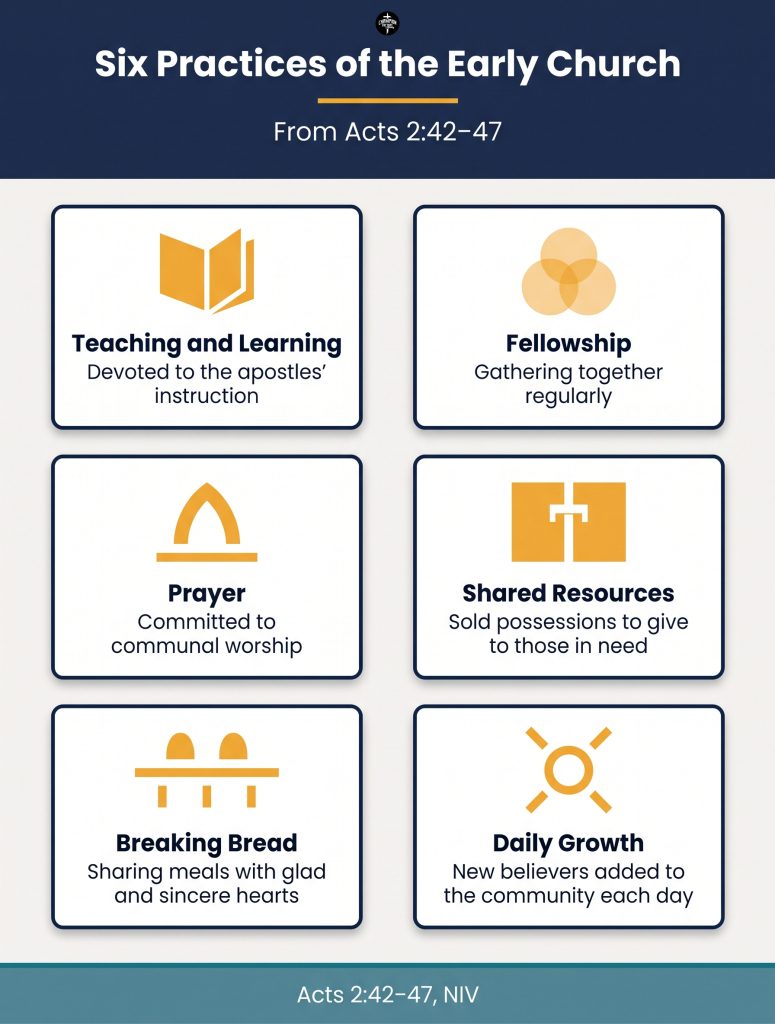
"They devoted themselves to the apostles' teaching and to fellowship, to the breaking of bread and to prayer. Everyone was filled with awe... All the believers were together and had everything in common. They sold property and possessions to give to anyone who had need. Every day they continued to meet together in the temple courts. They broke bread in their homes and ate together with glad and sincere hearts, praising God and enjoying the favor of all the people. And the Lord added to their number daily those who were being saved." (Acts 2:42-47, NIV)
This was a worshipping community. It was also a community built around practical care. The first Christians fed those in need, shared resources, and made room for people who had been pushed to the margins.
"When I read Acts 2, I'm not reading ancient history. I'm reading a description of what the church is called to be right now, for the families and children we serve." - Todd Medina, President and Founder, Champion Factory Ministry
Sociologist Rodney Stark, in his landmark research on early Christian growth, argues that this practical care was one of the primary reasons the faith spread as quickly as it did.
How Christianity Spread Beyond Jerusalem
The faith moved beyond Jerusalem through deliberate mission and ordinary community life. The apostles carried the message throughout Judea and into neighboring regions. The apostle Paul traveled extensively across the eastern Mediterranean, establishing communities of believers in cities including Ephesus, Corinth, Philippi, and Thessalonica. The mission Jesus had commanded was being lived out in real cities and real households.
Before his ascension, Jesus gave his disciples a clear direction:
"Therefore go and make disciples of all nations, baptizing them in the name of the Father and of the Son and of the Holy Spirit, and teaching them to obey everything I have commanded you. And surely I am with you always, to the very end of the age." (Matthew 28:18-20, NIV)
Paul's letters, written approximately between 50 and 65 AD, are the earliest documents in the New Testament. They reveal active, growing churches in cities across what is now Turkey and Greece, communities shaped by a teacher who visited them, corrected them, and encouraged them.
The faith also spread through the Jewish diaspora. Jewish communities were already present throughout the Roman Empire, and early Christian missionaries, many of them Jewish themselves, often began by speaking in synagogues before their message moved into the broader population.
It was in Antioch, the capital of Roman Syria, that the word "Christian" was first used. Acts 11:26 records that "the disciples were called Christians first at Antioch." The community had grown large and visible enough that outsiders gave it a name.
How the Faith Survived Opposition and Kept Growing
Early Christians faced real opposition from both Roman authorities and religious leaders. Some were imprisoned. Some gave their lives for the faith. Yet the church did not shrink under pressure. It grew. Tertullian, an early Christian theologian writing around 197 AD, observed: "The blood of the martyrs is the seed of the Church." History bore that out. Each generation brought more believers, not fewer.
Pliny the Younger, a Roman governor writing to Emperor Trajan around 112 AD, described Christians in his region as people who "were in the habit of meeting on a certain fixed day before it was light, when they sang in alternate verses a hymn to Christ, as to a God; and to bind themselves by an oath to commit no fraud, theft, or adultery." His letter is one of the earliest outside records of early Christian worship and reveals a community defined by both devotion and ethical commitment.
Emperor Constantine extended religious tolerance across the Roman Empire with the Edict of Milan in 313 AD, ending state-sponsored persecution of Christians. In 380 AD, the Edict of Thessalonica made Christianity the empire's official religion. The faith had moved from a marginalized community to a recognized institution in fewer than 300 years.
By approximately 350 AD, historian Rodney Stark estimates there were around 33 million Christians in the Roman Empire, up from a small group of followers in the first century.
A Living Faith: What the Origins of Christianity Mean Today
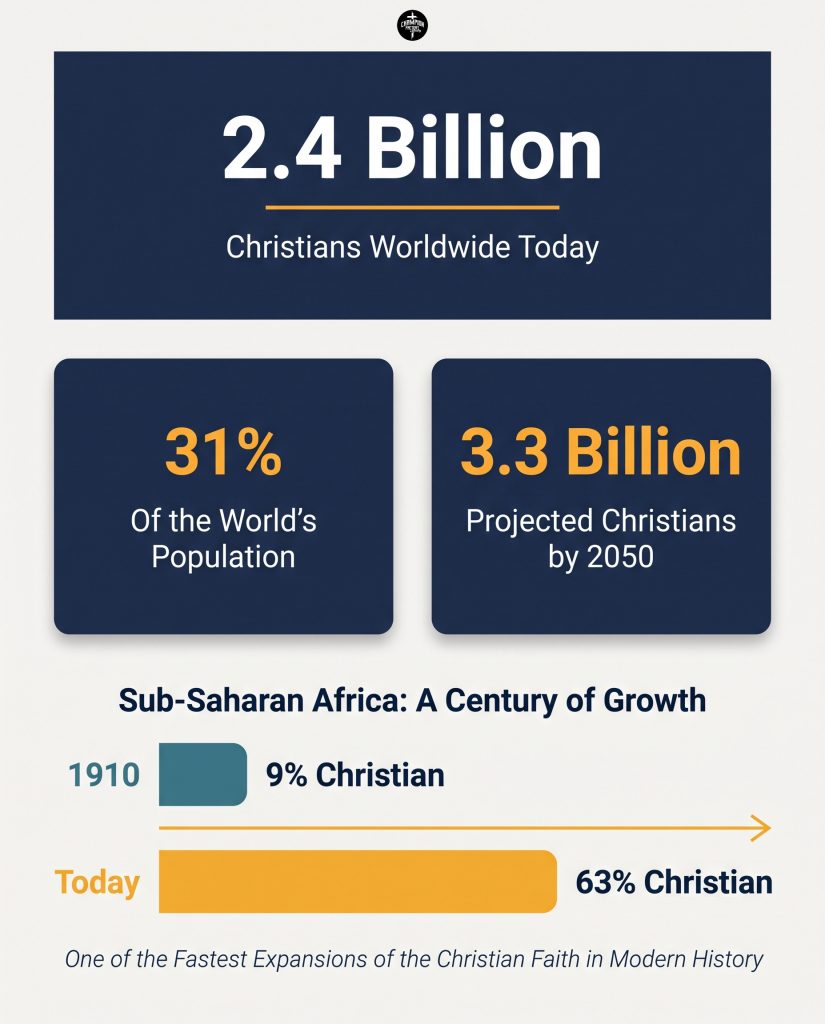
Christianity's origins are more than ancient history. The faith has continued to grow, return to its founding values, and meet people in real circumstances across every generation. Today, approximately 2.4 billion people worldwide identify as Christian, according to the Pew Research Center. Pew projects that number will reach 3.3 billion by 2050. The faith that began in a single city now reaches every country in the world.
Sub-Saharan Africa alone grew from approximately 9 percent Christian in 1910 to 63 percent today, one of the most significant expansions of the faith in modern history. That growth reflects what has always made Christianity compelling: a message that meets people where they are and offers real community.
"The faith has always grown fastest where someone was willing to go and serve. That pattern started in Acts. Our global outreach work is built on the same foundation." - Art Montgomery, Global Evangelism Strategy Architect, Champion Factory Ministry
Jaroslav Pelikan, Sterling Professor of History at Yale University, wrote that "Jesus of Nazareth has been the dominant figure in the history of Western culture for almost twenty centuries." That influence did not come through political force alone. It came through communities of people who lived out the values the early church practiced in Acts 2, feeding the hungry, welcoming the outcast, and caring for those no one else was caring for.
That same call is alive today. Organizations like Champion Factory Ministry carry out the same work the early church began: mentoring those who need guidance, providing food and care to families in need, and walking alongside individuals on the road to restoration. The faith that started with a small group in Jerusalem has always expressed itself through practical love for real people.
Augustine of Hippo, one of the most influential theologians in church history, captured this pull toward faith in his Confessions: "Thou awakest us to delight in Thy praise; for Thou madest us for Thyself, and our heart is restless, until it repose in Thee." That restlessness, and the faith that answers it, began two thousand years ago. It has not stopped.
The Story That Is Still Moving Forward
Christianity began with a teacher from Galilee who healed, taught, died, and rose again. His disciples carried that story into a world that often opposed it. The early church built communities of care, spoke with honesty and courage, and kept their doors open to the people everyone else had turned away.
That founding vision has outlasted every generation since. It holds because it responds to something true about human need: the need for meaning, for community, for hope, and for the assurance that a person's life matters.
If you are exploring the Christian faith for the first time, or returning to it after a long time away, you are entering a story that has been moving for two thousand years and has room for you.
If you want to be part of a community that takes both the faith and the work seriously, learn more about how Champion Factory Ministry serves through mentorship, discipleship, and care for families and individuals in need. You can also explore ways to get involved or support the mission.
FAQ
When Did Christianity Begin?
Christianity began around 30 AD, following the crucifixion and resurrection of Jesus of Nazareth in the region of Judea. The first public gathering of the church took place on the day of Pentecost, when approximately 3,000 people were baptized in Jerusalem following a sermon by the apostle Peter.
Was Jesus a Real Historical Person?
Yes. Multiple non-Christian historical sources confirm the existence of Jesus. Roman historian Tacitus referenced his crucifixion under Pontius Pilate in his Annals, written around 116 AD. Roman governor Pliny the Younger described early Christian communities in a letter to Emperor Trajan around 112 AD. These documents are widely accepted as credible historical records.
How Did Christianity Spread So Quickly?
The faith spread through the missionary work of the apostles and Paul, who established communities across the Roman Empire along trade routes and through the Jewish diaspora network. It also spread through the practical community life of early Christians, who cared for the sick and poor in ways that set them apart from the surrounding culture.
What Did the Early Church Actually Do Together?
According to Acts 2:42-47, the first Christians devoted themselves to learning, shared meals, prayer, and communal worship. They sold property to give to those in need and met together daily. Their community was marked by generosity, practical care, and shared life.
Is Christianity Still Growing Today?
Yes. According to the Pew Research Center, approximately 2.4 billion people identify as Christian today, representing about 31 percent of the global population. Pew projects that number will grow to approximately 3.3 billion by 2050, driven largely by expansion in sub-Saharan Africa, parts of Asia, and Latin America.