





Many people type this question into search and find answers that confuse or trouble them. Some sources point to one person. Others repeat the false and harmful idea that the Jewish people as a whole killed Jesus. Both miss what Scripture actually teaches, and the second one has caused real damage over the centuries.
This article walks through the biblical answer with care. It names the people involved, explains what Scripture says about God's plan, shows why Jesus chose the cross, and clears up a common and damaging misunderstanding. The goal is truth you can trust, explain to others, and hold with hope.
Who Was Responsible for the Death of Jesus
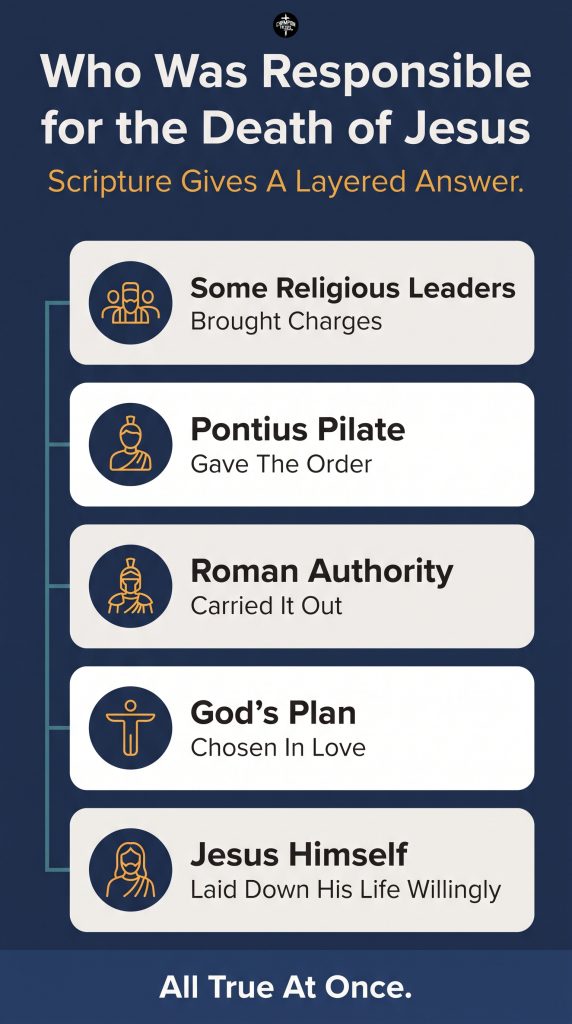
The Bible does not point to a single person. It describes several layers that are all true at once. Some religious leaders brought charges. The Roman governor gave the order. God carried out a plan to rescue people from sin. Jesus laid down his life willingly. And Scripture teaches that his death answered the sin of all people. Together these layers tell the full story.
When people ask who was responsible, they usually want one name. Scripture answers differently. It describes real people who made real choices, and it also lifts the question higher. The death of Jesus happened in a specific time and place. It was also the center of God's plan for the world. Holding both together keeps us from a narrow or harmful answer.
The sections below take each layer in turn.
The People Involved in the Trial and Crucifixion
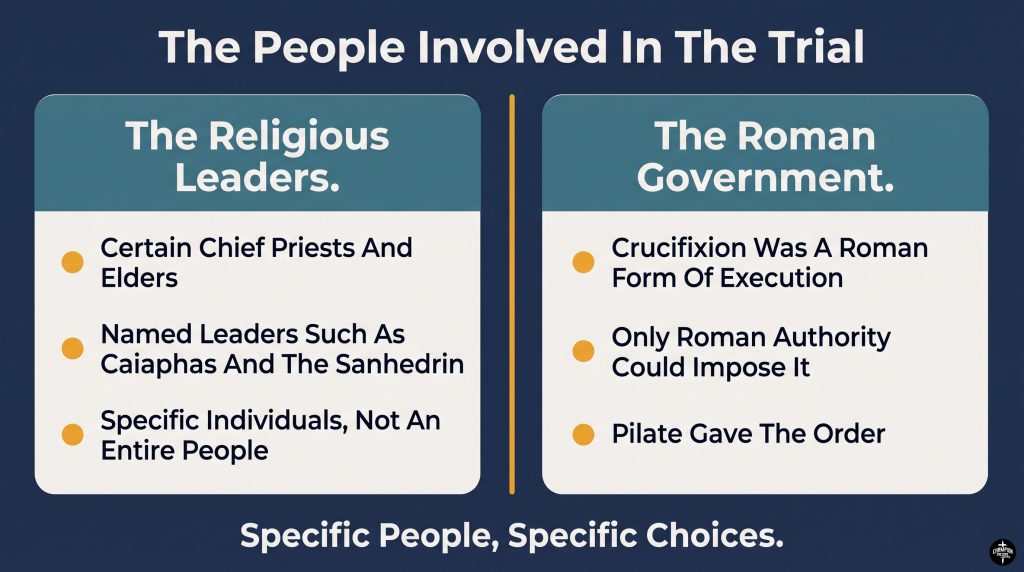
According to the Gospels, several people took part in the events that led to the cross. A group of religious leaders questioned Jesus and brought him to the Roman authorities. The governor, Pontius Pilate, held the power to order an execution, and he did. Roman soldiers carried it out. The Gospels describe specific people and specific choices, not an entire nation.
The Role of the Religious Leaders
The Gospels record that certain chief priests and elders planned to arrest Jesus and have him put to death. Matthew 26:3 to 4 describes this directly. These leaders saw Jesus as a threat to their position and brought charges against him.
It helps to be precise here. The Gospels name particular leaders, such as the high priest Caiaphas, and a council called the Sanhedrin. They do not name an entire people. Jesus was Jewish. His disciples were Jewish. The first members of the early church were Jewish. The events involved specific individuals, not a whole community then or now.
The Role of the Roman Government
Crucifixion was a Roman form of execution, used for those Rome considered political threats and for people without legal protection. Only Roman authority could impose it. Pontius Pilate served as the Roman prefect of Judaea and presided over the final trial. He gave the order for the crucifixion.
Pilate is a real figure of history, not only a name in the Gospels. He is attested by ancient writers and by an inscription found at Caesarea. The Gospels show religious leaders pressing for a death sentence and Pilate, the one man with the power to grant it, giving way. Both the pressure and the final order belong to the historical record.
Did God Plan the Death of Jesus
Scripture teaches that the death of Jesus was not an accident or a defeat. It was part of God's plan to rescue people from sin. The cross was a real human event and also a purpose God chose in love. The Bible holds both truths together without erasing either one.
The clearest example is Peter's words in Acts 2:23. He told a crowd, "This man was handed over to you by God's deliberate plan and foreknowledge, and you, with the help of wicked men, put him to death by nailing him to the cross" (NIV). In one sentence, Peter names both God's plan and human action. Neither cancels the other.
The prophet Isaiah pointed to this long before. Isaiah 53:6 says, "the Lord has laid on him the iniquity of us all" (NIV). The death of Jesus fulfilled what God had promised, for the sake of people who could not save themselves.
Jesus Laid Down His Life Willingly
Jesus said that no one took his life from him. He gave it. This reframes the entire question. The deepest answer is not about who forced the cross on him. It is about why he chose it. He went to the cross on purpose, out of love, to open the way to God.
In John 10:18, Jesus said, "No one takes it from me, but I lay it down of my own accord" (ESV). He was not a helpless victim of events beyond his control. He walked toward the cross knowing what it would cost.
This is why the question of blame only goes so far. The people in the story made their choices. Yet Jesus remained the one acting with the clearest purpose. He chose to give himself for others.
"When children ask me who killed Jesus, I tell them the truer answer is that Jesus chose to give his life for them. That one shift changes how they see the cross." Todd Medina, President & Founder, Champion Factory Ministry
Why the Bible Says Jesus Died for Everyone
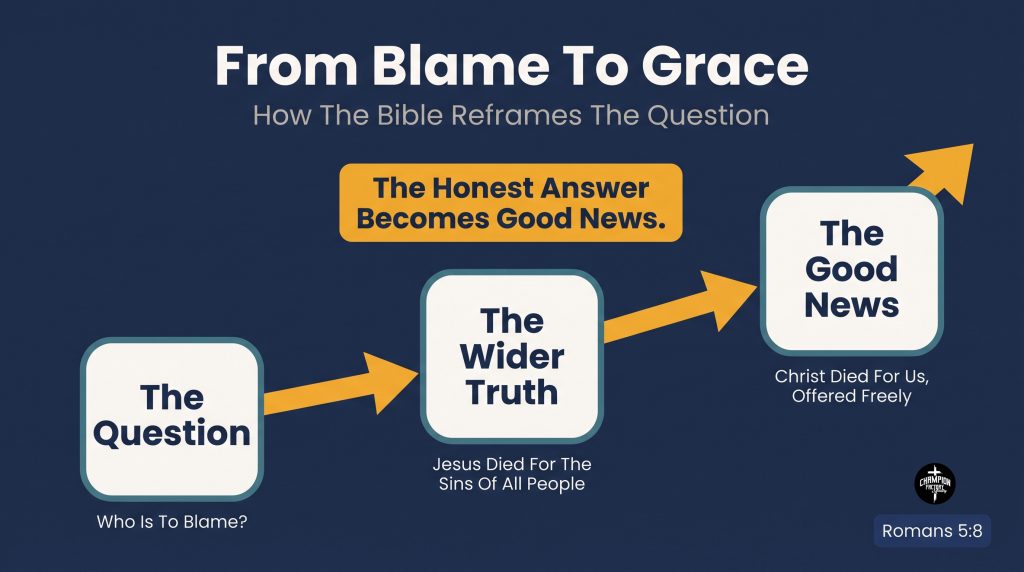
Scripture teaches that Jesus died for the sins of all people. That includes every reader of this page. So the question moves from blame to grace. The Bible does not invite us to find someone to accuse. It invites each person to see their own need and to receive the love God offers through the cross.
Romans 5:8 puts it simply: "While we were still sinners, Christ died for us" (NIV). The point is personal. The cross speaks to your life, not only to events long ago.
This is the heart of the matter. When we understand that Jesus died for all, the search for a single guilty party falls away. The honest answer becomes good news. The cross was for us, offered freely, so that we could be made right with God.
Does the Bible Blame the Jewish People for the Death of Jesus
No. The Bible does not hold the Jewish people as a whole responsible for the death of Jesus, then or now. The events involved specific leaders and Roman authority. Jesus himself was Jewish, along with his first followers. The claim that the Jewish people are collectively guilty is false, and it has caused great harm.
This false charge has been used for centuries to justify hatred and violence. Faithful teaching rejects it. A widely recognized church declaration in 1965, known as Nostra Aetate, stated plainly that the events of the passion cannot be charged against all the Jews living at the time or against the Jews of today. Christians across traditions hold this same view.
Isolated verses have sometimes been pulled out of context to support collective blame. Read carefully and as a whole, Scripture does not teach it. Hatred of any people goes against the teaching of Jesus. Even as he suffered, he prayed, "Father, forgive them, for they don't know what they are doing" (Luke 23:34, NLT). His response was mercy, not accusation.
"We teach this question with care because the answer has been twisted to harm people. A faithful reading guards both the truth and the dignity of every person." Art Montgomery, Global Evangelism Strategy Architect, Champion Factory Ministry
How we read this part of Scripture shapes how we treat people. Faithful teaching protects the dignity of those around us and leaves no room for hatred.
Holding the Truth of the Cross With Hope
The biblical answer to who was responsible for the death of Jesus is layered, honest, and finally hopeful. Specific people acted in real history. God carried out a plan of rescue. Jesus chose to give his life. And his death was for the sins of all people, including you.
If this question has weighed on you, let it lead somewhere good. Read one of the passages above slowly, such as Acts 2:23 or Romans 5:8. Sit with the truth that Jesus chose the cross out of love. If you want to keep growing in faith, our discipleship and spiritual growth resources are a good next step, and you are always welcome to connect with our community.
The cross is not finally about blame. It is about love that went all the way for you.
FAQ
Who actually gave the order to crucify Jesus?
The Roman governor Pontius Pilate gave the order. Under Roman rule, only the governor could impose a death sentence, and crucifixion was a Roman form of execution.
Did Judas cause the death of Jesus?
Judas betrayed Jesus, which set events in motion. Yet Scripture describes many people taking part and points to God's plan and to Jesus choosing to give his life. Judas was one part of a larger story.
Does the Bible say the Jewish people killed Jesus?
No. The Bible describes specific leaders and Roman authority, not an entire people. Jesus and his first followers were Jewish. The idea of collective guilt is false and harmful, and faithful teaching rejects it.
Why does the Bible say Jesus died for us?
Scripture teaches that the death of Jesus addressed the sin of all people. His death opened the way for anyone to be reconciled to God, which is why the Bible frames it as good news rather than only a tragedy.