




Search online for when the Roman Catholic Church began, and the answers vary widely. Some sources say the first century. Others say the 300s. Others point to 590 AD. It can feel like nobody agrees on basic history.
The truth is simpler than it looks. Historians agree on the actual events and dates. What differs is which event each source treats as the real starting point. This article walks through the documented history in order, explains why the disagreement exists, and closes with a short reflection on what this long story can mean for readers today, regardless of which Christian tradition they call home.
What Does The Word Catholic Actually Mean?
The word catholic comes from the Greek word katholikos, meaning universal. It originally described the whole body of Christian believers, not one specific denomination. The Roman Catholic Church later built this word into its formal name, but the word itself is older than any single church structure.
This distinction matters because readers often assume catholic and Roman Catholic mean the exact same thing. They do not. Early Christian writers used the word catholic to describe the unified, worldwide church, long before any of today's denominational lines existed.
The specific phrase Roman Catholic entered English usage later, as a way to describe the church in communion with the bishop of Rome specifically. According to the Oxford Advanced Learner's Dictionary, the term is a translation of the Latin phrase Ecclesia Romana Catholica, and it came into English use in the late 16th century. English speakers outside the Roman Catholic Church, including Anglicans and other Protestants, helped popularize the specific phrase, partly to distinguish themselves while still claiming the word catholic in its universal sense for their own traditions.
So when someone asks whether catholic just means universal, the answer is yes, in its original sense. Whether that universal church and today's Roman Catholic Church are the same thing is where different traditions part ways, and that question sits outside the scope of documented history.
Did Peter And Paul Establish The Church In Rome?
Christian tradition holds that the apostles Peter and Paul both spent time in Rome and helped establish a Christian community there by the middle of the first century AD. The New Testament itself confirms that believers already lived in Rome before Paul ever visited in person.
This is the anchor point almost every source agrees on, regardless of tradition. The apostle Paul wrote to the church in Rome years before he arrived there himself. In his letter, he wrote:
"First, I thank my God through Jesus Christ for all of you, because your faith is being reported all over the world" (Romans 1:8, NIV).
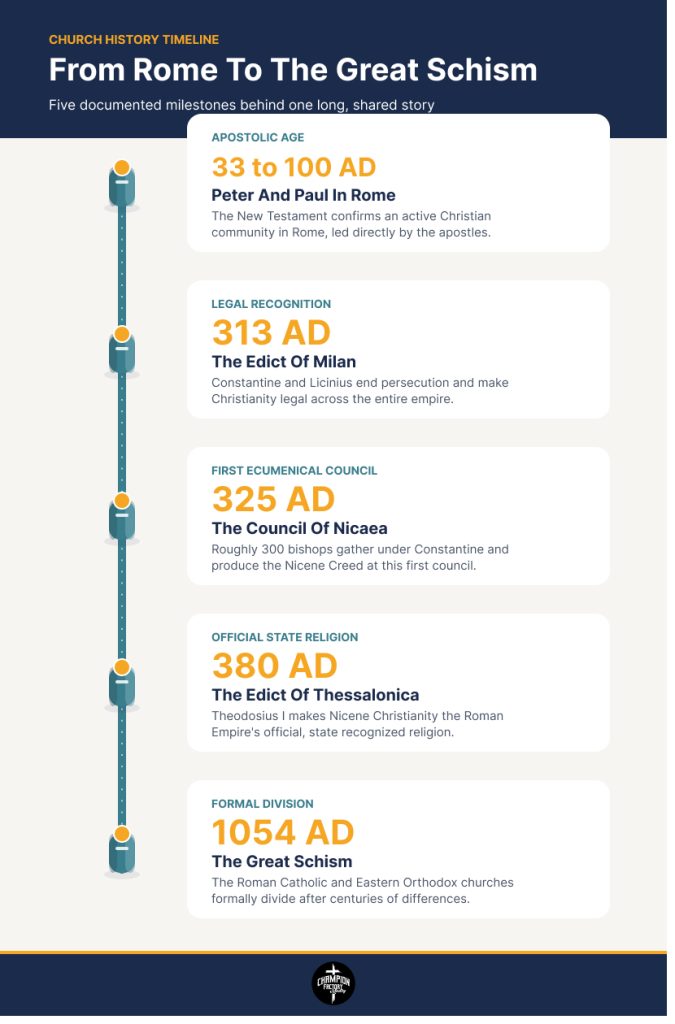
That single verse tells us something historians value highly. A Christian community existed in Rome early enough, and was active enough, that its reputation had already spread by the time Paul wrote to them. This period, roughly 33 to 100 AD, is often called the apostolic age, since the church during this time was led directly by the original apostles and their closest associates.
What The New Testament Confirms
The New Testament does not give a detailed founding narrative for the Roman church the way it does for some other early congregations. What it does confirm is presence, activity, and connection to the wider apostolic mission. As Encyclopaedia Britannica notes, Roman Catholic tradition holds that Peter lived in Rome in the middle of the first century and served as the city's first bishop, a role later traditions built the papacy upon. That belief is central to Catholic teaching. It is presented here as tradition, not as a claim this article is making on the reader's behalf.
When Did Christianity Become Legal In The Roman Empire?
Christianity became legal across the Roman Empire in 313 AD, when Emperor Constantine and his co-emperor Licinius issued the Edict of Milan. This ended roughly two and a half centuries of periodic, sometimes severe persecution and gave Christians the right to worship openly for the first time.
Before 313 AD, Christian communities in Rome and elsewhere often met in private, and practicing the faith openly carried real risk. The Edict of Milan changed that legal reality across the empire, not just in one city or province.
Here is a distinction readers often miss. Legal did not mean official. The Edict of Milan gave Christians freedom to practice their faith without persecution. It did not make Christianity the empire's state religion. That difference becomes important in the next section.
What Happened At The Council Of Nicaea In 325 AD?
In 325 AD, roughly 300 bishops gathered at the invitation of Emperor Constantine for the First Council of Nicaea. This council addressed a serious dispute over the nature of Christ and produced the Nicene Creed, a shared statement of belief still recited in many Christian churches today.
The Council of Nicaea matters for two reasons. First, it was the earliest ecumenical council, meaning a formal gathering of bishops from across the church called to settle a major dispute together, rather than one region or bishop deciding alone. Second, the creed it produced remains one of the few statements of faith shared across Catholic, Orthodox, and many Protestant traditions today, even where those traditions disagree on other matters.
According to a detailed academic summary of the council hosted by California State University, Northridge, 318 bishops met at Nicaea in May and June of 325 AD, at Constantine's direction, to resolve disputes that were destabilizing both the church and the empire. The bishop of Rome did not attend in person and instead sent representatives, a detail that complicates any simple story of Rome single handedly running the early church from the very beginning.
When Did Christianity Become Rome's Official State Religion?
Christianity became the official state religion of the Roman Empire in 380 AD, when Emperor Theodosius I issued the Edict of Thessalonica. This is a distinct milestone from the legal recognition Christianity received in 313 AD, and readers often confuse the two.
The gap between these two dates matters. For nearly seventy years after the Edict of Milan, Christianity was legal but not official. Other religious practices remained present across the empire. The Edict of Thessalonica changed that, establishing Nicene Christianity, the faith affirmed at the Council of Nicaea, as the empire's recognized religion.
According to Wikipedia's overview of Catholic Church history, this shift under Theodosius I gave the church a level of institutional support and influence it had never held before, shaping how bishops, including the bishop of Rome, related to imperial authority for centuries afterward.
When Did The Catholic And Orthodox Churches Formally Split?
The Roman Catholic and Eastern Orthodox churches formally divided in 1054 AD, an event historians call the Great Schism. The split followed centuries of theological, cultural, and political differences between the church centered in Rome and the church centered in Constantinople.
Unlike the earlier milestones, the Great Schism was not a single sudden event. It was the formal recognition of a division that had been building for generations, over questions of authority, church practice, and the relationship between church and empire in the East and West.
This is the clearest dividing line in the entire timeline. Before 1054 AD, the story belongs to Christianity as a whole. After 1054 AD, the story splits into Catholic and Orthodox branches that developed along separate paths, while still sharing the same earlier history described above.
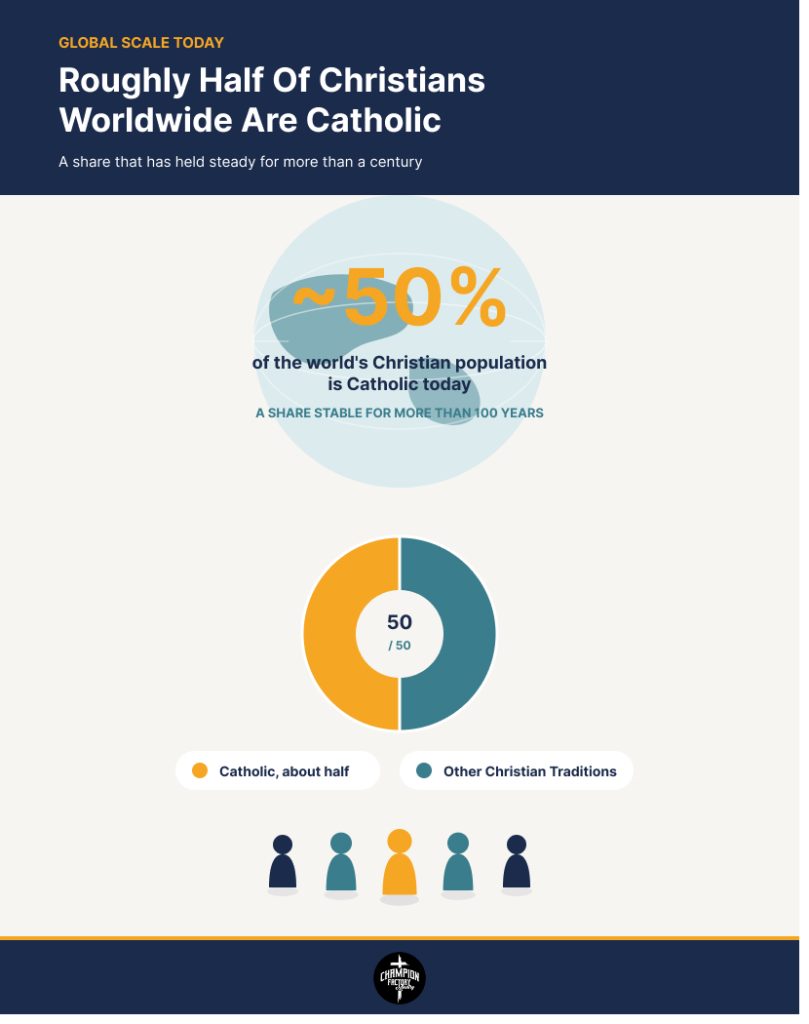
Today, Catholics make up roughly half of the world's Christian population, a share that has stayed fairly consistent for more than a century, according to the Pew Research Center. That scale is part of why this history still matters to so many readers, across many different church backgrounds.
"In evangelism work across many church backgrounds, shared history builds trust faster than debate ever does." Art Montgomery, Global Evangelism Strategy Architect and Board Visionary Luminary
Why Do Different Sources Give Different Founding Dates?
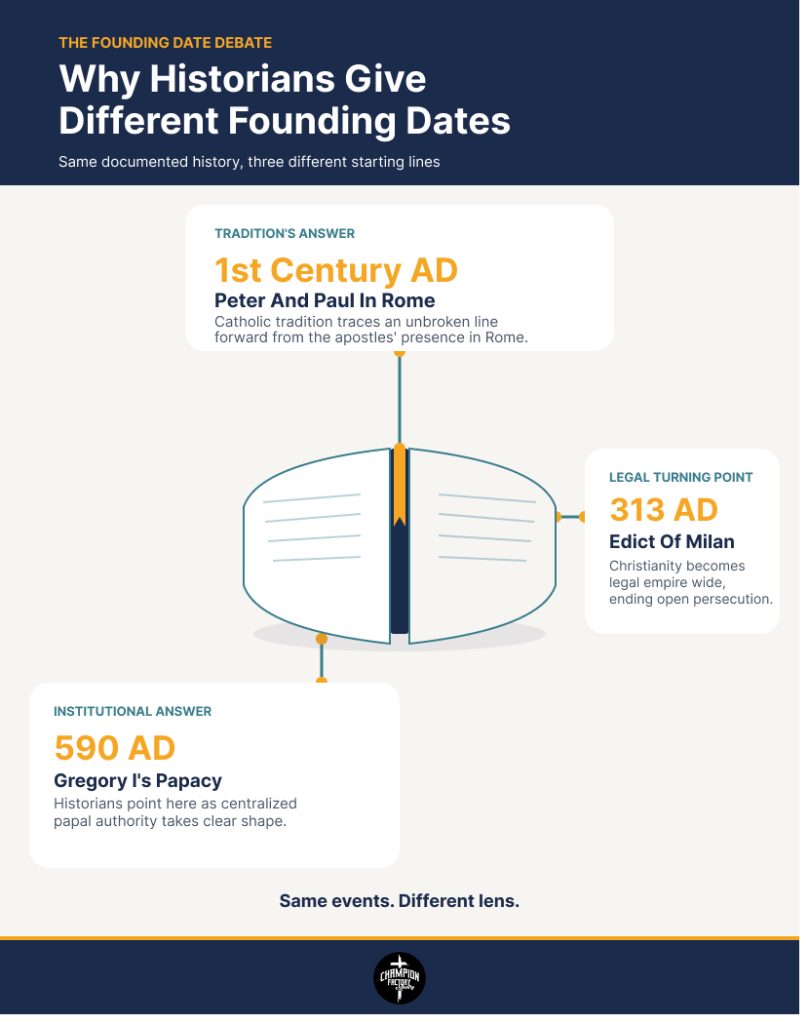
Sources disagree about the Roman Catholic Church's founding date because they are measuring different things. Some point to the first-century community gathered around Peter and Paul. Others point to 313 AD, when Christianity became legal, or to Pope Gregory I's papacy beginning in 590 AD, when historians say the kind of centralized papal authority familiar from the medieval church first took clear shape.
This is the real answer to the question that likely brought a reader to this article. It is not that historians disagree on what happened. The documented timeline above is not seriously contested. What differs is which milestone counts as the beginning.
Catholic tradition emphasizes continuity, tracing an unbroken line from Peter forward. Some historians outside that tradition emphasize institutional development instead, pointing to the point where papal structure and authority took the shape we would recognize today. Historian Mark A. Noll has described the Catholic Church as "the world's oldest continuously functioning international institution," a description that speaks to continuity without settling the separate question of when its specific doctrines and structure fully developed. Historian Dr. Eben De Jager makes a similar point in a piece on the papacy for TheCollector.com, calling it "the longest continually running institution in history."
A Common Misconception
The common misconception is that one of these dates must be objectively correct while the others are wrong. In reality, each date answers a different, legitimate historical question. Even the title of pope developed gradually rather than existing from day one. According to Wikipedia's account of the early bishops of Rome, the bishop of Rome was not contemporaneously called pope until Damasus I, who held the role from 366 to 384 AD.
New Testament scholar Bart Ehrman puts it plainly when he examines this exact question. The answer, he writes, "proves far more complex and nuanced" than a single date can capture, a point worth remembering the next time a headline promises a simple answer.
Finding Common Ground In A Long And Complicated Story
The history here is long, layered, and genuinely shared across Christian traditions, even where those traditions later took different paths. Peter and Paul in Rome, the Edict of Milan, the Council of Nicaea, the Edict of Thessalonica, and the Great Schism are not competing stories. They are chapters in the same story, read differently depending on which chapter a tradition treats as decisive.
For readers who came looking for a simple date, the honest answer is that a few dates matter, each for a different reason. For readers who came wondering why Christians disagree about their own history, the honest answer is that the disagreement is really about definitions, not facts.
Scripture offers a helpful place to land after a story this complicated. Paul wrote to the early church, "There is one body and one Spirit, just as you were called to one hope when you were called. There is one Lord, one faith, one baptism. There is one God and Father of all, who is over all and through all and in all" (Ephesians 4:4 to 6, NIV). That passage was not written to settle later denominational history. It was written to remind a divided, complicated church that unity in Christ runs deeper than institutional disagreement.
"We want the young people in our discipleship program to know the full story of the church, not a version chosen to win an argument." Todd Medina, President and Founder
At Champion Factory Ministry, our Nourish discipleship program exists to help people grow in faith with that same spirit, learning church history and scripture together without needing to resolve every denominational question first. If this history left you curious to keep learning, we would love to have you get involved with our community.
FAQ
Did Jesus start the Catholic Church?
Catholic tradition holds that Jesus commissioned Peter to lead the early church, a belief central to Catholic teaching about the papacy. Most Christian traditions agree Jesus founded the church as a spiritual body, while interpreting Peter's specific role differently. This article does not take a position on that theological question.
What is the difference between catholic and Roman Catholic?
Catholic, from the Greek katholikos, originally meant universal and described the whole body of Christian believers. Roman Catholic became a distinct English phrase in the late 16th century, referring specifically to the church in communion with the bishop of Rome.
What was the Great Schism?
The Great Schism was the formal split between the Roman Catholic and Eastern Orthodox churches in 1054 AD, following centuries of theological, cultural, and political differences between the churches of Rome and Constantinople.
Why do sources give different founding dates for the Roman Catholic Church?
Sources disagree because they are answering different questions. Some point to the apostolic community in first-century Rome. Others point to legal recognition in 313 AD or to the rise of centralized papal authority around 590 AD. The underlying historical events are well documented and not in dispute.