






If you have read Matthew 11:12 and felt a little unsettled, you are not alone. Jesus says the kingdom of heaven suffers violence, and the violent take it by force. For many readers, that phrase raises an honest question. Does this verse describe something troubling?
This article walks through what the verse actually says, why translations word it differently, and what it means for your own faith. You will also see how the setting around John the Baptist shapes the meaning, and what wholehearted pursuit of God can look like in everyday life.
What Does Matthew 11:12 Actually Say
Matthew 11:12 says that from the days of John the Baptist until now, the kingdom of heaven has been forcefully advancing, and violent people are attacking it, or in the older King James wording, the kingdom of heaven suffereth violence, and the violent take it by force. If that phrasing feels jarring, that reaction is reasonable, and the verse deserves a careful explanation.
Jesus said these words while describing John the Baptist's ministry and its impact. The verse is not a stray comment. It sits inside a larger conversation about how people were responding to John's message and to Jesus himself.
This is one verse where reading a single English translation on its own can leave you with more questions than answers. The sections below walk through why that happens, and what the verse means once the pieces come together.
Why Do Bible Translations Word This Verse So Differently
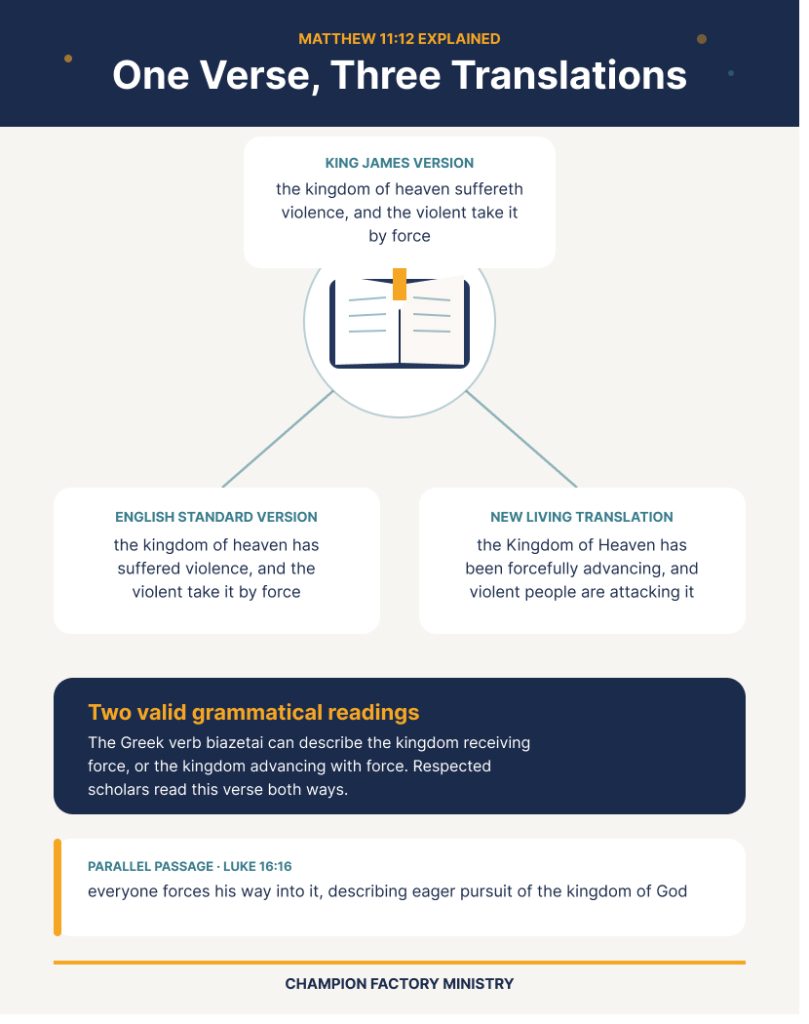
Bible translations differ here because the original Greek verb, biazetai, can be read in two different grammatical ways. One reading treats the kingdom as receiving violence, and the other treats the kingdom as advancing with force. Both are valid translation choices, which is why your Bible may sound different from a friend's.
This single Greek word carries the weight of the verse. Depending on how a translation team reads it, the kingdom of heaven is either something under attack or something moving forward with strength and momentum.
You can see the difference clearly across major translations:
- King James Version: the kingdom of heaven suffereth violence, and the violent take it by force
- English Standard Version: the kingdom of heaven has suffered violence, and the violent take it by force
- New Living Translation: the Kingdom of Heaven has been forcefully advancing, and violent people are attacking it
Scholars such as Robert H. Mounce and A. Jones read this verse in different, equally reasonable ways. Mounce reads it as the kingdom facing opposition from those around it. Jones reads it as the kingdom advancing through determined effort. Neither reading is a mistake. This is a place where the original language allows more than one faithful translation.
How Luke 16:16 Helps Make Sense of the Verse
Luke 16:16 records a similar saying from Jesus, and reading it next to Matthew 11:12 brings helpful clarity. Luke's version says everyone forces his way into it, describing eager, determined people entering the kingdom of God rather than the kingdom being overtaken by force.
Luke 16:16, in the English Standard Version, reads:
"The Law and the Prophets were until John. Since then the good news of the kingdom of God is preached, and everyone forces his way into it."
Because Matthew 11:12 and Luke 16:16 come from the same period of Jesus' teaching, comparing them side by side is one of the most reliable ways to understand the harder verse in Matthew. Luke's wording leans toward eager, wholehearted response rather than opposition or attack.
The Setting Behind Jesus' Words About John the Baptist
Jesus spoke these words while John the Baptist was in prison, arrested by Herod Antipas for confronting him over his conduct. This setting matters because it shows Jesus describing a season of real tension and urgency, not offering a general command about how people should treat one another.
The historian Josephus, writing in the first century, independently confirms that Herod Antipas imprisoned John the Baptist, a detail that lines up with the Gospel accounts. This backdrop helps explain the intensity in Jesus' words. He was describing a moment when crowds were responding to John and to Him with real urgency, while opposition to that message was also building.
This context helps readers hold the verse as a description of a specific, charged moment, rather than a timeless instruction to act with force toward others.
Does This Verse Call Believers to Be Aggressive or Forceful With Others
No. Matthew 11:12 does not call anyone to be aggressive, coercive, or violent toward another person. It describes wholehearted determination in pursuing God, not permission to pressure or force faith onto someone else.
This distinction matters. The words violence and force can carry real weight for readers who have lived through actual harm. If that describes you, your reaction to this language is valid, and this verse was never meant to minimize what those words can mean in real life.
The novelist Flannery O'Connor, who named her novel after the King James wording of this verse, described its violence as the intensity of love that gives more than what is required, not aggression toward others. That reading fits with the rest of Jesus' ministry, which consistently pointed toward mercy, patience, and invitation rather than force used against people.
"Every outreach approach we build starts with invitation, not pressure. When someone misreads a verse like this as license to push a message on another person, it works against the heart of the gospel." Art Montgomery, Global Evangelism Strategy Architect & Board Visionary Luminary
"If the word violence brings up something painful for you, that reaction deserves care, not correction. We would rather point you toward support than rush past it." Todd Medina, President & Founder
If language about violence or force ever feels heavy because of something you have lived through, that reaction makes sense. Talking with a counselor, pastor, or trusted support person is a healthy and wise step. This article, and Champion Factory Ministry itself, cannot replace that kind of professional care.
What Wholehearted Pursuit of God Can Look Like Today
Taking the kingdom by force, understood rightly, means bringing real determination to your faith. It looks like consistent prayer, honest seeking, and steady effort, not aggression toward anyone else. Jesus described this same heart in gentler language elsewhere, inviting people to ask, seek, and knock.
Matthew 7:7 to 8, in the New International Version, says:
"Ask and it will be given to you. Seek and you will find. Knock and the door will be opened to you. For everyone who asks receives, the one who seeks finds, and to the one who knocks, the door will be opened."
Jeremiah 29:13 adds a similar promise: "You will seek me and find me when you seek me with all your heart."
Practical Steps for Pursuing God Wholeheartedly
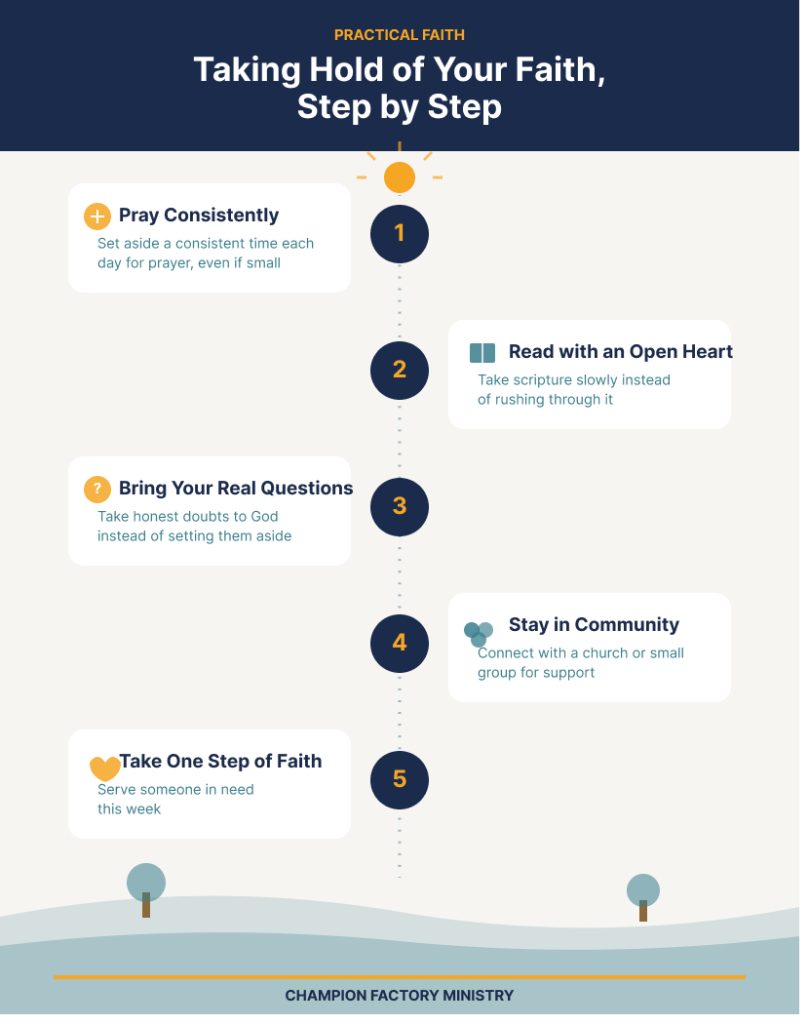
- Set aside a consistent time each day for prayer, even if it starts small
- Read scripture with an open, honest heart, rather than rushing through it
- Bring your real questions and doubts to God instead of setting them aside
- Stay connected to a church community or small group for support and accountability
- Take one practical step of faith this week, such as serving someone in need
"We see this in Nourish. Growth rarely comes from one big moment. It comes from showing up in prayer and scripture, day after day, alongside other people doing the same." Todd Medina, President & Founder
This kind of steady, wholehearted pursuit is exactly what Champion Factory Ministry's Nourish discipleship groups are built to support, walking with people step by step as they grow in their faith.
A recent Pew Research study found that four in ten American adults say they have grown more spiritual over their lifetime. If you feel that same pull toward deeper faith, Matthew 11:12 offers encouragement rather than confusion. It invites determined, wholehearted pursuit of God, the kind available to anyone willing to seek Him.
Taking Hold of Your Faith One Step at a Time
Matthew 11:12 is not a call to aggression. It is a picture of wholehearted, determined pursuit of God, offered during a real and specific moment in Jesus' ministry. Once you see the translation differences, the parallel passage in Luke, and the historical setting, the verse becomes an invitation rather than a source of confusion.
If you want support taking your next step in faith, Champion Factory Ministry would welcome the chance to walk alongside you. You can connect with our team to learn more about discipleship, community, and practical next steps.

FAQ
Does Matthew 11:12 Mean Christians Should Use Force or Violence
No. The verse describes wholehearted pursuit of God, not aggression or force used against other people.
Why Do KJV and NLT Translate Matthew 11:12 Differently
The original Greek verb can be read in two grammatically valid ways, so translation teams make different but reasonable choices.
Is Luke 16:16 the Same Verse as Matthew 11:12
They are parallel sayings from the same period of Jesus' ministry, and reading them together helps clarify the meaning.
Who Was John the Baptist, and Why Does His Imprisonment Matter Here
John the Baptist was a prophet who prepared the way for Jesus. He was imprisoned by Herod Antipas, and Jesus spoke these words during that tense, urgent season.