






Many donors want to give wisely, but they are not always sure what a nonprofit is required to show them or why some organizations choose to share more than the law demands. Without clear answers, giving can feel like a guess instead of a partnership built on trust.

This article explains what financial transparency actually means, what we publish and why, and what Scripture says about handling money entrusted to us. By the end, we hope you feel informed and invited into a relationship built on openness.
What Financial Transparency Actually Means
Financial transparency means a nonprofit makes its income, expenses, and spending decisions easy to see and understand, not hidden behind vague language. For us, that means our tax filings, annual reports, and spending categories are available for anyone to review without needing to ask twice.
Real transparency includes more than a single document. It usually covers:
- Our most recent IRS Form 990, the annual information return most nonprofits file
- An annual report summarizing income, expenses, and program outcomes
- A breakdown of spending across programs, administration, and fundraising
- Board review and approval of major financial decisions
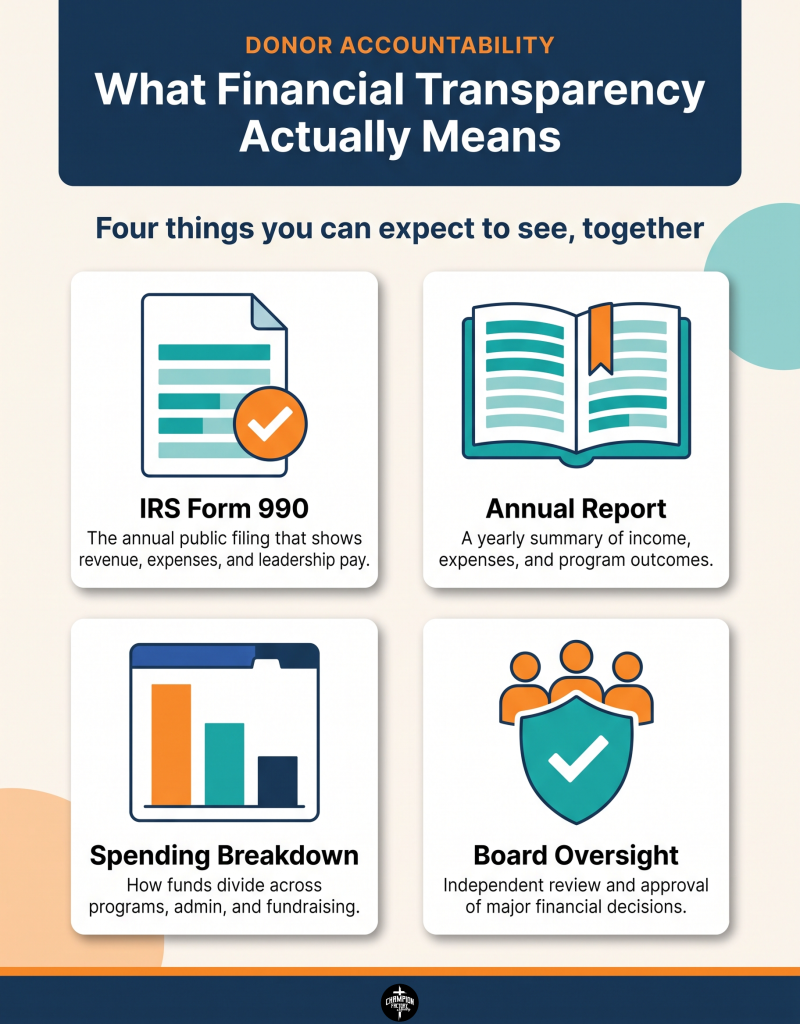
When these pieces are available together, a donor can see the full picture rather than a single number pulled out of context.
Why We Publish More Than the Law Requires
Federal law only requires a nonprofit to share its three most recent Form 990 filings when someone specifically asks for them, under Section 6104 of the Internal Revenue Code. We choose to publish this information on our own, without waiting to be asked, because openness should be our starting point, not something you have to request.
We understand why some donors hesitate before giving. Research from the BBB Wise Giving Alliance has found that even though most donors say trust matters to them, only a small share report a high level of trust in charities overall. At the same time, the alliance's most recent donor trust research shows donors are more open to giving today than they have been in years. We see that openness as an invitation, and we want to meet it with honesty.
"Our board reviews every major financial decision before it becomes part of a public report. That oversight helps our stewardship match what we say we believe."
Art Montgomery, Global Evangelism Strategy Architect & Board Visionary Luminary
What You Can See When You Ask
We make our core financial documents available to anyone who wants to review them, including our annual report and current tax filing. We would rather answer a question before it is asked than leave a supporter guessing.
If you want to look deeper into how we manage and report our finances, you can:
- Review our published annual report and financial summary.
- Reach out through our contact page with any specific question about our finances or governance.
- Ask about our board's role in reviewing budgets and approving major spending decisions.
We would rather have this conversation directly with you than let a question go unanswered.
Why Transparency Is a Matter of Faith
For us, financial transparency is a matter of conscience before God. Scripture calls those who manage others' resources to be honest before both God and people.
A Biblical Perspective on Stewardship
Paul wrote about the collection he was overseeing for the Jerusalem church with this conviction: "We want to avoid any criticism of the way we administer this liberal gift. For we are taking pains to do what is right, not only in the eyes of the Lord but also in the eyes of man" (2 Corinthians 8:20 to 21, NIV).
That same principle shapes how we think about your gifts. Jesus also taught that faithfulness with small, practical things reflects a deeper trustworthiness, tying honest handling of money to the kind of trust that matters far beyond finances (Luke 16:10 to 11). Publishing our financials is one small, practical way we try to live that out.
"Every gift someone gives us belongs first to God, and then to the mission. We do not take that lightly. Publishing our financials is one way we try to honor both."
Todd Medina, President & Founder
How to Evaluate Any Ministry You Support
Wise giving is not only about trusting one organization. It is a skill you can apply anywhere you give. Independent groups such as the BBB Wise Giving Alliance and the Evangelical Council for Financial Accountability have each set standards that help donors ask better questions.
Before you give to any nonprofit, faith based or otherwise, consider asking:
- Does the organization publish its Form 990 or make it easy to request?
- Does an independent board review and approve the budget?
- Can the organization explain, in plain language, how a gift is used?
- Is the organization willing to answer direct questions about its finances?
These are the same questions we welcome you to ask us. The BBB Wise Giving Alliance's standards cover governance, finances, and honest communication, and groups like ECFA hold Christian ministries to standards drawn from Scripture. Reputable organizations should not need convincing to be measured against them.
Where Your Gift Actually Goes
Your gift supports CFM's core work, including mentorship and spiritual guidance, food and essential care outreach, support for children and families, rescue and recovery support, and discipleship through our Nourish program. We describe this work in general terms to protect the dignity and privacy of the people we serve.

We do not share identifying details or specific stories tied to individuals in our care, especially those connected to our rescue and recovery support. This is a deliberate choice to honor the people we serve, not a gap in our transparency. You can see how these program areas fit together on our programs page and read about specific giving priorities on our causes page.
If you or someone you know is facing a crisis related to abuse, exploitation, or unsafe circumstances, please also reach out to local professional and community support services. Our ministry works alongside that kind of help. It is not a replacement for it.
A Standing Invitation: Ask Us Anything, Anytime
At Champion Factory Ministry, financial transparency is not a once a year task. It is an ongoing commitment to treat you, our donors and partners, with the same honesty and dignity we extend to everyone we serve. We publish our financials because we want your trust to rest on real information, not on our word alone.
"We want every gift, and every giver, treated with the same care we show the families and individuals in our programs."
Todd Medina, President & Founder
If you have a question about our finances, our governance, or how a specific gift is used, we would love to hear from you. You can explore our current impact and get involved pages, or give with confidence knowing exactly what that gift will help support.
FAQ
Where Can I Find CFM's Financial Statements?
Our annual report and current financial summary are available for review, and we are glad to answer specific questions directly.
Is CFM a Registered Nonprofit?
Yes. We operate as a tax exempt 501(c)(3) organization, which means our finances are subject to public disclosure requirements under federal law.
How Much of My Donation Goes Toward Programs Versus Overhead?
We break down our spending into program, administrative, and fundraising categories in our annual report so you can see this clearly rather than guessing.
Can I Ask CFM Specific Questions About How a Gift Was Used?
Yes. We welcome direct questions through our contact page and see this as part of our ongoing accountability to you.