





You may have opened a Catholic or Orthodox Bible and found books your own Bible lacks. Tobit, Judith, and Sirach can feel unfamiliar. You may wonder which view is right and how to talk about it kindly.
This article describes how each major tradition treats these books, and why. It does not rule on which canon is correct. Pew Research Center estimates from 2010 show that about half of Christians worldwide are Catholic, 37 percent are Protestant, and 12 percent are Orthodox. Readers from all three groups meet this question. You will also find simple steps for studying together.
What Is the Apocrypha, and Why Do Bibles Differ?
The Apocrypha is a group of Jewish writings, mostly from the centuries before Jesus, that appear in some Christian Old Testaments but not in the Hebrew Bible. Protestants call them the Apocrypha. Catholics and some Orthodox writers call them deuterocanonical, meaning second canon. The name a person uses often signals the view that person holds.
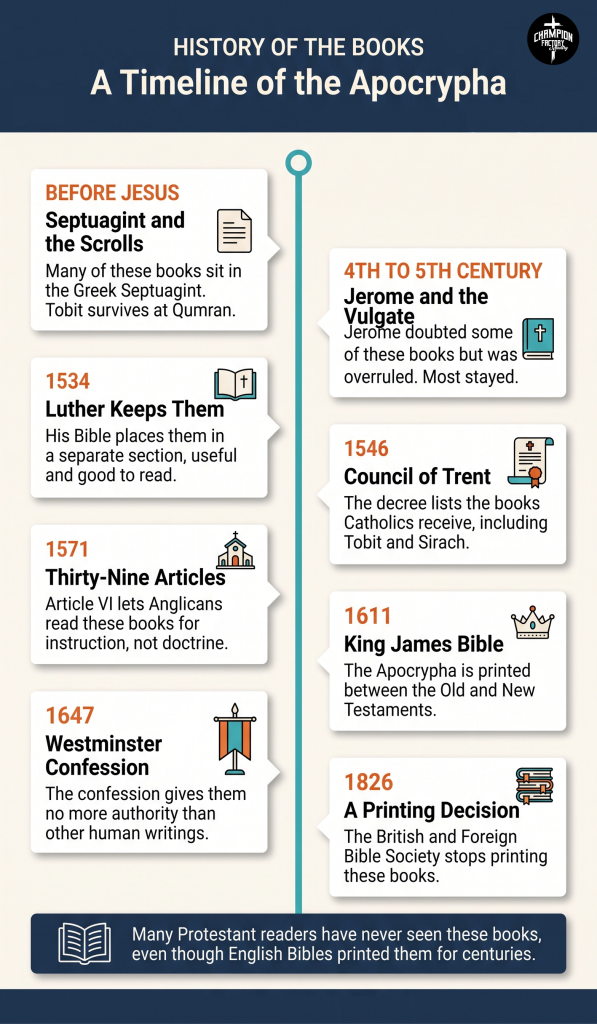
Many of these books appear in the Septuagint, an early Greek translation of the Hebrew Scriptures. Jerome, who produced the Latin Vulgate, doubted some of them. Britannica reports that he was overruled and most stayed in the Vulgate. So the disagreement is older than the Reformation. Orthodox writers often use the Greek term anagignoskomena, which means things worthy to be read.
"Churches have held different views on these books for centuries. Start by learning your own tradition's view, then listen to someone else's." Art Montgomery, Global Evangelism Strategy Architect & Board Visionary Luminary
What the Dead Sea Scrolls Show
The Israel Antiquities Authority notes that Tobit survives in both Aramaic and Hebrew among the scrolls found near Qumran. That shows at least one of these books circulated among Jewish readers before Jesus. It does not settle which books belong in a Bible.
How Do Catholic and Orthodox Christians View These Books?
Catholic and Orthodox Christians receive these books as part of the Old Testament, but their lists differ. The Council of Trent listed the Catholic books in 1546. Many Orthodox Bibles add more, such as 1 Esdras, 3 Maccabees, and Psalm 151. Orthodox practice also varies from one church to another.
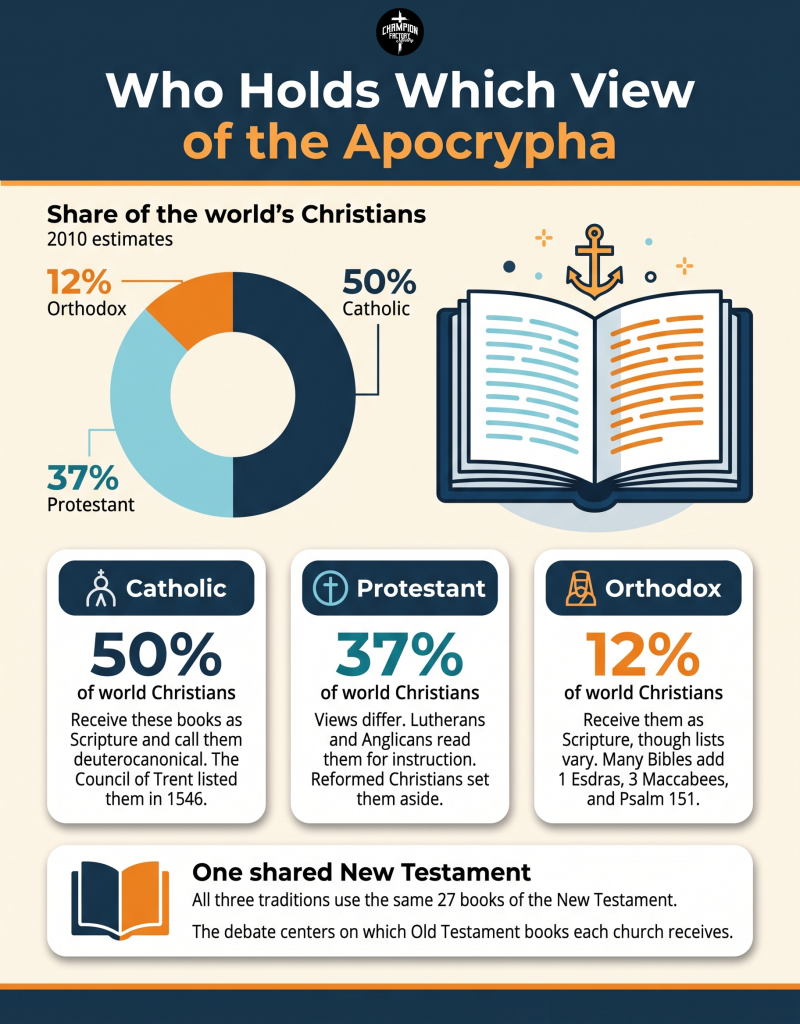
In its 1546 decree, the Council of Trent named Tobias, Judith, Wisdom, Ecclesiasticus, Baruch, and two books of Machabees. Tobias is Tobit, and Ecclesiasticus is Sirach. Many Orthodox Bibles add 1 Esdras, 3 Maccabees, the Prayer of Manasseh, and Psalm 151. Britannica notes that some Russian Orthodox theologians in the nineteenth century agreed to exclude these works.
How Do Lutheran, Anglican, and Reformed Christians View the Apocrypha?
Protestant views differ. Lutherans and Anglicans treat these books as useful for instruction but not equal to Scripture, and both traditions have included readings from them in worship. Reformed Protestants generally set them aside. None of these traditions uses them to set doctrine.
Some readers assume the Reformers discarded these books. Luther kept them. His 1534 Bible placed them in a separate section and called them useful and good to read, though not equal to Holy Scripture. Article VI of the Thirty-Nine Articles lets Anglicans read them for examples of life and moral instruction but not to establish doctrine. The Westminster Confession of 1647 gave them no more authority than other human writings.
| Tradition | Status | Typical Use |
|---|---|---|
| Catholic | Received as Scripture | Part of the Old Testament |
| Orthodox | Received, lists vary | Part of the Old Testament in many Bibles |
| Lutheran and Anglican | Useful, not equal to Scripture | Read for instruction, not doctrine |
| Reformed | Set aside | Not read as Scripture |
How Can Christians From Different Traditions Study Together?
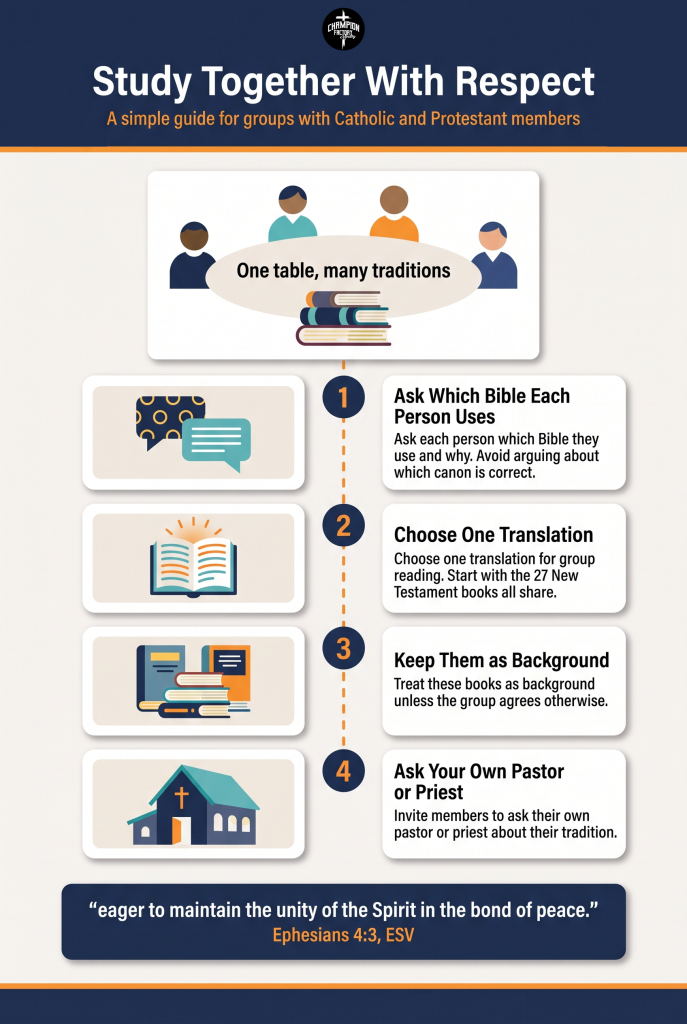
Christians from different traditions can study together by naming each tradition's view fairly, agreeing on a shared text, and focusing on the New Testament they hold in common. Start with listening. Ask each person how their church uses these books. Avoid arguing about which canon is correct.
All of these traditions use the same 27 books of the New Testament. Paul wrote to believers in one body, urging them to be "eager to maintain the unity of the Spirit in the bond of peace" (Ephesians 4:3, ESV). Paul was not addressing the canon. His call to peace still shapes how we talk. He also urged believers to "test everything that is said. Hold on to what is good" (1 Thessalonians 5:21, NLT). Apply that advice to everything you read, including this article.
"Discipleship helps people love Scripture and love one another. Different church traditions can read the same New Testament together with respect." Todd Medina, President & Founder
Practical Steps
- Ask each person which Bible they use and why.
- Choose one translation for group reading.
- Treat these books as background unless the group agrees otherwise.
- Invite members to ask their own pastor or priest about their tradition.
Keeping Unity While Reading Scripture Carefully
Christians differ on these books, yet they share one Lord, one New Testament, and a call to peace. Learn your own tradition's view, listen to others with care, and test what you read. A calm, informed conversation serves people better than a debate.
This week, ask someone from another tradition how their church uses these books, and listen first. Pray for patience and open ears. At Champion Factory Ministry, we believe Scripture leads people to Christ and to love for one another. If you want to grow in Scripture with others, explore Nourish discipleship or mentorship. Church partners can learn about partnering with us.
FAQ
Was the Apocrypha in the Original King James Bible?
Yes. The 1611 King James Bible printed these books between the Old and New Testaments. In 1826, the British and Foreign Bible Society decided to stop printing them.
Do These Books Change What Christians Believe About Jesus?
Not at the core. These traditions confess Jesus from the same New Testament. The debate centers on which Old Testament books each church receives.