






Many people first hear the phrase "God is sovereign" during a difficult moment. A diagnosis comes back wrong. A relationship falls apart. A situation unfolds that no one planned for. Someone says those three words and means them as comfort, but for many people, the phrase lands without a clear meaning attached to it.
This article explains what the Bible actually teaches about God's sovereignty. It covers what the word means, what the Scriptures say, and how this truth connects to real life, including the hard parts. If you have ever wondered whether God is really in control, or whether that control extends to your specific situation, this is a starting point for understanding one of the most important truths in the Christian faith.
What Does It Mean That God Is Sovereign?
God's sovereignty means he holds supreme authority over all of creation. He has the power to do whatever he chooses within his nature, and nothing in the universe happens outside of his knowledge or ultimate control. This is a statement about who God is: the King of kings, the Lord of lords, and the one whose purposes cannot be stopped.
The word sovereign does not appear the same way in every Bible translation. The NIV uses it nearly 300 times in the Old Testament. The ESV uses it only three times, often translating the same Hebrew word simply as "Lord." That difference points to something important. Sovereignty is a theme woven throughout the entire Bible through the names, titles, and actions of God, not a term that appears in a single place.
One of God's most common names in the Hebrew Old Testament is Adonai, which means Lord or Master. It carries the idea of relational authority, not just distant power. The name Yahweh, which appears thousands of times and is translated as Lord in most English Bibles, points to God's eternal self-existence and his covenant commitment to his people. These names say something a dictionary definition cannot fully capture. God's sovereignty is personal. He is the Father who rules creation, not simply a force running it.
A definition that holds up across Scripture: God is sovereign means he is in complete authority over all things, personally aware of every life, and nothing that happens is outside his reach or his ultimate purpose.
What the Bible Actually Says About God's Sovereignty
The Bible does not have one single verse that says "God is sovereign" in those exact words. Instead, sovereignty shows up in what God says about himself, in how he acts throughout history, and in the testimony of people who encountered him in the middle of loss and uncertainty. The passages below are some of the clearest statements in Scripture.
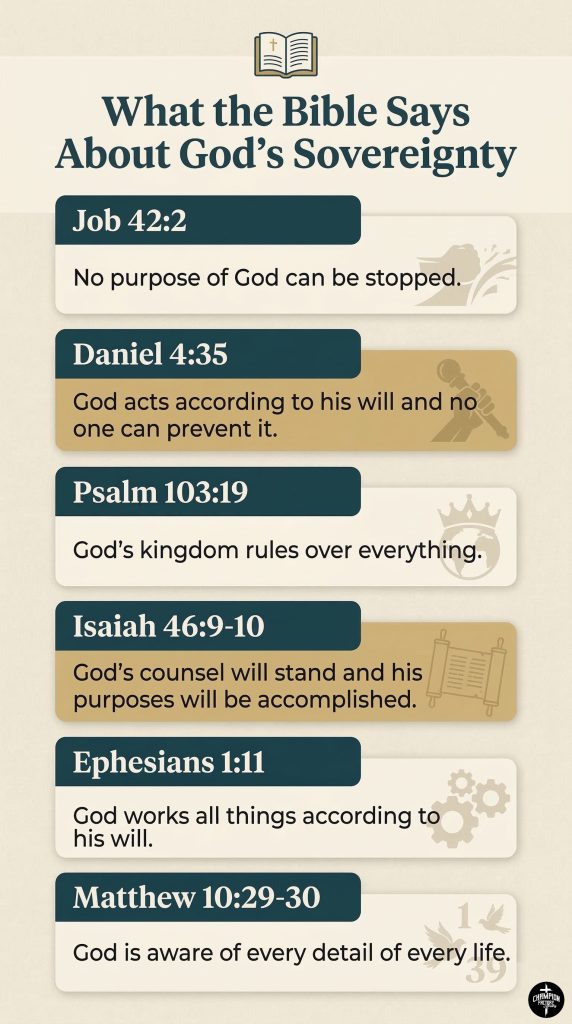
Job 42:2
Job lost nearly everything. His children died. His health failed. His friends offered bad theology in the middle of his grief. At the end of the book, after God speaks directly to him, Job responds: "I know that you can do all things, and that no purpose of yours can be thwarted." This is one of the most direct statements of sovereignty in the entire Bible. It did not come from a comfortable place. It came from someone who had suffered deeply and still found God's authority to be unbroken.
Daniel 4:35
King Nebuchadnezzar was one of the most influential rulers in the ancient world. After a humbling encounter with God, he declared that God "does according to his will among the host of heaven and among the inhabitants of the earth, and none can stay his hand." This acknowledgment from an unlikely source shows that sovereignty is not limited to the experience of believers. It is a reality that even those who opposed God were eventually brought to recognize.
Isaiah 46:9 to 10
God speaks directly in this passage: "I am God, and there is no other... my counsel shall stand, and I will accomplish all my purpose." The framing here is important. God connects his sovereignty to his character, not just his power. His purposes stand because he is faithful and consistent, not simply because he is strong.
Ephesians 1:11
Paul describes God as the one who "works all things according to the counsel of his will." Scholars at Crossway note that this verse is one of the most comprehensive statements of sovereignty in the New Testament. It covers all things, not just the outcomes that feel good.
Psalm 103:19
"The Lord has established his throne in heaven, and his kingdom rules over all." This verse is short and clear. It places God's authority over everything, not just religious life or spiritual matters.
Matthew 10:29 to 30
Jesus tells his disciples that not a single sparrow falls to the ground outside the Father's awareness, and that the hairs of every person's head are counted. This is sovereignty described in its most intimate form. The one who governs the universe also knows the specific details of each person's life.
God's Sovereignty Does Not Mean He Causes Every Bad Thing
God being sovereign does not mean he directly causes suffering, evil, or harm. The Bible makes a consistent distinction between what God causes and what he permits. Misunderstanding this point creates real spiritual harm. It leads people to blame God for acts of violence, abuse, or loss in ways that Scripture does not support.
Theologians across different Christian traditions agree on this basic point. God is sovereign over all things. He is also not the author of evil. These two truths coexist in Scripture without contradiction.
The book of James is direct: God does not tempt anyone with evil and is not tempted by it himself (James 1:13). The suffering people experience in this world flows from living in a broken world shaped by human choices, sin, and the reality of evil, not from God acting against his children.
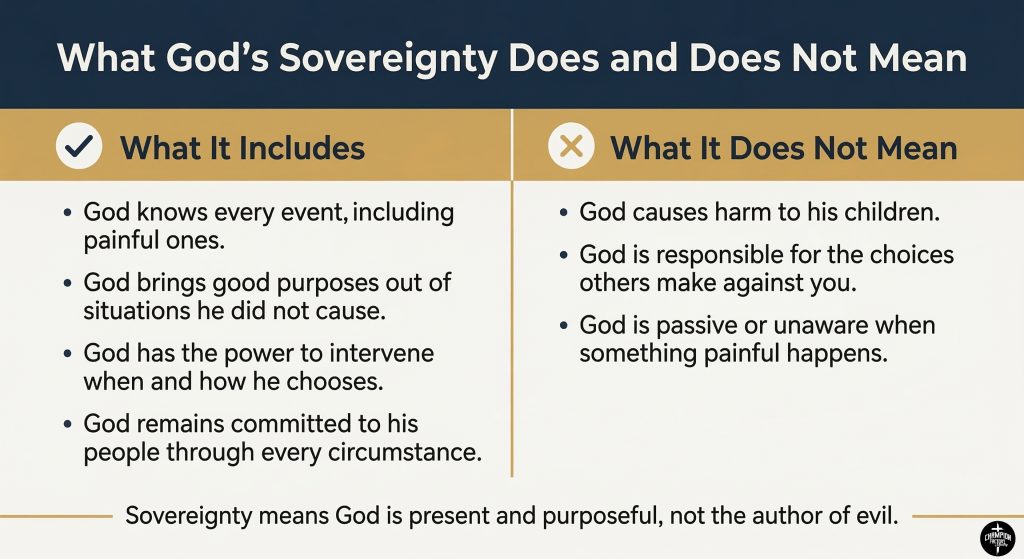
What Sovereignty Does Include
- God's knowledge of every event, including painful ones
- God's authority to bring good purposes out of situations he did not cause
- God's power to intervene when and how he chooses
- God's commitment to his people through every circumstance
What Sovereignty Does Not Include
- God causing harm to his children as a form of punishment or correction
- God being responsible for the choices people make against others
- God being passive or unaware when something painful occurs
This distinction matters deeply for anyone who has experienced harm, loss, or injustice. God's sovereignty means he is present in those moments and his purposes are not defeated by them. It does not mean he authored them.
Sovereignty and Free Will: How Both Can Be True
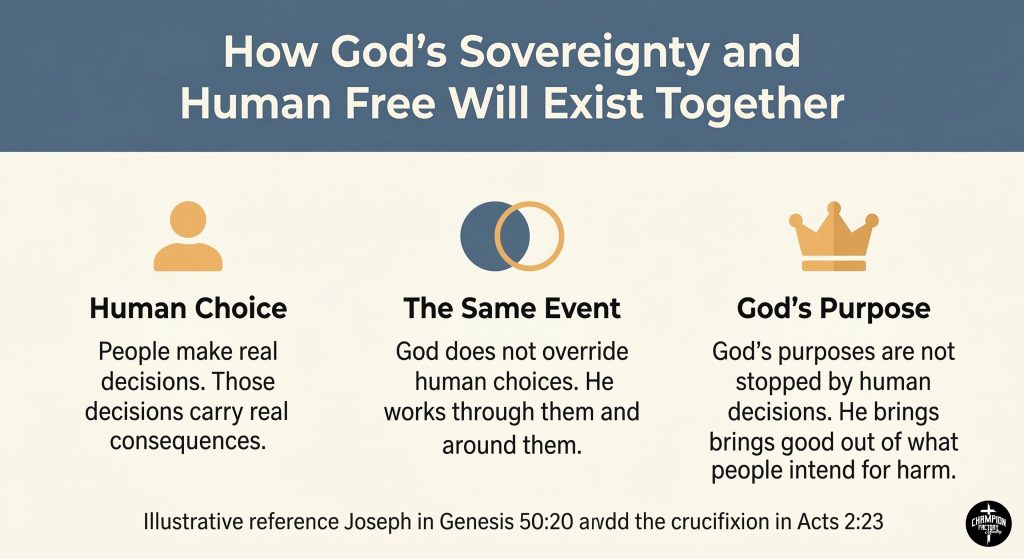
The Bible affirms both God's sovereignty and human responsibility. People make real choices. Those choices carry real consequences. At the same time, God's purposes are not stopped by human decisions. These two realities exist together in Scripture, and they are not opposites.
This question has occupied Christian thinkers since at least the 4th century, when Augustine first framed the tension formally. The Calvinist and Arminian traditions represent different ways of holding these two truths together, and thoughtful believers across both traditions affirm that God is sovereign and that human choices are genuine.
One of the clearest biblical examples is Acts 2:23. Peter describes the crucifixion of Jesus as both the predetermined plan of God and an act carried out by wicked men. God did not override human choices. He worked through them. Human responsibility and divine sovereignty occupied the same event.
Joseph's story in Genesis offers another clear example. His brothers sold him into slavery out of jealousy and cruelty. Years later, Joseph tells them: "You meant evil against me, but God meant it for good" (Genesis 50:20). The same event carried two different intentions. Human wrongdoing did not cancel God's purposes. God brought restoration out of genuine harm.
These examples do not resolve every theological question about predestination or free will. They do show that Scripture holds both truths without collapsing one into the other.
Finding Comfort in God's Sovereignty During Hard Seasons
God's sovereignty is not a doctrine designed to silence grief or dismiss pain. It is the truth that makes genuine hope possible. Knowing that God holds authority over every circumstance, including the ones that feel most broken, gives believers a place to stand when everything else is shifting.
Charles Spurgeon, the 19th century pastor known for both precision and warmth, described divine sovereignty as the most comforting truth a Christian can hold. He wrote that it sustains people through their most severe troubles, because it means their suffering is not outside God's reach and will not be wasted.
"The sovereignty of God is the one impregnable rock to which the suffering human heart must cling. The circumstances surrounding our lives are not accident: they may be the work of evil, but the evil is held firmly within the mighty hand of our sovereign God." — Amy Carmichael, missionary and author, quoted in Jerry Bridges, Trusting God
Jerry Bridges, in his book Trusting God Even When Life Hurts, adds that what sets believers apart in suffering is the confidence that their pain is held within the care of a God who is both all-knowing and all-loving. Suffering has meaning and purpose in God's plan, even when that meaning is not yet visible.
This is not a promise that pain will end quickly or that restoration will come in the form a person expects. It is an anchor. God is aware. God is present. God's purposes are not undone by what a person has been through.
What This Looks Like in Real Life
- When outcomes feel uncertain, sovereignty reminds you that God's purposes are not uncertain.
- When waiting feels endless, sovereignty reminds you that God is active even when nothing is visible.
- When harm has been done, sovereignty reminds you that God is not absent and evil does not have the final word.
- When questions go unanswered, sovereignty gives a place to bring those questions to a God who can hold them.
John Piper has written that God's sovereignty is the foundation of hope in difficult circumstances. When people try to soften this doctrine to avoid the discomfort of hard questions, they also lose the source of strength it provides.
Why Prayer Still Matters When God Is Sovereign
Prayer is not in conflict with God's sovereignty. Scripture commands prayer and also affirms God's complete authority. God uses prayer as a real part of how he works in the world, and the Bible consistently shows that prayer matters without putting limits on God's ultimate authority.
Some people wonder: if God already knows what will happen, why pray? The question is understandable. But Scripture never presents prayer as pointless. It presents prayer as a response to God's sovereignty, not a challenge to it.
2 Chronicles 7:14 records God's direct invitation to his people to humble themselves and pray, with a clear promise attached. The Psalms are filled with prayers that bring grief, confusion, and longing directly to God. Jesus taught his disciples how to pray and told them to keep asking, keep seeking, and keep knocking (Matthew 7:7 to 8). Paul instructs the church to pray continually (1 Thessalonians 5:17).
Prayer is the act of bringing your life before the one who holds all authority. It acknowledges that he is God and you are not. It is also how God invites his people into relationship with him, even when circumstances are not yet resolved.
For anyone who is struggling to pray, a short and honest prayer is a good place to start. Something as simple as: "God, I don't understand what's happening. But I know you are in control. Help me trust you today." That is not a small thing. That is faith in action.
Sovereignty and Hope: What This Truth Means for Restoration
God's sovereignty is directly connected to the possibility of restoration. Because nothing falls outside of his authority, no situation is beyond his reach. The people Scripture describes as most hopeful are often people who had lost the most. Their hope rested not on circumstances improving but on a God whose purposes could not be stopped.
The story of Joseph is one example. His path from betrayal to restoration was not short or painless. Years passed in circumstances that appeared to have no redemption in them. But his story ends with the words of Genesis 50:20, a passage that has become one of the most cited statements on sovereignty in all of Christian writing.
Lamentations is another. Written in the middle of catastrophic loss, the author describes grief in unflinching terms. And then in chapter 3, something shifts: "But this I call to mind, and therefore I have hope: The steadfast love of the Lord never ceases; his mercies never come to an end; they are new every morning; great is your faithfulness" (Lamentations 3:21 to 23). That hope was not built on circumstances. It was built on the unchanging character of a sovereign God.
At Champion Factory Ministry, we walk alongside people who have been through deep difficulty and are beginning to find their footing again. This truth does not erase what happened to them. It gives them somewhere to stand as they move forward. It opens the door to the long, real work of healing and restoration that our discipleship and support programs are built to support.
You Do Not Have to Understand Everything to Trust a Sovereign God
God's sovereignty is one of the most stabilizing truths in Scripture. It means God holds complete authority over all things. He is personally aware of every life. His purposes are not defeated by suffering, loss, or harm. He invites his people into an ongoing relationship with him through prayer, community, and his Word.
This article is a starting point, not a complete theological treatment. Thoughtful believers across many Christian traditions have held different views on specific questions like predestination and free will for centuries. What they agree on is this: God is God, and his purposes cannot be stopped.
If you are in a hard season and this truth feels distant, you do not have to resolve every theological question before you can rest in it. You can bring your uncertainty directly to God. He is not threatened by your questions. And he is not finished with your story.
If you are looking for a community to walk with you, Champion Factory Ministry offers practical care, mentorship, and spiritual encouragement to people in difficult seasons. You are welcome here.
If you are in a situation involving abuse, exploitation, or crisis, please reach out to a trained support professional or a local crisis resource. God's care for you includes the people and services he has placed around you.
FAQ
What does it mean that God is sovereign?
God's sovereignty means he holds supreme authority over all of creation. He is all-knowing and all-knowing, and nothing in the universe falls outside of his ultimate control or purpose. The Bible describes his kingdom as ruling over all things, from nations and history to the details of individual lives.
Does God's sovereignty mean he controls everything that happens?
God's authority covers all things, but the Bible draws a clear distinction between what God causes and what he permits. God is not the author of evil or suffering. He allows human choices, including harmful ones, while working his purposes through and around them.
What Bible verses talk about God's sovereignty?
Key verses include Job 42:2, Daniel 4:35, Psalm 103:19, Isaiah 46:9 to 10, Ephesians 1:11, Romans 8:28, and Matthew 10:29 to 30. Each passage addresses a different dimension of God's authority, from his control over nature to his care for individual people.
Does prayer make a difference if God is sovereign?
Yes. Scripture both affirms God's sovereignty and commands his people to pray. Prayer is not in conflict with God's authority. The Bible presents prayer as a real means through which God works in the world, and as an invitation to relationship with the one who holds all authority.
How does God's sovereignty help someone who is suffering?
Sovereignty does not erase pain. It gives pain a place to be held. Knowing that God is aware of what you are going through, that his purposes are not stopped by difficult circumstances, and that he is personally present in your situation gives believers a foundation for hope even when circumstances have not changed.
Does God's sovereignty mean free will is not real?
The Bible affirms both. People make genuine choices and carry genuine responsibility for them. At the same time, God's purposes are not stopped by human decisions. Acts 2:23 and Genesis 50:20 are two biblical examples where human choices and God's sovereign purposes operated at the same time, in the same event.