






Most people assume sloth is about doing nothing. In Scripture, the picture is more complex and more personal than that. Sloth can hide in a busy schedule, in avoided prayer, in a slow drift from the things that once mattered. Many believers recognize the feeling without having a name for it.
This article walks through what the Bible actually teaches about sloth and spiritual laziness. It covers the key passages, the theological history behind the concept, and practical guidance for anyone who wants to re-engage. Whether you feel stuck, flat, or quietly disconnected, this is written for you.
What Does the Bible Mean by Sloth and Spiritual Laziness?
Sloth in the Bible describes a spiritual condition: a loss of care for one's relationship with God, one's God-given purpose, and one's responsibility to others. The ancient Greek term connected to this idea is akedia, meaning a lack of care. It is a condition of the heart, not just a habit.
The word sloth carries a lot of baggage in everyday language. Most people picture someone who refuses to work or sleeps all day. But the biblical concept goes deeper. Thomas Aquinas, writing in the 13th century, defined sloth as sorrow about spiritual good. He described it as a sin not because sadness itself is wrong, but because it concerns something truly good and pulls a person away from what matters most.
Evagrius Ponticus, a fourth-century Christian monk, identified this condition as one of the most serious spiritual struggles a person can face. He called it the demon of noontide, pointing to a pattern that tends to set in during seasons of routine, comfort, or quiet exhaustion. Spiritual apathy rarely announces itself loudly. It creeps in through neglect.
The Catechism of the Catholic Church describes acedia as going so far as to refuse the joy that comes from God. Spiritual laziness is not just about doing less. It is about becoming indifferent to something worth caring about.
What Proverbs Says About the Sluggard
Proverbs uses the image of the sluggard, a person who avoids effort and delays responsibility, to illustrate the real cost of habitual passivity. The book does not treat laziness as a minor flaw. It connects inactivity with poverty, missed opportunity, and a distorted view of reality. These warnings apply to how we live our faith, not just how we manage our days.
The Hebrew word translated as sluggard in Proverbs is atsel. It describes someone who avoids work, offers excuses, and rationalizes inaction. Proverbs 6:9-11 puts it plainly: a person who sleeps too long will eventually find that poverty comes upon them like a prowler.
Several proverbs connect the sluggard's pattern to deeper consequences:
- Proverbs 13:4 says the soul of the lazy person desires and has nothing, while the diligent person finds richness.
- Proverbs 18:9 says a person who is slack in their work is related to one who destroys.
- Proverbs 24:30-34 describes a neglected vineyard overgrown with weeds. It is more than a farming picture. It describes what happens when care and attention are withdrawn over time.
Proverbs does not condemn exhaustion, rest, or seasons of slowing down. It warns against a pattern of choosing avoidance over engagement. The distinction matters, and the next section addresses it directly.
The Deeper Root of Spiritual Sloth
Spiritual sloth is not always visible as laziness. It can look like busyness without purpose, religious activity without real engagement, or a persistent sense of flatness in faith. The ancient concept of acedia describes this well. It is a dullness of the soul that cuts a person off from genuine care for God and neighbor. Busy people can be just as spiritually slothful as idle ones.
R.R. Reno, a theologian and editor at First Things, described it this way: sloth involves a torpor animi, a dullness of the soul that can stem from restlessness just as easily as from indolence. A person can fill their schedule, attend services, and still be spiritually absent.
Pope Francis named a similar pattern in The Joy of the Gospel: the problem is not always an excess of activity, but rather activity undertaken badly, without adequate motivation, without a spirituality which would permeate it and make it pleasurable.
"In our mentorship and discipleship work, we see this regularly," says a member of the Champion Factory Ministry editorial team. "People come carrying a quiet flatness in their faith. They are not hostile to God. They have simply stopped engaging, often without realizing when it started."
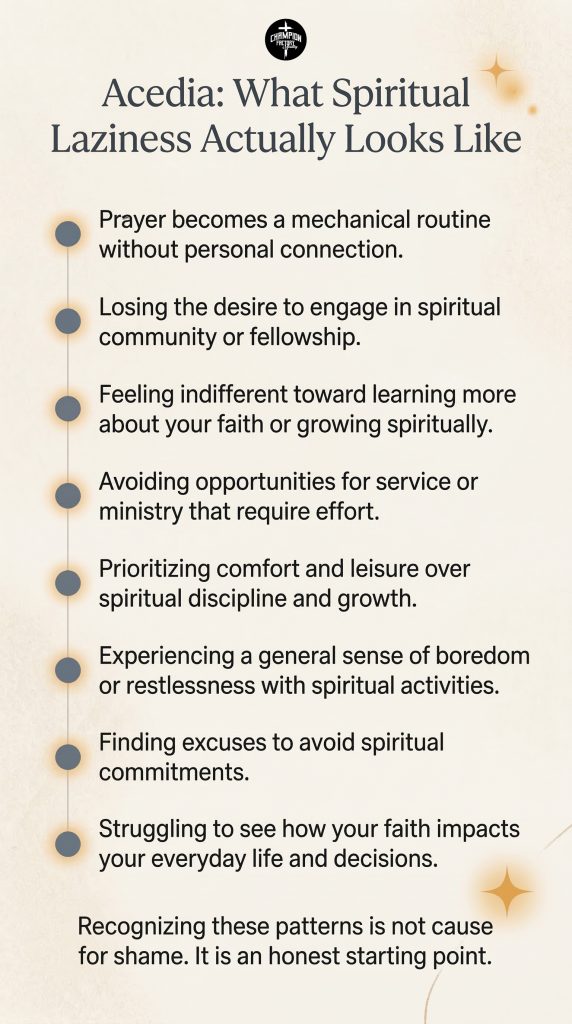
Spiritual laziness often shows up as:
- Prayer that becomes routine without real connection
- Avoiding time with Scripture because it feels like a chore
- Withdrawing from community or accountability
- Staying comfortable when growth would require risk or effort
- Losing the sense that faith actually changes how we live
Recognizing these patterns is not cause for shame. It is an honest starting point.
When Fear Drives Spiritual Inaction
One of the clearest biblical pictures of spiritual laziness comes from the Parable of the Talents in Matthew 25. The servant who buried his master's money was not cruel or rebellious. He was afraid. His inaction came from a distorted view of his master. Fear, not laziness alone, drove his passivity. That dynamic is more common than most people admit.
In Matthew 25:14-30, three servants receive different amounts of money. Two put them to work and produce more. The third buries his. When the master returns, the third servant explains his reasoning: he was afraid. He saw his master as harsh and demanding, so he played it safe and did nothing.
The master's response is sharp. The servant is not rebuked for failing to be impressive. He is rebuked for choosing passivity over faithful engagement.
This parable shows that inaction is often rooted in how a person sees God. When someone believes God is impossible to please, or that their efforts will never be enough, withdrawal can feel like the only safe response.
Writing on this passage, pastoral contributor Jack Wellman at Bible Study Tools observes: find your purpose. When you know why you were created and you know you are in the place doing what God desires you to do, you get motivated to work.
Spiritual engagement is about trust. The servants who acted did so because they trusted the master's purposes. That same trust is the starting point for moving out of spiritual passivity.
Is There a Difference Between Sloth, Burnout, and Depression?
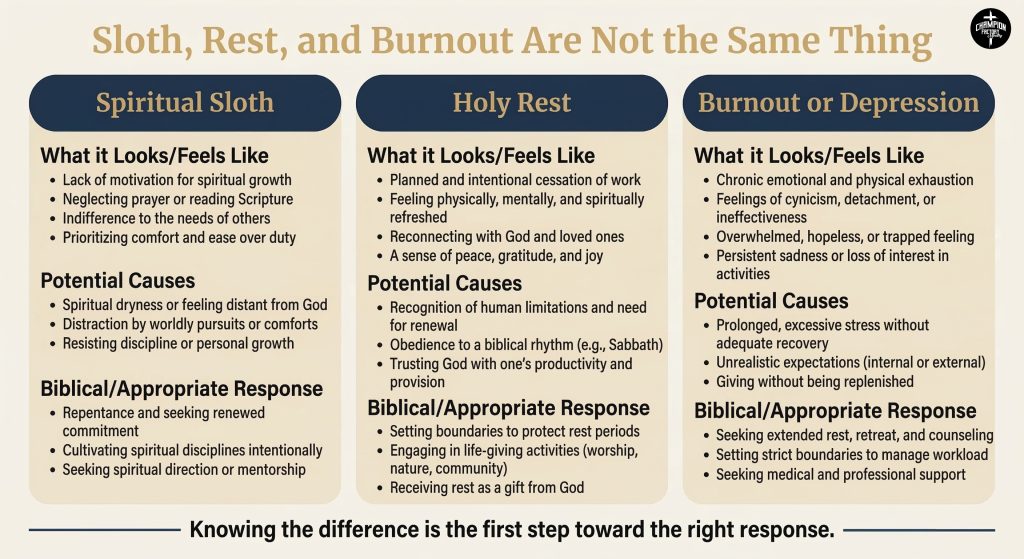
Yes. This distinction matters deeply. Spiritual laziness in the biblical sense is a voluntary drift, a choice over time to disengage from growth, prayer, and service. Clinical depression and burnout are not choices. They are conditions that affect energy, motivation, and function in ways that require professional care. Confusing them causes real harm. Both deserve honest, compassionate attention.
Christian Pure states it clearly: we must be careful not to confuse sloth with conditions such as clinical depression or burnout, which require compassionate understanding and professional care. True sloth, in the biblical sense, is a voluntary turning away from one's responsibilities.
If you are experiencing persistent low mood, loss of motivation, inability to function, or a sense of hopelessness that does not lift, please reach out to a counselor, pastor, or trusted support. These are signs that warrant real help.
"Getting this distinction right is essential," says a pastor who reviewed this article before publication. "Treating exhaustion or depression as a spiritual discipline failure does significant harm to people who are already struggling."
The signs that may point to spiritual laziness rather than burnout or depression include:
- Avoiding prayer or Scripture even when you feel capable of other activities
- Choosing comfort or distraction over known spiritual practices
- Recognizing a pattern of pulling back without external cause
- Feeling conviction about disengagement without physical or emotional exhaustion
Even these patterns rarely come from nowhere. Hardship, grief, and past hurt can all contribute to spiritual withdrawal. If that is your story, the path forward is gentle and supported, not demanding.
Rest Is Not the Same as Laziness
The Bible commands both work and rest. Rest is holy. God rested on the seventh day. Jesus withdrew to pray. Sabbath was built into the rhythm of creation. The difference between rest and laziness is not the amount of activity. It is the posture of the heart. Rest refreshes and prepares. Laziness withdraws and avoids.
John Piper, founder of Desiring God, draws this distinction clearly. He describes the restfulness of the diligent as a gracious reward for God-glorifying work and a pleasant preparation for renewed productivity. Laziness, by contrast, is an aversion to engagement that never leads back to purposeful effort.
Genesis 2:15 establishes that before the fall, God placed Adam in the garden to work it and keep it. Purposeful engagement was part of God's design from the beginning. Rest was given within that design, not as an escape from it.
A few practical markers that help distinguish rest from spiritual avoidance:
- Rest is intentional. You enter it knowing what you are recovering from and what you will return to.
- Rest renews. After genuine rest, you feel more ready to engage, not less.
- Avoidance lingers. It tends to extend itself and increase over time.
- Rest is at peace. Spiritual laziness often carries a quiet, unspoken unease.
If regular rest is part of your life and your faith feels alive, that is a gift. If rest has become a long pattern of avoidance, the passages in this article speak to that honestly and with compassion.
Sloth and the Failure to Care for Others
The Bible does not treat spiritual laziness only as a private problem. Ezekiel 16:49 describes the guilt of Sodom not only as pride and excess but as an abundance of idleness combined with a failure to care for the poor and needy. Spiritual passivity has a social cost. When we disengage from God and purpose, we also pull back from the people around us who need care, presence, and service.
Romans 12:11 connects the inner and outer dimensions of faith directly: do not be slothful in zeal, be fervent in spirit, serve the Lord. Zeal, spirit, and service belong together. The call to spiritual engagement extends to how we show up for others.
This angle rarely appears in articles on sloth. Most focus on individual habits and personal discipline. But the biblical picture is broader. Spiritual laziness affects communities. It contributes to isolation, unmet needs, and withdrawn care.
At Champion Factory Ministry, this connection shows up in our Nourish discipleship program and mentorship work. Community accountability and consistent presence help people move from passivity to engagement. Spiritual growth rarely happens in isolation. It happens in relationship, with people who show up and keep showing up.
If you are looking for a community that takes both spiritual growth and practical care seriously, explore how to get involved with Champion Factory Ministry.
Practical Steps to Move from Spiritual Passivity to Engagement
Re-engaging spiritually does not require a dramatic overhaul. It starts with small, consistent decisions made in relationship. The goal is to return to care, step by step, with support from others on the same path.
Hebrews 6:12 calls believers to follow the example of those who through faith and endurance inherit God's promises. Faith and endurance together point to a steady, patient return rather than a sudden sprint.
Here are practical starting points:
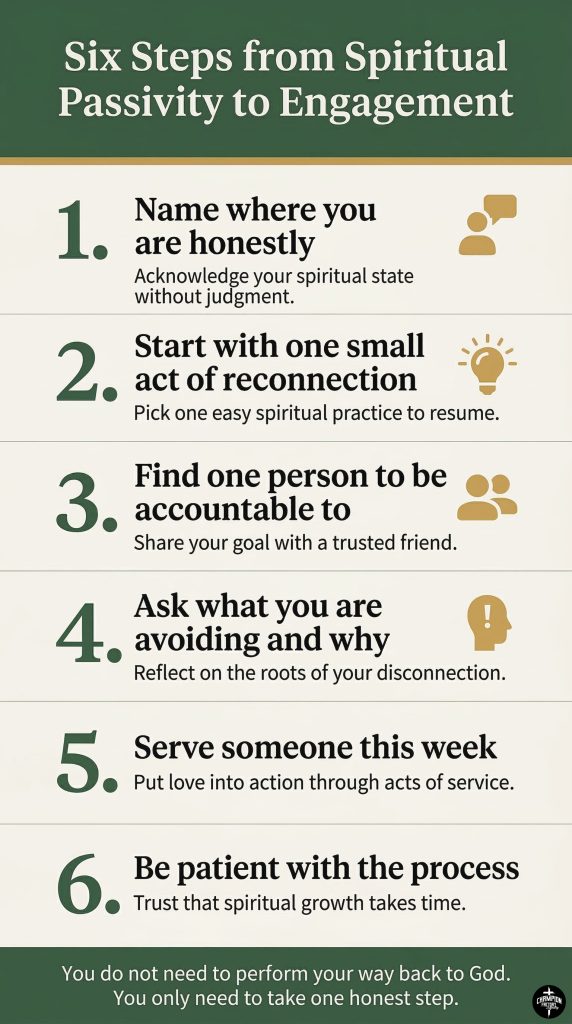
- Name where you are honestly. Acknowledge the drift without harsh self-judgment. Naming it is the beginning of movement.
- Start with one small act of reconnection. Open Scripture for five minutes. Pray a single honest sentence. Show up to one gathering. Small acts build momentum.
- Find one person to be accountable to. Community is not optional in the biblical model of growth. Accountability is not about pressure. It is about not staying isolated.
- Ask what you are avoiding and why. Fear often sits under spiritual laziness. Naming the fear makes it possible to address it.
- Serve someone this week. Ezekiel and Romans both connect spiritual engagement to care for others. Action toward someone else has a way of re-engaging the heart.
- Be patient with the process. Hebrews uses the word endurance for a reason. Spiritual growth builds over time through consistent, humble effort.
If your disengagement stems from grief, hardship, or a season of real exhaustion, begin even more gently. You do not need to perform your way back to God. You only need to take one honest step.
Sloth Is Where You Are, Not Where You Have to Stay
The Bible takes spiritual laziness seriously because what is neglected tends to erode quietly over time. But Scripture never presents the sluggard, the servant who buried his talent, or the person caught in acedia as beyond reach. The warnings exist because engagement is still possible.
Barna Group research tracking more than two decades of U.S. faith data shows that while many indicators of Christian conviction have declined, recent years show modest recovery in Bible reading and interest in Jesus. According to Barna, this moment represents a real opportunity for committed followers of Christ to address the fundamentals of faith in ways that lead to transformed lives. Spiritual passivity is common. It is not permanent.
If you recognize yourself in this article, that recognition itself is meaningful. Awareness is not the same as indifference. The person who sees their drift and names it honestly is already moving.
Take one step today. Pray one honest prayer. Open one passage. Reach out to one person. The path back to active, rooted faith begins with small, consistent choices made in the direction of God and others.
If you are walking through a hard season and want support, Champion Factory Ministry offers mentorship and discipleship resources for people who want to grow and rebuild in community.
FAQ
What does the Bible say sloth is?
The Bible presents sloth as more than physical laziness. It describes a pattern of avoiding responsibility, neglecting spiritual practice, and withdrawing from purposeful engagement with God and others. The concept of acedia, meaning a lack of care, captures the spiritual depth of this condition.
Is sloth a sin in the Bible?
Yes. Proverbs, the Parable of the Talents, and the writings of Paul all treat spiritual and physical laziness as patterns that move a person away from God's purpose. The sin is not in rest or exhaustion. It is in the pattern of choosing avoidance over faithful engagement.
What is the difference between sloth and depression?
Sloth in the biblical sense is a voluntary withdrawal from spiritual engagement. Depression is a medical condition that affects mood, energy, and function. They are not the same. If you are experiencing persistent low mood or loss of function, please seek support from a counselor or pastor rather than treating it as a spiritual discipline problem.
How can I overcome spiritual laziness?
Start small and start in community. Name where you are. Take one act of reconnection each day. Find someone to be accountable to. Ask honestly what you are avoiding and why. Serve someone this week. Spiritual re-engagement builds through consistent, humble steps over time.
What is acedia and how does it relate to sloth?
Acedia is a Greek word meaning a lack of care. It is the historical root of what we now call sloth. Fourth-century Christian monks identified it as a serious spiritual struggle involving listlessness, disconnection from God, and a loss of motivation for prayer and service. It describes a condition of the soul, not just a behavior.
Does the Bible allow for rest?
Yes. Rest is both commanded and modeled in Scripture. God rested on the seventh day. Jesus withdrew regularly to pray. The Sabbath was built into creation. The Bible distinguishes between rest that refreshes and prepares a person for engagement and laziness that avoids and withdraws. Both have a place in the biblical picture.