






Philippians 4:13 shows up on shirts, mugs, and graduation cards. It is one of the most quoted verses in the Bible, and one of the most misunderstood. Pulled away from its setting, "I can do all things through him who strengthens me" can sound like a promise that faith guarantees success.
Read in context, the verse offers something steadier and more lasting. This article walks through what Paul actually meant, why the verse gets misapplied, and how believers can hold onto its true encouragement during real hardship.
What Does Philippians 4:13 Actually Say?
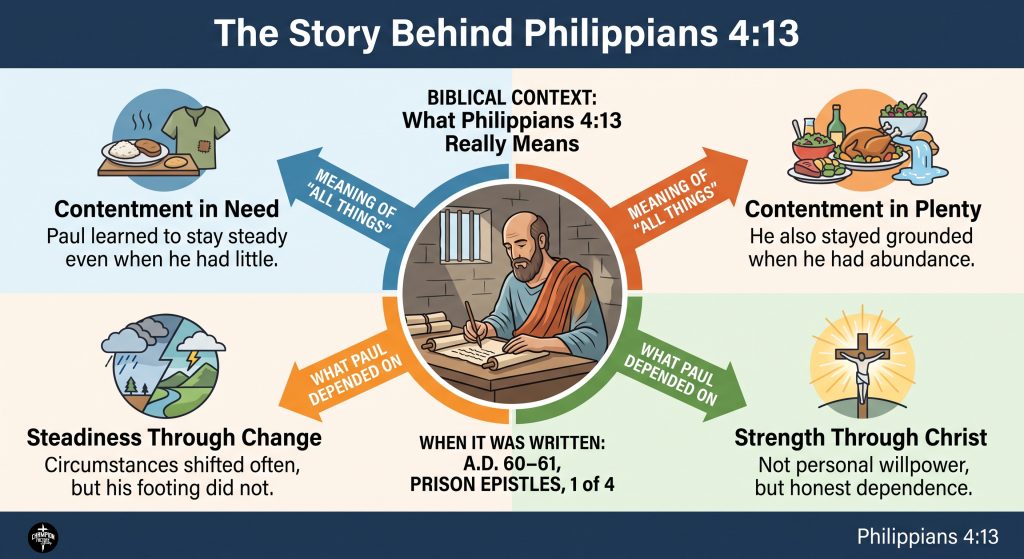
Philippians 4:13 reads, "I can do all things through him who strengthens me" (Philippians 4:13, ESV). Paul wrote these words from house arrest in Rome, likely around A.D. 60 to 61, while he waited for trial.
Paul was not celebrating a win. He was living under guard, uncertain of the outcome ahead. The words carry weight because of where they came from, not despite it.
Understanding the setting changes how the verse should be read. This was not a slogan written in comfort. It was a conviction formed in confinement, and that context shapes everything that follows.
Biblical Perspective
The letter to the Philippians is one of four letters Paul wrote from prison. Even in that setting, he wrote often about joy, peace, and contentment, themes that carry through the entire letter and lead directly into verse 13.
"When people quote this verse without the two verses before it, they usually miss the whole point Paul was making. Read together, the passage stops sounding like a slogan and starts sounding like a testimony." Todd Medina, President & Founder, Champion Factory Ministry
Why Is Philippians 4:13 So Often Misunderstood?
Philippians 4:13 is often treated as a promise that strong enough faith leads to any outcome a person wants. That reading skips the two verses right before it, where Paul explains exactly what "all things" means.
This verse consistently ranks among the most searched Bible verses online, which shows how familiar it has become. Familiarity can work against understanding. When a verse is quoted often, it gets separated from its surrounding thought, and the meaning starts to drift.
Without the verses before it, "I can do all things" sounds limitless. With them, the meaning becomes specific and grounded.
What Does "All Things" Really Mean in Philippians 4:13?
"All things" refers back to Philippians 4:11 to 12, where Paul says he has learned to be content whether he has plenty or nothing at all. The phrase describes endurance through changing circumstances, not the power to accomplish any goal.
Paul writes, "I have learned in whatever situation I am to be content. I know how to be brought low, and I know how to abound. In any and every circumstance, I have learned the secret of facing plenty and hunger, abundance and need" (Philippians 4:11 to 12, ESV).
That is the "all things" Paul had in mind. He could remain steady whether he had support or lacked it, whether life was easy or hard. Verse 13 is his conclusion to that thought, not a new and separate promise.
- Contentment in need
- Contentment in plenty
- Steadiness through changing circumstances
These are the "all things" Christ's strength made possible for Paul.
What Does It Mean That Christ Strengthens Us?
Being strengthened by Christ means depending on him for the ability to remain faithful, not drawing on personal willpower. Paul makes the same point elsewhere, describing Christ's power as something that shows up most clearly in weakness.
Paul writes, "My grace is sufficient for you, for my power is made perfect in weakness. Therefore I will boast all the more gladly of my weaknesses, so that the power of Christ may rest upon me. For when I am weak, then I am strong" (2 Corinthians 12:9 to 10, ESV). This is the same pattern found in Philippians 4:13. Strength through Christ often looks like endurance, not ease.
The historic commentator Matthew Henry described this same idea, writing that believers need Christ's strength to be content in every condition. That strength is not self reliance dressed in spiritual language. It is honest dependence on someone outside ourselves.
"In the work we do around the world, the believers who hold up the longest are rarely the ones relying on their own resolve. They are the ones who have learned to lean on Christ daily, in small and steady ways." Art Montgomery, Global Evangelism Strategy Architect & Board Visionary Luminary, Champion Factory Ministry
What Philippians 4:13 Does Not Promise
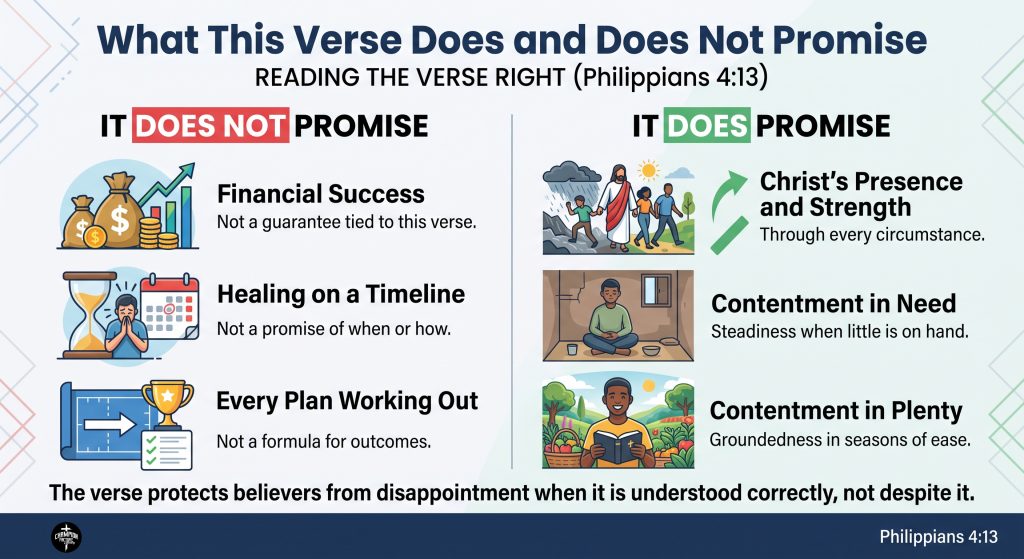
Philippians 4:13 does not promise that every goal will be reached, every prayer answered as hoped, or every hardship removed. It promises the strength to remain faithful through whatever comes.
This distinction matters. Treating the verse as a guarantee of outcomes can lead to real disappointment when life does not go as planned. Understood correctly, the verse protects against that disappointment instead of causing it.
- It does not promise financial success.
- It does not promise healing on a specific timeline.
- It does not promise that every plan will work out.
- It does promise the presence and strength of Christ through every circumstance.
If you are walking through grief, illness, or an unanswered prayer right now, this verse is not suggesting your faith is the problem. It offers companionship in the hard place, not a formula to escape it. If that hardship includes something you are struggling to carry alone, reaching out to a trusted friend, pastor, or counselor is a wise and faithful step, not a lack of faith.
How Can You Apply Philippians 4:13 During a Hard Season?
Applying Philippians 4:13 well means leaning on Christ for strength while also accepting support from the people around you. Paul modeled both at once, receiving help from the Philippian church without losing his contentment in Christ.
Earlier in the same letter, Paul thanks the Philippians for the financial support they sent through Epaphroditus (Philippians 4:15 to 18). He was content in Christ, and he was grateful for practical help. Both were true at the same time.
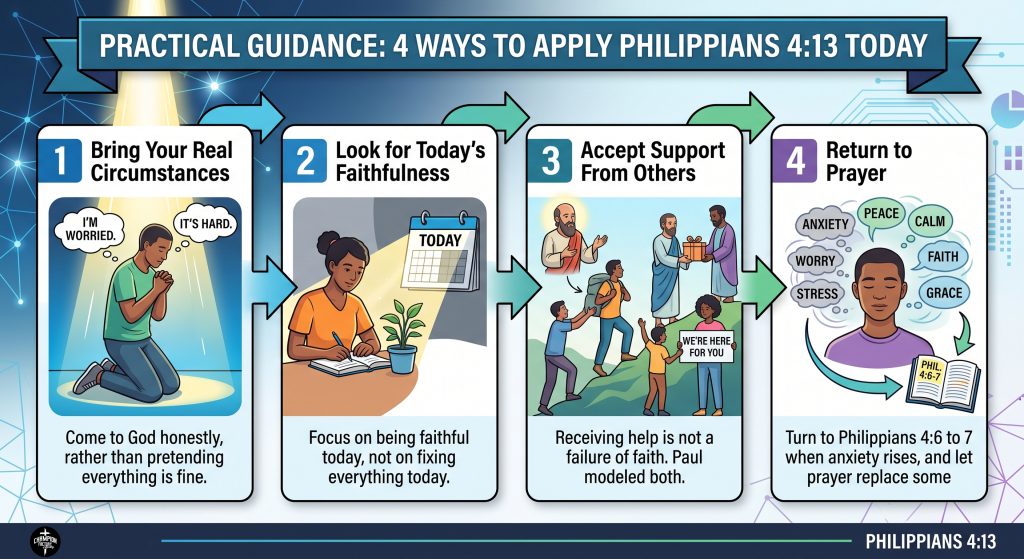
That combination offers a model worth following:
- Bring your actual circumstances to God honestly, rather than pretending everything is fine.
- Look for the specific way Christ is asking you to be faithful today, not to fix everything today.
- Accept support from trusted people without seeing it as a failure of faith.
- Return to Philippians 4:6 to 7 when anxiety rises, and let prayer replace some of the worry.
"I tell people all the time, needing help is not the opposite of faith. Paul received support and stayed content in Christ. Those two things were never in competition." Todd Medina, President & Founder, Champion Factory Ministry
Champion Factory Ministry walks alongside people in this kind of season through mentorship and spiritual guidance and ongoing discipleship through Nourish.
Strength for Today, One Step at a Time
Philippians 4:13 was never meant to be a promise of achievement. It is a testimony of contentment and endurance, written by a man who trusted Christ from a prison cell. That same strength is available in ordinary hard days too, in grief, uncertainty, and need.
If you are in a season where this verse feels distant rather than comforting, you do not have to carry it alone. Consider reaching out to a trusted community, a pastor, or a mentor who can walk with you. If you would like support or want to learn more about how Champion Factory Ministry serves individuals and families through hard seasons, you can connect with our team or explore ways to support this work.
FAQ
What does Philippians 4:13 really mean?
It means believers can find strength through Christ to remain faithful and content in any circumstance, not that they can achieve any goal they set.
Why is Philippians 4:13 often taken out of context?
Because it is quoted so widely on its own, separated from Philippians 4:11 to 12, which explain exactly what "all things" refers to.
Does Philippians 4:13 mean God will give me what I want?
No. The verse promises strength and contentment through Christ, not a guarantee of specific outcomes or answered prayers.
How should I apply this verse during a hard time?
Bring your real circumstances to God honestly, look for what faithfulness looks like today, and accept support from trusted people around you.