






When most people hear the word "heart," they think of feelings. They picture emotion, affection, or inner warmth that rises and falls with circumstances. That is how our culture tends to use the word. But when the Bible uses "heart," it means something much larger and more specific.
This matters because if you bring a modern definition to an ancient word, you will misread what God is actually saying. You may reduce the Great Commandment to an emotional feeling. You may misunderstand what it means to have a clean heart or to guard your heart. This article explains what scripture actually means by the heart and why getting that definition right can change how you approach your faith, your relationship with God, and your inner life.
What the Bible Actually Means by the Heart
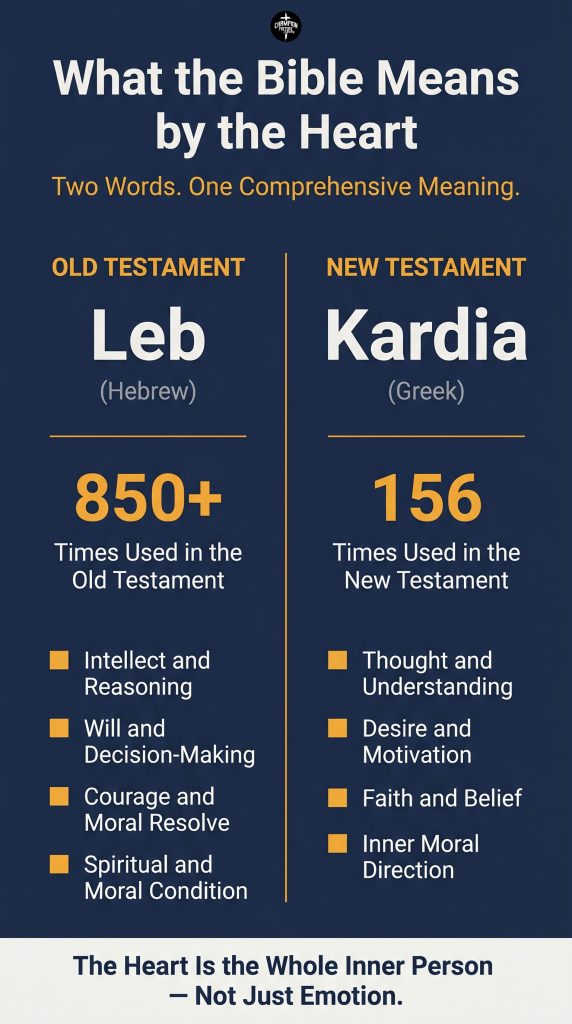
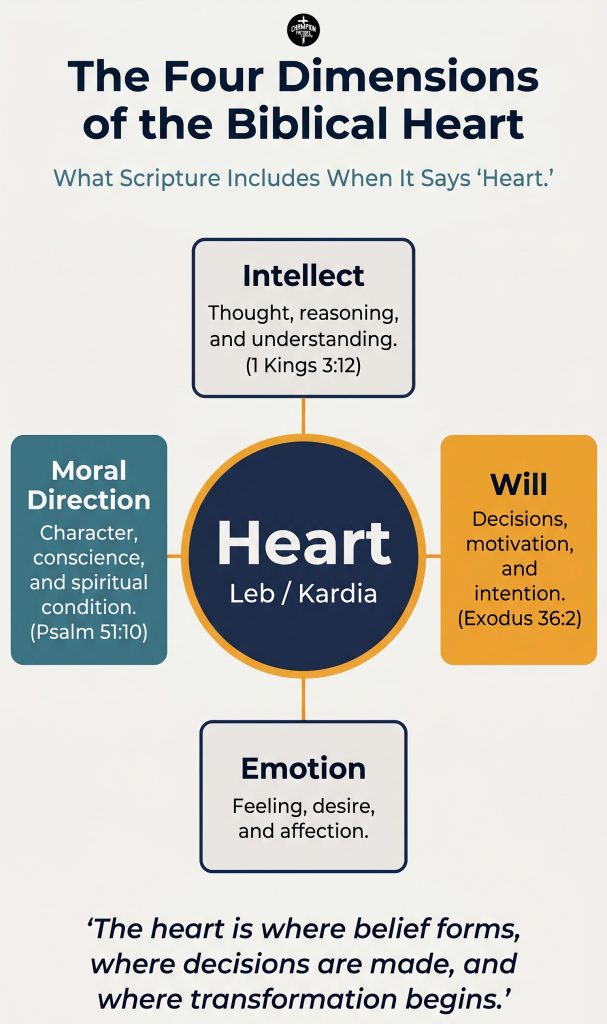
The biblical heart is the center of the whole inner person, including thought, will, desire, and moral direction. In the Old Testament, the Hebrew word "leb" appears approximately 850 times and encompasses the intellect, the will, and the moral condition of a person. In the New Testament, the Greek word "kardia" continues that same meaning. The heart is where belief forms, where decisions are made, and where transformation begins.
This differs significantly from how modern English uses the word. We tend to say "follow your heart" to mean "follow what you feel." But when scripture uses "heart," it refers to something deeper and more comprehensive.
Old Testament scholar Tremper Longman III puts it plainly: "The heart in biblical usage is not the center of the emotions alone but of the entire inner life of the person, including the intellect, the will, and the affections."
A few examples from across scripture show the breadth of this meaning:
- In 1 Kings 3:12, Solomon's "understanding heart" refers to his wisdom and reasoning, not his emotional state.
- In Exodus 36:2, skilled craftsmen whose hearts were stirred to do the work were moved by motivation and will.
- In 2 Samuel 17:10, a man of courage is described as having a heart like a lion, pointing to resolve, not sentiment.
The heart, in biblical terms, is the inner command center of a human being. It is where thought, choice, and character live.
"When we walk with people through hardship, we see that their struggle is rarely just emotional. It runs deeper, into how they see themselves, what they believe is possible, and what they trust. That is exactly what scripture is describing when it talks about the heart." Todd Medina, President and Founder, Champion Factory Ministry
Why This Definition Reframes So Much of Scripture
Once you understand that the biblical heart means the whole inner person, dozens of familiar passages open up differently. The invitation to love God with all your heart becomes a call to orient your entire inner life toward him. The promise of a new heart becomes a promise of inner renewal at the deepest level. The instruction to guard your heart becomes guidance about protecting the source of all that you think, choose, and do.
Take the Great Commandment. Jesus quotes Deuteronomy 6:5 in Matthew 22:37 when he says, "Love the Lord your God with all your heart and with all your soul and with all your mind." If heart only meant emotion, this would be asking you to feel intensely about God at all times. With the full biblical meaning in view, Jesus is calling for something more profound. He is calling for the orientation of your whole self, including your attention, your decisions, and your commitments, toward God.
Theologian Dallas Willard wrote, "When the Bible calls us to love God with all our heart, it is not asking for emotional intensity alone. It is calling for the orientation of our whole inner being toward God."
This is not a lower standard. It is a higher and more honest one. It reaches beyond feeling and asks about direction.
The Biblical Heart and the Problem It Reveals
Scripture does not treat the heart as neutral or naturally good. Jeremiah 17:9 says, "The heart is deceitful above all things and beyond cure. Who can understand it?" This is not a statement of hopelessness. It is a diagnosis. It shows why human effort alone is not enough to produce the kind of inner life God calls us toward.
That diagnosis matters because it reframes the entire conversation about spiritual growth. If the heart is the center of thought, will, and moral direction, and if the heart is prone to self-deception and drift, then trying harder is not the complete answer. Something deeper needs to change.
Christopher J.H. Wright, an Old Testament scholar and Global Ambassador for Langham Partnership, offers a grounding perspective: "The deceitfulness of the heart in Jeremiah 17 is not a statement of hopelessness. It is a diagnosis that prepares us to receive the only cure: a transformed heart that God himself provides."
The Bible does not leave the reader at the diagnosis. It moves directly toward the promise.
God's Promise: A New Heart
God does not ask you to repair your own heart. He promises to give you a new one. In Ezekiel 36:26, he says, "I will give you a new heart and put a new spirit in you; I will remove from you your heart of stone and give you a heart of flesh." This is a promise of deep inner transformation, not surface-level behavior change. It is something only God can initiate.
This promise is central to what the Bible calls the new covenant. God commits not only to forgiving sin but to changing the inner source of it. The heart of stone, resistant and closed, gives way to a heart of flesh, responsive and alive.
David understood this. In Psalm 51:10, written after a season of deep failure, he prays, "Create in me a pure heart, O God, and renew a steadfast spirit within me." He does not ask God to help him try harder. He asks God to create something new. That is the prayer of someone who understands both the depth of the problem and the scope of what God is able to do.
If you have ever felt like your heart is too far gone or too broken to be renewed, these passages speak directly to that fear. The promise of a new heart is not reserved for people who already have it together. It is offered to people who know they do not.
"The message of Ezekiel 36 has shaped how we think about our work in global evangelism. Transformation is not something we produce in people. It is something God does. Our role is to be faithful and present while he works." Art Montgomery, Global Evangelism Strategy Architect, Champion Factory Ministry
What It Means to Guard Your Heart
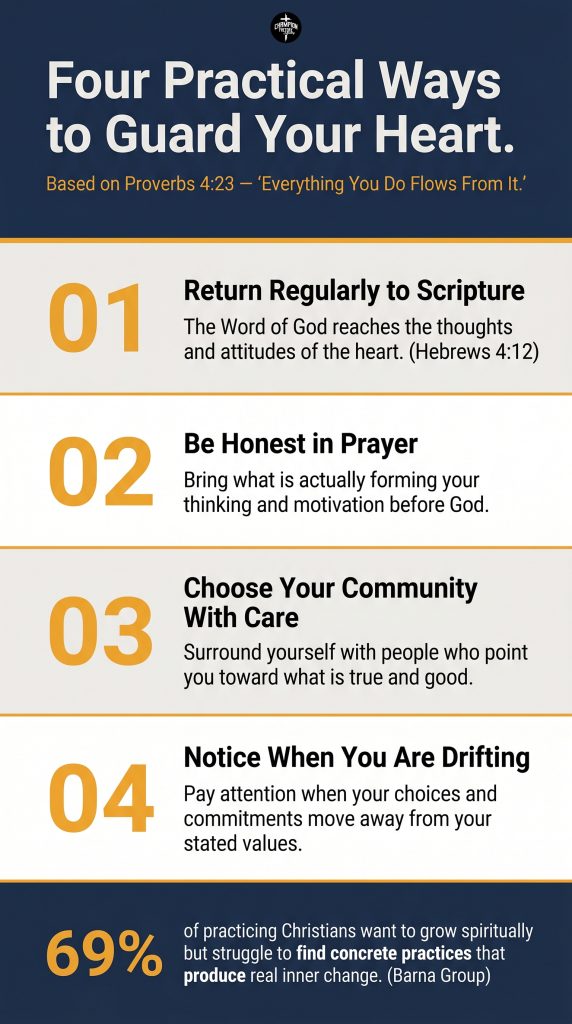
Proverbs 4:23 says, "Above all else, guard your heart, for everything you do flows from it." Guarding the heart is not just about avoiding bad influences or protecting your emotions. Because the heart encompasses thought, will, and moral direction, guarding it means being attentive to what shapes your inner life at every level.
John Goldingay, Professor of Old Testament at Fuller Theological Seminary, describes it this way: "In Hebrew anthropology, the heart is the organ of spiritual sight. What a person truly sees, believes, and wills begins in the heart."
Guarding your heart is a whole-life practice. It includes what you choose to focus on, what you allow to shape your thinking, how you engage with scripture, and who you invite to speak into your life.
Practical ways to guard your heart:
- Return regularly to scripture. Hebrews 4:12 describes the Word of God as reaching the thoughts and attitudes of the heart.
- Be honest in prayer about what is actually forming your thinking and motivation.
- Surround yourself with people and community that point you toward what is true and good.
- Notice when your attention, choices, and commitments are drifting away from your stated values.
This is not about fear or rigid control. It is about stewardship. The heart is the source of everything that flows outward into your actions and relationships, and it deserves thoughtful care.
The Heart, Struggle, and Spiritual Honesty
Many people come to this topic carrying something heavy. Grief, doubt, exhaustion, or a history that has left the heart feeling wounded or walled off. The biblical understanding of the heart does not dismiss those experiences. It takes them seriously, because the heart encompasses the full range of human inner life, including pain.
Research from the Barna Group found that 69 percent of practicing Christians say they want to grow spiritually but struggle to identify concrete practices that produce real inner change. That tension is real, and it often becomes more complicated for people carrying trauma or ongoing difficulty.
If you are in that place, this is worth saying clearly: spiritual transformation is not something you produce through enough effort or the right emotional state. Scripture does not promise that guarding your heart will prevent hardship, or that loving God will mean your heart always feels settled. What scripture does promise is that God is working in the heart even when the heart feels resistant, tired, or far from where you want it to be.
N.T. Wright writes, "The pure heart of the Beatitudes is not a heart without struggle but a heart without division. It is a heart fully set on God, even in its weakness."
That is a definition of heart purity that leaves room for the honest complexity of real life.
If you are walking through something that feels beyond what spiritual practices alone can address, please consider reaching out to a trained counselor or mental health professional. Spiritual growth and professional support work together well. They are not in conflict.
How Spiritual Practices Actually Shape the Heart
Spiritual practices are not rituals to perform. They are means by which God shapes the heart over time. Prayer, scripture engagement, community, and service each work at the level of the inner person, slowly forming thought, will, and desire in the direction of Christ.
Ruth Haley Barton, founder of the Transforming Center, writes, "Spiritual formation is essentially the transformation of the heart. Every practice we engage in is meant to bring the heart into greater alignment with God."
This framing helps answer a question many people carry quietly: if God changes the heart, why does my own practice matter? Spiritual practices are not how we earn transformation. They are how we position ourselves to receive it. We show up to scripture, prayer, and community not to fix ourselves but to remain open to what God is doing in us.
At Champion Factory Ministry, this understanding shapes how we approach discipleship through the Nourish program. Spiritual growth is about cultivating an inner life that is increasingly oriented toward God and open to his work.
A Heart Worth Tending: Moving Forward in Faith
The biblical heart is the full center of human inner life: thought, will, desire, and moral direction. That is what God addresses when he promises transformation. That is what Jesus references when he calls for whole-heart love. That is what Proverbs has in view when it says that everything you do flows from it.
Understanding this definition does not make faith more complicated. It makes it more honest. It means you can stop trying to manufacture the right feeling and start allowing God access to the deeper places where change actually begins.
Romans 10:10 says, "For it is with your heart that you believe and are justified, and it is with your mouth that you profess your faith and are saved." Faith is an inner orientation of the whole person toward God, not simply an emotional moment.
Wherever your heart is today, whether it feels steady or scattered, renewed or worn, you can bring it honestly to God. He is not waiting for you to arrive with a better heart. He is the one who provides the new one.
If you want to learn more about how Champion Factory Ministry supports people in their journey of faith and restoration, visit our programs page or explore how you can get involved in the work we do together.
FAQ
What does the Bible mean when it says "heart"?
In the Bible, heart refers to the whole inner person, including the mind, will, emotions, and moral center. The Hebrew word "leb" and the Greek word "kardia" both carry this broader meaning. It is not limited to feelings or emotion.
Why does Proverbs 4:23 say to guard your heart?
Because the heart is the source of everything you think, decide, and do. Guarding your heart means being attentive to what shapes your inner life, including what you focus on, what you believe, and who you allow to influence you.
Does loving God with all your heart mean I have to feel it emotionally all the time?
No. The Great Commandment calls for the orientation of your whole inner person toward God, including your thoughts, choices, and commitments. Emotion is part of that, but it is not the whole picture. You can pursue whole-heart love even in seasons when your feelings are complicated.
What does God mean when he promises a new heart?
In Ezekiel 36:26, God promises to replace a resistant inner life with one that is responsive to him. This is a promise of deep inner renewal that only God can initiate and complete.
Is it possible to follow God if my heart feels broken or damaged?
Yes. Scripture speaks honestly about the heart's condition without treating brokenness as disqualifying. Psalm 51:10 is a prayer from someone in real failure asking God to create something new. God's promise of transformation is not reserved for people who feel ready. It is offered to those who know they need it.