





Many believers reach a point where their faith feels thin. The trials are real, the energy is low, and the question underneath is simple: how do I keep going? Scripture has a word for what is needed in those moments. It is fortitude.
This article looks at what the Bible actually says about spiritual strength, where it comes from, and what Christians do to build it. The goal is not inspiration for a day. The goal is clarity about a lifelong process.
What Biblical Fortitude Actually Means
Biblical fortitude is the courage to endure adversity without losing faith. Ligonier Ministries describes it as "the strength to courageously endure adversity, temptation, and spiritual assault, which the Lord graciously supplies by His Spirit and through the promises of His Word." It is not stubbornness or emotional toughness. It is a quality God supplies and believers develop through practice.
The word "strength" appears more than 360 times in the Bible. Across the Old and New Testaments, it consistently points to inner resilience rooted in dependence on God, not human ability. Paul writes in Ephesians 6:10, "Be strong in the Lord and in the strength of his might." The source is not Paul. It is the Lord.
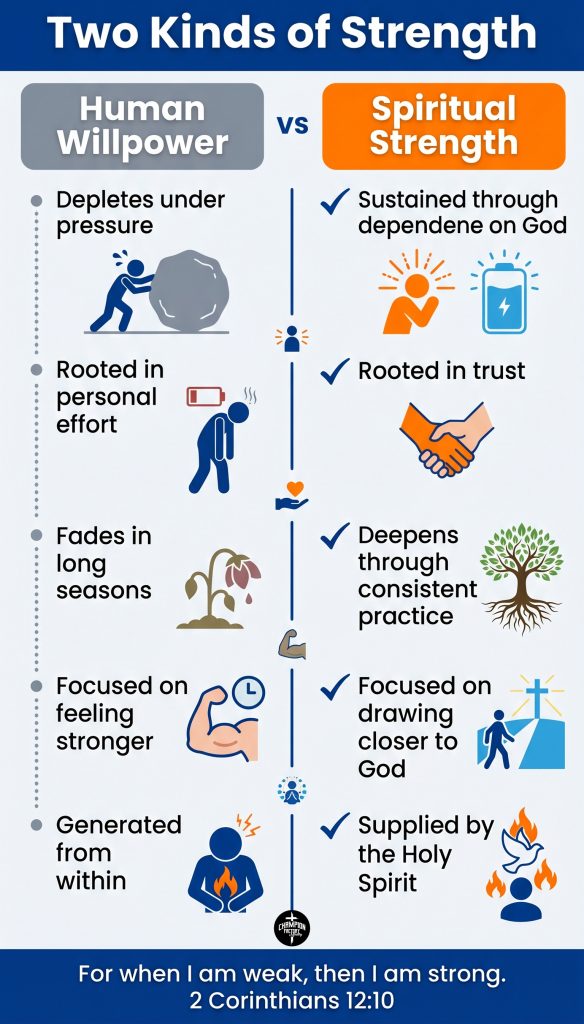
That distinction matters. Many people try to endure hard seasons through sheer effort. They push through grief, strain through uncertainty, and exhaust themselves trying to feel stronger. Biblical fortitude starts from the opposite direction. It begins with acknowledging weakness and trusting that God is the one who strengthens.
As Paul wrote in 2 Corinthians 12:9-10, "For when I am weak, then I am strong." That is not a contradiction. It is the foundation of everything that follows.
"Fortitude is not something we manufacture. It is something God grows in us as we stay close to Him and to one another." Todd Medina, President and Founder, Champion Factory Ministry
Why Spiritual Strength Is Different from Human Willpower
Spiritual strength is not the same as determination or discipline. Human willpower is limited and tends to collapse under sustained pressure. Spiritual strength is described in scripture as something God builds into the believer over time. It is connected to trust, not effort. The goal is not to try harder. The goal is to stay close to the One who strengthens.
Dr. Stephen Yuille, Vice President of Academics at Heritage College and Seminary, captures it well: "To be strengthened is to be fixed in place, immovable." That kind of stability does not come from optimism or personality. It is the result of being grounded in something that does not shift.
This is why the Bible uses language like "stand firm," "hold fast," and "endure." None of those phrases describe sprinting. They describe someone who has planted themselves and will not be moved. That kind of rootedness takes time and practice to build.
For people going through real difficulty, including loss, family hardship, or seasons of recovery, this distinction brings genuine relief. The pressure is not to feel stronger. The invitation is to draw closer to God, who is already strong.
How Prayer Builds Endurance Over Time
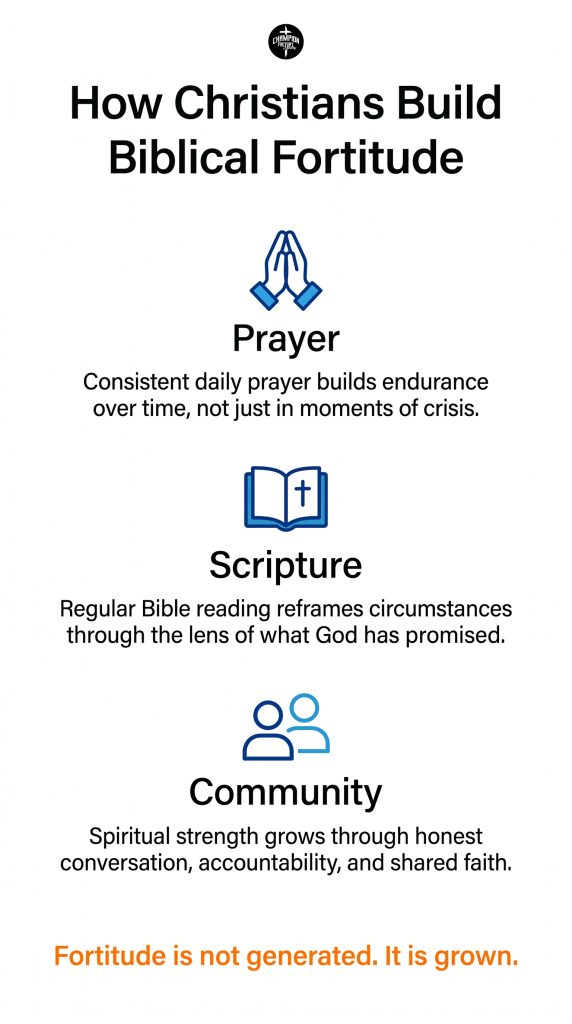
Prayer is not a crisis response. It is a daily practice that shapes how a person handles everything, including crisis. Consistent prayer builds spiritual endurance the same way regular exercise builds physical endurance. The strength does not appear all at once. It develops through repetition and trust. According to the Pew Research Center's 2023-2024 Religious Landscape Study, 44 percent of U.S. adults say they pray at least once a day.
Romans 8:26 says, "The Spirit helps us in our weakness." Prayer is the practical act of leaning into that help. It is not about saying the right words or feeling a certain way. It is about showing up consistently and letting God into the ordinary moments of each day.
Ligonier Ministries offers a useful comparison: spiritual disciplines work like exercise. You do not start by lifting the heaviest weight. You show up regularly and the capacity grows. Prayer is an acquired practice. The appetite develops the more it is fed.
Simple, sustainable ways to build a prayer habit:
- Set a specific time each day, even five minutes in the morning before anything else starts
- Use a journal to write out prayers, which slows the mind and adds focus
- Pray over scripture directly, which connects the reading to a conversation with God
- Pray with another person or group, which adds accountability and reduces isolation
None of these steps require advanced spiritual maturity. They require a small, consistent commitment.
Why Reading Scripture Is a Daily Practice, Not a One-Time Act
Scripture is not a tool for emergencies. It is the primary source through which God speaks into the life of a believer over time. Ligonier Ministries identifies scripture intake as the most important personal spiritual discipline for a reason: it is the foundation everything else is built on. Isaiah 40:31 says, "Those who wait for the Lord shall renew their strength." Waiting, in the biblical sense, is not passive. It is attentive, ongoing engagement with what God has said.
Regular Bible reading changes how a person thinks, responds, and holds up under pressure. It reframes circumstances through the lens of what God has promised. It corrects fear with truth. It also provides language for what is being experienced, which matters especially in grief or confusion.
For people who feel stuck in their reading, scripture offers a key insight: the appetite grows through feeding. The more you take in the Word of God, the more you want it.
Practical ways to make scripture reading consistent:
- Start with one chapter per day rather than committing to a full reading plan right away
- Choose a readable translation, such as the ESV or NIV, that is easy to follow
- Read the same passage multiple days in a row and ask what it says, what it means, and what to do with it
- Connect reading to prayer by responding to the passage before moving on with the day
The goal is not volume. The goal is familiarity with the voice of God, built one day at a time.
How Christian Community Strengthens Your Faith
Spiritual strength is not built in isolation. The Bible consistently places believers in community for a reason. Galatians 6:2 says, "Carry each other's burdens." The burden-sharing is mutual. Encouragement, accountability, and honest conversation with other believers all contribute to spiritual resilience in ways that solo practice cannot replicate.
Research supports what scripture teaches. According to a 2023 study from the Barna Group, church small groups reduce loneliness by 40 percent among Christian attenders. The 2023 Gallup and Radiant Foundation Faith and Wellness Report, which analyzed data from approximately 1.5 million people across 152 countries, found that religious people consistently scored higher on measures of social life, optimism, and community engagement than non-religious people.
Community does more than reduce loneliness. It provides mentorship, correction, and the kind of encouragement that does not come from a book or a podcast. Someone who has walked through grief and come through with faith intact offers something unique to someone just entering that season. That is discipleship in its most practical form.
At Champion Factory Ministry, the Nourish discipleship program is built around this principle. Consistent, relational engagement is one of the most reliable ways people grow in sustained spiritual strength.
If you are not currently connected to a faith community, here are three places to start:
- Look for a small group or Bible study at a local church where regular attendance is possible
- Ask someone whose faith you respect if they would be willing to meet with you occasionally
- Commit to showing up consistently before evaluating whether it is working
Community takes time to form. The investment is worth it.
Building Fortitude Through Long Seasons of Hardship
Sustained hardship is one of the most difficult tests of faith. Short-term trials feel manageable. Long ones can wear a person down in ways that are harder to name. The Bible does not promise quick resolution, but it does promise that endurance produces something real. Romans 5:3-4 says that suffering produces perseverance, perseverance produces character, and character produces hope.
For people walking through extended difficulty, including recovery, grief, or ongoing family strain, fortitude for the long haul looks different from fortitude in a crisis. In a crisis, energy spikes. In a long season, the challenge is staying consistent when there is no visible end in sight.
The practices that help most in long seasons are the same ones described above: prayer, scripture, and community. The mindset shifts slightly. The goal is not to feel stronger. The goal is to keep showing up.
A 2023 review published by the American Psychological Association found that religious coping buffers approximately 33 percent of trauma effects in Protestant samples. Faith practice does not erase pain. The research supports what scripture has long taught: it provides meaningful grounding during sustained hardship.
When the Season Is Especially Hard
Some hardships go beyond what daily disciplines alone can address. If you or someone you love is in a difficult situation or in need of more support, please reach out to trained professionals and trusted community members. Spiritual practices and professional care work together. One does not replace the other. Seeking help is not a sign of weak faith. It is often a sign of wisdom and courage.
Spiritual Disciplines Are Tools, Not Tests
One of the most common barriers to spiritual growth is the belief that inconsistency means failure. A missed devotion, a dry prayer, a week without Bible reading, these things do not disqualify a believer from growing in fortitude. Spiritual disciplines are tools God uses to shape us over time. They are not pass-fail tests of spiritual worthiness.
This matters especially for people who feel burned out on religious routine or who carry guilt about inconsistency. Ligonier Ministries puts it plainly: "No Christian coasts into Christlikeness." Growth requires training. And training includes setbacks.
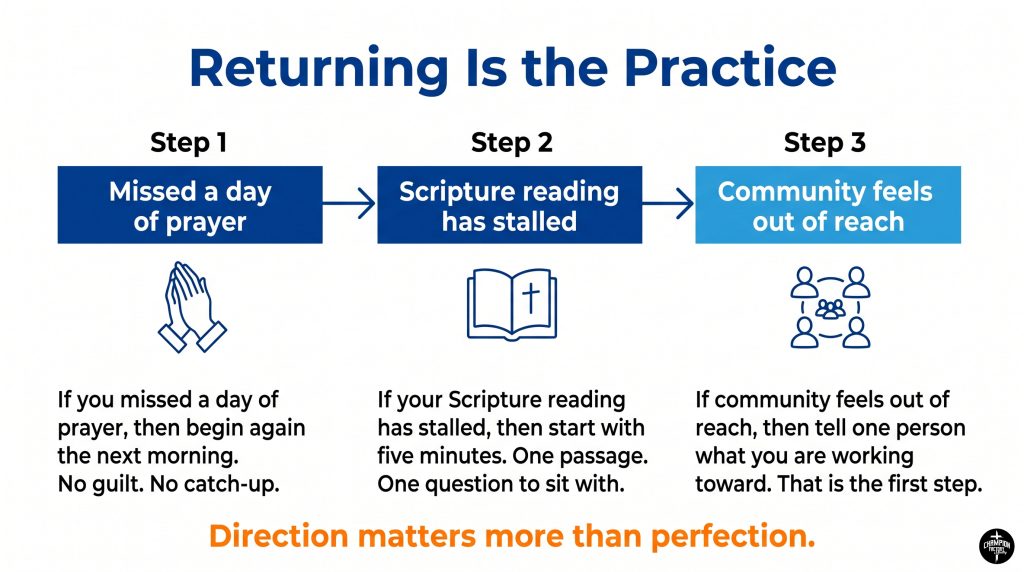
The key is returning. Not performing, not catching up, not waiting to feel a certain way. Returning. Picking the practice back up. Showing up again.
"We tell our athletes the same thing we say to everyone in this ministry: showing up consistently matters more than showing up perfectly." Troy Rallings, Global Sports and Physical Education Director, Champion Factory Ministry
Here is what returning looks like in practice:
- If you miss a day of prayer, begin again the next morning without guilt
- If scripture reading stalls, start with five minutes rather than skipping entirely
- If community feels hard to access, tell someone in your life what you are working toward
Spiritual disciplines build strength over time and through imperfect consistency. What matters most is direction, not perfection.
Taking the Next Step Toward Spiritual Strength
Biblical fortitude is not a trait some people are born with. It is a quality God provides and builds in believers through consistent, humble engagement with Him and with others. Prayer positions you to receive strength. Scripture gives your faith language and grounding. Community gives you people to walk with and to carry burdens alongside.
None of these practices require a perfect starting point. They require a next step.
Wherever you are in your faith journey, the invitation from James 4:8 stands: draw near to God, and He will draw near to you.
If you are looking for community and support, we would love to connect with you. You can learn more about how to get involved or explore our programs and services to see how Champion Factory Ministry serves individuals and families in our community.
FAQ
What Does Biblical Fortitude Mean?
Biblical fortitude is the God-given inner strength to endure adversity, temptation, and hardship without losing faith. It is not willpower. It is a quality supplied by the Holy Spirit and developed through scripture, prayer, and community over time.
How Do Christians Build Spiritual Strength?
Christians build spiritual strength through consistent spiritual disciplines: daily prayer, regular scripture reading, and active participation in a faith community. These practices develop endurance gradually, not all at once.
Can You Have Faith and Still Struggle with Anxiety or Grief?
Yes. Research from the Barna Group shows that 42 percent of practicing Christians report struggling with mental health challenges in a given year. Faith does not exempt believers from struggle. It provides grounding, support, and hope during it. Professional mental health care is appropriate and encouraged alongside spiritual practice.
What Is the Difference Between Spiritual Strength and Human Willpower?
Human willpower is a personal resource that depletes under sustained pressure. Spiritual strength is grounded in God's power and grows through dependence on Him. The Bible teaches that believers are strongest when they acknowledge their own weakness and lean on God rather than their own ability.
How Long Does It Take to Build Spiritual Fortitude?
Fortitude grows gradually through consistent practice over time. There is no set timeline. The focus should be on daily faithfulness in small practices rather than waiting to feel ready or strong enough to begin.