






You have probably heard the word heresy in a sermon, a book, or a conversation about faith. It tends to carry weight without always being clearly defined. Many Christians are uncertain what it actually means, how it differs from ordinary theological disagreement, or what a healthy response looks like when a teaching does not sit right with them.
This article is not about becoming a critic of everything you hear. It is about growing in the kind of discernment that protects your faith and helps you care well for the people around you. Jude 1:3 calls every believer to "contend for the faith that was once for all entrusted to God's holy people." Understanding what heresy is, and how to recognize it, is part of answering that call with both clarity and compassion.
What Heresy Actually Means
Heresy is teaching that departs from the core doctrines of the Christian faith in a way that distorts or undermines the Gospel, the nature of God, or the person of Jesus Christ. It is not a label for every theological difference of opinion. It refers to errors that strike at the foundation of what Christians have historically agreed is true and essential.
The word comes from the Greek "hairesis," meaning a choice or faction. In the New Testament, it described divisions within a community. Over time, as the church worked through major theological controversies, the term came to mean teaching that contradicted what the broader Christian tradition had affirmed as essential truth.
It helps to understand what heresy is measured against. Orthodoxy, from the Greek words for "correct" and "opinion," refers to the body of teaching the church has historically affirmed as faithful to Scripture. The Nicene Creed, produced at the First Council of Nicaea in 325 AD, is one of the clearest summaries of that shared faith. It is affirmed today by Catholic, Eastern Orthodox, Anglican, Lutheran, Reformed, and many other Protestant traditions, making it one of the broadest points of agreement in Christian history.
Heresy is not a disagreement about minor doctrinal details. It is a departure from the core of what the church has consistently held to be true.
"One of the most important things we can do for the people we walk alongside is help them understand that questions about doctrine are not something to fear. They are part of learning to think carefully about what we believe and why." Todd Medina, President and Founder, Champion Factory Ministry
Three Historical Heresies and What They Got Wrong
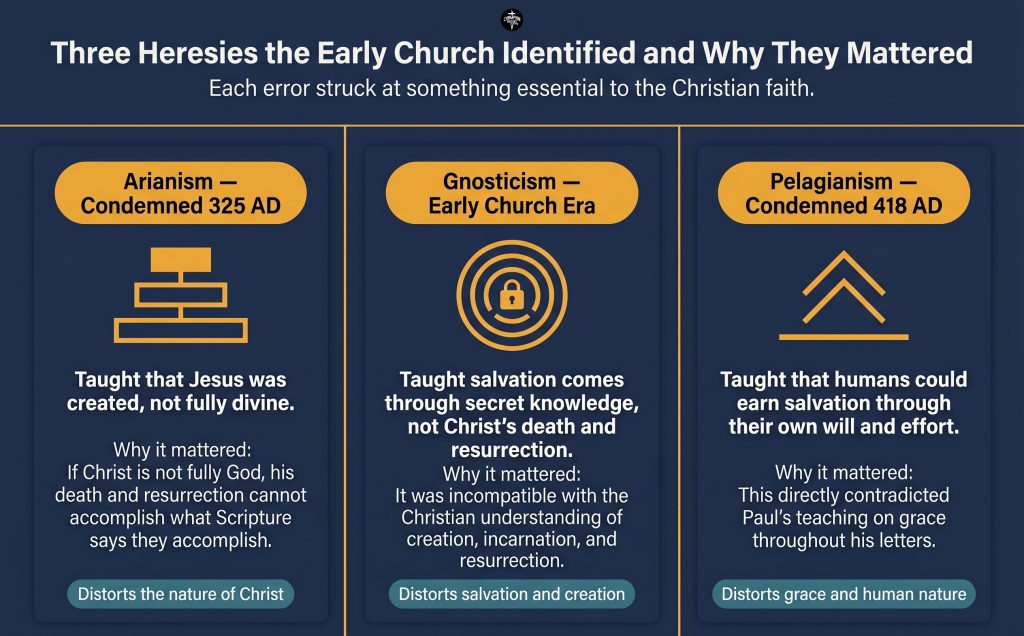
Three well-documented examples from church history show what heresy looks like in practice. Arianism denied the full divinity of Christ. Gnosticism rejected the goodness of the physical world and taught that salvation came through secret knowledge. Pelagianism taught that human beings could earn salvation through their own moral effort without divine grace. Each error struck at something essential to the Christian faith.
Arianism
Arianism, addressed at the Council of Nicaea in 325 AD, taught that Jesus was the greatest of God's creations but was not himself fully divine. The church recognized that this undermined the entire Christian understanding of salvation. If Christ is not fully God, his death and resurrection cannot accomplish what Scripture says they accomplish. The Nicene Creed was written specifically to affirm that Christ is "of one being with the Father."
A 2020 survey by Ligonier Ministries and LifeWay Research found that 65 percent of American adults who identify as Christian agreed that Jesus is the first and greatest being created by God, a position consistent with the Arian view the church rejected in 325. This is not a problem that belongs only to ancient history.
Gnosticism
Gnosticism taught that the physical world was evil and that salvation came through secret spiritual knowledge available only to a select few. It was incompatible with the Christian understanding of creation, incarnation, and resurrection. Christ taking on human flesh, and rising bodily from the dead, only makes sense if the physical world is part of God's good creation.
Pelagianism
Pelagianism, condemned at the Council of Carthage in 418 AD, taught that human beings could achieve salvation through their own will and moral effort without needing God's grace. This directly contradicted Paul's teaching throughout his letters. The pattern it represents, overconfidence in human effort and a diminished view of grace, has recurred in various forms throughout church history.
How Heresy Differs from Theological Disagreement
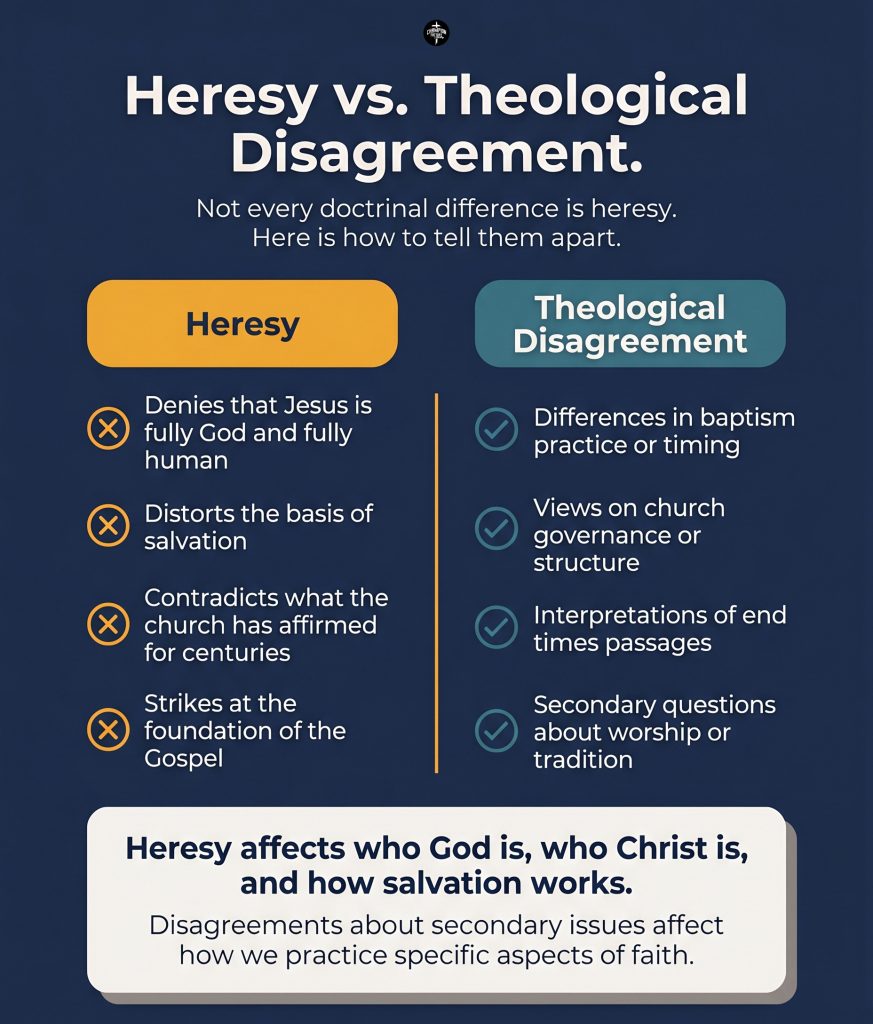
Christians across traditions disagree about baptism, the nature of communion, church governance, and the timing of the end times. These are real and sometimes significant differences, but they are not heresy. Heresy involves the core doctrines that are foundational to the Gospel itself, specifically the nature of God, the person of Christ, and the basis of salvation.
A useful way to think about this is in terms of what is at stake. Disagreements about secondary issues affect how we practice and understand specific aspects of faith. Heresy affects the very foundation that everything else is built on.
Theologian R.C. Sproul put it plainly: heresy "is not just about getting theology wrong. It is about getting it wrong in a way that attacks the foundation of the Christian faith itself."
C.S. Lewis observed in Mere Christianity that most major heresies were not invented by people trying to destroy the church. They came from sincere believers who got one significant thing badly wrong. That is an important note for how we approach this topic. Recognizing that a teaching is heretical does not require assuming bad intent on the part of the person who holds it. It requires asking whether the teaching itself is consistent with what the Christian faith has always affirmed.
"When I sit with someone who is confused about what they believe, I rarely find that they set out to believe something wrong. More often, they were taught something incomplete, and no one helped them fill in the gaps." Art Montgomery, Global Evangelism Strategy Architect, Champion Factory Ministry
Practical Questions to Help You Evaluate a Teaching
You do not need a seminary degree to evaluate what you are hearing. A few honest questions, asked with humility and a willingness to look at Scripture carefully, can help you assess whether a teaching is consistent with orthodox Christian belief.
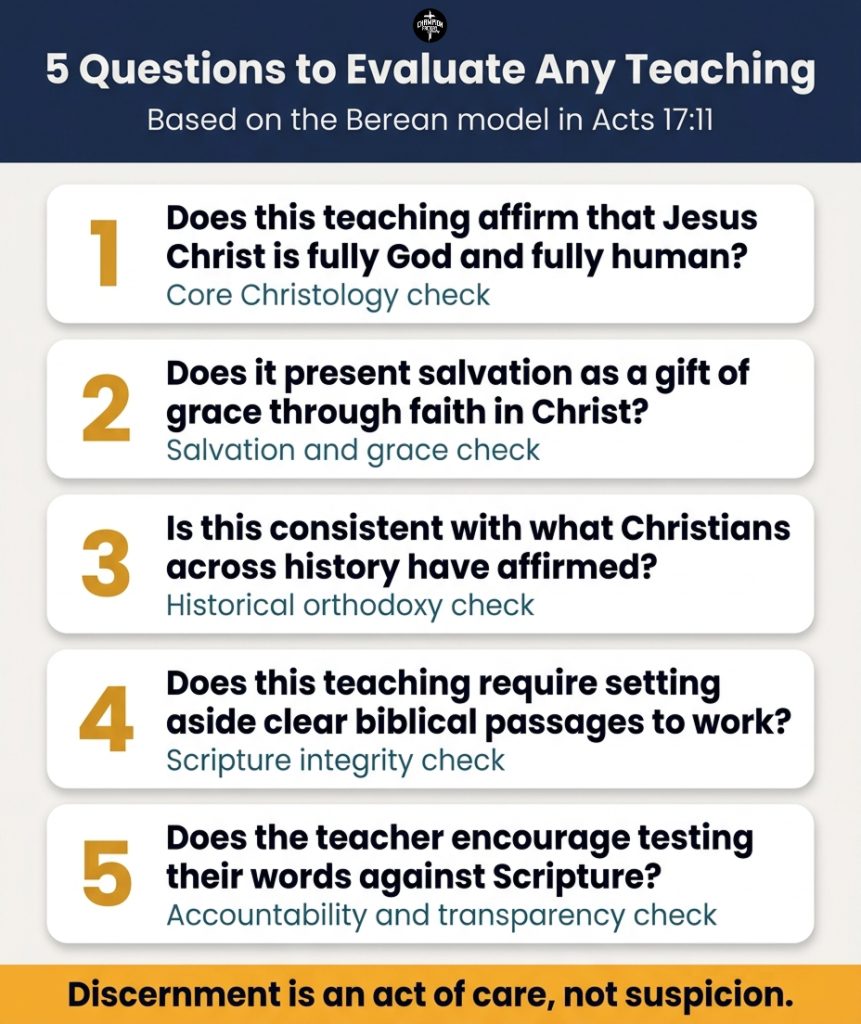
The Bereans in Acts 17:11 are commended because they "received the message with great eagerness and examined the Scriptures every day to see if what Paul said was true." Their approach is practical and available to any believer. They did not dismiss teaching out of hand, nor did they accept it without thought. They tested it against Scripture.
Here are questions you can use when a teaching concerns you:
- Does this teaching affirm that Jesus Christ is fully God and fully human?
- Does it present salvation as a gift of grace received through faith in Christ, or does it make salvation dependent on something else?
- Is this consistent with what Christians across traditions and across history have affirmed?
- Does this teaching require setting aside or reinterpreting clear biblical passages to make it work?
- Does the teacher encourage people to test what they say against Scripture, or do they discourage that kind of questioning?
First John 4:1-3 offers a similar framework. John writes, "Dear friends, do not believe every spirit, but test the spirits to see whether they are from God." He then gives a specific measure centered on the confession of Jesus Christ. Testing teaching is not an act of pride or suspicion. It is an act of care for yourself and for those around you.
The Role of Creeds and Community in Discernment
Doctrinal discernment is not meant to be a solo exercise. The creeds and councils of the church exist because Christians across centuries worked together to identify and protect core truths. You are not starting from scratch. You have access to the conclusions of a long and serious conversation.
N.T. Wright, a widely respected New Testament scholar, has written that the creeds "are not about limiting faith. They are about protecting it so that what is handed on is the same faith the apostles received." The Apostles' Creed and the Nicene Creed are not denominational documents. They are the inheritance of the whole church, and they provide a reliable starting point for evaluating what you hear.
Your church community plays an important role as well. If you have concerns about a teaching, bringing those concerns to a trusted pastor, elder, or small group leader is a healthy first step. Discernment practiced in community is more grounded and less prone to error than discernment practiced alone.
If a teaching is creating significant confusion or distress, speaking with a pastor or a trained Christian counselor is a wise next step. Theological confusion can surface deep questions about faith and identity, and a qualified counselor can help you work through those questions in a safe and supported way.
How to Respond When You Encounter Questionable Teaching
A faithful response to concerning teaching involves prayer, Scripture, community, and humility. It does not require public confrontation and should never come from a place of pride. The goal is to hold fast to what is true while remaining committed to the people around you.
Second Timothy 4:3-4 offers a realistic picture of human tendency: "People will not endure sound teaching, but having itching ears they will accumulate for themselves teachers to suit their own passions." The warning is honest. The response it calls for is not alarm. It is faithfulness.
A measured response looks like this:
- Pray and ask for clarity and humility before doing anything else.
- Search the relevant Scripture passages yourself, not just the ones cited in the teaching.
- Check what the broader Christian tradition has said about the topic.
- Talk with a trusted pastor, elder, or mature believer.
- Make decisions about your engagement with that teaching based on what you find, not on emotion alone.
Orthodoxy and love are not in tension. Theologian Rowan Williams has written, "Orthodoxy is not the enemy of love. It is the condition for love to be about what it claims to be about." You can care deeply about the people in your community and still take seriously whether the teaching they receive is faithful to the Gospel.
Discernment Is a Lifelong Practice, Not a One-Time Test
Discernment deepens over time through reading, relationship, and regular engagement with Scripture. It is built in community, not acquired in isolation. At Champion Factory Ministry, our Nourish discipleship program is grounded in the belief that healthy faith formation includes learning to read Scripture well and to think carefully about what we believe and why. That kind of growth takes time, and it takes people willing to ask honest questions together.
The believer who notices something wrong in a teaching they once trusted is not being harsh or suspicious. They are doing what Jude calls every believer to do: contending for the faith with care. Understanding what heresy means, and having clear questions to ask when you are uncertain, is one of the most practical steps you can take to protect your own faith and serve the people around you well.
If you want to learn more about how Champion Factory Ministry supports people in their spiritual growth, we invite you to learn about our discipleship work or explore how you can get involved.
FAQ
Is it heresy to disagree with my church about baptism or the end times?
No. Disagreements about secondary doctrines like baptism practices, end times timelines, or church structure are real differences but they do not rise to the level of heresy. Heresy involves core doctrines about the nature of God, the person of Christ, and the basis of salvation.
How do I know if a teaching is heresy or just an unfamiliar perspective?
Start by checking the teaching against clear Scripture passages and the historic creeds of the church. Ask a trusted pastor or elder. A teaching that contradicts what Christians across traditions have affirmed for centuries deserves careful evaluation.
Can I still love someone whose teaching I think is false?
Yes. Recognizing that a teaching is wrong does not require hostility toward the person who holds it. Most historical heresies came from sincere people who made serious errors, not from bad intentions. You can care about someone and still take seriously whether what they teach is faithful to Scripture.
What is the Nicene Creed and why does it matter?
The Nicene Creed was produced at the Council of Nicaea in 325 AD to affirm core truths about the nature of Christ against the Arian heresy. It is affirmed today by Catholic, Eastern Orthodox, Anglican, Lutheran, Reformed, and many other Protestant traditions. It is one of the most reliable summaries of broadly shared Christian belief and a useful reference for evaluating teaching.
Should I confront someone I think is teaching heresy?
Not necessarily, and not right away. The first steps are prayer, Scripture study, and conversation with a trusted pastor or elder. How you respond depends on the context, your relationship with the person, and the seriousness of the error. Public confrontation is rarely the right first move.