






You may have heard the name Jehovah Jireh in a worship song, on a church wall, or in a moment of personal prayer. But if you have ever wondered what it actually means, where it comes from, or whether it has anything real to say to your situation right now, you are not alone. Many people carry this name without a full understanding of the story behind it.
This article walks through the biblical origin of Jehovah Jireh, what the Hebrew actually says, and why this name still carries weight for people in hard seasons. Whether you are searching out of curiosity, deep faith, or genuine need, there is something here worth holding onto.
Where the Name Jehovah Jireh Comes From
Jehovah Jireh appears only once in the entire Bible, in Genesis 22:14. Abraham gave this name to the place where God provided a ram after calling him to offer his son Isaac. The name came out of a moment of trust, obedience, and unexpected provision. It is not a general phrase. It is a declaration tied to a specific act of God.
The story in Genesis 22 is one of the most significant passages in all of scripture. God called Abraham to take his son Isaac, the son he had waited decades for, to a mountain in the region of Moriah. Abraham obeyed. He traveled with Isaac, carried the wood, built the altar, and moved forward without knowing how the story would end.
What happened next changed everything. As Abraham reached out, an angel called out and stopped him. Abraham looked up and saw a ram caught in a thicket nearby. He took the ram and offered it in place of his son. Then, in verse 14, he named that place: "So Abraham called that place The LORD Will Provide. And to this day it is said, 'On the mountain of the LORD it will be provided'" (Genesis 22:14, NIV).
The name did not come from a calm moment of reflection. It came from a man on a mountain who had trusted God completely and then watched God show up.
"When I read Genesis 22, I am struck by the simplicity of Abraham's obedience. He did not have a roadmap. He had a relationship. That is what Jehovah Jireh is built on." Todd Medina, President and Founder, Champion Factory Ministry
What Jehovah Jireh Means in Hebrew
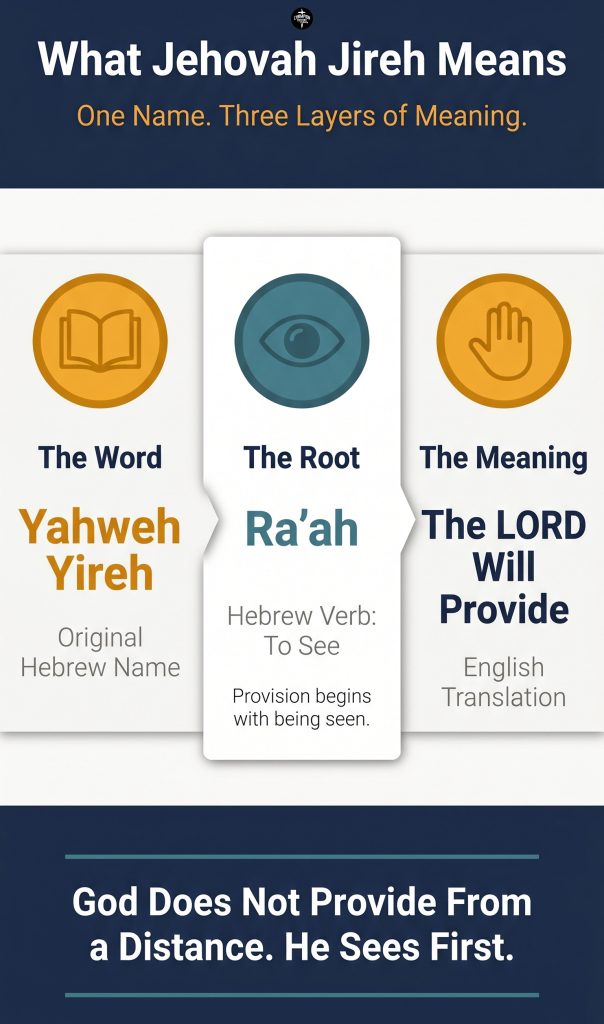
The Hebrew behind Jehovah Jireh is Yahweh Yireh. Yahweh is the personal name of God used throughout the Old Testament. Yireh comes from the Hebrew verb ra'ah, which means "to see." The full name means "The LORD sees" or "The LORD will see to it." Provision in Hebrew starts with being seen.
This is worth sitting with. In most English translations, the name is rendered "The LORD Will Provide." That is accurate, but it can lead readers to think primarily of material supply. The Hebrew carries something deeper. To provide, in this context, begins with God looking upon a situation, perceiving the need, and acting from that place of full awareness.
As A.W. Tozer wrote in The Knowledge of the Holy, "The names of God in the Old Testament are not titles. They are revelations. Each name shows us something about who God is in relation to human need."
Jehovah Jireh tells us that God does not provide from a distance. He sees first. He is already aware of what is needed before the request is formed. That is a different kind of assurance than a transaction or a formula. It is a statement about who God is.
How This Name Fits the Broader Tradition of God's Names
The Hebrew Bible contains many names for God, each tied to a specific aspect of his character and relationship with people. According to Oxford Biblical Studies Online, this tradition reflects a theology of describing God through his acts and relationships rather than through abstract qualities alone.
Some of the other names include:
- El Shaddai, meaning God Almighty, tied to his power and sustaining presence
- Jehovah Rapha, meaning the LORD who heals
- Jehovah Shalom, meaning the LORD is peace
- Jehovah Nissi, meaning the LORD my banner, a name given after victory in battle
Each name came from a real moment. Jehovah Jireh is no different. It rose out of an act of complete trust and undeniable provision.
Provision Means More Than Money
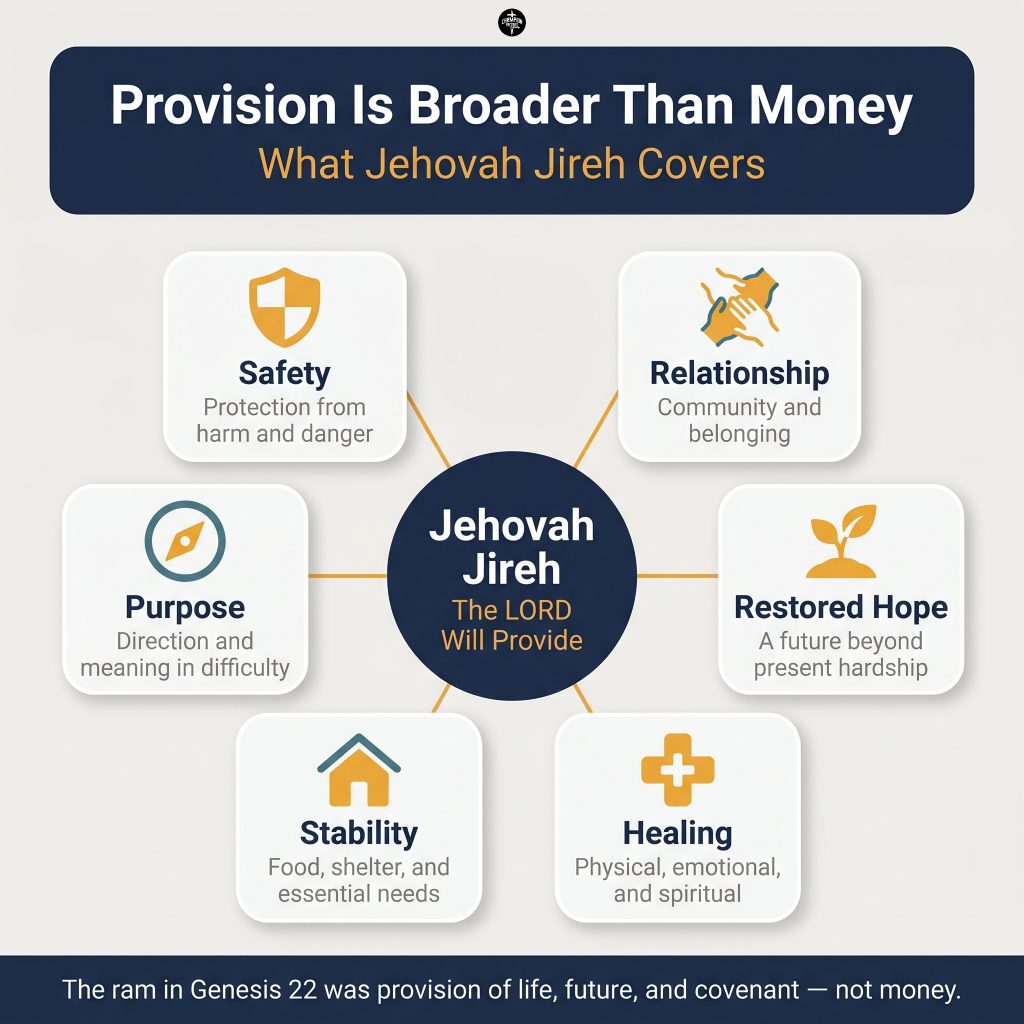
Many people hear Jehovah Jireh and think immediately of financial need. But the provision God gave Abraham in Genesis 22 was not money. It was life, future, covenant, and relationship. Biblical provision is as broad as human need itself. It includes safety, healing, community, purpose, and restored hope.
Dr. John Goldingay, Professor of Old Testament at Fuller Theological Seminary, puts it plainly in Genesis for Everyone: "Provision in scripture is not limited to material goods. The ram God provided for Abraham was provision from death, provision of a future, provision of a covenant. We make God too small when we limit his provision to dollars and resources."
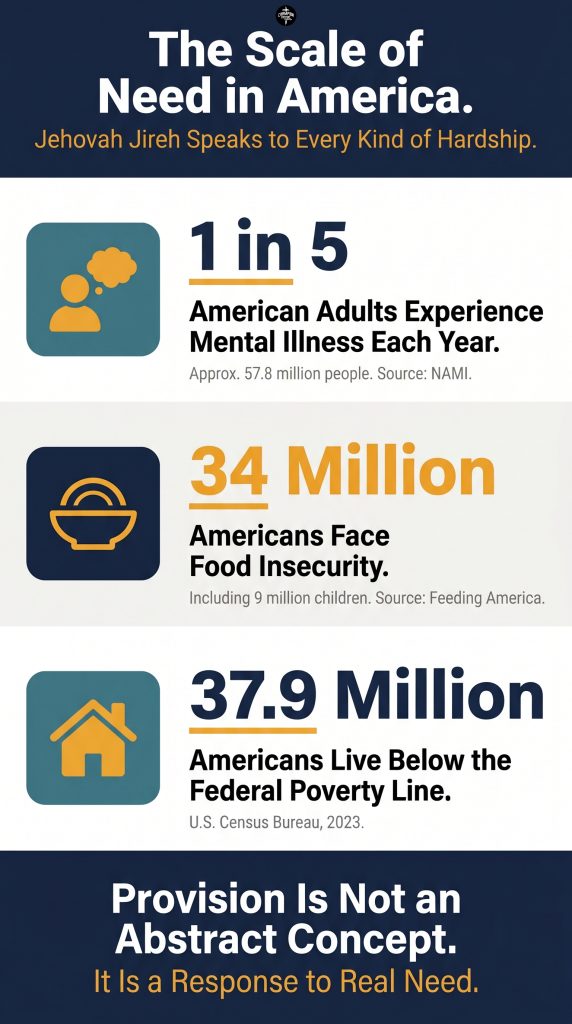
This matters especially for readers whose unmet need is not primarily financial. Consider what genuine need looks like across the United States:
- According to NAMI, 1 in 5 American adults experiences mental illness in any given year, approximately 57.8 million people.
- Feeding America reports that approximately 34 million people, including 9 million children, face food insecurity.
- The U.S. Census Bureau reported in 2023 that approximately 37.9 million Americans live below the federal poverty line.
These numbers represent real people in real situations. Jehovah Jireh speaks to all of it. The hunger for stability. The need for safety. The longing to feel seen.
Provision That Comes Through People
God's provision in Genesis 22 came through something tangible. The ram was real. It was physical. It arrived at a specific moment and met a specific need.
That pattern holds throughout scripture and throughout history. Dr. Amy Sherman, Senior Fellow at the Sagamore Institute for Policy Research, writes in Kingdom Calling that "faith communities have historically been the first and most consistent responders to poverty and need. The concept of Jehovah Jireh is not just a theological idea. It is the engine behind millions of acts of care."
Provision often arrives through the hands of other people. Volunteers who show up. Neighbors who share food. Communities that offer support when a family has nowhere else to turn. When someone says yes to serving, they participate in what God is already doing.
"We see it constantly in our outreach work. Someone arrives with nothing, and the community wraps around them. That is provision. It is real, and it is happening through real people saying yes." Art Montgomery, Global Evangelism Strategy Architect, Champion Factory Ministry
How Jehovah Jireh Connects to Jesus
The New Testament draws a direct line from Genesis 22 to the life, death, and resurrection of Jesus. The ram that God provided in place of Isaac was a foreshadowing. The ultimate provision was not an animal. It was God's own Son. Romans 8:32 makes this connection plain: "He who did not spare his own Son, but gave him up for us all, how will he not also, along with him, graciously give us all things?" (NIV).
The writer of Hebrews looks back on Genesis 22 and describes Abraham's trust this way: "Abraham reasoned that God could even raise the dead, and so in a manner of speaking he did receive Isaac back from death" (Hebrews 11:19, NIV). Abraham moved forward in faith. The provision came. And the early Christian community recognized that same pattern in the resurrection.
Paul echoes the name Jehovah Jireh in his letter to the Philippians: "And my God will meet all your needs according to the riches of his glory in Christ Jesus" (Philippians 4:19, NIV). The Old Testament declaration and the New Testament promise point to the same God who sees, who acts, and who provides.
What This Name Says to People in Hard Seasons
The name Jehovah Jireh was not written for comfortable moments. It was named on a mountain, in a moment of complete uncertainty, by a man who had no idea how things would turn out. The name came after the provision arrived. And it became a declaration for every generation that followed.
Trusting God's provision does not mean the waiting is easy or that things unfold on a predictable timeline. Dr. Timothy Keller wrote in Prayer: Experiencing Awe and Intimacy with God that "to trust that God will provide is not passive. It requires obedience, action, and a willingness to move forward before the outcome is clear. Abraham moved toward the mountain before the ram appeared."
That kind of trust is honest. It does not pretend hardship away. It does not promise that every prayer results in immediate relief. What it holds is the conviction that God sees. That he is not distant or unaware. That provision, in whatever form it takes, flows from a God who looks upon real situations with full knowledge and genuine care.
Jesus spoke directly to provision anxiety in Matthew 6:31-33 (NIV): "So do not worry, saying, 'What shall we eat?' or 'What shall we drink?' or 'What shall we wear?' For the pagans run after all these things, and your heavenly Father knows that you need them. But seek first his kingdom and his righteousness, and all these things will be given to you as well."
A Note on Seeking Support
For anyone in serious hardship, including mental health struggles, trauma, or recovery from harm, faith and professional care work together. Trusting God for provision does not mean declining help that is available. Counselors, community organizations, and licensed support programs are often part of how provision arrives. Seeking that support is wise, not a sign of weak faith.
If you or someone you care for needs practical help right now, reaching out to a trusted person or organization is a meaningful first step. Champion Factory Ministry offers mentorship, recovery support, and community care programs for those who need a place to start.
Holding This Name When Provision Feels Far Away
The name Jehovah Jireh was not coined in a moment of ease. It came from a hard climb and an act of complete surrender. It has been passed down through thousands of years because it says something true about a God who sees what people carry and meets them in it.
You do not have to have everything figured out to hold onto this name. You do not need certainty about timing or outcome. What Jehovah Jireh offers is a declaration about who God is, rooted in what he has already done, and pointing forward to what he continues to do.
If you are waiting right now, that waiting is not evidence that God is absent. Abraham waited too. He walked toward the mountain without knowing what he would find. The ram was already there.
If your next step is prayer, take it. If it is reaching out for support, take that step too. If it is simply sitting with this name and letting it mean something real, that is enough.
Jehovah Jireh. The LORD sees. The LORD will provide.
You can explore ways to get involved or support the work if you feel called to be part of how God provides for others.
FAQ
What does Jehovah Jireh mean?
Jehovah Jireh is a Hebrew name for God meaning "The LORD Will Provide." It comes from the Hebrew root ra'ah, meaning "to see." The name reflects the belief that God perceives every need and acts on behalf of those who trust him. It first appears in Genesis 22:14 when Abraham named the place where God provided a ram.
Where does Jehovah Jireh appear in the Bible?
The name Jehovah Jireh appears only once in scripture, in Genesis 22:14. Abraham gave this name to the place on Mount Moriah where God provided a ram in place of his son Isaac after Abraham demonstrated full trust and obedience.
Does Jehovah Jireh only apply to financial provision?
No. While many people associate the name with financial need, the biblical concept of provision is much broader. In Genesis 22, God provided life, future, and covenant. Provision in scripture includes safety, healing, relationship, community, and restored hope. The name speaks to the full range of human need, not only material supply.
How does Jehovah Jireh connect to Jesus?
The ram God provided in place of Isaac is widely understood in Christian theology as a foreshadowing of Christ. Romans 8:32 draws this connection directly, noting that God did not spare his own Son. The New Testament fulfillment of the Jehovah Jireh principle is the ultimate provision of salvation through Jesus.
How can I trust God to provide when I am in a hard season?
Trusting God's provision does not require certainty about timing or outcome. It begins with the conviction that God sees your situation and is not indifferent to it. Practical steps include prayer, honest acknowledgment of your need, and openness to provision coming through unexpected channels, including community, support organizations, and people who serve. Seeking professional help when needed is also a responsible and wise part of trusting God's care.