



If you have ever said "amen" at the end of a prayer, recited the Lord's Prayer with your congregation, or stood for a call to worship on a Sunday morning, you have participated in liturgy. For many people, the word feels formal or distant, associated with robes and chanting and traditions that seem to belong to a different kind of church. But liturgy is much simpler and more familiar than it sounds.
This article explains what liturgy actually means, where it comes from in Scripture and church history, and why it matters for the life of faith. Whether you worship in a traditional setting or a more informal one, understanding liturgy can deepen the way you see and experience worship together.
What Liturgy Means and Where the Word Comes From
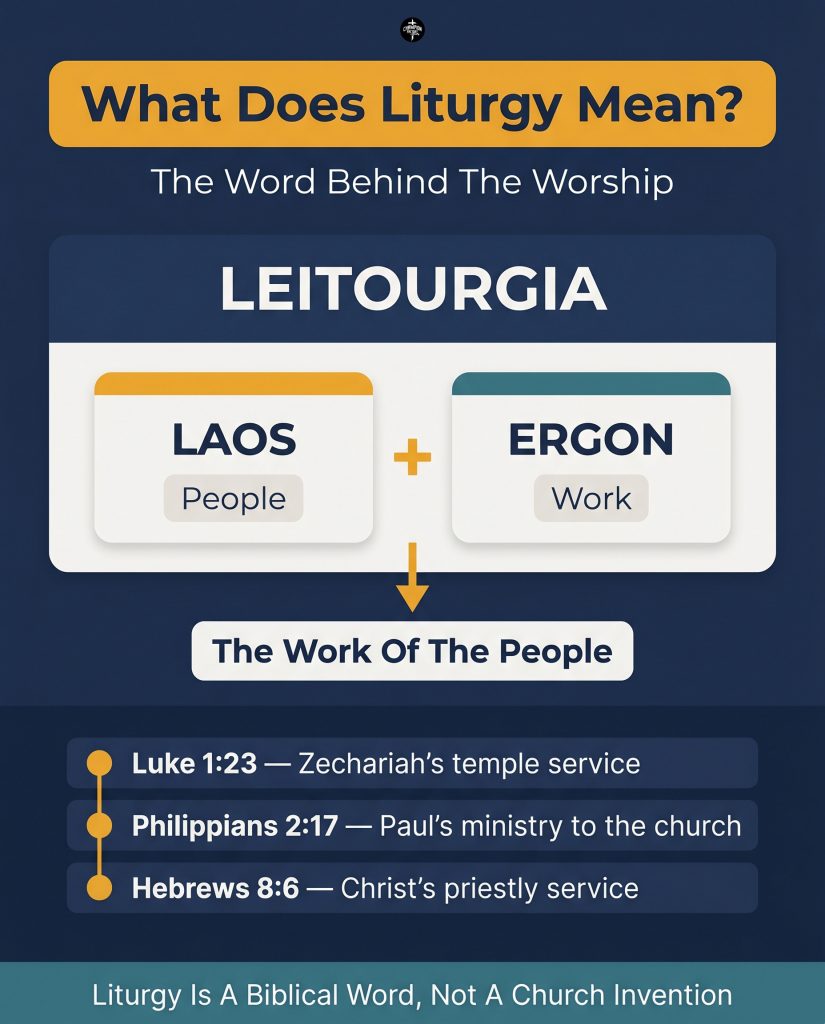
Liturgy comes from the Greek word "leitourgia," which combines "laos" meaning people and "ergon" meaning work. Together, the phrase means "the work of the people." In the church, it refers to the structured order of worship that a congregation follows together, including prayers, scripture readings, responses, songs, and declarations of faith.
The word is not a modern church invention. It appears in the New Testament itself. In Luke 1:23, it describes Zechariah completing his service in the temple. In Philippians 2:17, Paul uses it to describe his own ministry. In Hebrews 8:6, it refers to the priestly service of Christ. The term was part of everyday religious vocabulary in the early church long before it became associated with formal tradition.
Understanding this origin changes how liturgy feels. It is not something done to a congregation by clergy at the front of a room. It is something the whole gathered community does together before God.
"When people hear the word liturgy, they often assume it does not apply to them. But the moment a group of believers gathers to pray, read scripture, and worship together in any consistent pattern, they are already practicing it." Todd Medina, President and Founder, Champion Factory Ministry
Is Liturgy Found in the Bible?
Yes. Structured, repeated worship is present throughout both the Old and New Testaments. The Psalms were the liturgical prayer book of ancient Israel, sung and prayed together in communal worship. The early church continued this pattern as followers of Jesus gathered around word, prayer, bread, and water.
The Shema, drawn from Deuteronomy 6:4, was the central spoken declaration of Jewish faith. Jesus quoted it in Mark 12:29-30 as the greatest commandment. It is one of the oldest forms of liturgical confession in recorded history.
In Colossians 3:16, Paul instructs the church to use "psalms, hymns, and songs from the Spirit" as part of gathered worship. In Psalm 95:6, the congregation is called together: "Come, let us bow down in worship, let us kneel before the Lord our Maker" (NIV). These are communal, structured acts of faith.
The Lord's Prayer in Matthew 6:9-13 is itself a liturgical text. Jesus gave his followers a set form for prayer. Most Christian traditions incorporate it into weekly worship. If you have ever prayed it alongside your church, you have practiced one of the oldest liturgical forms in Christianity.
How the Early Church Used Liturgy
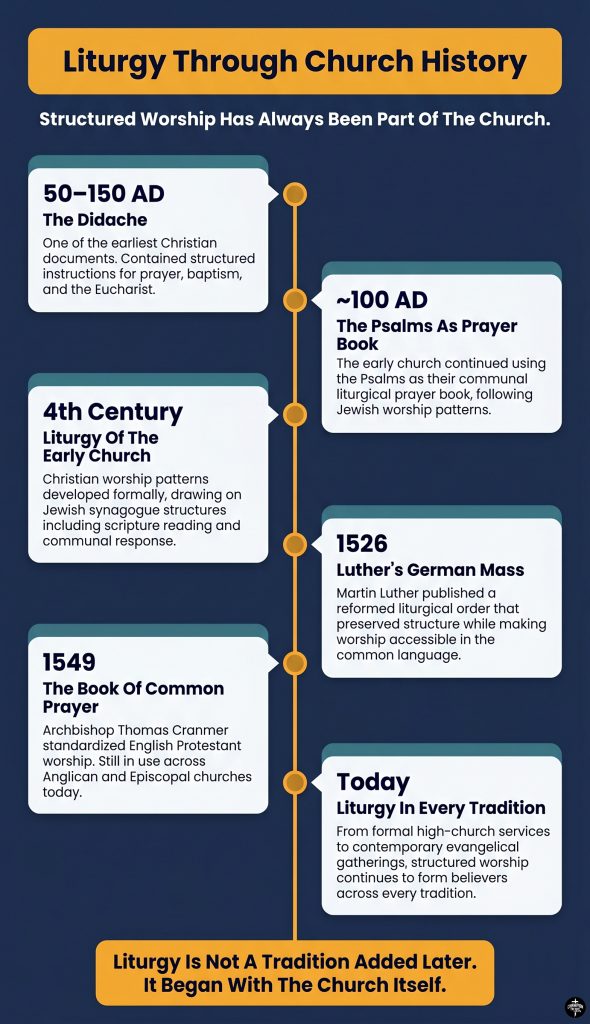
One of the oldest surviving Christian documents, the Didache, was likely written between 50 and 150 AD. It contains specific instructions for worship, including prayer forms, baptism, and the Eucharist. Structured worship did not develop centuries after Christ. It was present in the church from its earliest days, shaped by the Jewish worship patterns that Jesus and his disciples already knew.
What Liturgy Looks Like in a Church Service
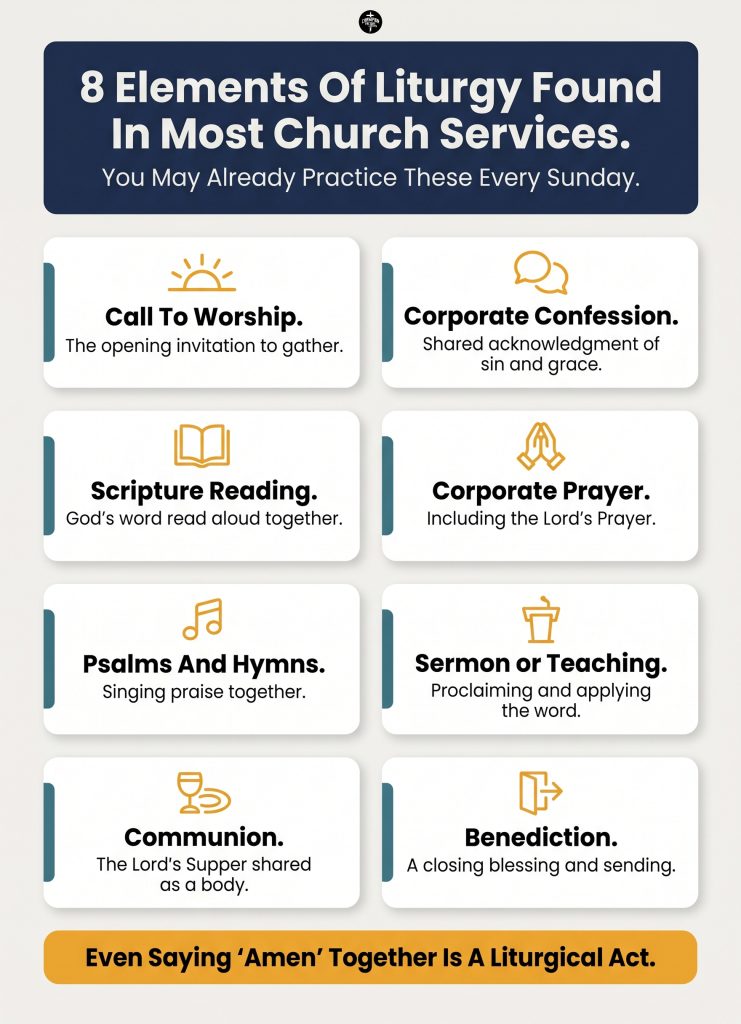
Liturgy is the order and rhythm of a worship service. It includes every repeated or structured element that a congregation practices together: the call to worship, communal prayer, scripture reading, a confession of faith, songs, the Lord's Prayer, communion, and the closing blessing.
Not every church uses the word liturgy. But most churches follow a recognizable order of worship week after week. That order is their liturgy, whether they label it or not.
Common liturgical elements include:
- An opening call to worship or greeting
- Communal confession of sin and assurance of grace
- Scripture readings
- Corporate prayer, including the Lord's Prayer
- Singing of psalms, hymns, or worship songs
- A sermon or teaching
- The Lord's Supper or communion
- A closing benediction or blessing
Even saying "amen" together at the end of a prayer is a liturgical act. The word is Hebrew, meaning "so be it" or "let it be so." Its communal use in worship appears throughout both Testaments. Liturgy is already more familiar than most people realize.
Liturgical and Non-Liturgical Worship: What Is the Difference?
Liturgical worship follows a defined order, often written down and shared across a tradition. Non-liturgical worship is more informal and may change week to week. In practice, most congregations fall somewhere in between. The difference is a matter of structure and intentionality, not biblical faithfulness.
More formally liturgical traditions include Catholic, Eastern Orthodox, Anglican, Episcopal, and Lutheran churches. These traditions follow a set order of worship, often drawn from historic texts like the Book of Common Prayer, first published in 1549. That document shaped Protestant worship broadly and remains in use today.
The Protestant Reformers valued liturgical structure as well. Martin Luther published his German Mass in 1526, retaining significant liturgical order while reforming doctrinal content. John Calvin developed a structured worship order for the church in Geneva that included scripture, prayer, preaching, and the Lord's Supper. Both men understood that ordered worship teaches and forms the people of God.
Contemporary evangelical and charismatic churches may not call their services liturgical. But a church that opens with three worship songs, moves to announcements, an offering, a sermon, and a closing prayer is following an order. That order shapes how a community experiences God, week after week.
Why Liturgy Matters for Spiritual Formation
Liturgy shapes believers over time in ways that go deeper than information alone. When a congregation returns to the same words, prayers, and rhythms of worship week after week, those words become part of how believers think, pray, and understand God. Liturgy forms faith by training the whole person, not just the mind.
Philosopher James K.A. Smith, whose work on worship and spiritual formation is widely read across evangelical and mainline traditions, writes that "you are what you love, and liturgy is the training ground for desire." Repetition in worship is not empty habit. It is how God reorders the affections of his people over time.
Dietrich Bonhoeffer described the Psalms as "the prayer book of Jesus." To pray them is to practice the very prayers that shaped Jesus's own devotional life. When believers pray them together, they join a conversation between Jesus and the Father that has continued across centuries.
Hebrews 10:24-25 frames the practice of gathering together as an act of mutual care: "Let us consider how we may spur one another on toward love and good deeds, not giving up meeting together, as some are in the habit of doing, but encouraging one another" (NIV). Regular, ordered gathering is not optional. It is the context in which believers form and sustain one another.
"Evangelism is never just a one-time encounter. It is sustained by the ongoing rhythms of worship, prayer, and scripture that a community shares together. That is what gives proclamation its roots." Art Montgomery, Global Evangelism Strategy Architect, Champion Factory Ministry
What Liturgy Offers in Difficult Seasons
Structured worship offers something especially valuable for people in hard seasons. When someone does not have words for prayer, the church's liturgy supplies them. When faith feels fragile, the congregation carries the words forward together. The same prayers said every week become an anchor when life is unstable.
This is a dimension of liturgy that most theological discussions overlook. Liturgy is the shared language the church has built over generations. It holds believers even when they struggle to hold on themselves. If you or someone you know is walking through a difficult season, support and community are available.
Common Misconceptions About Liturgy
The most common concern about liturgy is that repeating the same words leads to empty, mindless habit. This concern is understandable, but it misunderstands how liturgy works at its best. Repetition in worship is not a substitute for sincerity. It is a discipline that trains the heart toward sincerity over time.
Is Liturgy Just Going Through the Motions?
Any form of worship can become mechanical. An informal service can be performed without genuine engagement just as easily as a formal one. The issue is not structure. The issue is whether the heart is present. Liturgy provides the structure. The congregation brings the faith.
Returning to the same words week after week is an act of trust that the words of God are true enough to say again. Many believers who grew up in informal settings and later encountered liturgical worship describe a sense of being held by something larger than themselves. That steadiness is one of the things liturgy offers.
Does Liturgy Only Belong to Traditional or High-Church Settings?
No. Liturgy belongs to the whole church. It takes different forms in different traditions, from the quiet formality of an Anglican morning prayer service to the call-and-response rhythms found in many historically Black congregations to the simple shared structure of a small faith community gathering around scripture and bread. The form varies. The principle is the same. When God's people gather and worship together in a consistent pattern, they are practicing liturgy.
Worshipping Together: How Liturgy Builds Community
Liturgy is not a private practice. It is something the church does together. When a congregation recites the same creed, prays the same prayers, and shares the same table week after week, those shared acts create belonging. They bind people together across differences in background, experience, and circumstance.
This communal dimension is one of the most underappreciated aspects of liturgical worship. It is not only what the words say. It is the act of saying them together that matters. People who might otherwise have little in common find themselves standing side by side, speaking the same words before the same God. That shared practice builds something real and lasting.
At Champion Factory Ministry, community and shared faith are central to the work of discipleship and support. Whether in a small group gathering, a Nourish session, or a time of communal prayer, the rhythms of shared worship, shared scripture, and shared blessing are already at work.
Paul captures this in Colossians 3:16: "Let the message of Christ dwell among you richly as you teach and admonish one another with all wisdom through psalms, hymns, and songs from the Spirit, singing to God with gratitude in your hearts" (NIV). Corporate worship is not separate from Christian community. It is one of the primary ways community is formed.
Liturgy as the Church's Shared Language Across Generations
One of the most significant things liturgy does is carry faith from one generation to the next. When children and adults worship together using the same prayers, the same scripture, and the same rhythms, those forms become part of how faith is passed down. Liturgy is the church's way of saying: these words have held us, and they will hold those who come after us.
This is practical, not sentimental. A congregation that prays the Lord's Prayer together every week teaches it to every child in the room without a separate lesson. A congregation that reads from the Psalms together plants those words in memory in a way that persists through difficulty. The early church understood this. It is why structured worship was established early and preserved carefully.
If you are exploring liturgy for the first time or returning to it after years away, you are not picking up something new. You are reconnecting with a practice that has formed the faith of believers for two thousand years. Learn more about mentorship and spiritual guidance and how it supports that ongoing formation.
Finding Your Place in the Rhythm of Worship
Liturgy is the church's shared language for approaching God together. It is grounded in Scripture, rooted in early Christian practice, and present in some form in nearly every worshipping community. It offers structure for those who need it, words for those who cannot find their own, and belonging for those who are still finding their way.
If you are curious about what it means to grow in faith through communal worship and discipleship, we invite you to explore the Nourish program at Champion Factory Ministry, where structured spiritual growth and community come together. You can also learn more about how to get involved or explore ways to support the ministry's work.
Wherever you are in your faith journey, you do not have to find the words alone. The church has been gathering and worshipping together for a long time, and there is a place for you in that.
FAQ
What is the simple definition of liturgy?
Liturgy is the structured order of worship that a church follows together. It comes from the Greek word "leitourgia," meaning "the work of the people," and includes any repeated or shared elements of a worship service, such as prayers, scripture readings, songs, creeds, and blessings.
Is liturgy only for Catholic or traditional churches?
No. While formally liturgical traditions like Catholic, Orthodox, Anglican, and Lutheran churches have the most developed structures, nearly every Christian congregation practices some form of liturgy. Any repeated order of worship, from opening songs to a closing prayer, is liturgical in nature.
Is liturgy biblical?
Yes. The Psalms were the liturgical prayer book of Israel and the early church. The New Testament uses the Greek word "leitourgia" to describe priestly service, Paul's ministry, and the service of Christ. Jesus himself gave the church the Lord's Prayer as a structured form for communal worship.
Why do some Christians distrust liturgy?
Some believers associate liturgy with empty ritual or mechanical repetition. This concern is real, but it applies to any form of worship practiced without sincere engagement. The goal of liturgy is not to replace sincerity but to provide a shared structure within which sincere faith can be expressed and formed over time.
What does liturgy offer someone going through a hard season?
Liturgy provides words and structure when personal words are hard to find. When someone is grieving, exhausted, or spiritually uncertain, the congregation's shared prayers carry them. Returning to familiar rhythms of worship can be an anchor during seasons of change or loss.
How does liturgy support spiritual growth?
Repeated participation in liturgical worship shapes the desires, habits, and memory of believers over time. Praying the same prayers, hearing the same scripture, and worshipping alongside others regularly forms faith in ways that information alone cannot. It is a long-term practice that builds a stable foundation for the life of faith.