






Something has shifted in how many people talk about spirituality. Words like manifesting, energy healing, the universe, and consciousness have moved from niche communities into mainstream conversations, social media feeds, and some church settings. Many Christians sense something is off but are not sure how to name it or what to do.
This article will help you understand what New Age teaching is, where it shows up, and what the Bible says about testing spiritual ideas. The goal is not to create fear. The goal is to help you stand with clarity and genuine care.
What Is the New Age Movement?
The New Age movement is not a single religion with a fixed creed or leader. It is a loose collection of spiritual beliefs drawing from Eastern religions, Western occult traditions, and humanist philosophy. Its core ideas include the divinity of the self, the oneness of all reality, and the belief that spiritual progress comes from within. It has no central text, no founder, and no formal membership. That is what makes it hard to identify.
Because it has no fixed structure, New Age ideas appear in many forms. You may encounter them in astrology content, manifestation coaching, energy healing practices, guided meditation rooted in altered states of consciousness, or books that use the name of Jesus in ways that do not align with the biblical record.
Concordia Publishing House describes New Age beliefs as a mixture of Eastern religion and man-centered humanism. That combination makes them flexible enough to blend into almost any cultural setting, including spaces that use Christian language.
Why New Age Teaching Feels Appealing
New Age spirituality rarely presents itself as a threat. It presents itself as healing, peace, and connection. For people who have been hurt, who feel distant from God, or who are genuinely searching for something real, those promises feel meaningful. Understanding this helps Christians respond with compassion rather than defensiveness.
Many people drawn to New Age ideas are not rejecting God. They are searching for Him in a culture that offers many alternatives. They want peace, purpose, and a sense that they are not alone.
The longing behind that search is real and worth honoring. The problem is the direction it leads. When spiritual teaching redirects people away from the God of Scripture and toward the self, the universe, or undefined spiritual forces, it leads somewhere different from where they think they are going.
"We meet a lot of people who have been drawn to New Age ideas precisely because they are hurting and looking for something that feels true. That search matters to us. Our job is to point toward something real." — Champion Factory Ministry staff member
Someone drawn to astrology or manifesting is often carrying a genuine spiritual hunger. The response to that hunger is not judgment. It is the truth of a personal, present, and trustworthy God.
Core New Age Beliefs That Conflict With Scripture
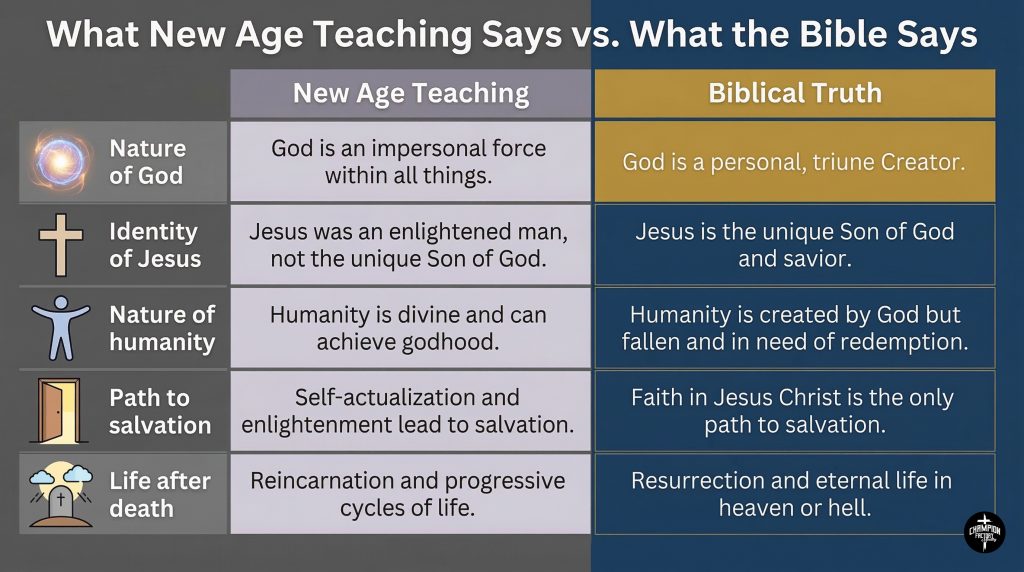
New Age teaching centers on several foundational beliefs that directly contradict what the Bible teaches. Naming these beliefs helps Christians recognize them in everyday content and conversations. You do not need a theology degree to identify them. You need to know what Scripture says and what these teachings say in return.
Here are the most common ones:
Pantheism and Divine Energy
New Age teaching holds that God is not a personal being but an impersonal energy present in all created things. The North American Mission Board notes that this view replaces the God of Scripture, who is sovereign, relational, and distinct from creation, with a force that can be accessed through practice or ritual. The Bible describes a God who speaks, acts, loves, and holds His creation accountable. That is not the god of the New Age.
Human Divinity
New Age teaching holds that people are inherently divine and can reach a state of godhood through spiritual progress. Romans 3:23 says all have sinned and fall short of the glory of God. The idea that humanity is already divine or can become so apart from Christ contradicts the biblical account of creation, the fall, and redemption.
The Law of Attraction and Manifestation
This teaching holds that thought and intention attract outcomes into a person's life. It denies sin, rejects repentance, and replaces trust in God's sovereignty with confidence in mental power. Ligonier Ministries describes this as a rejection of the biblical doctrine of human sinfulness and the need for grace through Christ. This teaching appears frequently in wellness culture and on social media without obvious religious framing.
Reincarnation
New Age teaching often includes the belief that the soul lives through multiple lives until it reaches a higher state. Hebrews 9:27 is direct: it is appointed for people to die once and after that to face judgment. Reincarnation contradicts both the finality of physical death and the Christian hope of resurrection.
Syncretism
New Age thinking treats all religious paths as equally valid roads to the same destination. Jesus said clearly, "I am the way, and the truth, and the life. No one comes to the Father except through me" (John 14:6). That is a specific claim, not one option among many.
How the New Age Movement Redefines Jesus
This is one of the clearest points of contrast between New Age teaching and biblical Christianity. The New Age uses the name of Jesus but changes what that name means. In New Age spirituality, Jesus is not the unique Son of God who died for sin and rose bodily from the dead. He is presented as one enlightened teacher among others, a model of spiritual achievement that anyone can eventually reach.
The Christian Research Institute describes the New Age view of Jesus as a man who attained spiritual enlightenment through occult practice, not the second person of the Trinity who declared Himself the only way to the Father. When a teaching uses the name of Jesus but removes His deity, His atoning death, and His resurrection, it is not presenting the Jesus of the Bible.
Doreen Virtue, a former top-selling New Age author who came to Christian faith in 2017, has noted that New Thought and New Age spirituality labels the biblical call to repentance as fear-based thinking. That reframing is significant. It positions the gospel as something to be avoided rather than received.
This matters because the language can sound familiar. A teacher who speaks warmly about Jesus, love, and spiritual growth may still be presenting a Christ who is not the Christ of Scripture. The warmth of the language is not the test. The content of the teaching is.
What the Bible Says About Testing Spiritual Teaching
The Bible does not leave believers without tools. Scripture provides a clear and practical framework for evaluating any spiritual teaching or teacher. Knowing these tests helps Christians engage confidently, not anxiously.
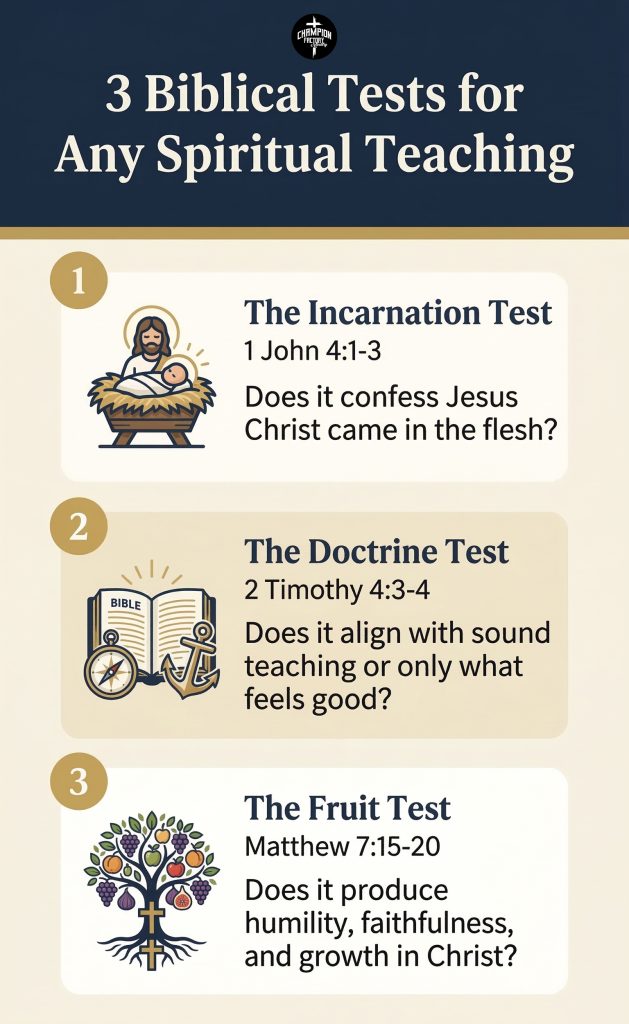
The Test of 1 John 4:1 to 3
The Apostle John writes: "Beloved, do not believe every spirit, but test the spirits to see whether they are from God, for many false prophets have gone out into the world." His specific test is this: any spirit that does not confess Jesus Christ as having come in the flesh is not from God.
Does the teaching affirm Jesus as fully God and fully human, who came in the flesh, died, and rose again? If it does not, or if it redefines what those words mean, the test has already answered the question.
The Warning of 2 Timothy 4:3 to 4
Paul warns that a time will come when people will not endure sound teaching but will gather teachers who confirm their own desires. He describes this as having itching ears. The result is turning away from truth and toward myths.
This passage does not describe people who are hostile to God. It describes people who want spiritual content that feels good and costs little. New Age teaching is well-suited to providing exactly that.
The Fruit Test of Matthew 7:15 to 20
Jesus warns about false prophets who come dressed as sheep and instructs His followers to look at fruit. Does this teaching produce people who are growing in humility, love, service, and faithfulness? Or does it produce people who are increasingly self-focused, spiritually unstable, or disconnected from community and accountability?
Long-term fruit reveals the root.
Practical Steps to Grow in Biblical Discernment
Discernment is not a defensive posture. It is the natural result of knowing what is true. Dave Jenkins of Servants of Grace Ministries writes that discernment is about being so grounded in truth that anything false becomes immediately obvious. That kind of grounding grows through regular, consistent habits. It is available to every believer, regardless of theological background.
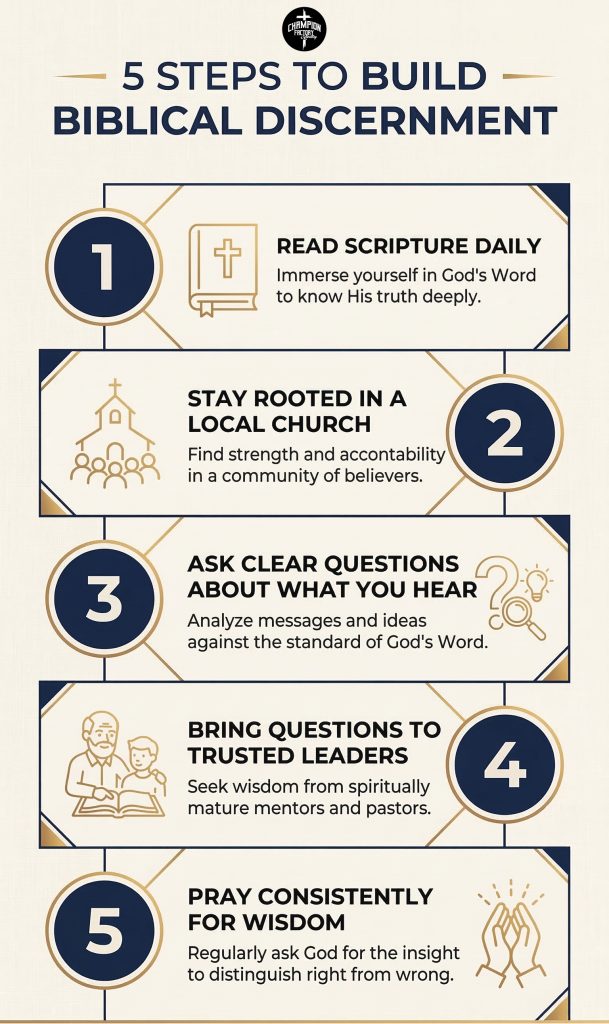
Here are practical steps to build it:
- Read Scripture consistently. You cannot recognize a counterfeit without knowing the original. Daily Bible reading, even in small portions, builds the foundation over time.
- Stay connected to a local church. John Piper of Desiring God describes belonging to a healthy, Bible-preaching church as one of the best protections against false teaching. Isolation increases vulnerability. Community builds strength.
- Ask clear questions about any teaching you encounter. Does it affirm Jesus as God come in the flesh? Does it acknowledge human sinfulness and the need for grace? Does it point to Scripture as the standard? Does it call people toward repentance and genuine transformation?
- Bring questions to trusted spiritual leaders. When something feels off, name it and ask. Pastors, elders, and mature believers can help you work through what you have encountered.
- Pray for wisdom. James 1:5 promises that God gives wisdom generously to those who ask. Biblical discernment is not just intellectual. It includes prayer and dependence on the Holy Spirit.
Spiritual growth is a community process. The Nourish discipleship program at Champion Factory Ministry is built around this kind of grounded formation, offering people a space to grow in faith alongside others who take truth and people seriously.
How to Respond When Someone You Love Holds New Age Beliefs
Many readers are not personally drawn to New Age ideas but care deeply about someone who is. The right response to that situation is neither silence nor confrontation. It is patient, honest, and rooted in relationship. People are far more open to hard conversations with people they genuinely trust.
A few principles to hold:
- Lead with the relationship. Before you address the belief, invest in the person. Know their story and what drew them to these ideas.
- Ask genuine questions. Understanding the need behind the belief helps you speak to the person, not just the doctrine.
- Be honest without being harsh. You can clearly and calmly say that you see things differently without attacking the person or dismissing what they care about.
- Share what you believe and why. Your own experience of who Jesus is and what He has done is a gift. You do not need to win an argument to plant a seed.
- Pray consistently. The work of bringing someone from spiritual confusion to truth is not yours alone to carry. Faithfulness in prayer is not passive. It is active and important.
If someone's involvement in New Age practices is affecting their mental health, relationships, or safety in significant ways, gently encourage them to speak with a pastor or a qualified counselor. Spiritual care and professional support work well together. This article is written for spiritual encouragement and education, not as a substitute for pastoral guidance or professional mental health support.
Grounded in Truth, Ready to Engage With Grace
Biblical discernment is not about suspicion or spiritual superiority. It is about caring enough about truth to hold it clearly and share it with patience.
New Age teaching is not fading from the cultural conversation. It will continue to appear in wellness spaces, online content, popular books, and personal conversations. Christians who know what they believe and why are better equipped to engage those spaces with both confidence and compassion.
The same faith that teaches us to test every spirit also calls us to respond to people with patience, love, and hope. Those two things belong together.
If you are working through questions about faith, rebuilding your spiritual footing after a difficult season, or looking for a community that takes both truth and people seriously, we invite you to explore how Champion Factory Ministry walks alongside individuals and families through that kind of journey. You can also learn more about how to get involved or support this work.
FAQ
What is the New Age movement?
The New Age movement is a loose collection of spiritual beliefs that emphasizes personal divinity, universal energy, and self-realization. It draws from Eastern religions, occult traditions, and humanist philosophy. It has no central leader or text and appears in many cultural forms including wellness practices, astrology, and manifestation content.
Are New Age beliefs common among Christians?
Yes. According to Pew Research, about 61 percent of self-identified Christians hold at least one New Age belief. Many believers encounter New Age ideas without recognizing them because they often appear in language that sounds spiritual or even Christian.
What is the clearest biblical test for false teaching?
1 John 4:1 to 3 gives a direct test: does the teaching confess Jesus Christ as having come in the flesh? Any spirit or teaching that does not affirm this is not from God. The fruit test from Matthew 7:15 to 20 adds a practical second layer: does the teaching produce people growing in Christlike character over time?
Is manifesting a New Age belief?
Yes. Manifestation is rooted in the Law of Attraction, a core New Age concept that teaches that thought and intention attract outcomes. This teaching denies sin, rejects repentance, and places the self in the role that Scripture gives to God.
Can someone mix Christian faith with New Age beliefs?
Some people blend Christian language with New Age ideas without recognizing the conflict. The problem is that New Age spirituality redefines key Christian terms including the nature of Jesus, sin, salvation, and God. When those definitions change, the teaching being followed is no longer biblical Christianity, even if familiar words remain.
How do I grow in discernment?
Read Scripture consistently, stay connected to a local church, ask clear questions about any teaching you encounter, bring questions to trusted leaders, and pray for wisdom. Discernment grows over time through these regular habits and is available to every believer.