





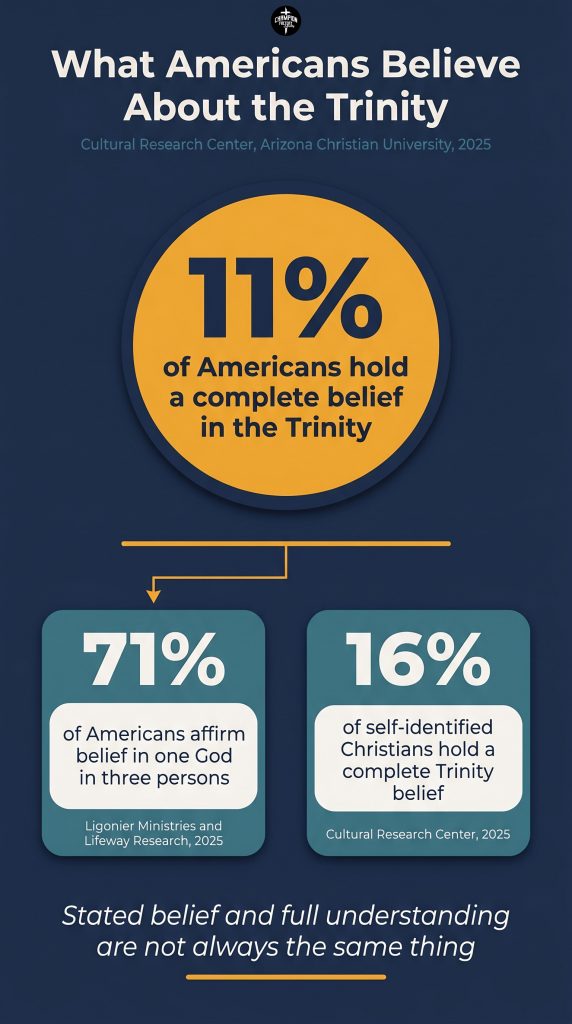
Most Christians believe in the Trinity, but many find these two terms confusing the first time they encounter them. A 2025 survey from the Cultural Research Center at Arizona Christian University found that only 11% of Americans hold a complete belief in the Trinity. Most people confess the doctrine without being able to explain what it means or why it matters for daily life.
That gap is not a sign of weak faith. It is an invitation to go deeper. These two terms answer two of the most important questions anyone can ask about God: Who is he? And what has he done for us? This article answers both in plain language and connects both answers to the faith you already hold.
What Is the Ontological Trinity?
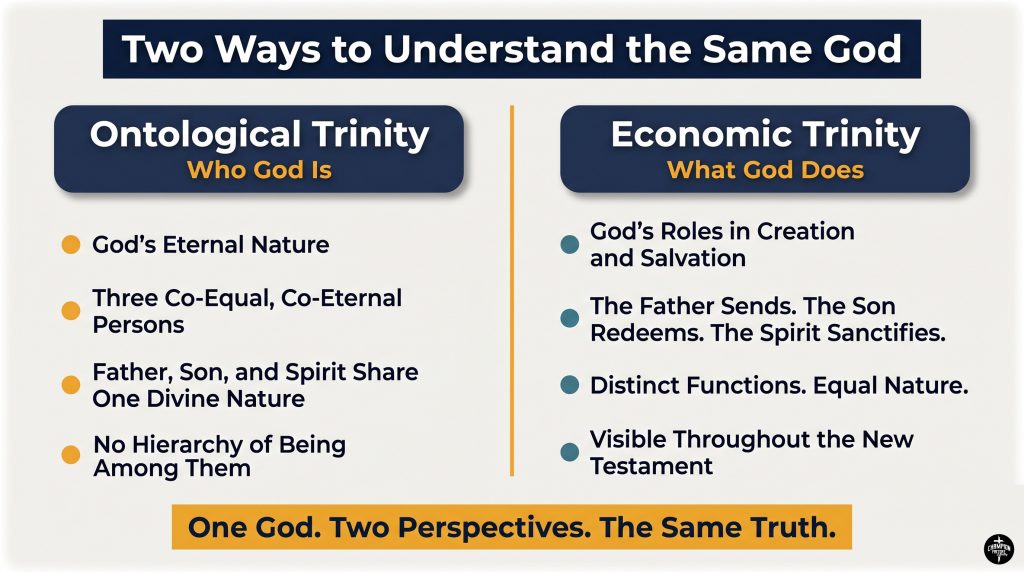
The Ontological Trinity describes who God is in his eternal nature. "Ontological" comes from ontology, the philosophical study of being and existence. When theologians speak of the Ontological Trinity, they are saying that God exists as three persons, Father, Son, and Holy Spirit, who share one divine nature. All three are co-equal, co-eternal, and fully God. There is no hierarchy of being among them.
This concept is grounded in some of the most familiar passages in Scripture. John 1:1-2 says, "In the beginning was the Word, and the Word was with God, and the Word was God. He was in the beginning with God" (ESV). The Son was not created. He existed alongside the Father before anything else came into being. He is God.
The church has affirmed this from its earliest centuries. The First Council of Nicaea in 325 AD, where approximately 318 bishops gathered from across the known world, formally declared the Son to be "very God of very God," equal in essence to the Father. The First Council of Constantinople in 381 AD extended that affirmation to include the Holy Spirit, confirming one divine substance shared by three co-equal persons.
These councils did not invent the doctrine. They protected what the church had already understood from Scripture. God is not three separate gods. The Father, Son, and Spirit are also not three modes or masks of a single figure who appears differently in different contexts. They are three distinct persons who share one divine nature.
The term "ontological Trinity" is sometimes also called the "immanent Trinity" or the "essential Trinity." All three phrases refer to the same truth: who God is in himself, apart from creation.
What Is the Economic Trinity?
The Economic Trinity describes what God does. The word "economic" comes from the Greek oikonomikos, meaning "the arrangement of activities." This term has nothing to do with finance. It refers to God's ordered plan for creation and salvation. When theologians speak of the Economic Trinity, they are describing the distinct roles the Father, Son, and Spirit each take on in history and in the life of every believer.
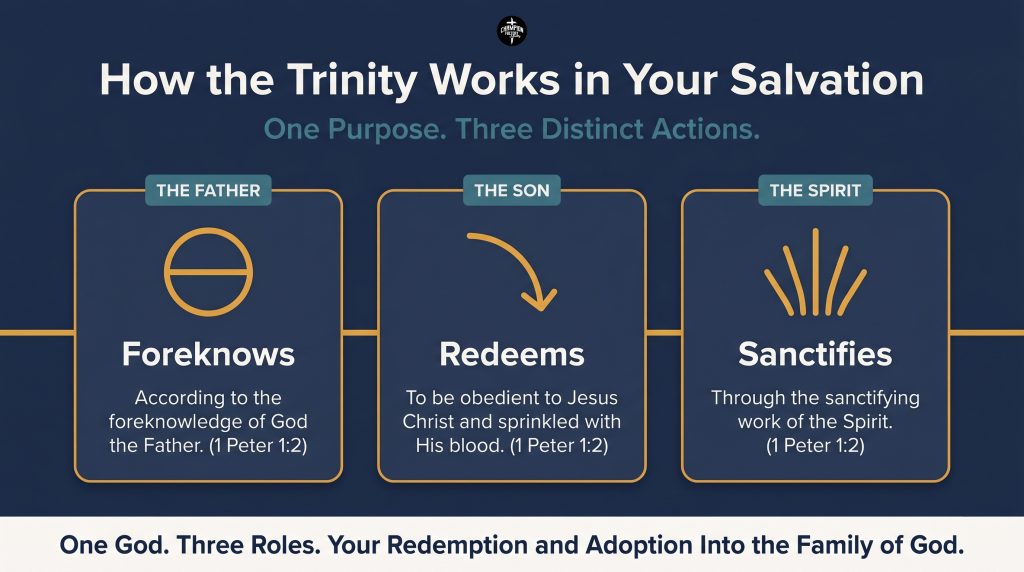
Galatians 4:4-6 makes this plain: "But when the set time had fully come, God sent his Son, born of a woman, born under the law, to redeem those under the law, that we might receive adoption to sonship. Because you are his sons, God sent the Spirit of his Son into our hearts, the Spirit who calls out, Abba, Father" (NIV).
Three persons. Three distinct actions. One purpose: your redemption and adoption into the family of God.
First Peter 1:2 covers the same ground in a single sentence. The Father foreknows. The Spirit sanctifies. The Son redeems by his blood (NIV). The Economic Trinity is not a later theological invention. It appears throughout the New Testament wherever God's work in salvation is described.
"In our discipleship work, we often find that people know they believe in God but are unsure how to trust him when life gets hard. Walking through what the Father purposed, what the Son accomplished, and what the Spirit is actively doing gives people a concrete faith to stand on." Todd Medina, President and Founder, Champion Factory Ministry
If the Father Sends the Son, Does That Mean Jesus Is Less Than God?
No. The Economic Trinity describes functional differences, not differences in worth, nature, or dignity. Jesus taking on a role of service in history did not change who he is in eternity. Theologians call this functional subordination. The Son chose to serve the Father's mission without surrendering his divine nature or his equality within the Godhead.
Philippians 2:6-8 addresses this directly: "Who, being in very nature God, did not consider equality with God something to be used to his own advantage; rather, he made himself nothing by taking the very nature of a servant, being made in human likeness. And being found in appearance as a man, he humbled himself by becoming obedient to death, even death on a cross" (NIV).
Jesus was fully God. He chose to serve. These two realities are not in conflict. His economic role, coming as a servant and dying in our place, was an expression of love, not evidence of inferiority.
This distinction matters for the gospel itself. If Jesus were less than God, his sacrifice would not be sufficient to carry the weight of human sin. The Ontological Trinity confirms that the One who came for us is truly and fully God.
The God Who Acts in History Is the Same God Who Exists in Eternity
Understanding how the Ontological and Economic Trinity connect builds trust in God's character. Karl Rahner, one of the most influential theologians of the twentieth century, proposed what is now called Rahner's Rule: the God who reveals himself in history is the same God who exists in eternity. There is no hidden God behind the one you encounter in Scripture, in prayer, and in your own story.
This connection has real weight for everyday faith. The love the Father showed in sending the Son is genuine. The Spirit who lives in you is not a lesser representative. Millard Erickson, theologian and author of Christian Theology, describes the Spirit's role this way: "The Holy Spirit is active within the lives of believers; he is resident within us. He is the particular person of the Trinity through whom the entire Triune Godhead currently works in us."
"The question we hear most in evangelism is whether God is actually present with people. The Economic Trinity answers that directly. The Father sent the Son. The Spirit was sent into the hearts of believers. God did not announce a plan for salvation. He enacted it." Art Montgomery, Global Evangelism Strategy Architect, Champion Factory Ministry
Fred Sanders, systematic theologian at Biola University and author of The Deep Things of God, puts the connection plainly: "Salvation is Trinitarian, whether you know it or not; breakthroughs can happen when you move from not knowing to knowing." Understanding these two terms does not add to your salvation. It deepens your confidence in it.
What You Believe Has Room to Hold You
The Ontological Trinity and the Economic Trinity are not competing ideas. They describe the same God from two angles: who he is, and what he has done.
God is three co-equal persons sharing one divine nature. That is the Ontological Trinity. The Father sent the Son, the Son redeemed you, and the Spirit now lives in you. That is the Economic Trinity. Together, these two truths describe an eternal, unchanging God who came into history to redeem you and has not withdrawn.
At Champion Factory Ministry, our Nourish discipleship program exists to help believers grow in exactly this kind of understanding. Knowing who God is shapes how we pray, how we trust him through hard seasons, and how we walk with him over time.
If you want to go deeper, bring these questions to your local church or a trusted pastor. This article is an introduction. The questions it raises are worth staying with through your small group, your own study, or a conversation with someone who has walked with God longer than you have.
Jesus gave the church its commission with Trinitarian language: "Go and make disciples of all nations, baptizing them in the name of the Father and of the Son and of the Holy Spirit" (Matthew 28:19, NIV). One name. Three persons. A God worth knowing more fully.
FAQ
What does "ontological" mean in theology?
Ontological refers to the nature of being. In theology, the Ontological Trinity describes who God is in his eternal nature: three co-equal and co-eternal persons, Father, Son, and Holy Spirit, sharing one divine essence.
What is the difference between the Ontological Trinity and the Economic Trinity?
The Ontological Trinity focuses on who God is. The Economic Trinity focuses on what God does. Both describe the same God. One describes his eternal nature. The other describes his active roles in creation, redemption, and the life of every believer.
Does the Economic Trinity mean Jesus is not fully God?
No. The Economic Trinity describes functional roles, not levels of divine nature or worth. Jesus chose to take on a role of service and obedience to the Father in history. That choice did not change his eternal equality with the Father. He is fully God.
Is the word "trinity" in the Bible?
The word "trinity" does not appear in the Bible, but the doctrine is drawn directly from Scripture. Passages like Matthew 28:19, Galatians 4:4-6, John 1:1-2, and 1 Peter 1:2 all reflect a Trinitarian understanding of God.
What is Rahner's Rule?
Rahner's Rule is a theological principle from Karl Rahner (1904-1984). It states that the God who reveals himself in history through creation and salvation is the same God who exists in eternity. The God you meet in Jesus is not a partial representation. He is the real God.
Is the Ontological Trinity the same as the Immanent Trinity?
Yes. "Ontological Trinity," "immanent Trinity," and "essential Trinity" are all terms for the same concept. Each one refers to who God is in his eternal nature, apart from any action in creation or history.