






Propitiation is not a word most people use in daily conversation. Many encounter it in a scripture passage, a sermon, or a Bible study and move past it without a clear understanding of what it means. That gap matters, because propitiation sits at the center of what the New Testament teaches about the cross.
This article explains what propitiation means, where it appears in the Bible, and why it matters practically for how you carry guilt, find assurance, and relate to God and others. You do not need a theology degree to understand this. The concept is profound, but it is also deeply personal.
What Propitiation Means
Propitiation is the act by which God's righteous response to sin is fully satisfied through the sacrifice of Jesus Christ. The word carries two connected ideas: the wrath that sin deserves is addressed, and the broken relationship between God and the sinner is restored. God provided the sacrifice himself. That is the foundation of the entire concept.
In the Bible, God's wrath is not irrational anger or personal hostility. It is the holy and just response of a perfect God to sin and rebellion. A God who is truly good cannot be indifferent to evil. Wrath, in this context, is the consistent and righteous opposition of God's nature to everything that corrupts and destroys.
Because God is both just and loving, his justice demanded that sin be dealt with fully. His love desired that sinners be forgiven and restored. Propitiation is the resolution. At the cross, God provided the sacrifice that his own justice required so that his love toward sinners could be expressed without compromise.
The Gospel Coalition defines it this way: propitiation refers to the turning away of God's wrath as the just judgment of sin through God's own provision of the sacrifice of Jesus Christ.
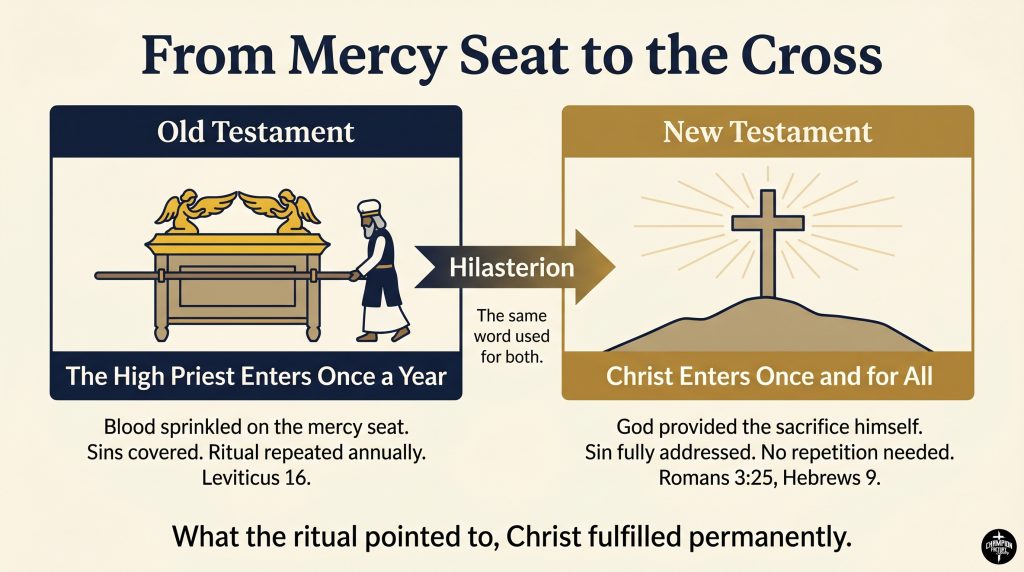
The Old Testament Picture Behind the Word
The Greek word used for propitiation in the New Testament is hilasterion. This is the same word the Greek Old Testament uses for the mercy seat, the gold lid placed over the Ark of the Covenant. On the Day of Atonement, the high priest sprinkled blood on this mercy seat to cover the sins of the people. When New Testament writers used this word to describe Christ, they were pointing to him as the fulfillment of everything that ritual represented.
The Day of Atonement and What It Pointed To
Leviticus 16 describes the Day of Atonement in detail. Once a year, the high priest entered the Holy of Holies, the innermost room of the tabernacle. He carried the blood of a sacrificial animal and sprinkled it on the mercy seat to atone for the sins of Israel. No one else could enter. The ritual was precise and deliberate.
This annual act was never the final answer. It was repeated each year because it pointed forward to something greater. The book of Hebrews describes these rituals as a foreshadowing of Christ's sacrifice. Where the high priest entered once a year with the blood of animals, Christ entered once and for all with his own blood, making permanent what the Old Testament ritual could only anticipate.
The Meaning Behind the Hebrew Root
The Hebrew word for the mercy seat is kapporeth, from the verb kipper, meaning to cover. When Paul chose hilasterion in Romans 3:25 to describe Christ, he was drawing a direct line from that physical place in the tabernacle to the cross. As Ligonier Ministries explains, Christ is the acceptable, wrath-satisfying sacrifice who fulfills what the mercy seat always represented. He did not just provide a sacrifice at the mercy seat. He became it.
God Provided the Sacrifice Himself
One of the most important and most misunderstood aspects of propitiation is that God is both the one whose wrath needed to be satisfied and the one who provided the means of satisfying it. This is not a picture of humans working to appease an angry deity. It is a picture of a loving God absorbing the cost of his own justice so that broken people could be restored to relationship with him.
In many ancient religions, people brought offerings to win divine favor. The dynamic moved from human to divine. The Bible presents the opposite. God takes the initiative. He provides what his own justice requires, at his own cost.
First John 4:10 says this plainly: "In this is love, not that we loved God but that he loved us and sent his Son to be the propitiation for our sins."
This verse sits at the heart of the concept. Propitiation did not create God's love for us or persuade a reluctant God to care. As Easton's Bible Dictionary explains, propitiation is the means by which it becomes consistent with God's character and government to pardon and bless the sinner. The love was always there. The propitiation is how that love is expressed justly.
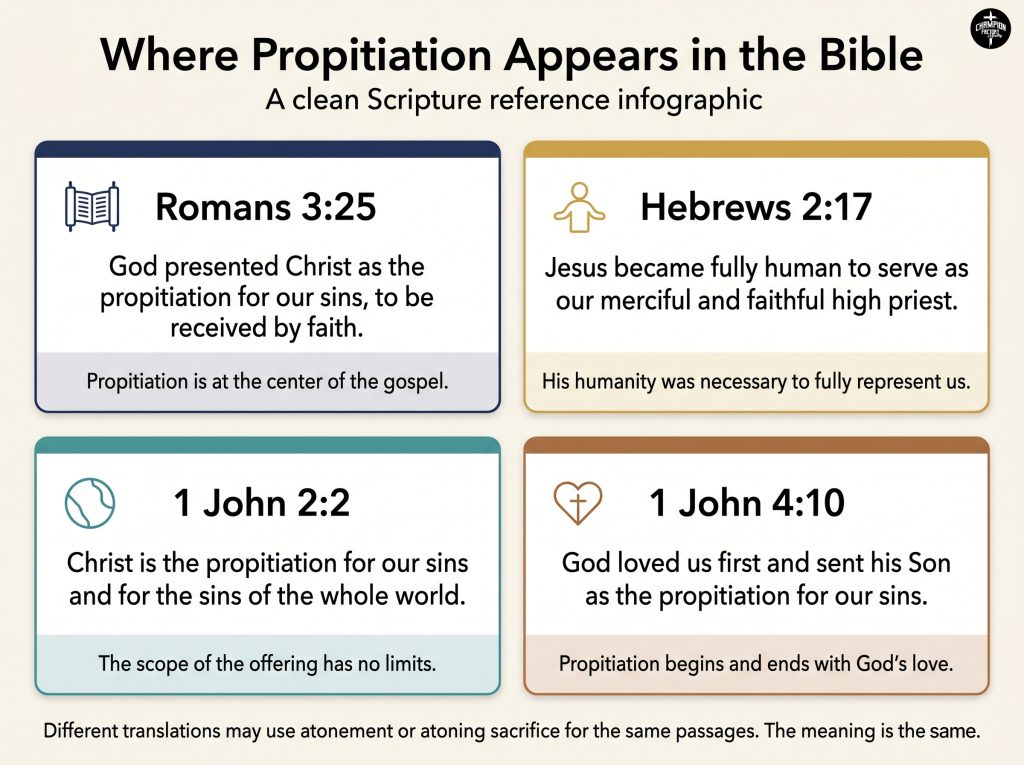
Where Propitiation Appears in the Bible
The word propitiation appears in four key New Testament passages: Romans 3:25, Hebrews 2:17, 1 John 2:2, and 1 John 4:10. Readers using different Bible translations may find words like atonement, atoning sacrifice, or sacrifice for sin instead. These are translation choices for the same underlying Greek words, hilasterion and hilasmos. The concept and the theological weight behind each passage remain the same.
Here is a brief look at each passage:
- Romans 3:25: Paul writes that God presented Christ as a propitiation by his blood, to be received by faith. This passage places propitiation at the center of the gospel. It connects Christ's sacrifice directly to God's righteousness and the forgiveness of sin.
- Hebrews 2:17: The author explains that Jesus had to become fully human so that he might become a merciful and faithful high priest and make propitiation for the sins of the people. Christ's shared humanity was not incidental. It was necessary for him to fully represent us before God.
- 1 John 2:2: John writes that Christ is the propitiation for our sins, and not for ours only but also for the sins of the whole world. The scope of the offering is not limited to one group or one generation.
- 1 John 4:10: John places propitiation inside the definition of love itself. God sent his Son as the propitiation for our sins. This is what love looks like in action.
"First John 2:2 is the foundation of everything we do in evangelism. Christ's propitiation was not offered to a select few. It was made for the whole world. That truth drives us to reach every person we can."
— Art Montgomery, Global Evangelism Strategy Architect, Champion Factory Ministry
GotQuestions.org provides a helpful overview of how these passages work together and why translation differences across Bible versions need not cause confusion.
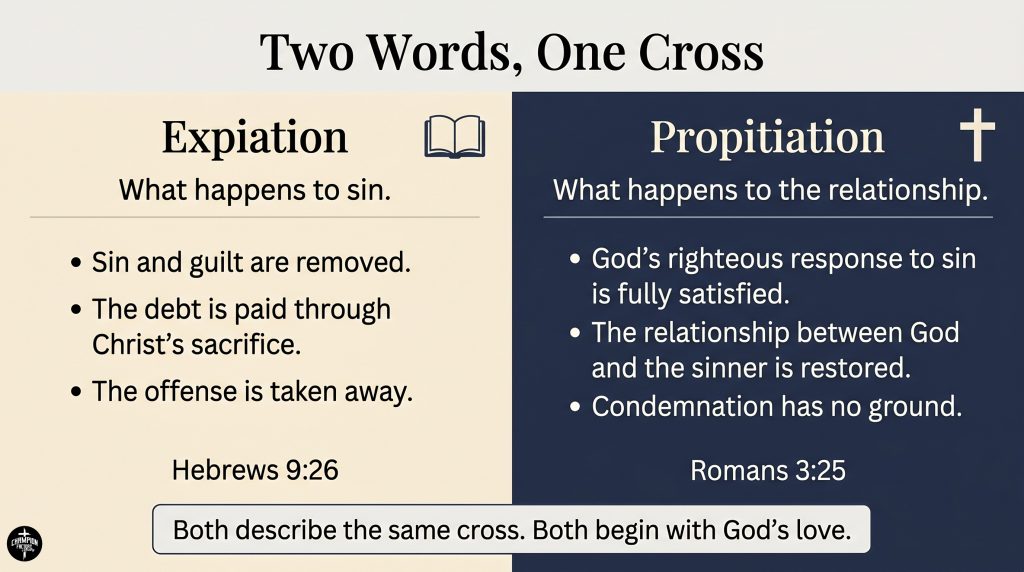
Propitiation and Expiation: What Is the Difference?
Propitiation and expiation are closely related but describe two different dimensions of Christ's work. Expiation is the removal of sin and guilt through Christ's sacrifice. Propitiation is the change in God's disposition toward the sinner that results from that removal. Expiation focuses on what happens to sin. Propitiation focuses on what happens to the relationship between the sinner and God.
Ligonier Ministries explains it this way: expiation is what Christ did at the cross. Propitiation is the result. God's disposition toward the sinner changes because sin has been fully addressed. The two concepts always occur together but describe distinct aspects of the same act.
A simple way to hold both together:
- Expiation: Sin is removed from the sinner through Christ's sacrifice.
- Propitiation: God's wrath is turned away, and the relationship is restored.
Both point to the same cross. Both are expressions of the same love.
Why Some Translations Choose One Word Over the Other
Some Bible translations use propitiation while others prefer expiation, atonement, or atoning sacrifice. This reflects a genuine discussion among scholars about which English word best captures the range of meaning in the original Greek. Neither choice indicates a theological error. Both are attempting to represent the same redemptive reality.
Why This Truth Changes How You Live
Because Christ fully satisfied God's justice at the cross, there is nothing left for the believer to earn or repay. Propitiation is the foundation of assurance. It means guilt no longer has the final word. It means the distance between you and God has been closed, not by your effort, but by his. That shapes how you carry your past, how you approach God daily, and how you see the people around you.
Romans 8:1 builds on the propitiation described in Romans 3:25: "There is therefore now no condemnation for those who are in Christ Jesus." Because the wrath was fully satisfied, condemnation has no ground.
For anyone carrying long-standing guilt, shame, or the sense that they are too far gone to be received by God, propitiation speaks directly to that weight. God did not wait for you to put yourself in order before moving toward you. He moved toward you at the highest possible cost. That is not a reason for carelessness. It is a reason for genuine, settled peace.
"Understanding that God moved toward us first changes everything about how we serve. We don't wait for people to have it all together. We go toward them, just as God did."
— Todd Medina, President & Founder, Champion Factory Ministry
This truth also shapes how we see and serve others. At Champion Factory Ministry, the work of going toward people and offering care without conditions reflects something real about the character of a God who reached toward humanity first. If you are exploring faith or looking for practical spiritual support, the Nourish discipleship program offers a grounded place to grow.
A Truth Worth Carrying: What Propitiation Offers Every Believer
Propitiation is not a term to master and set aside. It is a truth to return to regularly, especially in seasons when guilt feels heavy or faith feels shaky.
God addressed sin seriously because sin is serious. He provided the answer himself because his love toward us is serious. Those two realities meet at the cross in a way that is both just and merciful. Neither quality was set aside for the other.
Dr. Burk Parsons of Ligonier Ministries puts it plainly: propitiation is not a vocabulary word to file away. The concept runs through the entire Bible. It is woven into the narrative of scripture from the sacrificial system of the Old Testament through the declaration of Romans 8:1. Knowing this word well means knowing the gospel well.
If you are walking through spiritual questions, looking for a community that takes both faith and practical care seriously, or simply want to connect with others on this journey, we invite you to get involved with Champion Factory Ministry. Faith is not meant to be walked alone.
FAQ
What Does Propitiation Mean in Simple Terms?
Propitiation means that God's righteous response to sin was fully satisfied through the death of Jesus Christ. God provided the sacrifice himself. Because of this, the debt of sin is paid and relationship with God is restored for those who believe.
Is Propitiation the Same as Atonement?
They are related but not identical. Atonement is the broader term for reconciliation between God and humanity through Christ's work. Propitiation describes a specific aspect of that work: the satisfying of God's just response to sin. Some Bible translations use these words interchangeably.
What Is the Difference Between Propitiation and Expiation?
Expiation refers to the removal of sin and guilt. Propitiation refers to the restored relationship with God that results from that removal. Expiation focuses on sin. Propitiation focuses on the relationship between the sinner and God.
Does Propitiation Mean God Was Angry at Us?
God's wrath in the Bible is his holy and just response to sin, not personal hostility or arbitrary anger. Propitiation means that response was fully addressed at the cross. For those who trust in Christ, condemnation is gone and relationship with God is fully restored.
Why Do Different Bible Translations Use Different Words?
Some translations use propitiation while others use atonement, atoning sacrifice, or sacrifice for sin. These are translation choices for the same Greek words, hilasterion and hilasmos. The concept and the theological meaning are the same regardless of which word your translation uses.