






Romans 3 is dense. The theological terms come quickly, and the first half of the chapter is not easy to sit with. Paul builds a careful argument about human sinfulness and the failure of the law to fix it, and that weight is real before the chapter turns.
But it does turn. Romans 3 is also one of the most freeing chapters in the entire Bible. If you have ever wondered whether God's grace could reach someone with your specific history, this chapter was written with you in mind. This article walks through what Paul is saying, explains the key terms in plain language, and shows why the message of Romans 3 still matters today.
What Romans 3 Is About
Romans 3 is a theological turning point. Paul has spent the first two and a half chapters of his letter making an airtight case that no person, regardless of religious background, can earn a right standing before God through personal effort. Chapter 3 completes that argument and then turns to the good news: God has provided a different way.
Paul was writing to Christians in Rome, a community made up of both Jewish and Gentile believers. Throughout chapters 1 through 3, he addresses both groups equally. Jews who followed the law. Gentiles who lived without it. His conclusion is the same for both: all people fall short, and all people need what God alone can provide.
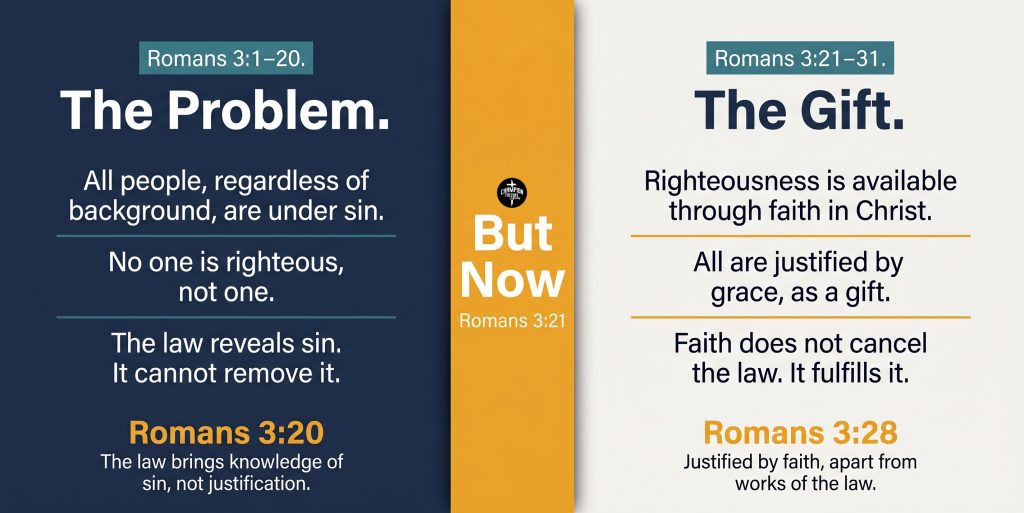
The chapter divides into two clear movements. Verses 1 through 20 establish the problem. Verses 21 through 31 announce the solution. Both halves matter. You cannot fully understand the relief of the second half without first sitting with the honesty of the first.
What Paul Teaches About Sin in Romans 3:1-20
In the first half of Romans 3, Paul establishes that every person, without exception, has sinned. He draws from multiple Old Testament passages to show this is not a new idea. The diagnosis runs through all of Scripture. Paul quotes at least six passages in verses 10 through 18 alone, including Psalm 14. The law did not create this problem. It named it.
Paul quotes from Psalm 14 directly: "None is righteous, no, not one" (Romans 3:10, ESV). This is not an accusation aimed at a specific group. It is a statement about the shared human condition.
Why Paul Spends So Much Time on Sinfulness
Many readers ask why Paul takes so long on the problem before getting to grace. The logic is deliberate. A person cannot fully receive a gift if they have not understood why they need it. Paul wants every reader to see that no background, religious effort, or moral record closes the gap between humanity and God.
What the Law Can and Cannot Do
Romans 3:20 states that no person is justified before God through keeping the law. Paul clarifies that the law's function is to reveal sin, not remove it. The law shows a person where they fall short of God's standard. But it has no power to change that reality or restore the relationship with God that sin has broken.
This was a significant claim for Paul's Jewish audience. He is not criticizing the law. He is clarifying its purpose. As Bible.org notes in its study of Romans 3, the law points to humanity's need for something only God can provide.
The Most Important Pivot in Romans 3
Romans 3:21 opens with two words that change everything: "But now." After a long and honest look at the human condition, Paul shifts direction. He has established that no person can reach God through personal effort. Now he turns to what God has done instead.
This is where the chapter turns. The weight of verses 1 through 20 makes what follows that much clearer. Paul is not changing the subject. He is revealing the answer to the problem he has been building toward throughout the letter.
"In evangelism, the turn from diagnosis to gospel is everything. That two-word phrase, 'but now,' is where Paul stops building the case and starts announcing the answer. I have seen it land with people who had given up on themselves." Art Montgomery, Global Evangelism Strategy Architect, Champion Factory Ministry
For any reader who has carried shame, exhaustion, or doubt about whether God's grace could apply to them personally, this moment matters. Paul's announcement is not conditional. The work has already been done. What follows is his explanation of how.
What Justification by Faith Means
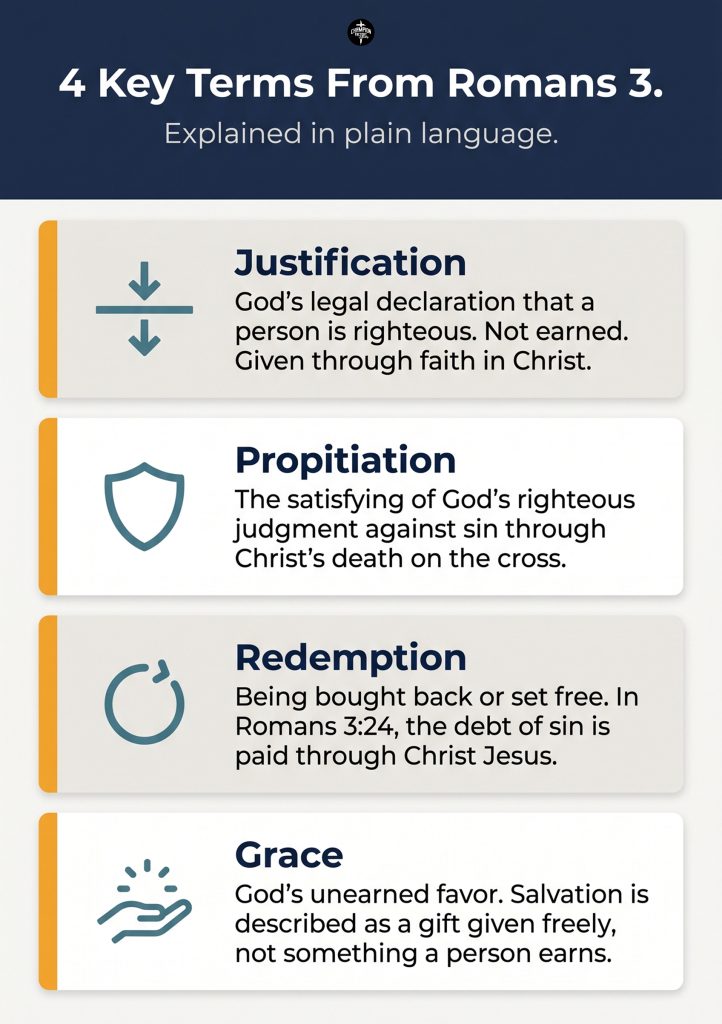
To be justified, in Paul's language, is to be declared righteous before God. It is not a moral improvement you achieve over time. It is a declaration God makes about a person on the basis of what Christ has already done. Romans 3:28 states it plainly: "one is justified by faith apart from works of the law" (ESV).
Romans 3:23-24 brings the diagnosis and the gift together in back-to-back sentences: "for all have sinned and fall short of the glory of God, and are justified by his grace as a gift, through the redemption that is in Christ Jesus" (ESV).
Justification is a legal term. Think of a court in which the verdict is not earned but given. The debt exists. The sentence is real. But someone else has stepped in and paid what was owed. That is the framework Paul works within throughout this passage.
John Piper, founder and teacher at Desiring God, writes that the doctrine of justification by faith alone is the heart of the gospel itself. It is not a reward believers earn after enough right behavior. It is what God gives at the beginning, through faith.
What Propitiation Means in Plain Language
Romans 3:25 introduces a word that stops many readers: propitiation. It refers to the satisfying of God's righteous judgment against sin. Sin carries real consequences. God's justice requires those consequences to be addressed. Through Christ's death on the cross, the debt was paid and justice was satisfied.
D.A. Carson, co-founder of The Gospel Coalition and emeritus professor of New Testament at Trinity Evangelical Divinity School, describes the cross as demonstrating both God's justice and His grace at the same time. Both are present in Romans 3:25. Neither cancels the other.
Is Grace Really for Everyone?
Romans 3:22 states directly that there is "no distinction." The grace of God, made available through faith in Jesus Christ, extends to every person regardless of background, history, or current circumstances. Paul makes this point deliberately. No group holds an advantage. No history disqualifies a person from receiving what God offers.
This is one of the most significant statements in the chapter for anyone who has ever believed they were too far gone. Paul is not softening the message to be kind. He is making a theological claim about the nature of grace itself. As Charles Spurgeon wrote, the blood and righteousness of Jesus Christ will reach every person who trusts in him, because "there is no difference."
"When someone comes to us feeling like they have gone too far, one of the first things I point them to is Romans 3:22. There is no distinction. That phrase is not a footnote. It shapes how we approach every person we serve." Todd Medina, President and Founder, Champion Factory Ministry
A 2023-24 Pew Research Center study found that about 62% of U.S. adults still identify as Christian. Research from the American Worldview Inventory found that 45% of U.S. adults now believe salvation comes by grace rather than good works, up from 35% just three years earlier. The message Paul wrote two thousand years ago continues to shape how people understand faith today.

Does Faith Make the Law Irrelevant?
No. Romans 3:31 addresses this directly: "Do we then overthrow the law by this faith? By no means! On the contrary, we uphold the law" (ESV). Paul anticipates the objection that grace might lead to lawlessness and responds clearly. Faith does not cancel the law. It fulfills what the law was pointing toward all along.
The law pointed to a need that the law itself could not meet. Through Christ, that need is addressed. The law remains good. It still reflects God's standards. But it no longer stands as the mechanism of salvation. That work belongs to Christ alone.
Matthew Henry, writing in the 17th century, observed that God's plan for salvation was designed to exclude human boasting from the beginning. If a person could earn their salvation, they would take credit for it. The gift structure of grace, given freely through faith, removes that possibility entirely.
What Romans 3 Means for Anyone Searching for Hope
Romans 3 does not leave the reader in condemnation. It walks through a hard truth and then announces that God has provided another way. That way is not earned. It is received through faith.
Ephesians 2:8-9 carries the same truth Paul builds in Romans 3: salvation comes by grace through faith, and it is a gift, not the result of personal effort. Neither passage presents this as something only certain people can access. Both present it as the offer God extends to every person who trusts in Christ.
If you are exploring your faith or returning to it after a long time away, Romans 3 is worth reading slowly. The first half is honest about the human condition. The second half is honest about what God has done about it.
Champion Factory Ministry's discipleship programs are grounded in the belief that every person carries dignity and that growth happens in relationship, not through performance. If you are looking for a place to explore these questions alongside others, we invite you to connect with us.
Theological understanding grows best within a faith community. Spending time with a local church or a trusted pastor can help you go deeper into passages like Romans 3 and find the support that comes from walking alongside others in faith.
Frequently Asked Questions
What Is the Main Point of Romans 3?
Romans 3 teaches that all people have sinned and cannot earn right standing with God through their own effort. The chapter then announces that God has provided justification as a gift through faith in Jesus Christ, available to every person without distinction.
What Does Romans 3:23 Mean?
Romans 3:23 states that all people have sinned and fall short of God's glory. The Greek verb translated as "fall short" is in the present tense, indicating an ongoing condition rather than just a single past event. The verse points to the universal need for salvation and sets up the gift announced in the following verse.
What Is Justification According to Romans 3?
Justification is God's declaration that a person is righteous before Him. It is not something a person achieves through good behavior. Romans 3:24 describes it as a gift given freely through grace, made possible through the redemption found in Jesus Christ.
What Does Propitiation Mean in Romans 3:25?
Propitiation refers to the satisfying of God's righteous judgment against sin. Romans 3:25 describes Christ as the one God put forward as a propitiation through His blood. This means Christ's death addressed the consequences of sin and made justification possible for all who believe.