






Many people have heard pieces of Romans 8 quoted at difficult moments. A verse on a card. A line read at a graveside. A well-meaning friend sharing Romans 8:28 when things fall apart. But hearing a verse and truly understanding it are different things. For many believers, Romans 8 has stayed just out of reach, familiar in sound but not yet grounded in daily life.
This article walks through Romans 8 in full, section by section, at a pace that allows the meaning to settle. Whether you are studying it for the first time or returning to it during a hard season, the goal is the same: to help you move from knowing what this chapter says to understanding what it means for you today.
Why Romans 8 Matters More Than You Might Realize
Romans 8 is the most Spirit-focused chapter in the entire New Testament. The Holy Spirit is mentioned more than twenty times in its 39 verses. That alone signals that this chapter is not simply a list of comforting quotes. It is a sustained argument for why believers in Christ can live with confidence, grieve without despair, and hold on to hope even when circumstances do not improve.
Paul wrote the letter to the Romans to a community of believers working through real difficulty. They were not asking abstract theological questions. They were asking whether their faith was enough. Whether God was still present. Whether the struggle they felt inside was a sign that something had gone wrong.
Romans 8 is Paul's answer to those questions. It follows Romans 7, where Paul describes the inner conflict between wanting to do good and failing. If Romans 7 describes the struggle, Romans 8 describes the way through.
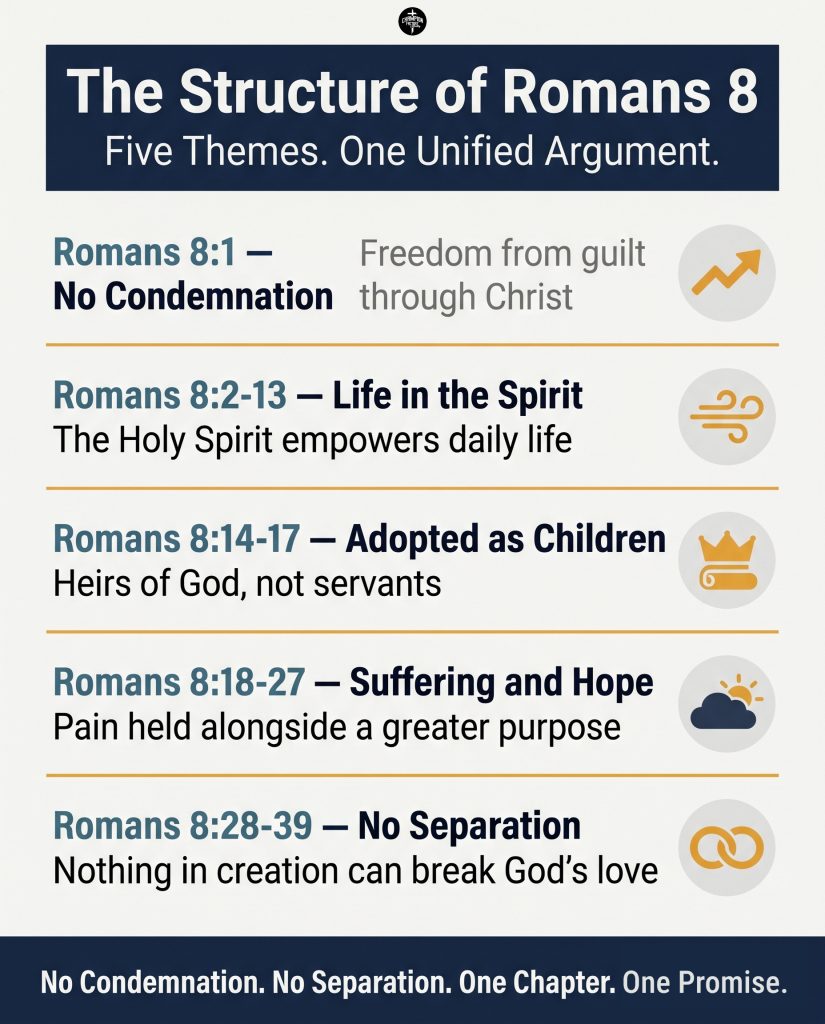
Theologian John Stott observed that the chapter is bookended by two declarations: "no condemnation" at verse 1 and "no separation" at verses 38 and 39. Everything in between builds the case for why both are true.
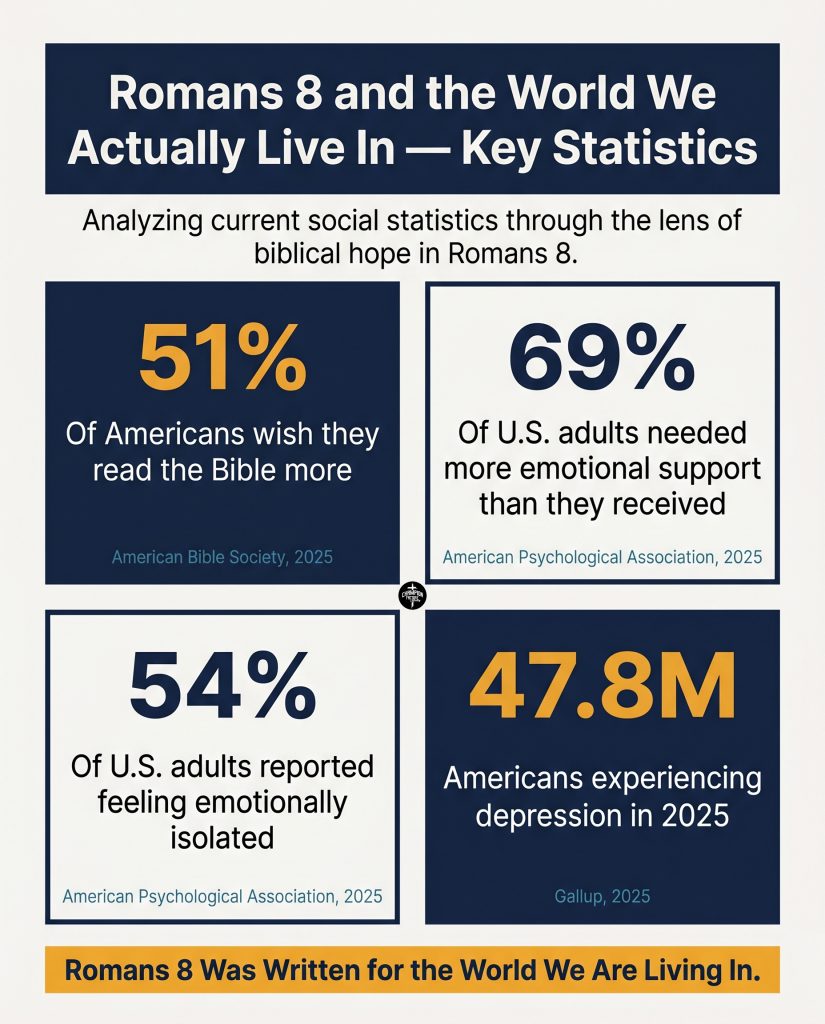
According to the American Bible Society's 2025 State of the Bible report, more than half of Americans say they wish they read the Bible more. Romans 8 is one of the most cited chapters in all of scripture. But reading it and receiving it are two different things. This article is for the reader who wants to receive it.
"Romans 8 has been a touchstone for me personally and for the people we serve. It speaks to the whole person, not just to what they have done or failed to do, but to who they are before God right now." Todd Medina, President and Founder, Champion Factory Ministry
What "No Condemnation" Actually Means
The opening verse of Romans 8 is one of the most important sentences in the entire Bible: "Therefore, there is now no condemnation for those who are in Christ Jesus" (Romans 8:1, NIV). The word "condemnation" here refers to a legal verdict of guilt. Paul is saying that God has looked at every believer in Christ and rendered a verdict: not guilty. Not improved. Not probationary. Not guilty.
Many believers live as if the verdict was only partial. As if God extended some grace but is still keeping score. This is understandable. We know our own failures. We feel the weight of things we have done and things done to us. Shame has a way of convincing us that the verdict cannot possibly apply to the full truth of who we are.
Pastor David Guzik puts it plainly in his Enduring Word commentary: the verdict is not "less condemnation." Our standing before God has not simply improved. It has been completely transformed.
The Difference Between Condemnation and Conviction
This distinction matters, especially for believers who are still growing and still failing. Condemnation says you are guilty and there is no way forward. Conviction is the Holy Spirit's work of pointing out where we have gone wrong so we can return to God. Condemnation crushes. Conviction restores.
Romans 8:1 is the end of condemnation for those who are in Christ. The Spirit's work of conviction continues, but it carries a different weight. It leads toward grace, not away from it.
If you carry shame from your past, Romans 8:1 was written for you. It is not a quick theological fix. It is a foundational truth that can begin to reshape how you see yourself before God.
The Holy Spirit's Role in Daily Life
The Holy Spirit is not a distant force. Romans 8 describes the Spirit as someone who lives in you, guides you, intercedes for you, and connects you to God as a child connects to a parent. "The Spirit of God, who raised Jesus from the dead, lives in you. And just as God raised Christ Jesus from the dead, he will give life to your mortal bodies by this same Spirit living within you" (Romans 8:11, NLT). That is the basis for how Christians are meant to live.
Paul draws a clear contrast between two ways of living: according to the flesh and according to the Spirit. In Paul's writing, "the flesh" does not simply mean the physical body. It describes human nature oriented around self, driven by fear, comparison, and self-preservation. Living according to the Spirit means ordering your life around what God values rather than what the self demands.
New Testament scholar Leon Morris described the contrast in terms that remain useful today: Moses' law had right but not might. Sin's law had might but not right. The law of the Spirit, Paul says, has both. The Spirit does not simply set a standard. The Spirit provides the power to move toward it.
What Living According to the Spirit Looks Like
Paul is describing the texture of an ordinary day, not an abstract spiritual exercise. A few practical ways this takes shape:
- Choosing patience in a frustrating moment rather than reacting from fear or habit
- Returning to God in prayer when you feel far from Him, even when the words do not come easily
- Receiving correction without collapsing under shame
- Trusting that God is present in circumstances you cannot control
Living according to the Spirit is about where you are oriented. Where your hope is anchored. Who you are turning toward when things are hard.
You Are a Child of God, Not a Servant
Romans 8:14-17 introduces one of the most significant identity shifts in all of Paul's writing. Believers have not received a spirit of slavery that leads back to fear. They have received the Spirit of adoption. God has not simply improved their standing. He has changed the relationship entirely. Believers are sons and daughters, not servants. They are heirs, not employees.
"For you did not receive the spirit of slavery to fall back into fear, but you have received the Spirit of adoption as sons, by whom we cry, 'Abba! Father!' The Spirit himself bears witness with our spirit that we are children of God." (Romans 8:15-16, ESV)
The word "Abba" is the Aramaic word a child uses to address their father. It is close and personal. Paul is saying that the Spirit enables believers to approach God with the same access and intimacy a child has with a parent they trust.
This matters because many people carry a servant's posture into their relationship with God. They feel like they must earn their place, prove their worth, or perform well enough to remain accepted. The adoption language of Romans 8 addresses that directly.
What Adoption Changes
The shift from servant to child changes more than terminology. It changes how you pray. It changes how you approach failure. It changes what you believe God thinks of you when you fall short. A servant worries about losing their position. A child trusts that the relationship holds even on hard days.
As Matthew Henry wrote in his commentary on Romans 8, the Spirit witnesses to none the privileges of children who do not have the nature and disposition of children. That means the Spirit's work in a believer is ongoing, drawing them deeper into the character and closeness of a child of God rather than the performance of someone trying to earn acceptance.
"The people we walk with often carry more shame than anything else. Romans 8 gives us language to speak directly to that. You are not just forgiven. You are adopted. That changes everything about how you see yourself and how you approach God." Todd Medina, President and Founder, Champion Factory Ministry
Champion Factory Ministry's Nourish discipleship program is built around this kind of formation, walking with people as they move from spiritual depletion toward a grounded identity in Christ.
Suffering, Hope, and the Honest Promise of Romans 8
Romans 8 does not promise that suffering will end. Paul names suffering plainly and places it alongside something larger. "Yet what we suffer now is nothing compared to the glory he will reveal to us later" (Romans 8:18, NLT). This is not a dismissal of pain. It is a reframing of proportion. Paul is writing to people who are suffering, and he is telling them that what they are carrying is real and that God's purposes extend beyond it.
According to Gallup, more than 18 percent of U.S. adults experienced depression in 2025, projecting to an estimated 47.8 million people. The American Psychological Association's 2025 Stress in America survey found that more than half of U.S. adults reported feeling emotionally isolated, and nearly seven in ten said they needed more support than they received.
Those numbers describe the world the readers of this article are actually living in. Romans 8 was written for people in that world.
Pastor Ray Galea, who wrote a study of Romans 8 titled "From Here to Eternity," observed: "Romans 8 doesn't pretend that life is a bed of roses. It contains a healthy realism about the Christian life. There is no promise of an unachievable perfectionism this side of glory, no promise of heaven on earth."
The honesty of Romans 8 is part of what makes it credible. Paul does not offer easy comfort. He names the groaning, describes the waiting, and then points to a hope that outlasts circumstances.
A Note on Suffering and Support
Faith and professional care are not in conflict. If you are carrying depression, grief, or the weight of trauma, Romans 8 is for you and so is professional support. Seeking help from a qualified counselor or mental health professional is not a failure of faith. It is part of how God provides care through the people and resources He has placed in the world. If you are walking through something serious, we encourage you to reach out to a trusted professional alongside your faith community. Our mentorship and spiritual guidance program is also here to walk with you in community.
What Romans 8:28 Actually Promises
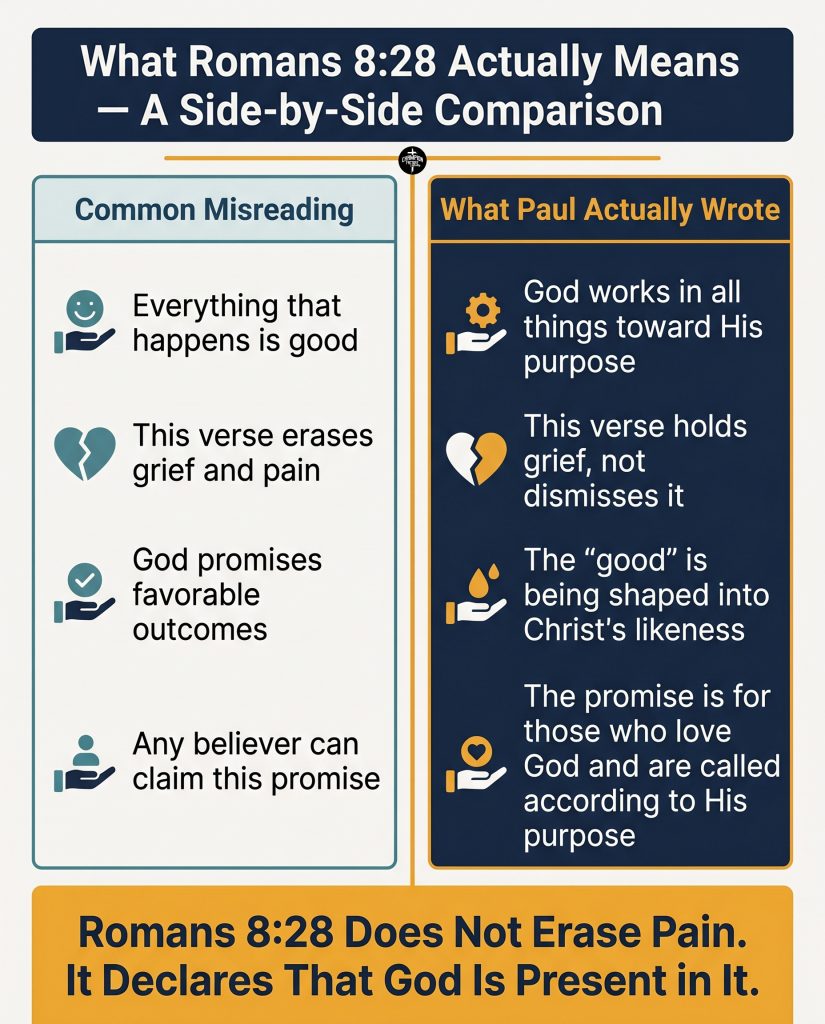
Romans 8:28 is one of the most quoted and most misused verses in the Bible. "And we know that in all things God works for the good of those who love him, who have been called according to his purpose" (Romans 8:28, NIV). This is a promise about God's redemptive purpose, not a guarantee that every situation will produce a favorable outcome. The "good" Paul describes is being conformed to the image of Christ (Romans 8:29), not comfort, success, or the resolution of pain.
This matters because Romans 8:28 is often offered to people in grief as if it erases the grief. It does not. Paul is not saying that everything that happens is good. He is saying that God is at work in all things toward His purposes for those who love Him.
The pastoral teaching team at Christ Church Memphis describes the verse's intent as an invitation for believers to reorient themselves: God is not a compartment in your life. He is working in every circumstance because He is present in all of it. That is not a dismissal of what is painful. It is a shift in how you understand what God is doing in the middle of it.
If you want to study how to read verses like this carefully in their context, our article on what hermeneutics is and how to apply the Bible walks through responsible interpretation step by step.
"Romans 8:28 is not a verse to rush past when someone is hurting. It is an invitation to trust that God is present and purposeful even in the worst of it. That takes time to receive, and that is okay." Art Montgomery, Global Evangelism Strategy Architect and Board Visionary, Champion Factory Ministry
How to Read Romans 8:28 Without Minimizing Pain
A few things worth holding when reading this verse:
- The promise belongs to "those who love God and are called according to his purpose." It is not a universal guarantee for every outcome.
- The "good" Paul describes is the ongoing work of being shaped into the likeness of Christ, which is a long and sometimes difficult process.
- This verse does not mean God caused every painful thing. It means God is not absent from it.
- Grief, loss, and unanswered questions are not signs that Romans 8:28 has failed.
If you are in a season where this verse feels hollow, you are not alone. Sitting with that honestly is part of faith, not a departure from it.
When You Cannot Find Words to Pray
Romans 8:26-27 addresses one of the most common and least discussed experiences in the Christian life: not knowing how to pray. "The Holy Spirit helps us in our weakness. For example, we don't know what God wants us to pray for. But the Holy Spirit prays for us with groanings that cannot be expressed in words" (Romans 8:26-27, NLT). This is not a failure state. It is a described reality that Paul addresses directly, and it comes with a specific promise.
The Spirit does not wait for you to have the right words before interceding for you. He brings your needs before the Father even when you cannot name them. The Father, who knows all hearts, understands exactly what the Spirit is communicating on your behalf.
Nearly seven in ten U.S. adults said in 2025 that they needed more emotional support than they received, according to the American Psychological Association. Many of those people are believers who sat in silence, unsure how to bring what they were carrying to God. Romans 8:26-27 speaks directly to that.
You do not have to have your prayers figured out. You do not need eloquence or certainty. Romans 8 describes a Spirit who fills the gap between your weakness and God's hearing. That is not a small thing. For many people in hard seasons, it is the difference between feeling cut off from God and feeling held by Him.
Nothing Can Separate You from God's Love
The final section of Romans 8 builds to one of the most comprehensive statements of God's love found anywhere in the Bible. Paul lists everything that might threaten a believer's standing before God and then declares that not one of them is enough. "Neither death nor life, neither angels nor demons, neither the present nor the future, nor any powers, neither height nor depth, nor anything else in all creation, will be able to separate us from the love of God that is in Christ Jesus our Lord" (Romans 8:38-39, NIV).
This is the close of the chapter that began with "no condemnation." Paul ends where he started: with security. What opened as a legal declaration closes as a declaration of love.
More than half of U.S. adults reported feeling emotionally isolated in 2025, and the American Psychological Association identified loneliness as a defining feature of life in America today. Romans 8:38-39 speaks directly to that experience. It is a direct answer to the question many people carry quietly: does anyone actually love me and will they stay?
The answer Romans 8 gives is yes. Paul names every possible threat and declares that not one of them qualifies.
Reading Verses 38-39 Slowly
Take a moment with the list. Read it against whatever you are carrying right now.
- What you have done
- What has been done to you
- What you are afraid of
- What you have lost
- What you do not know about your future
Paul's declaration is that none of it can pull you out of the love of God. Not your worst day. Not your longest season. Not the things you have never said aloud.
How Romans 8 Can Shape Your Daily Life
Romans 8 is not a chapter to read once and set aside. It is a passage designed to be returned to across different seasons of life. Different sections will speak to you at different times. The promise of no condemnation may matter most when shame is loudest. The section on suffering may matter most when circumstances are hardest. The closing declaration may matter most when isolation feels heaviest.
Here are some practical ways to work with Romans 8 over time:
- Read the full chapter in one sitting. Do not stop to analyze every verse. Let the shape of the argument land first.
- Identify which section speaks most to where you are right now. Come back to that section over a week.
- Sit with the adoption language of verses 14-17. Notice whether you relate to God more as a servant than as a child, and what it would take to shift that.
- When you do not know how to pray, name that honestly and remember verses 26-27. The Spirit is already interceding.
- Read verses 38-39 aloud. There is something different about hearing a promise spoken.
"We have seen Romans 8 do real work in people's lives, not because they had the right theology, but because they were willing to sit with it long enough to let it speak. That takes community. That takes people walking alongside you." Art Montgomery, Global Evangelism Strategy Architect and Board Visionary, Champion Factory Ministry
Consider studying Romans 8 alongside a trusted community. The truths of this chapter were not designed to be held alone. They take root more fully when shared with people who are walking the same road. If you are looking for that kind of community, we invite you to learn more about how Champion Factory Ministry supports individuals and families through faith, mentorship, and care.
The Promises of Romans 8 Are for You, Right Now
Romans 8 was not written for people who have everything together. It was written for people in the middle of struggle, asking whether God is still present and whether their faith is still real. Paul's answer, across 39 verses, is a clear and structured yes.
The chapter opens by removing condemnation. It describes a Spirit who lives in you, guides you, and prays for you when you cannot find words. It names suffering without dismissing it. It handles Romans 8:28 with the care that verse deserves. And it closes with a declaration of love so complete that nothing in creation qualifies as a threat to it.
You do not need to receive all of this at once. Romans 8 is a companion for the long road. Come back to it. Bring your questions. Bring your grief. Bring the silence.
The promises here were written for exactly that.
If you are going through a hard season and looking for practical support alongside faith, we encourage you to connect with Champion Factory Ministry. We walk with individuals and families through difficulty, pointing toward stability, restoration, and the kind of hope that Romans 8 describes.
Frequently Asked Questions
What is Romans 8 mainly about?
Romans 8 is about the life available to believers through the Holy Spirit. It covers freedom from condemnation, the Spirit's work in daily life, the believer's identity as a child of God, how to hold suffering with hope, and the security of God's love. The chapter opens with "no condemnation" and closes with "no separation."
Does Romans 8:28 mean everything will work out?
Not exactly. Romans 8:28 is a promise about God's redemptive purpose, not a guarantee of favorable outcomes. Paul says God works all things toward the good of those who love Him, and the "good" he has in mind is being shaped into the likeness of Christ. The verse does not erase grief or promise that pain will resolve. It promises that God is at work in the middle of it.
What is the difference between condemnation and conviction in Romans 8?
Condemnation is a legal verdict of guilt with no way forward. Conviction is the Holy Spirit's work of pointing believers toward areas where they need to turn back to God. Romans 8:1 declares that condemnation is gone for those in Christ. Conviction continues, but it leads toward restoration rather than shame.
What does Romans 8:26-27 mean when it says the Spirit intercedes with groanings?
Paul is describing what happens when a believer does not know how to pray. The Holy Spirit fills that gap, interceding on behalf of the believer in ways that go beyond words. God, who knows all hearts, understands exactly what the Spirit is communicating. This is a gift for people who feel spiritually depleted or unable to bring their needs to God in words.
What does it mean to live "according to the Spirit"?
Living according to the Spirit means orienting your daily life around what God values rather than what fear, self-interest, or habit would otherwise drive you toward. Paul contrasts this with living "according to the flesh," which describes a life shaped by self-focus and separation from God. Living according to the Spirit is not about perfect behavior. It is about who you are turning toward and where your hope is anchored.
Can anything separate a believer from God's love?
Romans 8:38-39 gives the most complete answer to this question found anywhere in the Bible. Paul lists death, life, angels, demons, the present, the future, any powers, height, depth, and anything else in all creation, and declares that none of it can separate believers from the love of God in Christ Jesus. The answer is no. Nothing qualifies.