






Reading the Bible on your own can bring up honest questions. A verse feels unclear, a passage carries history you do not know, or a word choice raises more questions than it answers. That moment of not understanding does not mean something is wrong with your faith. It means you are reading carefully.
This guide walks through what a Bible commentary actually is, the different types available, and how to choose one that fits where you are in your study. You will also find guidance on using a commentary well, along with free and low cost ways to start building a small home library.
What Is a Bible Commentary and How Is It Different From a Study Bible
A Bible commentary is a resource written to explain the meaning, context, and background of a Bible passage in depth, while a study Bible includes shorter notes printed alongside the biblical text itself. Both tools help you understand Scripture, but they work differently. A study Bible gives brief explanations in the margins as you read. A commentary is a separate book or volume dedicated entirely to explaining one book, section, or the whole Bible in much greater detail.
A study Bible works well for daily reading. A commentary works well when you want to slow down and study one specific passage closely.
This kind of guided understanding has a long history in Scripture itself. In Acts 8, an official reading the book of Isaiah was asked if he understood what he was reading. He answered, "How can I, unless someone explains it to me?" (Acts 8:31, NIV). Wanting help to understand God's word is not a sign of weak faith. It is part of how people have grown in understanding Scripture for centuries.
Which Type of Bible Commentary Fits Your Season of Study
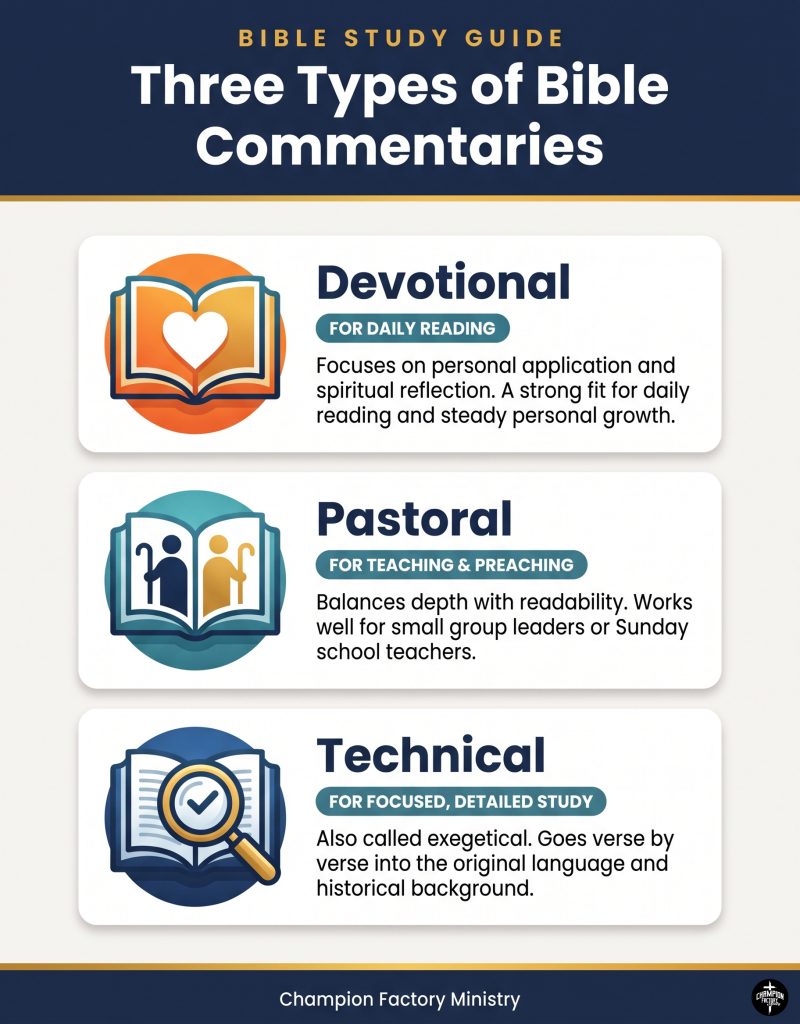
Bible commentaries generally fall into three categories: devotional, pastoral, and technical, and choosing the right type depends on your current study goals rather than your level of education. Matching the type to your need prevents frustration and helps you actually use the resource you buy.
- Devotional commentaries focus on personal application and spiritual reflection. They are a strong fit for daily reading and personal growth.
- Pastoral commentaries are written for teaching and preaching. They balance depth with readability and work well for small group leaders or Sunday school teachers.
- Technical commentaries, sometimes called exegetical commentaries, go verse by verse into the original language and historical background. These fit readers doing focused, detailed study.
Long before modern commentaries existed, this same principle of clear explanation shaped how God's people engaged with Scripture. In Nehemiah 8, leaders "read from the Book of the Law of God, making it clear and giving the meaning so that the people understood what was being read" (Nehemiah 8:8, NIV). A good commentary today continues that same purpose, making Scripture clearer without changing its meaning.
"Every commentary should point you back to Scripture, not away from it. That is the standard we teach through our discipleship work." Todd Medina, President & Founder, Champion Factory Ministry
Common Misconceptions About Commentary Types
Many readers assume a technical commentary is always better because it looks more scholarly. In reality, a devotional commentary can be exactly the right tool for someone building a consistent reading habit, while a technical commentary may be more than a new reader needs right now.
How to Choose a Commentary for a Book of the Bible or a Whole Bible Set
A single book commentary usually offers more depth than a whole Bible set, since it can focus entirely on one section of Scripture instead of covering all sixty six books in one volume. Whole Bible commentaries are useful for a broad overview or quick reference. Single book commentaries work better when you want to study one book carefully, such as Romans, John, or Psalms.
A practical approach many readers use:
- Start with the book of the Bible you are currently studying or teaching.
- Look for one well reviewed commentary on that specific book.
- Add a whole Bible commentary later as a general reference, once you have a few single book resources.
Well known commentary series such as the New International Commentary series are consistently ranked among the most trusted resources for individual books of the Bible, which makes them a solid starting point when you know exactly which book you want to study.
How to Use a Commentary Without Losing Your Own Time in Scripture
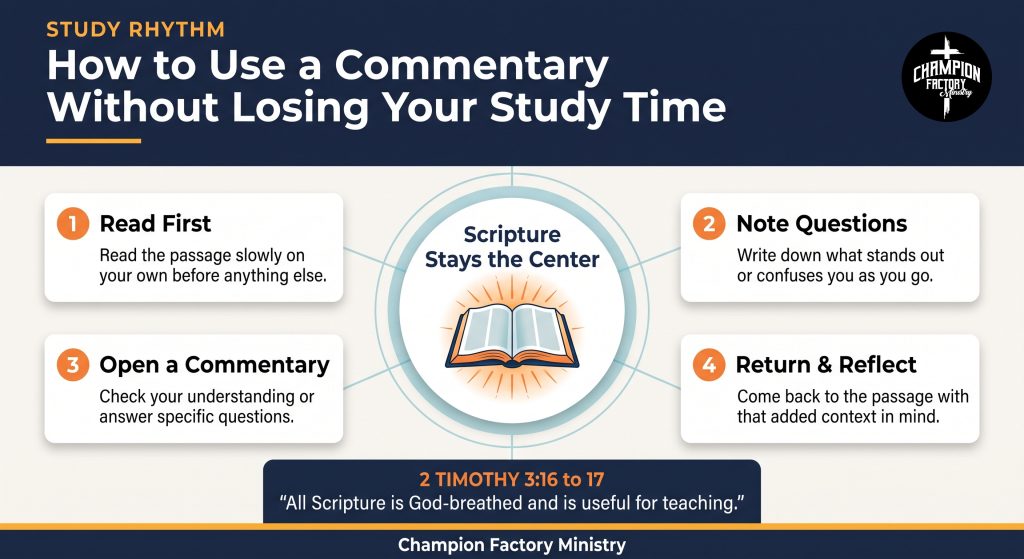
A commentary works best as a support for your own reading, not a substitute for it, so it is wise to read the passage yourself first before turning to outside explanation. This keeps your own reflection, prayer, and questions at the center of your study time.
A simple rhythm that keeps this balance:
- Read the passage slowly on your own first.
- Write down what stands out or confuses you.
- Open a commentary to check your understanding or answer specific questions.
- Return to the passage again with that added context in mind.
Scripture itself remains the foundation for this whole process. Paul wrote to Timothy that "all Scripture is God-breathed and is useful for teaching, rebuking, correcting and training in righteousness" (2 Timothy 3:16 to 17, NIV). A commentary supports that process. It does not replace it.
A pastor who regularly uses commentary series built for preaching described his preferred resources as ones "written for preachers by people who have done a lot of preaching themselves," a reminder that the best study tools come from people who have wrestled with the text in real ministry settings, not just in theory.
"In outreach work, we have seen that people trust guidance more when it comes alongside their own reading of Scripture, not in place of it. That principle applies just as much to a commentary as it does to a conversation." Art Montgomery, Global Evangelism Strategy Architect & Board Visionary Luminary, Champion Factory Ministry
Where to Find Trustworthy Commentaries for Free or on a Budget
Many reliable Bible commentaries are available online at no cost, which makes deep study accessible even on a limited budget. Cost should never be the reason someone cannot access solid, trustworthy explanations of Scripture.
Free and low cost options include:
- Online commentary libraries that host classic, public domain works alongside modern selections.
- Church or seminary library access, often available to the public or through a membership.
- Digital Bible study apps that include commentary notes alongside the biblical text.
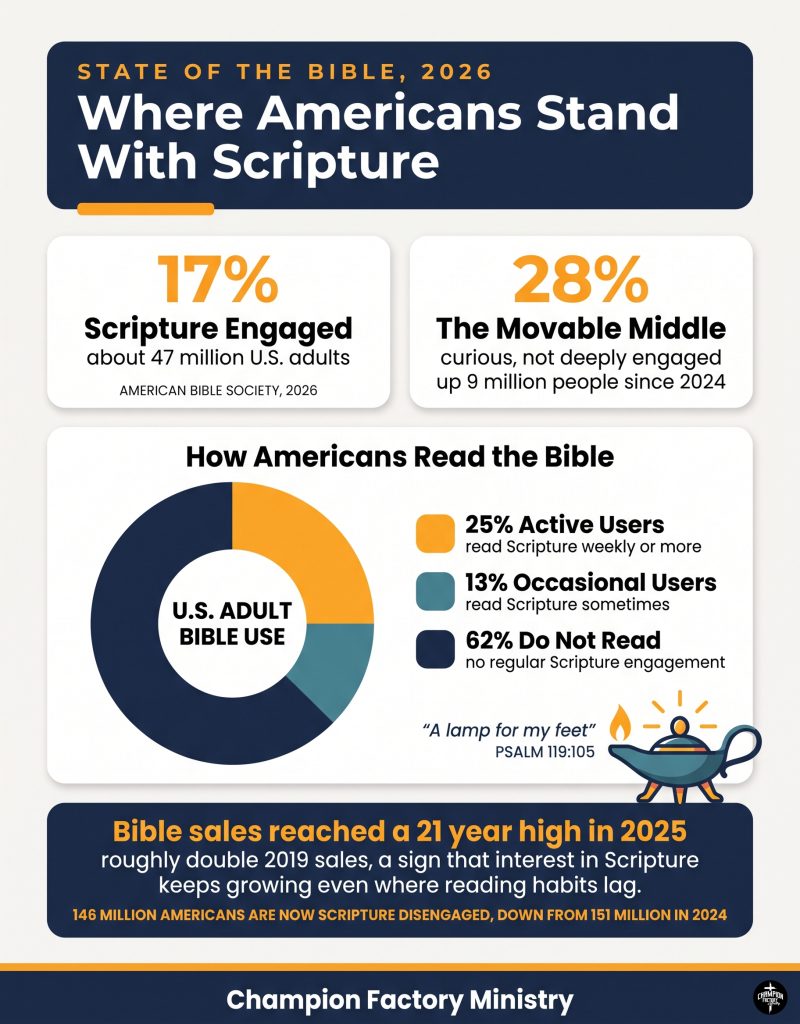
Interest in owning and reading Scripture has grown in recent years. Bible sales reached a 21 year high in the United States in 2025, a sign that many people are looking for ways to engage with God's word more deeply. A commentary does not need to be expensive to be part of that growth.
How to Build a Small Bible Study Library Over Time
A focused Bible study library starts with one or two trusted resources and grows slowly as your study needs change, rather than being built all at once. Buying an entire commentary set before you know what you actually need often leads to unused books and wasted money.
A helpful starting point:
- Choose one commentary on a book of the Bible you are currently reading.
- Add a whole Bible reference commentary once you have used a few single book volumes.
- Let your library grow as your study deepens, adding resources only when a real need comes up.
Classic commentaries have earned their place in many home libraries over generations. Matthew Henry's commentary, first written in the early 1700s, remains one of the most widely used devotional commentaries nearly three centuries later. A resource does not need to be brand new to be trustworthy. It needs to be sound, clear, and faithful to Scripture.
Research from the American Bible Society found that many people who are curious about the Bible but not yet reading it regularly "would welcome someone to guide them through the complexity of the Bible." A well chosen commentary can be exactly that kind of steady, patient guide.
Growing in Scripture With Confidence and Support
Choosing a Bible commentary does not need to feel overwhelming. Start small. Pick one resource that matches where you are right now, whether that means a devotional commentary for daily reading or a single book resource for closer study. Let your library grow slowly as your understanding grows.
The Psalmist wrote, "Your word is a lamp for my feet, a light on my path" (Psalm 119:105, NIV). A commentary can help make that path easier to understand, but Scripture itself remains the guide. If you are looking for support as you grow in your walk with God, Champion Factory Ministry's Nourish discipleship track offers encouragement and community for people building a steady practice of Scripture engagement. You can also explore ways to get involved or connect with others on the same journey.
FAQ
Is it wrong to read a commentary before studying a passage myself?
No. It is simply more effective to read the passage first, form your own thoughts, and then use a commentary to check or deepen your understanding.
What is a good first commentary to buy?
A single book commentary on whichever book of the Bible you are currently reading is usually the most useful starting point.
Do I need to know Greek or Hebrew to use a commentary?
No. Devotional and pastoral commentaries are written for readers without formal language training. Technical commentaries include original language notes but explain them clearly for general readers as well.
Can I find good commentaries without spending money?
Yes. Many trustworthy commentaries, including classic works, are available online at no cost, along with library and church access options.