






Many people have heard John 3:16 quoted at sporting events, seen it printed on shirts, or memorized it in Sunday school. Few have paused to ask what the word "world" actually means. Because the verse is so familiar, it can start to feel like background noise instead of a personal promise.
This article walks through the original Greek word behind "world," shows how it is used elsewhere in Scripture, and explains what it means for anyone reading it today. No theological debate, no complicated language, just a clear look at one of the most quoted verses in the Bible.
What Does the Greek Word Kosmos Actually Mean?
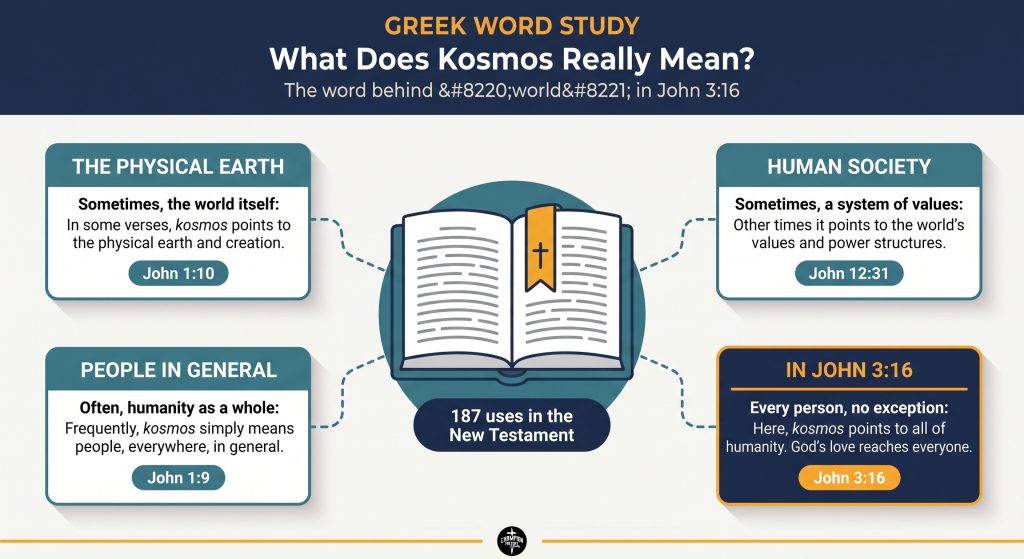
In John 3:16, the word "world" translates the Greek term kosmos. Strong's and Thayer's Greek lexicons describe kosmos as a wide reaching word that can mean the earth, human society, or humanity as a whole, depending on the verse. In John 3:16, the context points to people, not simply a place.
The word kosmos appears more than 180 times across the New Testament. Its root idea is an orderly arrangement, which is also where the English word cosmos comes from. From that root, kosmos grew to describe the created order and the people who live within it.
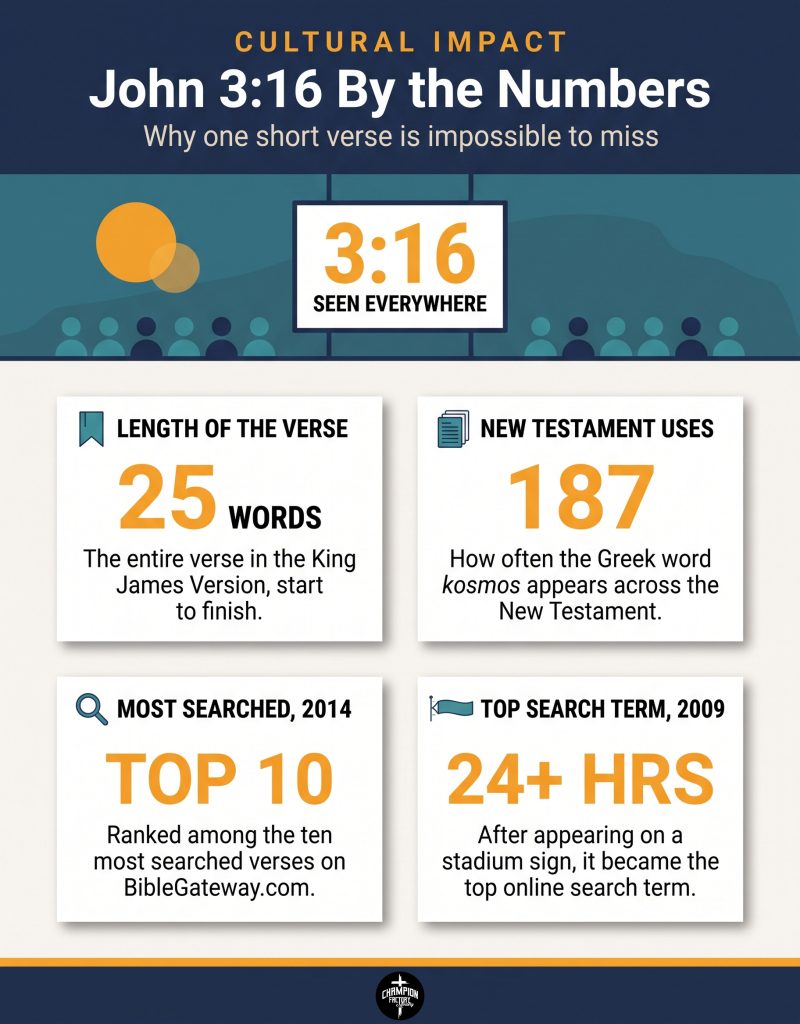
John 3:16 is only 25 words long in the King James Version, yet it carries enormous weight. Bible commentator Paul T. Butler described it as "the golden text of the Bible" because it summarizes the heart of the gospel in a single sentence. Understanding one word inside that sentence changes how the whole verse lands.
Why Would God Love a Broken World?
John 3:16 does not say God loved the world because it deserved love. It says God loved the world enough to give His only Son, even though the world was marked by sin. This is the heart of the gospel, a love that meets people where they are, not where they should be.
The Greek word translated "loved" here is agape, a selfless kind of love with no single exact equivalent in English. Agape is not earned. It is given.
This idea appears elsewhere in Scripture too. Paul writes in Romans 5:8, "But God demonstrates his own love for us in this: While we were still sinners, Christ died for us." The pattern is consistent. God's love reaches people before they have anything to offer in return.
"When I explain God's love to a child or a struggling parent, I start right here. This verse tells them they are already included, not something they have to earn." Todd Medina, President and Founder
For anyone who feels they need to clean themselves up before approaching God, this verse offers a different starting point. The love comes first.
Does "World" Always Mean the Same Thing in the Bible?
No. The word kosmos shifts meaning depending on context. Sometimes it points to the physical earth, sometimes to human society, and sometimes to people in general. In John 3:16, the surrounding context points clearly to people, specifically the whole of humanity rather than one nation or group.
A Word Worth Reading in Context
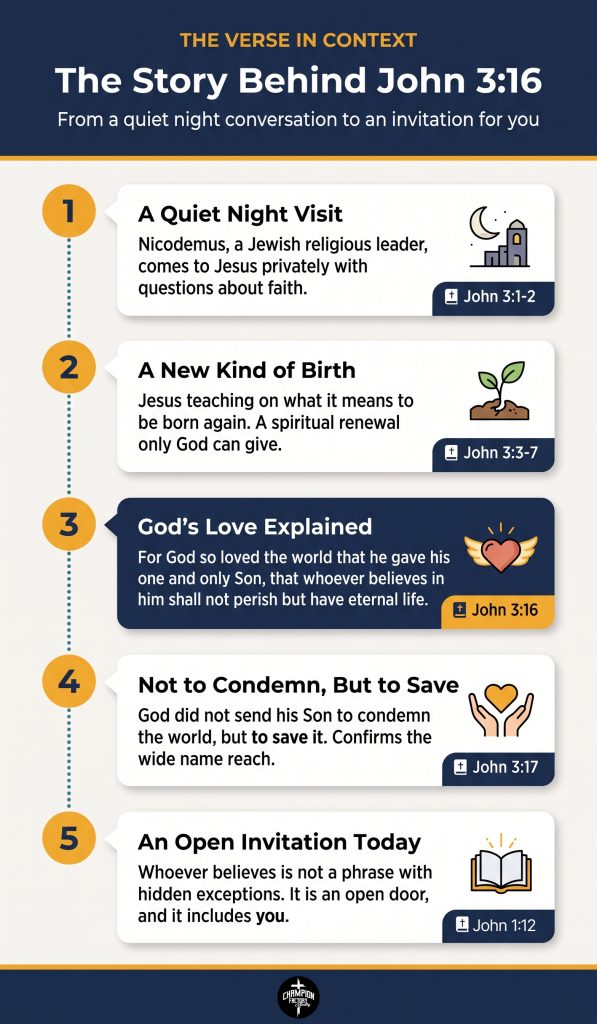
Because kosmos is used so many different ways, it helps to read each verse on its own terms rather than assuming one fixed meaning everywhere. In John 3:16 and the verse right after it, the meaning stays consistent. John 3:17 says, "For God did not send his Son into the world to condemn the world, but to save the world through him." Both verses use "world" the same way, pointing to people in need of rescue, not to a place or a select group.
This consistency matters. Readers do not need to untangle a complicated puzzle to understand the verse. The word means people, broadly and simply.
What Was Happening When Jesus Said This?
John 3:16 comes from a nighttime conversation between Jesus and Nicodemus, a Jewish religious leader who came to Jesus privately with questions about faith. Jesus had just described what it means to be born again spiritually. John 3:16 is His summary of why that new life is possible, through God's love for the world expressed in His Son.
Nicodemus was a Pharisee, part of a group generally cautious toward Jesus. His decision to seek Jesus out, even quietly and at night, shows genuine curiosity. Later in John's Gospel, Nicodemus reappears and stands up in support of Jesus.
This context matters. John 3:16 was not written as a slogan. It was spoken in the middle of a real, personal conversation with someone still working out what he believed. That makes it easier to read the verse as an invitation rather than a formula.
Why Is John 3:16 Everywhere You Look?
John 3:16 is one of the most referenced verses in the Bible, appearing on signs, shirts, and at major sporting events. In 2014, it ranked among the ten most searched Bible verses on BibleGateway.com, according to a report from Christianity Today. Its popularity comes from its simplicity, a short verse that carries the heart of the Christian faith.
Its visibility is not new. In 2009, football player Tim Tebow wrote "John 3:16" on his eye black during the BCS National Championship Game, and the phrase became the top online search term for more than a day afterward. Moments like that show why so many people can recite the verse without ever having studied it closely.
"In outreach across many countries, I have watched this one verse open conversations nothing else could. People can carry one sentence with them anywhere they go." Art Montgomery, Global Evangelism Strategy Architect and Board Visionary Luminary
Familiarity can work against understanding. A verse seen many times can start to feel like wallpaper. Slowing down long enough to ask what one word means is often the difference between reciting a verse and actually receiving it.
What Does This Verse Mean for You Today?
If kosmos means all of humanity, then John 3:16 is not a distant theological statement. It is a personal invitation. "Whoever believes" is not a phrase with hidden exceptions. It is an open door. This verse tells the reader they are included in God's love, regardless of past mistakes or present circumstances.
This theme continues elsewhere in Scripture. John 1:12 says that to all who receive Him and believe in His name, He gives the right to become children of God. First John 4:9 to 10 echoes John 3:16 almost directly, describing God's love shown through sending His Son.
"We see this every week in our discipleship groups. Once someone understands that 'world' means them personally, their whole posture toward God changes." Todd Medina, President and Founder
At Champion Factory Ministry, this is the same love we hope to reflect through mentorship, discipleship, and everyday care for people who need to know they have not been forgotten. If you want to keep growing in faith after reading this, our Nourish discipleship resources offer a next step for going deeper.
A Love Big Enough to Include You
John 3:16 is not a slogan to memorize and move past. It is a statement that the word "world," in its original language, means people, all people, without exception based on nation or background. That is what makes the verse worth revisiting even after hearing it many times.
A simple next step is to read John chapter 3 in full, rather than the single verse alone, to see the conversation it came from. Another is to spend a few quiet minutes reflecting on whether this verse has ever felt personal to you. If you are wrestling with deeper questions about faith, a pastor or trusted spiritual mentor can walk through them with you. If you would like to connect with our community as you take that next step, you are welcome to explore how to get involved with Champion Factory Ministry.
FAQ
What does "world" mean in John 3:16?
It refers to all of humanity, not one nation or select group, showing that God's love is wide enough to include every person.
What is the golden text of the Bible?
It is a description Bible commentator Paul T. Butler used for John 3:16, since it summarizes the heart of the gospel in one short verse.
Why did Jesus mention being born again before this verse?
John 3:16 follows Jesus's conversation with Nicodemus about spiritual rebirth. The verse explains why that new life is possible through God's love.
Does this verse mean everyone is automatically saved?
No. The verse ties eternal life to belief in Jesus, so it describes an invitation to receive rather than an outcome that happens regardless of response.