






You may have encountered the word Elohim in a sermon, a devotional, or while reading through the Old Testament. It sounds ancient and weighty because it is. Elohim is one of the most significant names for God in all of Scripture, and it appears before any other name. Many people who hear it want more than a pronunciation guide. They want to know what it actually means and what it says about the God who carries it.
This article explains what Elohim means in Hebrew, why the plural form does not point to multiple gods, and what this foundational name reveals about God's character. It also looks at what knowing this name means in real life, including the seasons when faith requires more than information.
What the Name Elohim Actually Means
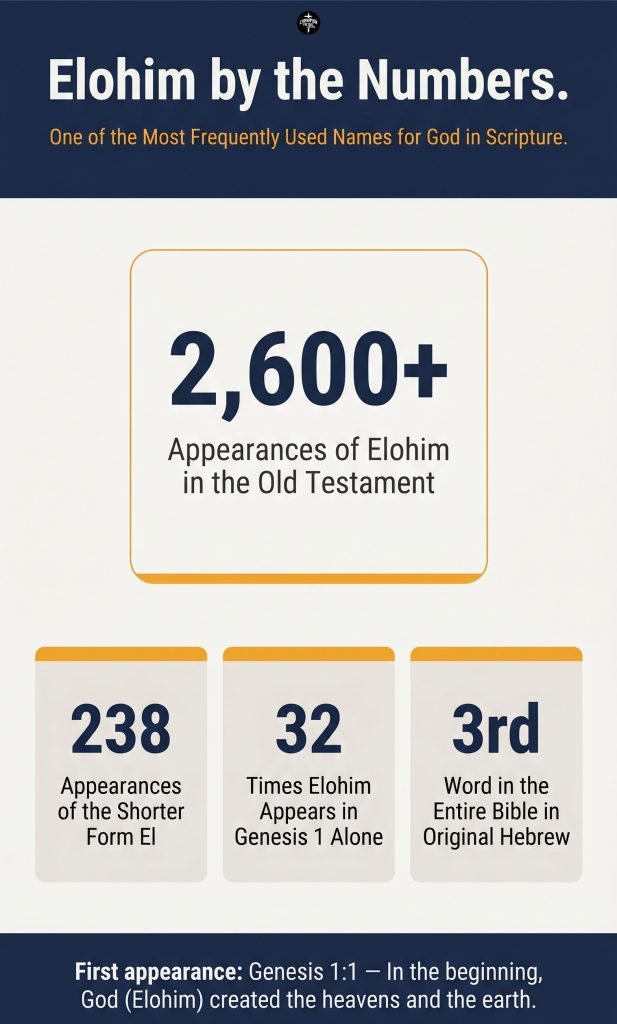
Elohim is a Hebrew word that carries the meaning of supreme power and might. It is the most commonly used name for God in the Old Testament, appearing approximately 2,600 times throughout the Hebrew Scriptures. By comparison, the shorter form El appears about 238 times. Elohim is the name Israel used across every book, era, and circumstance of the biblical narrative to speak of the God who holds all authority.
The word derives from the Hebrew root El, or the related singular form Eloah. Both point to strength, sovereignty, and deep reverence. Strong's Hebrew Lexicon (H430) defines Elohim as referring to "the supreme God" while noting that the word also applies in specific passages to judges or leaders who exercised delegated divine authority.
Dr. William Wood, Associate Professor of Old Testament at Reformed Theological Seminary Atlanta, describes the name as pointing to "the mighty One who is to be feared" while functioning as a royal title that communicates God's "exclusive royal authority over all creation."
"When people first hear the name Elohim, they sometimes expect something abstract. But this is one of the most grounded names in Scripture. It tells you immediately that you are dealing with a God of real authority, not a concept." Todd Medina, President & Founder, Champion Factory Ministry
The name is not ornamental. It is a direct description of who God is, stated plainly at the very start.
Why Elohim Is Plural and What That Actually Means
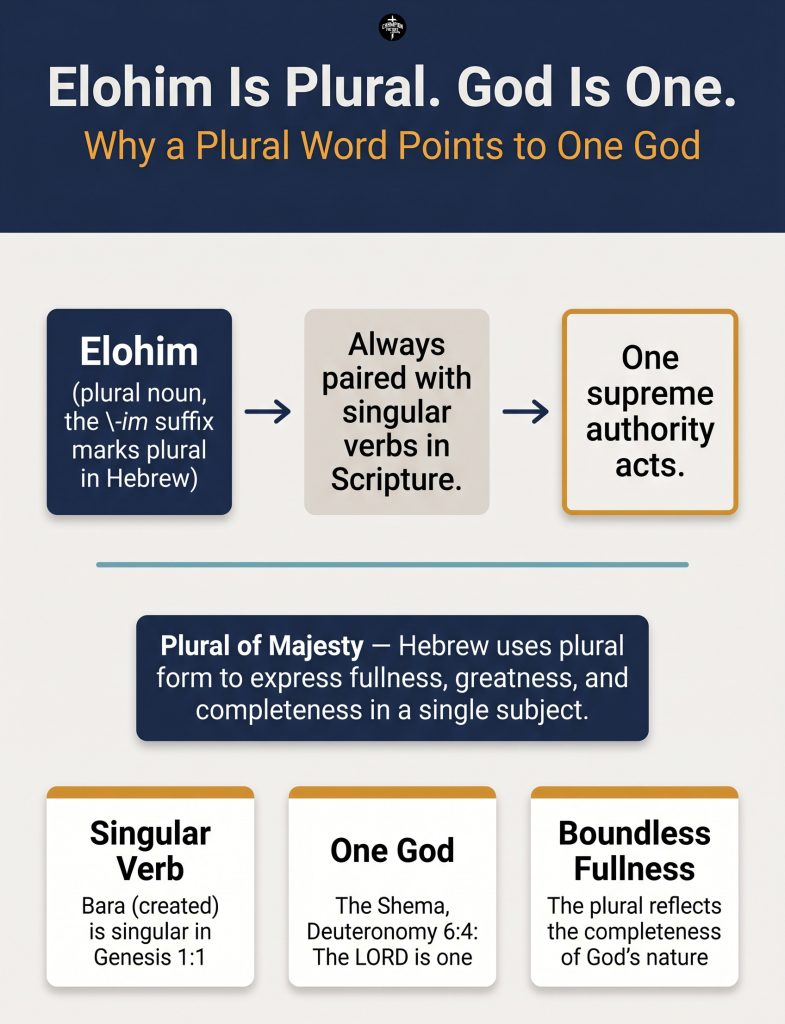
Elohim is grammatically plural in Hebrew. This raises an immediate question: if there is one God, why use a plural word? The answer lies in how Hebrew grammar works. When Elohim refers to the one true God of Israel, it always appears alongside singular verbs. This pattern is called the plural of majesty. It uses plural form to express fullness, completeness, and supreme greatness rather than numerical quantity.
The Hebrew verb in Genesis 1:1, bara, meaning "created," is singular. One supreme authority acted. The NIV Study Bible notes that "this use of the plural expresses intensification rather than number and has been called the plural of majesty, or of potentiality." Wilhelm Gesenius, one of history's most respected Hebrew grammarians, wrote that the Hebrew language itself "entirely rejected the idea of numerical plurality in Elohim whenever it denotes one God."
The Shema, the central declaration of Jewish faith from Deuteronomy 6:4, makes the point plainly. "Hear, O Israel: The LORD our God, the LORD is one" (NIV). The word translated "our God" is Elohim. The most foundational monotheistic statement in Scripture uses the plural form and still declares one God. The plural does not divide God. It reflects the boundless fullness of who He is.
Some readers wonder whether the plural form hints at the Trinity. Scholars across traditions acknowledge that Elohim alone does not establish the doctrine of the Trinity. What the word does reflect is a God whose nature exceeds what any single term can fully express. Christians understand that fullness more completely through the New Testament's teaching on Father, Son, and Holy Spirit. The name Elohim introduces something true. It does not say everything.
The First Name God Chose to Reveal
Elohim is the third word in the Bible in its original Hebrew. "In the beginning God (Elohim) created the heavens and the earth" (Genesis 1:1, NIV). God did not introduce Himself with a theological argument or a formal declaration. He introduced Himself through an act of creation. The name He carried into that first act was Elohim. This was no accident. Everything Scripture teaches about God begins with this name.
Elohim appears 32 times in the first chapter of Genesis alone. Throughout the creation account, Elohim speaks, separates, forms, fills, and names everything that exists. The repetition is not for rhythm. It is for emphasis. Each use reinforces who is acting and why that matters.
This is where the rest of the biblical story begins. The same Elohim who creates is the one who calls Abraham, speaks through Moses, and through Jesus Christ makes all things new. The creation account is where God first establishes His identity. The rest of Scripture builds from there.
How Elohim Connects to Other Names of God
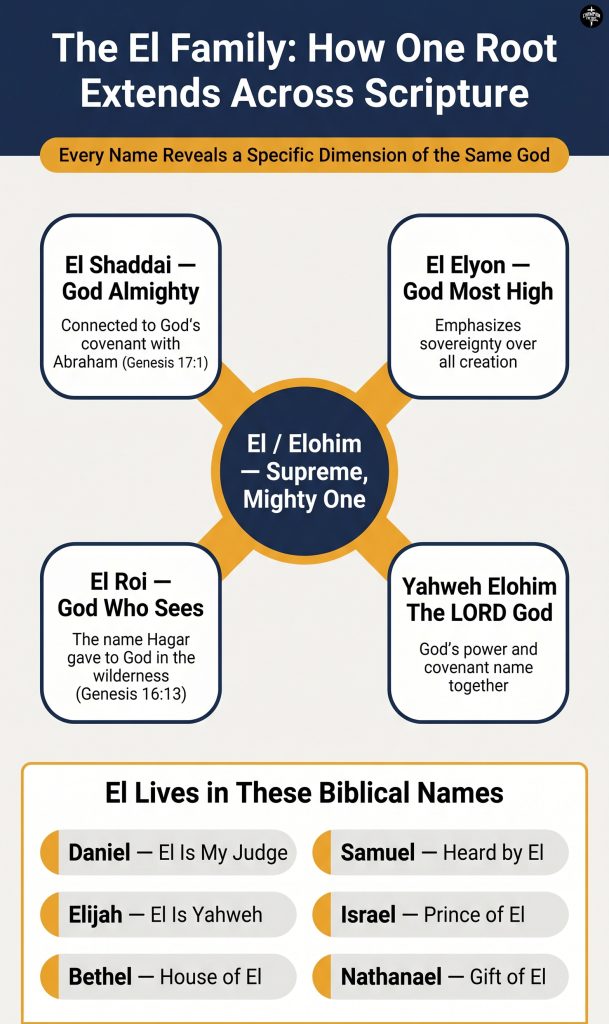
The root El from Elohim extends into several other names for God throughout Scripture. These compound names reveal specific dimensions of the same God. El Shaddai means God Almighty, connected to God's covenant with Abraham in Genesis 17:1. El Elyon means God Most High and emphasizes His sovereignty over all creation. El Roi means God Who Sees, the name Hagar gave to God in the wilderness when she was alone and believed no one had noticed her.
Rambam, the medieval Jewish philosopher, drew a useful distinction in Guide for the Perplexed: "Elohim represents God's attribute of justice and power, whereas the name YHWH represents His attribute of mercy and compassion." Elohim points to power and creative authority. Yahweh is God's personal covenant name and carries His mercy, faithfulness, and relational closeness. Both names refer to the same God and together give a fuller picture of who He is.
The root El also appears in the names of biblical figures. Daniel means "El is my judge." Samuel means "heard by El." Elijah means "El is Yahweh." The name Israel itself means "prince of El." In the ancient world, these were acts of testimony. To carry El in your name meant your life was bound to the God of supreme authority.
"One of the things you notice in global outreach is that people across cultures connect to the names of God once someone explains what they mean. El Roi, God Who Sees, reaches people who feel invisible. That name changes how they understand their situation." Art Montgomery, Global Evangelism Strategy Architect & Board Visionary Luminary, Champion Factory Ministry
What Elohim Reveals About God's Character
Elohim is a name with presence in suffering. When Jesus cried from the cross, "Eloi, Eloi, lema sabachthani?" (Mark 15:34), He used Eloi, a form of Elohim. Mark translates the words as "My God, my God, why have you forsaken me?" In the moment of greatest pain, Jesus addressed the Father using this name. That moment ties the authority of Elohim directly to the reality of human suffering.
This matters for anyone who wonders whether God's greatness translates into closeness. Elohim created the universe. He also heard a cry from a cross. He is a God of supreme authority who is not indifferent to what people carry.
Ligonier Ministries puts it this way: "Because the Lord's character and attributes are multifaceted, Elohim describes the depth of the riches of His being. This use, the plural of intensity, emphasizes His transcendence and His authorship of the world's diversity." The fullness captured by Elohim includes both authority over creation and care for what He has made.
The God Behind This Name Is One You Can Trust
The name Elohim is a foundation for trust. The God who holds all authority and created everything from nothing is the same God who meets people in weakness. Isaiah 40:28-29 (NIV) says it directly: "Do you not know? Have you not heard? The LORD is the everlasting God, the Creator of the ends of the earth. He will not grow tired or weary, and his understanding no one can fathom. He gives strength to the weary and increases the power of the weak."
That passage is where Elohim becomes personal. The creative authority behind the universe is available to the tired, the struggling, and the uncertain. The same God who acted in Genesis 1 is still active and still present.
The psalmist knew this from his own hard season. "Your way, O God, is holy. What god is great like our God? You are the God who works wonders; you have made known your might among the peoples" (Psalm 77:13-14, ESV). Those words were not written from a comfortable place. They were written by someone who turned toward Elohim in distress and found something steady.
"In this work, we meet people who have run out of reasons to trust. What we offer them first is not a program. It is the truth that the God who made everything sees them specifically. That is what the name Elohim gives us to stand on." Todd Medina, President & Founder, Champion Factory Ministry
Our discipleship and mentorship work at Champion Factory Ministry grows from this conviction: Elohim, the God of all authority, is also a God who stays close. If you want to explore what that kind of support looks like, or if you want to help extend it to others, we invite you to learn more about our work or make a gift.
Deeper study of God's names is always worth the time. A study Bible or a resource like Blue Letter Bible provides original Hebrew definitions and context. For ongoing guidance and community, a local church or pastor can walk alongside you in ways an article cannot replace.
FAQ
What is the simplest definition of Elohim?
Elohim is the Hebrew word for God that emphasizes His supreme power and might. It appears over 2,600 times in the Old Testament and is the name used in Genesis 1:1 when God creates the heavens and the earth. Its root, El, means mighty one or supreme power.
Does the plural form of Elohim mean there are multiple gods?
No. When Elohim refers to the one true God of Israel, it always takes singular verbs in Hebrew. The plural form is called the plural of majesty, a grammatical feature that expresses fullness and greatness rather than numerical plurality. The Shema in Deuteronomy 6:4 uses Elohim and still declares that God is one.
How is Elohim different from Yahweh?
Both names refer to the same God. Elohim emphasizes God's power, authority, and creative greatness. Yahweh is His personal covenant name and emphasizes mercy, faithfulness, and relational presence. The two names often appear together in Scripture as Yahweh Elohim, translated in English as "the LORD God."
Is El the same as Elohim?
El is the singular root form that Elohim extends from. They both refer to God, but Elohim is the fuller and more frequently used form. El also appears in compound names like El Shaddai (God Almighty), El Elyon (God Most High), and El Roi (God Who Sees), each one revealing a specific attribute of the same God.