





Many people have sung Hosanna in church for years without fully knowing what the word means. We know it belongs to Palm Sunday. We know it sounds like praise. But few sermons stop to explain where the word actually comes from or how much it carries.
This article unpacks the origin of Hosanna, why the crowd shouted it at Jesus, and what it means for anyone who has ever cried out to God on a hard, ordinary day.
What Does Hosanna Actually Mean?
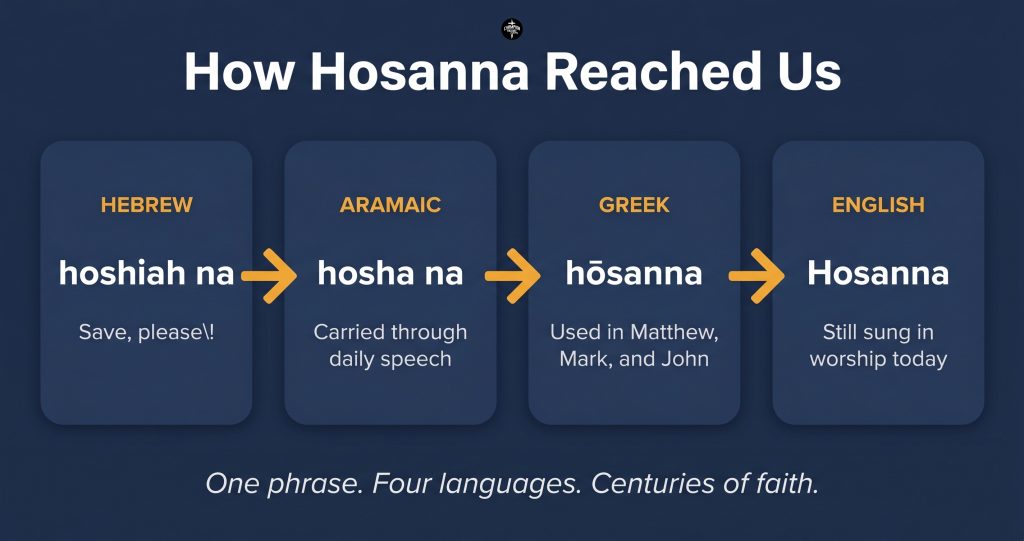
Hosanna comes from the Hebrew phrase "hoshiah na," found in Psalm 118:25, where it means "Save, please!" or "Save us, we pray." At its core, Hosanna is a cry directed at God, asking him to act, to rescue, and to bring deliverance. It is not a vague cheer. It is a request aimed at someone the speaker believes can actually save.
The Hebrew verb "hoshia" carries an intensive, causative meaning. It does not describe salvation from a distance. It calls for it directly. The related Hebrew root, "yasha," is also the root of the name Yeshua, translated into English as Jesus. The name Jesus literally means "God saves." When the crowd cried Hosanna, they were calling on someone whose name was already the answer to their plea.
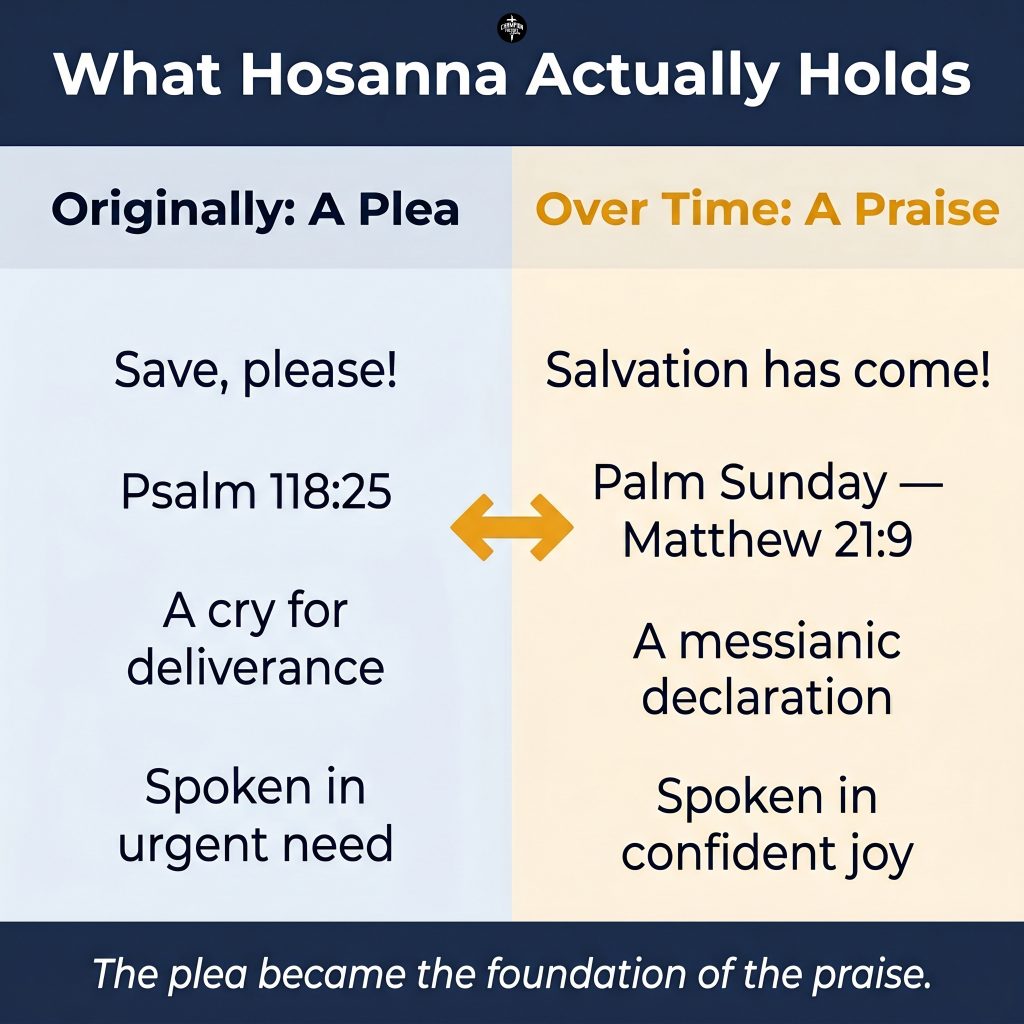
According to Baker's Evangelical Dictionary, Hosanna began as "an appeal for deliverance" that evolved in liturgical use to express "joy and praise for deliverance granted or anticipated." The plea and the praise were always present in the same breath.
Where Hosanna Comes From in the Bible
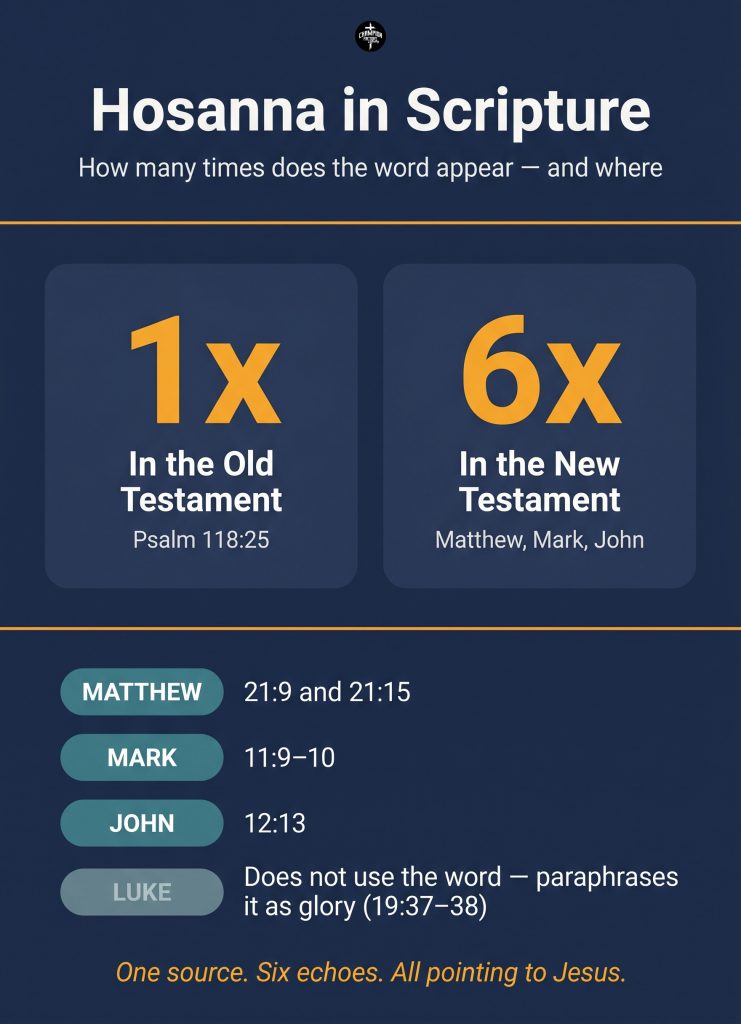
The Hebrew root of Hosanna appears only once in the entire Old Testament, in Psalm 118:25. Outside that single passage, Hosanna appears only in the Gospel accounts of Jesus entering Jerusalem. That narrow biblical footprint gives the word unusual precision. It is rooted in one specific cry from one specific psalm.
Psalm 118 belongs to the Hallel Psalms, a collection of six psalms (113 through 118) that Jewish worshipers sang at Passover and the Feast of Tabernacles. Psalm 118 was the final and most quoted psalm in the set. Most scholars believe it was among the hymns Jesus and his disciples sang together after the Last Supper, before they made their way to the Mount of Olives (Matthew 26:30).
When you consider that Jesus likely sang Psalm 118 with his disciples that same night, the crowd's Hosanna the following week carries a different weight. This was not background noise. It was Israel's prayer, known by everyone in that city, finally meeting the person it had always pointed toward.
Why the Crowd Shouted Hosanna at Jesus
When Jesus entered Jerusalem on a donkey, the crowd was not improvising. They were quoting Psalm 118:25-26, a psalm their community had sung at every major festival for generations. Their shout, "Hosanna to the Son of David!" was a direct messianic declaration. They recognized Jesus as the long-awaited deliverer and said so in the most scripturally weighted language available to them.
Matthew records the scene: "The crowds that went before him and that followed him were shouting, 'Hosanna to the Son of David! Blessed is he who comes in the name of the Lord! Hosanna in the highest!'" (Matthew 21:9, ESV).
This moment fulfilled the words of Zechariah 9:9, which described Israel's king arriving "lowly and riding on a donkey." Kings who came in peace rode donkeys. Kings who came for war rode horses. The crowd read the scene and responded with Hosanna by recognition, not coincidence.
The Pharisees understood the weight of that word. Their anger at the children shouting Hosanna in the temple tells you exactly what the word implied. Jesus did not correct them. He affirmed it (Matthew 21:15-16).
How the Meaning of Hosanna Shifted Over Time
Hosanna began as a desperate plea and gradually became a confident declaration. Theologian John Piper describes the shift in a reflection for Desiring God: the word moved from plea to praise, from cry to confidence. What once meant "Save, please!" came to mean "Salvation has come!" The cry was answered so reliably over generations of worship that it became a shout of certainty.
Dr. Benjamin Shaw of Ligonier Ministries notes that the Didache, an early Christian document from the late first or early second century, uses Hosanna as an expression of praise in a eucharistic prayer. The shift from petition to celebration was not a modern reinterpretation. It was present in the worship of the earliest church.
Hosanna did not lose its original meaning when it became an expression of praise. The plea became the foundation of the praise.
"Every time I have sat with someone exploring faith for the first time, the thing they need most is permission to bring their real situation to God. Hosanna is that permission. It was true in the first century and it is true now." Art Montgomery, Global Evangelism Strategy Architect, Champion Factory Ministry
What Hosanna Means When Life Is Hard
Hosanna gives you permission to come to God with what is actually true. You do not have to manufacture joy to say it. The word began as a cry, not a celebration. As Pastor Jason Elder puts it, "Faith is not pretending everything is fine. It is naming what is broken while trusting God to heal it." Hosanna does exactly that. It names the need and reaches toward the one who can meet it.
For many people, praise feels out of reach in seasons of grief, exhaustion, or uncertainty. Hosanna offers a different entry point. You can cry out to God from the middle of difficulty and call that worship. The crowd at Palm Sunday was not a group of people without troubles. They were a people who had been waiting a long time for rescue. Their shout carried longing alongside joy.
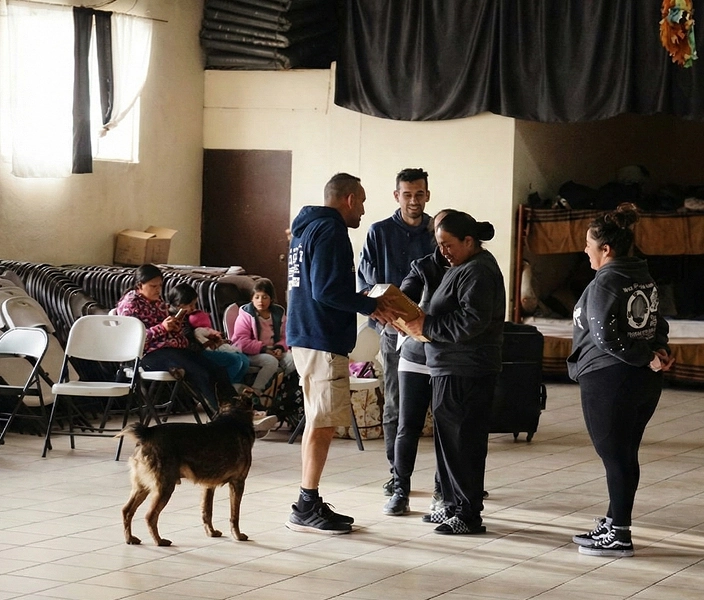
Champion Factory Ministry walks alongside people who know what it feels like to need help that only God can provide. The families, individuals, and children the ministry serves understand the original weight of Hosanna, not as a liturgical word but as an honest cry.
"The people we walk alongside often come without polished words for what they are facing. But they know what it means to need God to show up. That is what Hosanna is." Todd Medina, President and Founder, Champion Factory Ministry
If you want to connect with the care and support Champion Factory Ministry provides to families and individuals, explore our programs and how to get involved.
Hosanna Is a Word You Can Carry Forward
The next time you hear Hosanna in a worship song or say it in a service, you are holding something with real history behind it. The word began in a single Hebrew psalm. It traveled through centuries of Jewish worship. It landed on the lips of a crowd who recognized their Savior. It found its way into the earliest Christian prayers and into churches across every generation since.
It is both prayer and declaration. It holds the honest cry of someone who needs God and the grounded confidence of someone who trusts him. You can say it when life is full. You can say it when life feels broken.
That is not a tension to resolve. It is how scripture teaches us to pray.
FAQ
Is Hosanna a Prayer or a Praise?
Hosanna is both. Its original Hebrew meaning is a cry for salvation, "Save, please!" Over time it became a confident expression of praise for God's deliverance. In biblical worship it has always carried both at once, honest need and real faith.
Where Does Hosanna Appear in the Bible?
The Hebrew root appears once in the Old Testament, in Psalm 118:25. In the New Testament, Hosanna appears six times, all in Matthew, Mark, and John, in accounts of Jesus entering Jerusalem on Palm Sunday. Luke does not use the word but paraphrases it with the Greek word for "glory."
What Is the Difference Between Hosanna and Hallelujah?
Both are words of praise used in Christian worship. Hallelujah means "Praise the Lord" and is a declaration of adoration. Hosanna carries the element of need alongside the praise. It acknowledges God as Savior while calling on him to act. Hallelujah is pure celebration. Hosanna is honest faith expressed as worship.
Can I Say Hosanna When I Am Struggling?
Yes. The original meaning of Hosanna is a cry for God's help. The word was never reserved for easy or celebratory moments. Bringing real need honestly to God and trusting him to act is exactly what Hosanna was designed to express.