






You may not have heard the word syncretism before, but you have likely felt its effects. It shows up when someone describes themselves as Christian but also believes in karma, consults horoscopes regularly, or treats God mainly as a source of personal blessing with no claim on how they live. It is not always dramatic or obvious. Often it looks like a slow drift.
This article is not written to judge anyone. It is written because understanding syncretism clearly is one of the most practical things a believer can do. When you can name what is happening, you can make thoughtful choices about your faith rather than absorbing whatever the culture offers. Here is what syncretism is, how it appears in everyday Christian life, and how to hold your faith with confidence and grace.
What Syncretism Actually Means
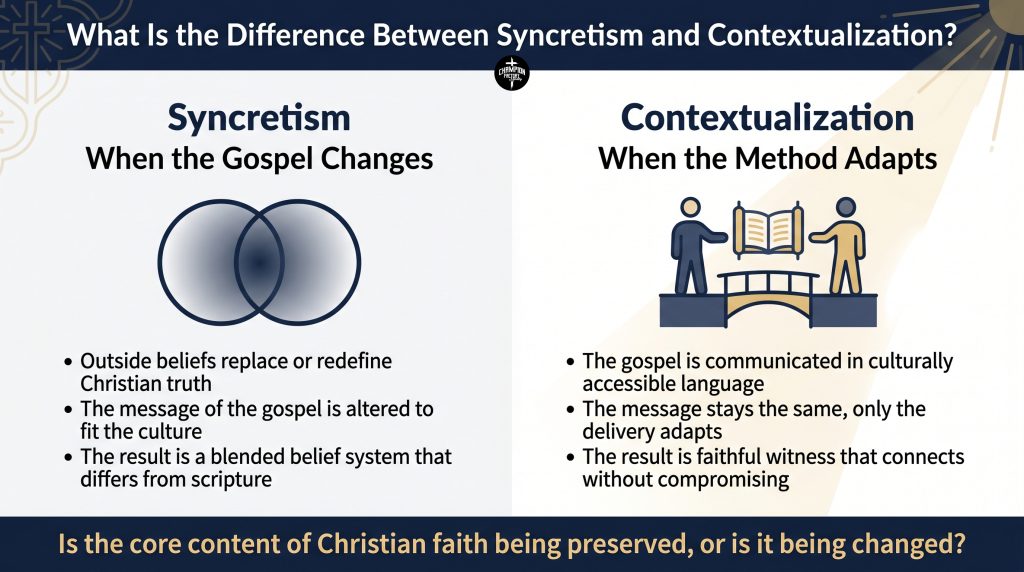
Syncretism is the blending of elements from different religious or philosophical belief systems into one combined system. For Christians, it describes what happens when biblical faith is mixed with outside beliefs in ways that change, replace, or dilute core Christian teaching. The result is not a more open faith. It is a different one.
The word comes from Greek roots meaning to join together or mix. In theology, the term most often describes what happens when Christian beliefs get combined with ideas from other spiritual traditions, philosophies, or cultural worldviews. The mix can be subtle. One person might pray to Jesus and also use crystals for spiritual protection. Another might attend church faithfully while holding to reincarnation as a core belief about what happens after death. Neither practice was drawn from scripture.
The challenge with syncretism is that it rarely feels like compromise from the inside. George Barna of the Cultural Research Center at Arizona Christian University describes it as a cut-and-paste approach to making sense of life, where people embrace beliefs and behaviors that feel comfortable rather than building a coherent worldview. That description fits a lot of people, including many who consider themselves followers of Christ.
Syncretism is not the same as learning about other religions, respecting people of other faiths, or engaging thoughtfully with the world around you. That distinction matters, and this article returns to it.
Syncretism in the Bible: A Pattern Through History
The Bible addresses syncretism directly throughout both testaments. Israel repeatedly blended worship of God with practices drawn from surrounding nations. The New Testament church faced the same pressure from competing philosophies. In both cases, the concern was the same: when other beliefs are added to or mixed into faith in the God of scripture, the integrity of that faith is compromised.
In the Old Testament, Israel's pattern of mixing the worship of God with the worship of Baal, Asherah, and other regional deities is one of the defining conflicts of the historical books and the prophets. The first two of the Ten Commandments address this directly. Exodus 20:3-5 establishes that God requires undivided worship and prohibits the addition of other gods or the creation of idols. The prophets returned to this theme consistently, and scripture connects Israel's syncretism to the exile of the northern kingdom in 722 BC.
The New Testament church faced its own version of this pressure. Gnosticism taught that the physical world was evil and that Christ could not have had a real physical body. Manichaeism blended dualistic philosophy with Christian language. Various forms of Neoplatonism tried to absorb Christian ideas into existing philosophical frameworks. The church fathers spent generations defending the gospel against these pressures. They understood that a mixed gospel is not the gospel.
This history matters because it shows that syncretism is not a modern failure. It is a recurring pattern. The pressure to accommodate surrounding beliefs has always existed. The question has always been the same: what does Christian faith actually teach, and are we willing to hold to that with clarity?
How Syncretism Shows Up in American Christianity Today
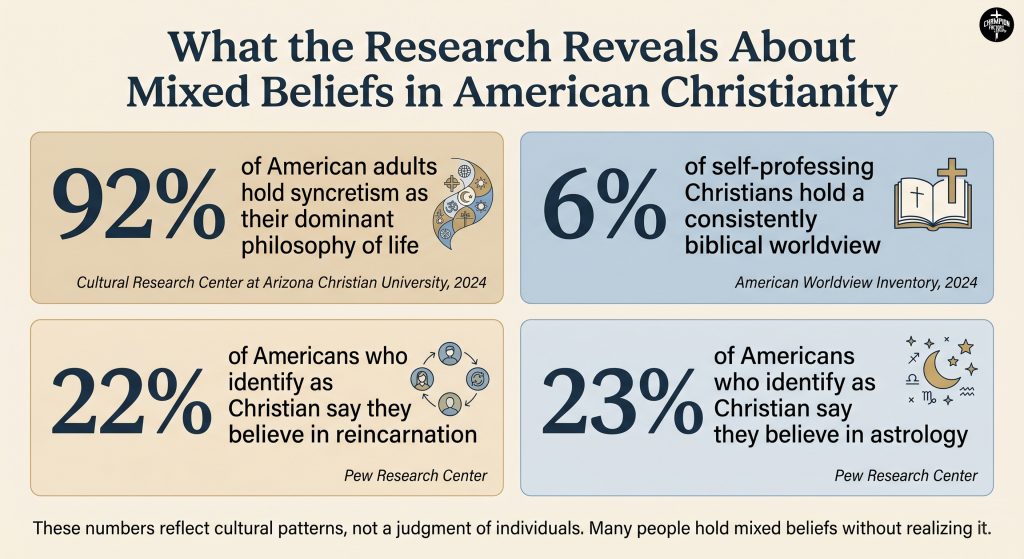
Most Americans, including many who identify as Christians, hold beliefs drawn from more than one worldview. Research from the Cultural Research Center at Arizona Christian University found that 92% of American adults hold syncretism as their dominant philosophy of life, combining ideas from an average of nine distinct worldviews. Their 2024 American Worldview Inventory found that only 6% of self-professing Christians hold a consistently biblical worldview.
Those numbers deserve honest reflection, not condemnation. They describe a culture shaped by pluralism, social media, therapeutic thinking, and widespread spiritual curiosity. People blend beliefs because it feels natural in a culture that encourages building your own framework from whatever resonates.
Pew Research Center data shows what this looks like in practice. Among Americans who identify as Christian, 22% say they believe in reincarnation, and 23% believe in astrology. These findings reflect how widely beliefs from non-Christian traditions have entered the lives of people who see themselves as followers of Christ.
Some specific forms of syncretism that appear in American Christian contexts include:
- Combining Christian faith with New Age practices such as energy healing, crystal use, or spirit communication
- Incorporating astrology or horoscopes into daily decision making alongside prayer
- Treating God primarily as a source of personal blessing and emotional support, without reference to scripture or obedience, a pattern sometimes called moralistic therapeutic deism
- Blending Christian identity with national or political identity in ways that elevate one above the other
- Adopting ideas about karma, the inherent goodness of all people, or universal salvation drawn from Eastern or secular philosophical traditions
None of these examples are listed to shame anyone. They are listed because naming them clearly helps believers ask honest questions about where their beliefs actually come from.
The Difference Between Syncretism and Cultural Sensitivity
Engaging your culture, loving people of other faiths, and presenting the gospel in language people understand is not syncretism. These are part of what faithful Christian witness has always looked like. The line between syncretism and cultural sensitivity comes down to one question: is the core content of Christian faith being preserved, or is it being changed?
This distinction has a theological name: contextualization. Contextualization is the process of communicating biblical truth in ways that are accessible within a specific cultural context, without altering what is being communicated. The early church did this as it moved from a Jewish context into the Greek-speaking world. Missionaries have practiced it throughout history. It is careful, faithful work.
Syncretism crosses a different line. It happens when outside beliefs stop shaping how the gospel is communicated and start replacing or redefining what the gospel is. When the resurrection becomes a metaphor rather than a historical event because that framing fits better culturally, that is syncretism. When prayer to ancestors is added to worship of Christ as an equally valid spiritual practice, that is syncretism.
"Everywhere the gospel travels, there is pressure to reshape it to fit existing beliefs. Faithful ministry meets people where they are. It does not move the gospel to meet them."
Art Montgomery, Global Evangelism Strategy Architect & Board Visionary Luminary, Champion Factory Ministry
A practical question to ask: Is this belief or practice rooted in or consistent with scripture? If the answer requires stretching the Bible far beyond its plain meaning, that is a signal worth taking seriously.
Christians can and should:
- Respect the dignity and freedom of people who hold different beliefs
- Learn about other religious traditions with genuine curiosity
- Adapt how they share their faith to different audiences and settings
- Serve, love, and build relationships across religious and cultural differences
None of that requires blending what they believe with what others believe. Compassion and biblical clarity can exist together.
Why Syncretism Is a Concern Worth Taking Seriously
Syncretism erodes faith gradually. One of its most consistent effects is that it dulls spiritual discernment over time, making it harder to tell sound teaching from false teaching. When a person grows accustomed to holding contradictory beliefs without noticing, evaluating new ideas carefully becomes much harder.
Hebrews 5:14 speaks about the spiritually mature as those who have trained themselves to distinguish good from evil. That kind of discernment does not grow when we treat all beliefs as equally valid. It develops through sustained engagement with scripture, honest community, and a willingness to test what we believe against what God has actually said.
There is also the matter of spiritual stability. A faith assembled from multiple contradictory sources cannot hold under genuine pressure. When a person faces a real crisis, they need something firm to stand on. A belief system built on personal preference and comfort tends not to provide that.
Romans 12:2 puts it plainly: do not be conformed to the pattern of this world, but be transformed by the renewing of your mind. That verse is not a call to cultural withdrawal. It is a call to ongoing, honest engagement with what actually shapes our thinking.
Practical Ways to Stay Grounded in Biblical Faith
Guarding against syncretism does not require suspicion or isolation. It requires consistency. Regular scripture reading, honest community, and a habit of asking where beliefs come from are the most practical protections a believer has.
The following steps support that kind of groundedness:
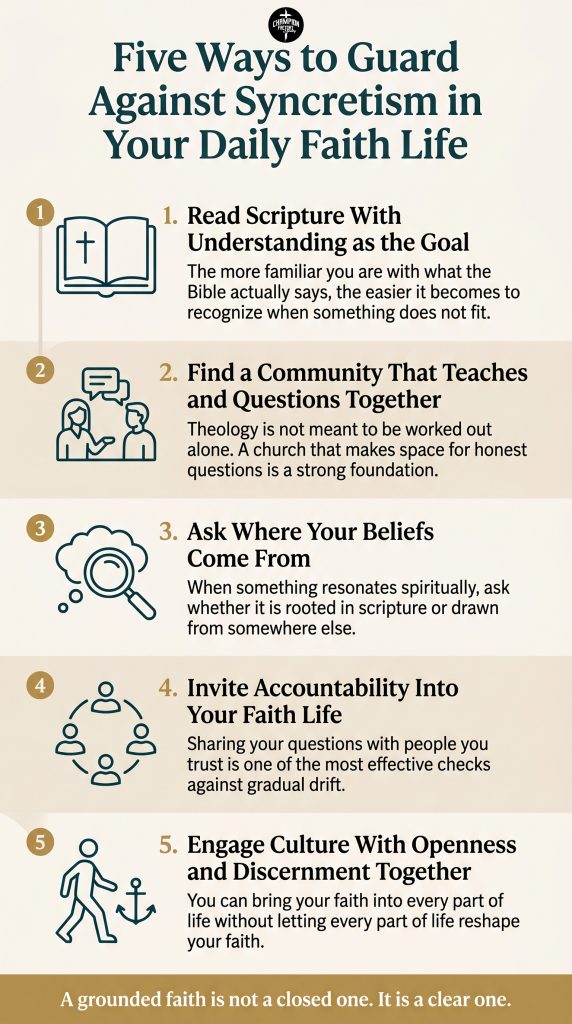
- Read scripture consistently, with understanding as the goal. The more familiar you are with what the Bible actually says, the easier it becomes to notice when something being taught does not fit.
- Find a church community that teaches the Bible clearly and creates space for honest questions. Theology is not meant to be worked out alone.
- Ask where beliefs come from. When you hear something that resonates spiritually, ask whether it is rooted in scripture or drawn from a different tradition. That question can be asked with genuine curiosity, not defensiveness.
- Invite accountability. Share your faith questions with people you trust. Articulating what you believe and having others engage it honestly is one of the most effective checks against gradual drift.
- Approach cultural engagement with both openness and discernment. You can bring your faith into every part of your life without letting every part of your life reshape your faith.
"When someone comes to us carrying a mix of beliefs collected over the years, we do not begin with correction. We begin with scripture and relationship. The clarity comes from there."
Todd Medina, President & Founder, Champion Factory Ministry
Discipleship is one of the clearest protections against syncretism. When believers are consistently taught, mentored, and given space to ask questions in community, theological drift is far less likely to go unnoticed. If you are looking for that kind of community, explore how Champion Factory Ministry supports spiritual growth through mentorship, discipleship, and practical care.
Faith That Holds and Stays Compassionate
Understanding syncretism is not about drawing walls around your faith or viewing your neighbors with suspicion. It is about knowing what you actually believe and why, so you can hold it clearly and share it honestly.
Most people who hold mixed beliefs do so without realizing it. The culture makes it easy to absorb ideas from many sources and call it spirituality. That is not a reason for judgment. It is a reason for patient, grounded, and compassionate teaching.
If you are reading this and feel uncertain about some of what you believe, that is a healthy starting point. Honest questions are the beginning of real faith formation, not a sign of weakness. Bring those questions to scripture, to a trusted pastor or mentor, and to a community that takes both truth and compassion seriously.
Second Timothy 3:16-17 affirms that scripture is sufficient for equipping believers for every good work. That is not a promise of easy answers. It is a statement that the foundation is reliable.
If you want to explore discipleship, mentorship, and faith community through Champion Factory Ministry, visit our programs page to learn how we walk alongside individuals and families in their spiritual growth.
FAQ
What is syncretism in simple terms?
Syncretism is what happens when beliefs from two or more different religious or philosophical traditions are combined into one mixed system. In Christianity, it refers to mixing biblical faith with beliefs or practices from other traditions in ways that change what that faith actually teaches.
Is celebrating Christmas or Easter a form of syncretism?
This is a question many Christians ask honestly. Most theologians distinguish between cultural practices that carry no ongoing spiritual meaning and practices that alter or replace core Christian belief. The key question is whether a practice is shaping your understanding of who God is and what He requires. That discernment is best worked through with a pastor or faith community you trust.
How is syncretism different from learning about other religions?
Learning about other religions is not syncretism. Understanding what others believe helps Christians engage the world thoughtfully and share their faith clearly. Syncretism happens when beliefs from other traditions are incorporated into Christian faith as equally true, changing what that faith actually teaches.
Can a Christian practice yoga or mindfulness?
This is a question sincere Christians hold different views on. The relevant question is whether a practice is purely physical or cultural, or whether it carries spiritual meaning from a tradition that conflicts with biblical teaching. Bringing this question to scripture and a trusted pastor is the most reliable path forward.
What should I do if I realize I have been holding syncretic beliefs?
Recognizing it is the first step, and it takes honesty to get there. Return to scripture, talk with a pastor or trusted mentor, and allow your beliefs to be examined and shaped by what God has actually said. There is no condemnation in that process. There is only growth.