






Many people hear that they should be growing spiritually, but they feel unsure what that actually means. Sanctification is one of those church words that gets used often and explained rarely. If you have ever wondered whether you are growing the right way, or fast enough, you are not alone.
This article explains what sanctification means in simple terms. It shows how spiritual growth really happens, why it often feels slow, and how to recognize it when it comes. The goal is to give you clarity and encouragement, not pressure.
What Does Sanctification Actually Mean?
Sanctification means to be set apart and made holy. In the Christian life, it describes God's ongoing work of shaping a believer to become more like Jesus. The word points to both a settled truth and a lifelong process. You are set apart the moment you trust Christ, and you keep growing from there.
The root idea behind the word is to set something apart for a special purpose. When the Bible speaks of people being sanctified, it means they belong to God and are being shaped for his purposes. Scripture names this as God's intention for every believer. As Paul writes, "It is God's will that you should be sanctified" (1 Thessalonians 4:3).
That framing matters. Sanctification is not a private project you take on by willpower. It is something God does in you and with you over the course of your life.
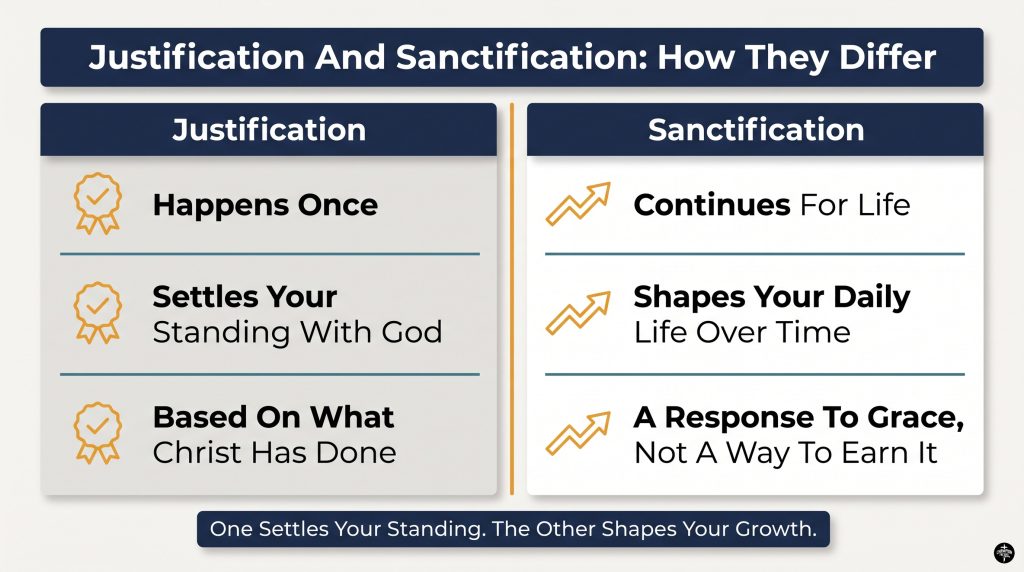
How Sanctification Differs From Justification
Justification and sanctification are connected but not the same. Justification is the moment God declares you right with him through faith in Christ. It happens once and does not change. Sanctification is the growth that follows. One settles your standing with God. The other shapes your daily life over time.
People often blur these two together, which can lead to confusion and quiet anxiety. If you think your standing with God depends on how well you are growing, every setback feels like a threat. That is exhausting, and it is not how grace works.
Here is the relief. Your acceptance by God rests on what Christ has done, not on your progress. Growth then becomes a response to that acceptance rather than a way to earn it. You grow because you already belong, not in order to belong.
Who Does the Work, and What Is Your Part?
God does the work of sanctification, and you take part in it. Scripture presents growth as something the Holy Spirit produces in you, not something you manufacture alone. Your role is to stay close to God and make space for his work. This keeps growth from becoming either passive waiting or constant self-effort.
It helps to hold two truths at once. God is the one who changes you. You are also invited to show up and participate. These are not in competition.
In practice, that means you cannot force growth through sheer effort, and you also cannot grow while staying distant and disengaged. The practices that help you grow do not earn God's favor. They simply place you where his work can reach you.
Does Sanctification Happen at Once or Over Time?
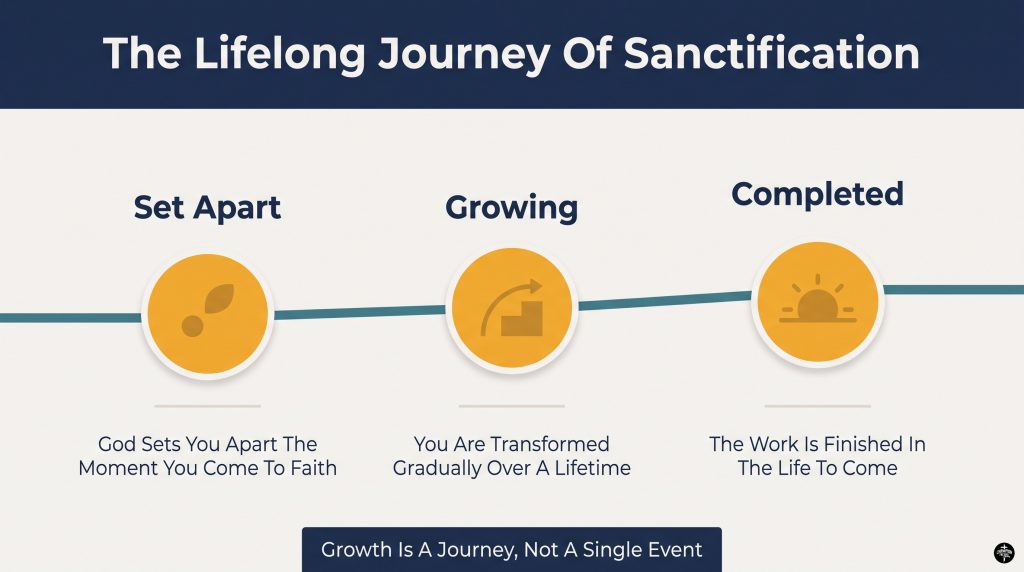
Sanctification has more than one dimension. In one sense, God sets you apart the moment you come to faith. In another sense, you keep growing for the rest of your life. Christian teaching also looks ahead to a future completion when this work is finally finished. Growth is a journey, not a single event.
This is why your experience can feel mixed. You are already set apart by God, and you are still very much a work in progress. Both are true at the same time.
Scripture describes this ongoing change as a gradual transformation. Paul writes that believers "are being transformed into his image with ever-increasing glory, which comes from the Lord, who is the Spirit" (2 Corinthians 3:18). The phrase ever-increasing points to steady movement, not instant perfection. Different Christian traditions describe the finer details in different ways, but they share this core. God begins the work, continues it through your life, and completes it in the end.
How Spiritual Growth Actually Happens
Spiritual growth happens through ordinary, repeated practices that keep you connected to God. Prayer, reading Scripture, worship, honest community, and serving others all create space for the Holy Spirit to work. These habits do not earn God's love. They help you respond to it. Growth comes from consistency over time, not intensity in a single moment.
None of these practices are complicated. The challenge is steadiness. National research shows how common that struggle is. The share of Christians who say they pray every day has fallen in recent years, according to data from the Pew Research Center. If your habits feel inconsistent, you are not failing, and you can begin again at any time.
A few practices tend to shape growth the most:
- Prayer. Simple, honest conversation with God, even in a few minutes a day.
- Scripture. Reading a little at a time, looking for what it shows you about God.
- Worship and gathering. Joining with others to remember who God is.
- Community and discipleship. Walking with people who can encourage and challenge you.
- Serving others. Letting love move outward into action.
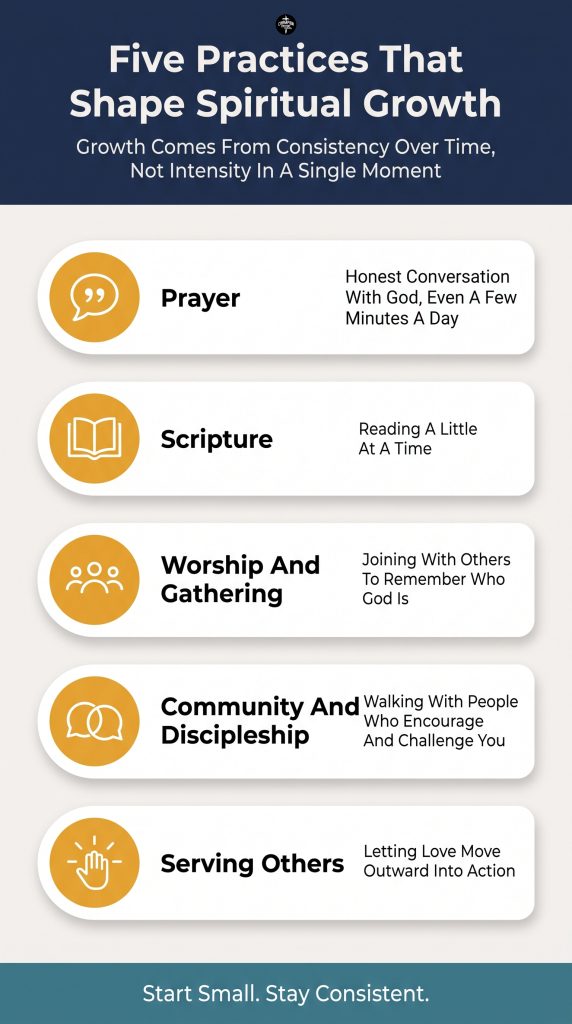
Start Small and Stay Consistent
You do not need to do everything at once. Pick one practice and keep it small enough to repeat. Five honest minutes a day will shape you more than an ambitious plan you abandon in a week. Scripture puts it plainly, calling believers to "grow in the grace and knowledge of our Lord and Savior Jesus Christ" (2 Peter 3:18). Growth is expected, and it is meant to be gradual.
"In our discipleship work, the people who grow the most are rarely the ones who start big. They are the ones who keep showing up with one small habit, week after week." Todd Medina, President & Founder
Why Spiritual Growth Often Feels Slow
Slow growth is normal, and it does not mean your faith is failing. Real change takes time, especially through seasons of pain, loss, or recovery. Setbacks are part of the process for almost everyone. God's work in you continues even when progress feels invisible. Faithfulness in small steps matters more than speed.
If you feel stuck, that feeling alone is not evidence of failure. Many people grow slowly because they are dealing with real hardship. Hardship does not stop sanctification. It often becomes the very place where it deepens.
Scripture offers steady assurance here. Paul writes that God, "who began a good work in you will carry it on to completion until the day of Christ Jesus" (Philippians 1:6). The work is his to finish, which takes the pressure off your timeline.
It also helps to remember that spiritual practice supports a healthy life but does not replace professional care. If you are facing trauma, addiction, grief, or a mental health crisis, please reach out to a qualified counselor, doctor, or support service. Faith and professional help work well together, and many mental health providers now recognize the role of spirituality in care. At Champion Factory Ministry, our Nourish discipleship and mentorship work reflects the same belief that steady, small steps in community matter more than fast change.
How to Recognize Real Spiritual Growth
Healthy growth shows up mostly in character, not in performance. Over time you tend to grow more loving, patient, humble, and steady. These changes often come gradually and through ordinary life. Growth is not a checklist to score. It is the slow shaping of who you are becoming as you follow Jesus.
Scripture describes these qualities as fruit. Paul lists "love, joy, peace, forbearance, kindness, goodness, faithfulness, gentleness and self-control" (Galatians 5:22-23). Fruit grows slowly and in season. You rarely notice it forming day to day, but over months and years the change becomes clear.
"We watch for growth in how people treat each other, not in how much they can recite. A little more patience and honesty over a year tells us far more than a perfect attendance record." Art Montgomery, Global Evangelism Strategy Architect & Board Visionary Luminary
So look for direction more than perfection. Are you a little quicker to forgive than you were a year ago? A little more honest, a little more patient, a little more aware of others? Those small shifts are real signs of growth, even when they feel modest.
Walking Forward in Steady Hope
Sanctification is not a test you pass or fail. It is God's patient work of making you more like Christ, and it unfolds across an entire life. You do not have to rush it, force it, or carry it alone.
A simple next step is to choose one small practice and begin this week. Pray honestly. Read a short passage. Reach out to someone who can walk with you. If you want encouragement and community as you grow, you are welcome to get involved. Wherever you are starting from, growth is possible, and God is already at work.
FAQ
Is sanctification the same as being saved?
No. Being saved, often called justification, is the moment God declares you right with him through faith in Christ. Sanctification is the ongoing growth that follows. One settles your standing, and the other shapes your life over time.
How long does sanctification take?
It lasts a lifetime. Sanctification begins when you come to faith and continues for the rest of your life. Christian teaching looks ahead to a future point when the work is finally complete, so it is best understood as a journey rather than a goal you finish quickly.
What practices help spiritual growth the most?
Prayer, reading Scripture, worship, honest community, and serving others all create space for growth. The most helpful approach is to start small and stay consistent. A short daily habit you can keep will shape you more than a large plan you cannot sustain.
Does slow growth mean my faith is weak?
No. Growth is often slow, especially through seasons of hardship, loss, or recovery. Setbacks are normal for almost everyone. God continues his work in you even when progress feels invisible, so steady faithfulness matters more than speed.