






Most people know King David's name before they know his story. He is the shepherd who fought a giant, the king who wrote songs to God, and the man Scripture calls someone after God's own heart. He was patient in some seasons, impulsive in others, and honest about both his pain and his sin.
This article walks through who David really was, what the Bible and history tell us about his life, and what his story offers you today. Whether you are facing a hard season, waiting on God, or carrying guilt over past mistakes, David's life offers an honest and hopeful place to start.
Who Was King David Before He Became King
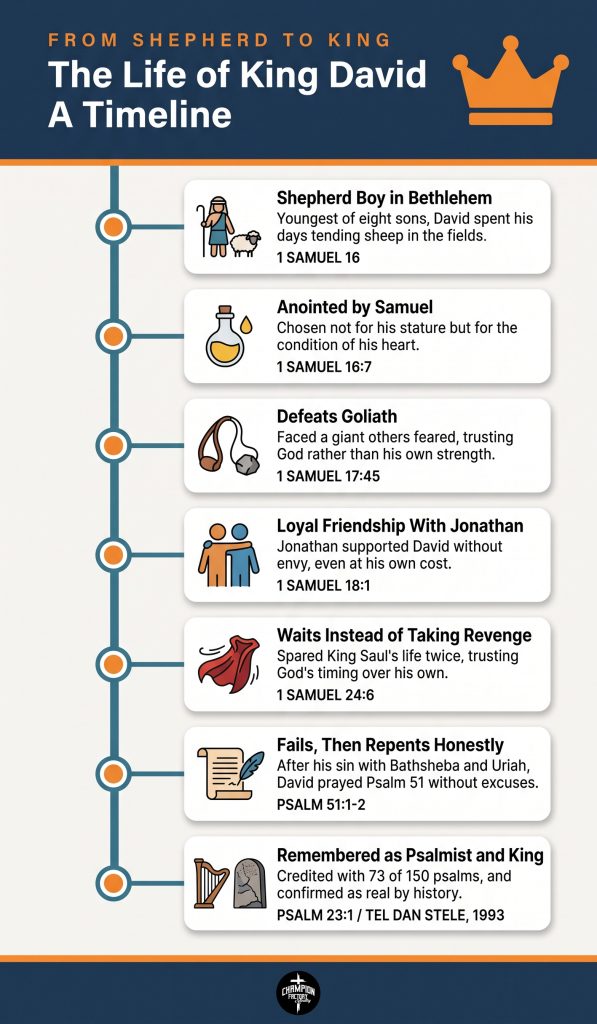
King David was the youngest son of Jesse, a farmer from Bethlehem, and spent his early years tending his family's sheep before the prophet Samuel anointed him as Israel's future king. His story begins in an ordinary field, not a palace, showing that God often calls people long before their circumstances look like it.
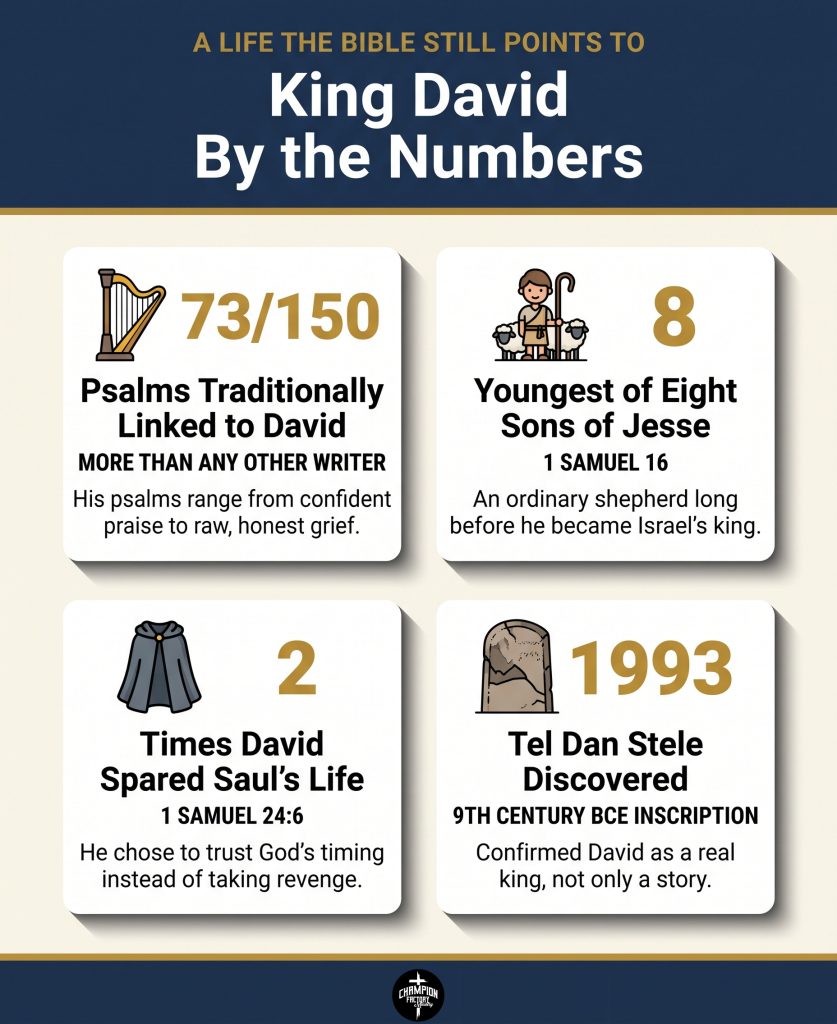
David grew up the youngest of eight sons in a farming family from Bethlehem, a small town with no particular status. According to Britannica's account of his life, David went on to become the second ruler of the united kingdom of Israel and Judah, founding a dynasty that shaped the nation's history for generations. Long before any of that, he spent his days watching sheep, a quiet and often overlooked job.
The prophet Samuel anointed David as Israel's next king while Saul was still on the throne. God's reasoning is recorded plainly: "The Lord does not look at the things people look at. People look at the outward appearance, but the Lord looks at the heart" (1 Samuel 16:7, NIV). God chose David not for his stature or experience, but for the condition of his heart.
For anyone who feels overlooked or unqualified, David's early story is a reminder that God's timing and God's criteria rarely match what the world expects.
The Story Of David And Goliath: Facing Giants With Faith
David's defeat of Goliath is the most famous story connected to his life. As a young shepherd too young for Saul's army, David volunteered to face a Philistine giant who had frightened Israel's soldiers for weeks, trusting that God would fight on Israel's behalf rather than relying on his own strength.
Goliath had mocked the armies of Israel for over a month, and no trained soldier stepped forward to face him. David, who had come only to deliver food to his brothers, volunteered instead, armed with a sling and a handful of stones.
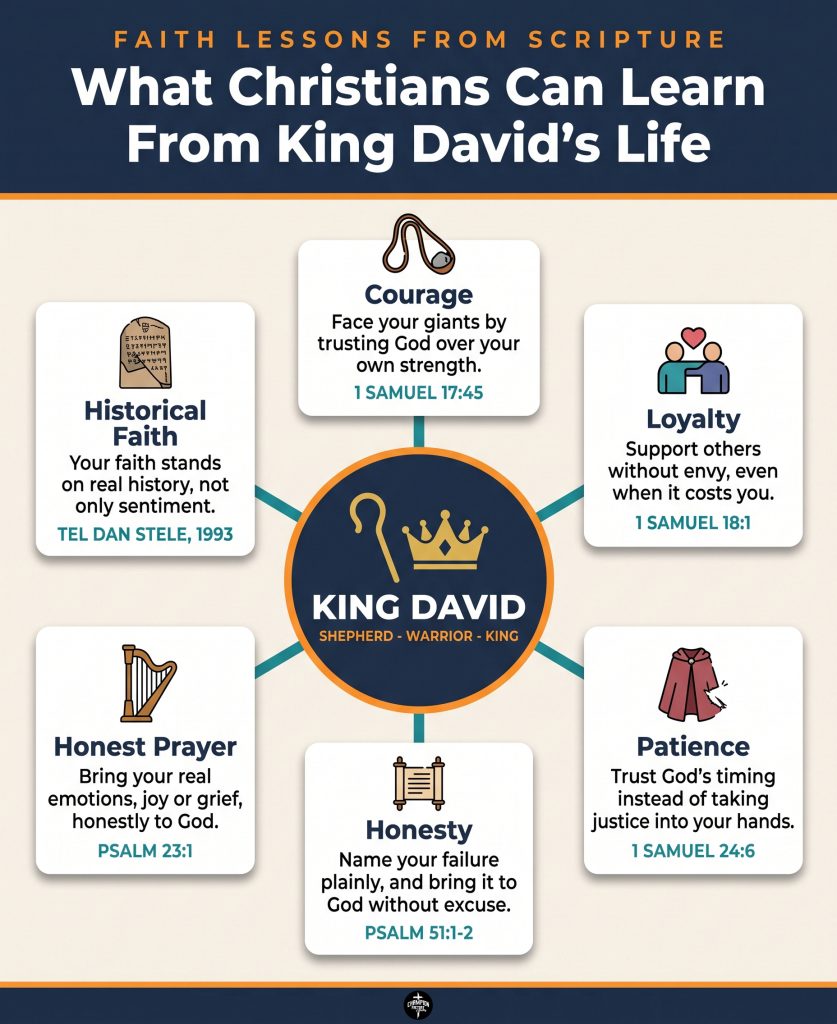
David's confidence did not come from confidence in his own skill. He told Goliath he came "in the name of the Lord Almighty" (1 Samuel 17:45, NIV). The outcome surprised everyone watching, but it fits a pattern that repeats throughout David's life. He faced overwhelming odds by trusting God's presence rather than his own resources.
This story still resonates because most people eventually face a giant of their own, whether that is a health crisis, a financial setback, or a personal fear. David's example is not about having no fear. It is about facing fear with faith instead of stepping back from it.
David And Jonathan: What Real Friendship Looks Like
David's friendship with Jonathan, the son of King Saul, is one of the clearest examples of loyalty in the Bible. Jonathan supported David even though David's rise to power meant Jonathan would likely never be king himself, showing a friendship built on trust in God's plan rather than personal ambition.
Scripture describes their bond directly. After David defeated Goliath, "Jonathan became one in spirit with David, and he loved him as himself" (1 Samuel 18:1, NIV). Jonathan warned David when Saul's jealousy turned dangerous and helped him escape more than once, even though doing so worked against his own claim to the throne.
Jonathan's example offers a model worth naming:
- He supported David without envy.
- He kept his word even when it cost him something.
- He trusted God's plan for David's life more than his own position.
"We see this same pattern in mentorship today. A young person grows fastest when someone with nothing to gain simply shows up for them, again and again." Todd Medina, President & Founder, Champion Factory Ministry
Healthy friendship and mentorship still shape how people grow. Champion Factory Ministry's mentorship and spiritual guidance work rests on the same idea Jonathan modeled, that people grow stronger with someone walking alongside them, not alone.
Why David Waited On God Instead Of Taking Revenge On Saul
David had at least two clear chances to kill King Saul, who was actively hunting him, but he refused both times. He chose to wait for God to remove Saul from power rather than take justice into his own hands, trusting God's timing over his own sense of what felt fair.
David and his men once hid in the same cave where Saul stopped to rest. David's men urged him to strike, but David only cut a piece of Saul's robe, then felt troubled even by that small act. He told his men, "The Lord forbid that I should do such a thing to my master, the Lord's anointed, or lay my hand on him" (1 Samuel 24:6, NIV).
Waiting is rarely comfortable. David spent years running from a king who wanted him dead, with no clear timeline for when it would end. His restraint was not passive. It was an active decision to trust that God's timing, even when delayed, is not the same as God being absent.
Anyone waiting on a difficult situation to change, whether in a relationship, a health outcome, or a season of financial hardship, can find honest company in David's long wait. His story does not promise a quick resolution. It shows what faithfulness looks like while still waiting.
David's Failure And Repentance: What Psalm 51 Teaches About Grace
David's greatest failure came when he took another man's wife, Bathsheba, and arranged for her husband Uriah to be killed to hide the consequences. When the prophet Nathan confronted him, David did not defend himself or shift blame. He owned his sin honestly before God, and Psalm 51 records one of the most direct prayers of repentance found anywhere in Scripture.
Nathan told David a story about a rich man who stole a poor man's only lamb. When David reacted with anger at the injustice, Nathan said simply, "You are the man" (2 Samuel 12:7, NIV). David's response set the tone for how Scripture treats his failure. He said, "I have sinned against the Lord" (2 Samuel 12:13, NIV), without qualifying it or explaining it away.
David's prayer in Psalm 51 goes further than a simple apology. He wrote, "Have mercy on me, O God, according to your unfailing love, according to your great compassion blot out my transgressions. Wash away all my iniquity and cleanse me from my sin" (Psalm 51:1-2, NIV). This was not a private thought kept to himself. It became part of Scripture, meant to be read by others carrying their own guilt.
"People rarely come to faith because someone convinced them of an argument. They come because someone was honest with them first. David's prayer in Psalm 51 still does that work today." Art Montgomery, Global Evangelism Strategy Architect & Board Visionary Luminary, Champion Factory Ministry
Modern research on honest self-reflection points to something similar. Psychologist Dr. Kristin Neff, who studies self-compassion, describes it as treating ourselves kindly, like we would a close friend we cared about. David's honesty with God did not excuse what he did. It opened the way to real change.
If you are carrying guilt or shame from your own past, David's example points toward honesty rather than hiding. Naming what happened, without excusing it, is often the first step toward healing. If that guilt feels heavy or connects to a painful season involving harm or trauma, a licensed counselor or trusted pastor can offer support that a blog post cannot replace.
David The Psalmist: Bringing Honest Emotion To God
David is traditionally credited as the author of about 73 of the Bible's 150 psalms, more than any other writer. His psalms range from confident praise to raw grief, showing that honest, unfiltered prayer has always been part of a genuine relationship with God.
David wrote about joy, fear, guilt, gratitude, and confusion, often within the same collection of songs. Psalm 23 opens with the calm confidence of someone who once tended sheep himself: "The Lord is my shepherd, I lack nothing" (Psalm 23:1, NIV). Other psalms carry deep sorrow and even confusion about why God feels distant.
This range matters. David did not edit his emotions before bringing them to God. Modern research on expressive writing, the practice of putting difficult emotions into words, has found real benefits for emotional and even physical wellbeing. David's psalms suggest people have known this instinctively for thousands of years, long before anyone studied it in a lab.
You do not need to write like a poet to follow David's example. A simple, honest prayer or journal entry about what you are actually feeling, whether that is gratitude, fear, or frustration, follows the same pattern David modeled long ago.
Is There Historical Evidence King David Really Existed
Yes. Archaeologists discovered a 9th century BCE inscription known as the Tel Dan Stele in 1993, which contains the earliest known reference outside the Bible to the House of David. This finding gave scholars solid evidence that David was a real historical king, not only a literary or religious figure.
For years, some historians questioned whether David was a real person or a legendary figure created generations later. The discovery of the Tel Dan Stele, a basalt fragment found at an archaeological site in northern Israel, changed that conversation. Dr. Bobby Duke, chief curatorial officer at the Museum of the Bible, has called it one of the most significant discoveries made in biblical archaeology.
Archaeologist Yosef Garfinkel has explained the inscription simply, noting that "House of David" means "dynasty of David," confirming that a real ruler by that name established a lasting royal line. The stele is now part of the Israel Antiquities Authority's collection and has been displayed at the Israel Museum in Jerusalem.
This evidence does not answer every question scholars debate about the size or reach of David's kingdom. It does confirm that the man at the center of these stories was not invented. For readers who want their faith grounded in something more than sentiment, that kind of evidence matters.
What King David's Life Still Offers You Today
David was never a perfect king. He was a shepherd who trusted God against a giant, a friend who was loyal without envy, a man who waited years for justice, and a leader who failed badly and repented honestly. Scripture sums him up simply as "a man after my own heart" (Acts 13:22, NIV), not because he never failed, but because he kept turning back to God when he did.
If you are waiting on something to change, carrying guilt you have not brought into the light, or wondering whether God can still use an ordinary or flawed life, David's story says yes. It does not promise an easy path or a fast resolution. It points to a God who works patiently, even through failure and long seasons of waiting.
"I have watched this pattern hold true for years. God rarely waits for someone to get their life fully sorted out before He starts using them. He starts with whoever is willing to be honest." Todd Medina, President & Founder, Champion Factory Ministry
A simple next step is honest prayer. Tell God what you are actually feeling this week, the way David did, without polishing it first. If you want support putting that into practice, our Nourish discipleship series offers guided ways to grow in honest faith, and our mentorship program connects people with someone to walk alongside them through a hard season. You can also learn more about ways to get involved and support this work in the community.
FAQ
Who was King David in the Bible?
King David was Israel's second king, a shepherd from Bethlehem who became a warrior, worship leader, and the writer of many psalms. Scripture describes him as a man after God's own heart despite serious personal failures.
What is King David best known for?
David is best known for defeating the Philistine giant Goliath, writing many of the psalms, and later failing seriously in his treatment of Bathsheba and Uriah, followed by honest repentance.
Why is David called a man after God's own heart?
The title reflects David's honest devotion to God, not moral perfection. He repeatedly returned to God in prayer and repentance after failure instead of hiding from his mistakes.
Is there proof King David actually existed?
Yes. The Tel Dan Stele, a 9th century BCE inscription discovered in 1993, contains the earliest reference outside the Bible to the House of David, confirming him as a real historical figure.