



Paul shows up across the New Testament and in nearly every church service, yet many believers carry only a blurry picture of who he was. We hear his words read aloud and see his name on letter after letter, but his story can feel scattered and hard to hold together.
This article gives you a clear place to start. You will learn who Paul was, what changed his life, and five key things that make his story matter for your own faith. The tone stays warm and practical, so you walk away informed and encouraged.
Who Was the Apostle Paul?
The Apostle Paul was a first-century Jewish teacher who became the most influential missionary of the early church. Born around 4 BCE in Tarsus, in what is now Turkey, he was first known as Saul. After he encountered the risen Jesus, he spent the rest of his life sharing the gospel and writing letters that still guide Christians today.
Paul stands among the most important people in early Christianity. According to Encyclopaedia Britannica, about half of the New Testament traces back to Paul and the people he influenced. He was a Greek-speaking Jew, trained in the Scriptures and shaped by both Jewish faith and the wider Roman world.
He went by Saul in his early life and later by Paul, his Roman name, as his work spread among non-Jewish people. He also worked as a tentmaker, which helped support his travels. His story carries a simple theme. A man who once worked against the church became one of its greatest voices. That change is the heart of what follows.
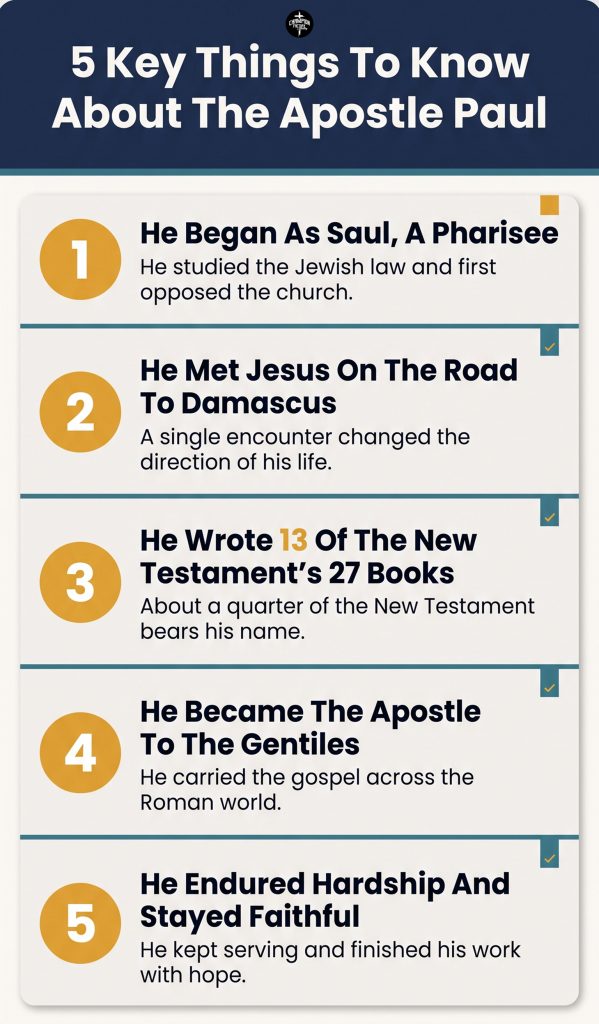
Key Thing 1: Paul Began as Saul, a Pharisee Who Opposed the Church
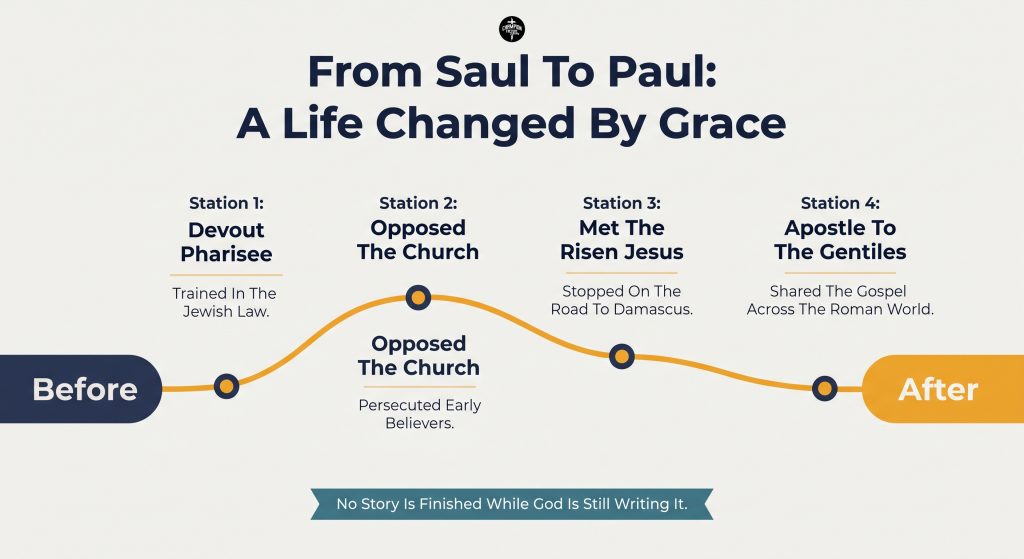
Before he followed Jesus, Paul was known as Saul, a devoted Pharisee who studied the Jewish law with great care. He was sincere and zealous, and he was convinced he was serving God. In that zeal, he took part in persecuting the first followers of Jesus. His past was real, and he never tried to hide it.
Paul described his own background plainly. He called himself a Hebrew of Hebrews and a Pharisee when it came to the law (Philippians 3:5). He also named his harm openly. "I persecuted the church of God and tried to destroy it" (Galatians 1:13).
This honesty matters. Paul did not pretend his past was clean. He owned it, and he let it stand as evidence of how far grace can reach. For anyone who carries regret, his starting point is a reminder that God is not limited by where a person begins.
"I have watched grown men weep when they realize Paul started as someone who hurt the church. If God could use him, they start to believe God can use them too." Todd Medina, President and Founder, Champion Factory Ministry
Key Thing 2: Paul Met the Risen Jesus on the Road to Damascus
Paul's life changed on a single journey. As he traveled to Damascus to arrest followers of Jesus, a light from heaven stopped him. He heard the voice of Jesus and was left blind for three days. When his sight returned, he was a different man. The one who set out to harm the church became a preacher of the very faith he once opposed.
The account appears in Acts 9. Paul fell to the ground and heard the words, "Saul, Saul, why do you persecute me?" (Acts 9:4). That moment turned his life in a new direction.
Paul never credited himself for the change. He pointed to grace. "By the grace of God I am what I am" (1 Corinthians 15:10). His story shows that transformation is God's work, offered freely to anyone.
A word of care belongs here. Paul's change was sudden, but real growth often comes slowly and with support. If you are working through a painful past, lean on trusted people and seek professional help when you need it. Grace and good support can walk together.
Key Thing 3: Paul Wrote a Large Part of the New Testament
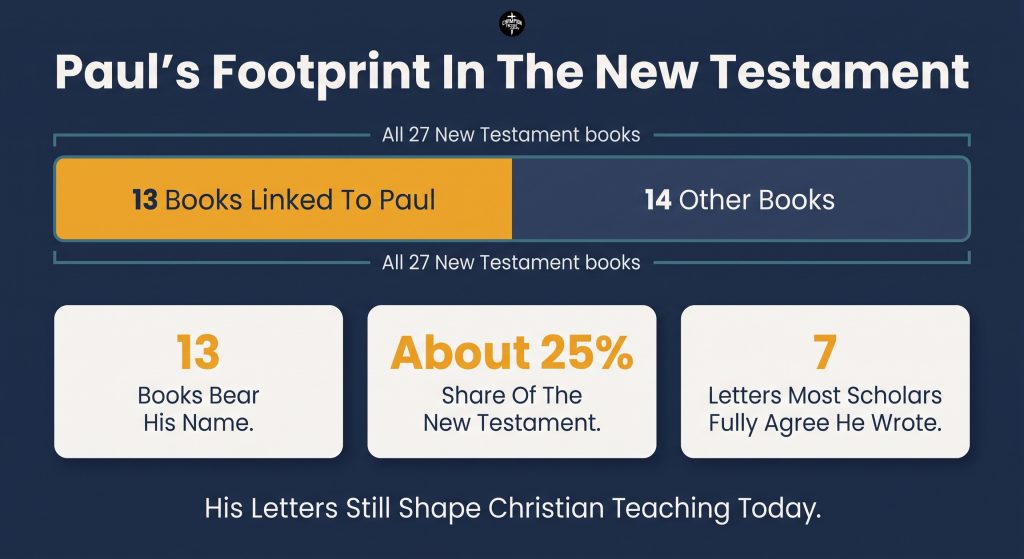
Paul wrote more books of the New Testament than anyone else. Of its 27 books, 13 carry his name. His letters, also called epistles, were written to churches and individuals across the Roman world. They cover faith, daily living, hope, and how to follow Jesus in real situations. Much of Christian teaching still rests on these letters.
His writing shaped the faith deeply. Research from Duke Divinity School notes that the 13 letters bearing Paul's name make up about a quarter of the New Testament. By the late second century, these letters were recognized as Scripture for the life and faith of the church.
A few simple facts help you read his letters well:
- His letters appear in the Bible by length, not by the order he wrote them, with letters to churches first and letters to individuals after.
- Most scholars fully agree on seven letters as written by Paul himself, while church tradition has long held all 13 as his. You do not need to settle that debate to learn from them.
- Each letter answers real questions from real communities, which is why they still feel practical.
When you read Romans, Philippians, or 1 Corinthians, you are reading some of the earliest Christian writing we have. That nearness to the first believers is part of what makes Paul's voice so valuable.
Key Thing 4: Paul Became the Apostle to the Gentiles
Paul is often called the apostle to the Gentiles because he carried the gospel beyond Jewish communities to the wider non-Jewish world. He traveled across the eastern Roman Empire on a series of missionary journeys, starting and strengthening churches along the way. His work helped the message of Jesus spread far past where it began.
According to the World History Encyclopedia, Paul founded Christian communities across Asia Minor and Europe, roughly from the mid 40s to the mid 50s AD. His journeys covered long distances by land and sea, often through hardship. He held Roman citizenship, which gave him certain legal protections as he traveled and faced opposition.
This part of Paul's story still matters for most believers today. If you are not Jewish by birth, Paul's mission is one reason the gospel reached you at all. He believed the good news was for everyone, near and far, and he gave his life to carry it.
"Paul refused to keep the gospel inside one group. That same conviction shapes how we train people to carry hope across cultures and borders today." Art Montgomery, Global Evangelism Strategy Architect, Champion Factory Ministry
Key Thing 5: Paul Endured Hardship and Stayed Faithful
Paul's life was not easy after his conversion. He faced beatings, imprisonment, shipwreck, and rejection. Yet he kept serving and kept writing, even from prison. Christian tradition holds that he was put to death in Rome for his faith in the mid 60s AD. Through all of it, he held on to hope and finished his work.
Paul learned to trust God in weakness. He recorded the words he received, "My grace is sufficient for you, for my power is made perfect in weakness" (2 Corinthians 12:9). Near the end of his life, he wrote with quiet confidence, "I have fought the good fight, I have finished the race, I have kept the faith" (2 Timothy 4:7).
His endurance offers something steady for hard seasons:
- Faith can hold even when circumstances do not improve.
- Purpose can continue through setbacks and limits.
- Finishing well matters more than starting strong.
If you are carrying heavy burdens, Paul's example is an encouragement, not a standard to measure yourself against. Reach out for prayer, community, and professional care when life feels like too much to carry alone.
What Paul's Life Can Mean for You Today
Paul's story is one of the clearest pictures in Scripture of grace changing a life. He began far from God and became a faithful servant who shaped the church for generations. His past did not disqualify him, and his hardships did not stop him. That same grace is still at work, and it is still available today.
Paul's influence reaches our own time. Christianity is now the world's largest religious group, with about 2.3 billion followers, according to the Pew Research Center. The movement Paul helped carry forward has touched lives across the world.
You can take a simple next step today. Read one of Paul's letters, such as Philippians, and notice how he writes with hope from a hard place. Sit with one verse and let it settle. If you want to put grace into action, you can learn about our mentorship and discipleship programs, where we walk with people through real change and restored hope. You can also find simple ways to get involved and support that work.
Paul reminds us that no story is finished while God is still writing it.
FAQ
How many books of the Bible did Paul write?
Thirteen of the New Testament's 27 books carry Paul's name. Most scholars fully agree on seven as written by Paul himself, while church tradition has long held all 13 as his.
Was Paul one of the original twelve apostles?
No. Paul was not part of the original twelve who followed Jesus during his earthly ministry. He became an apostle after he met the risen Jesus on the road to Damascus and was sent mainly to the Gentiles.
Did Paul start Christianity?
No. The Christian faith centers on Jesus. Paul was a missionary and teacher who spread the gospel widely and explained it in his letters. His work helped the early church grow, but he always pointed to Jesus, not himself.
What is Paul most known for?
Paul is best known for his conversion, his missionary journeys, and his letters. He carried the gospel across the Roman world and wrote a large part of the New Testament.
Why is Paul called the apostle to the Gentiles?
Paul focused his ministry on non-Jewish people, known as Gentiles. He believed the gospel was for everyone, and he traveled widely to share it beyond Jewish communities.