






Few groups carry a heavier reputation than the Puritans. The name brings to mind grim faces, black hats, and a long list of forbidden pleasures. Some of that picture is fair. Much of it is not. The real story is more human and more useful than the caricature.
This article gives you a clear, honest look at who the Puritans were and what they believed. It names what they got wrong without flinching. It also points to what is still worth carrying forward, especially for readers who want their own faith to feel grounded, steady, and real.
Who Were the Puritans?
The Puritans were English Protestants in the 16th and 17th centuries who believed the Church of England still held on to practices that were too close to Roman Catholicism. They wanted a simpler church shaped only by Scripture. The name began as an insult from their critics, yet the movement grew into one of the most studied religious groups in history.
According to Britannica, the Puritans pushed for deeper reform than the English Reformation had delivered. They were not a single organized denomination. They were a wide movement of pastors, families, and ordinary believers who shared a hunger for a purer faith.
Their opponents coined the label to mock them. As HISTORY notes, the word Puritan started as a term of contempt, and critics also called them precisionists for their careful attention to right living. The people we now call Puritans usually thought of themselves simply as faithful members of the Church of England.
Were the Puritans the Same as the Pilgrims?
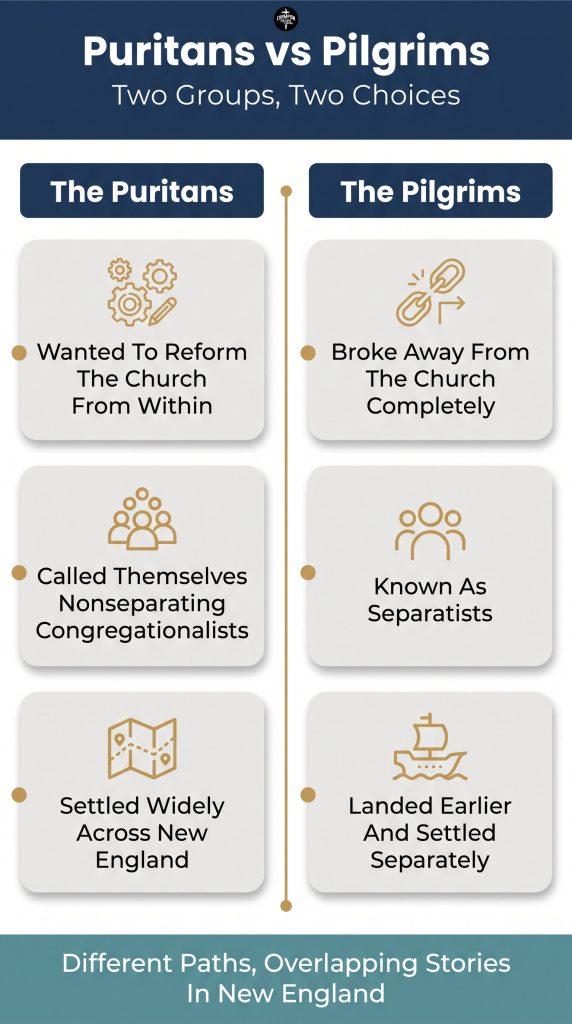
No. The two groups are often confused, but they made different choices. The Pilgrims were Separatists who broke away from the Church of England completely. The Puritans, by contrast, called themselves nonseparating congregationalists. They wanted to reform the church from the inside rather than leave it. Many later sailed to New England, where both groups eventually settled and their stories overlapped.
What Did the Puritans Believe?
The Puritans believed the Bible was their highest authority and that it spoke to every part of life. They held to Reformed teaching on God, sin, and grace, and they prized a personal, heartfelt relationship with God. Their faith was not meant to stay in church. It shaped their homes, their work, and their communities.
At the center of Puritan belief was Scripture. They treated the Bible as the guide for worship, family life, and daily decisions. This conviction lines up with a verse they loved, 2 Timothy 3:16-17, which says, "All Scripture is God-breathed and is useful for teaching, rebuking, correcting and training in righteousness, so that the servant of God may be thoroughly equipped for every good work."
The Puritans also held beliefs that many Christians today read with care. They taught predestination and spoke of the elect, the people they believed God had chosen for salvation. These are contested ideas, and faithful believers land in different places on them. This article does not argue the doctrine. It simply names it as part of who they were.
Their faith touched ordinary life in a striking way. They saw eating, working, resting, and parenting as acts that could honor God. That spirit echoes 1 Corinthians 10:31, "So whether you eat or drink or whatever you do, do it all for the glory of God." For the Puritans, no part of life sat outside of worship.

Were the Puritans Really That Strict?
The popular image of joyless, fun-hating Puritans is partly a myth. They did live disciplined lives and held firm moral standards. Yet they also valued marriage, friendship, good food, music in the home, and honest laughter. Scholars say pop culture has exaggerated their gloom and flattened a far more human picture.
The Puritans were serious about holiness, and that seriousness was real. But seriousness is not the same as misery. A Study.com lesson reviewed by educators points out that their austere reputation has been overstated in popular culture.
A few corrections help round out the picture:
- They cherished marriage and saw deep affection between husband and wife as a gift.
- They enjoyed everyday pleasures like food, drink, and music within their homes.
- Many were warm, witty people, not the scowling figures of later fiction.
Holding an accurate view matters. When we judge people of the past by a caricature, we lose the chance to learn from them. The Puritans were neither saints to copy without question nor villains to dismiss without thought. They were people, capable of both depth and error.
Why Did the Puritans Care So Much About Scripture, Family, and Education?
The Puritans believed every person should be able to read the Bible directly. That single conviction drove them to build strong families, found schools, and start colleges. Their goal was not education for its own sake. They wanted hearts and minds shaped by Scripture across generations.
Because they trusted the Bible as their guide, they wanted everyone to read it. This led to an early and serious push for literacy. Within five years of its founding, Massachusetts established schools so children could learn to read the Bible. They also looked to the next generation of ministers. As TheCollector explains, the Puritans founded Harvard College in 1636 to train clergy and promote biblical literacy.
Family stood at the heart of their vision. Unlike many early colonies that drew single young men, Puritan migration usually moved whole families across the ocean together. Parents carried real responsibility for the spiritual life of the home, and the household was treated as a small place of worship and learning.
"When children learn to read Scripture for themselves, you give them something no hardship can take away. We see that truth in the families we walk alongside." Todd Medina, President & Founder
Their view of work flowed from the same source. They saw daily labor as a calling, a way to serve God with care and diligence. That outlook connects to Colossians 3:23, "Whatever you do, work at it with all your heart, as working for the Lord, not for human masters." Their reputation for a strong work ethic grew out of this belief, an idea the sociologist Max Weber later explored in The Protestant Ethic and the Spirit of Capitalism.
Which Puritan Writers Are Still Worth Reading Today?
The Puritans left behind a rich library of writing on prayer, holiness, suffering, and hope. Authors like John Owen and Richard Baxter are still in print and still read by Christians around the world. Their books are honest about sin and warm about grace, which is why many readers return to them.
The Puritans were prolific writers, and their best work has lasted. They wrote for ordinary believers who wanted help walking with God through real struggles. A few names stand out:
- John Owen, known for searching, practical books on holiness and the inner life.
- Richard Baxter, a pastor whose devotional writing on rest and heaven still comforts readers.
Their writing tends to be direct. Owen famously urged believers to deal honestly with sin, writing, "Be killing sin or it will be killing you." Read in context, this is not a call to shame. It is an invitation to find freedom by facing sin clearly and leaning fully on God's grace.
If you want to read them, start small. A short collection of Puritan prayers or a single accessible book is a gentler entry than a thick volume. The aim is not to admire old writing. It is to let the wisdom they gained through hardship encourage your own faith.
What Did the Puritans Get Wrong?
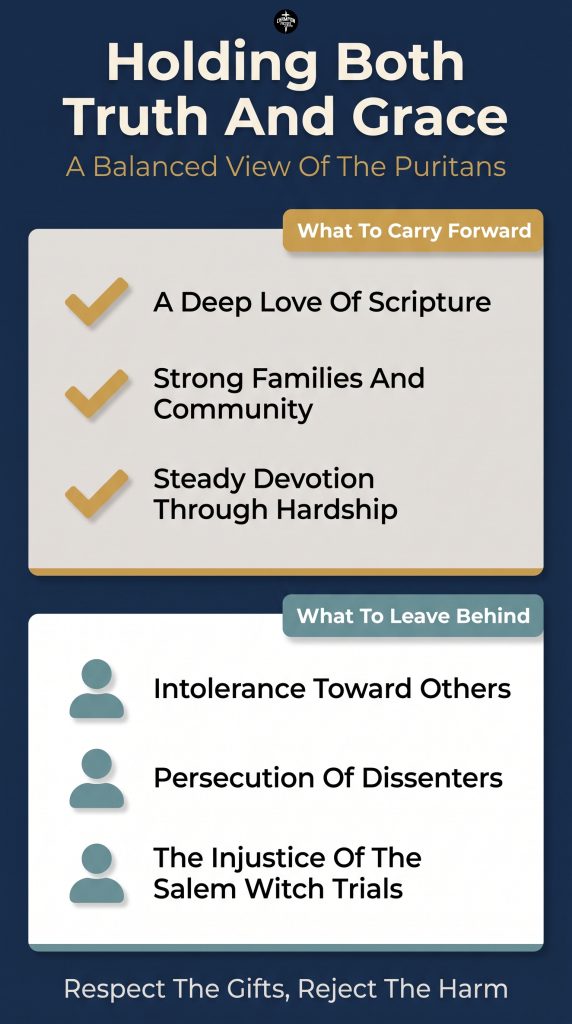
The Puritans caused real harm, and an honest account has to say so. They came to America seeking freedom to worship, but they often denied that same freedom to others. Groups like the Quakers faced persecution, and the Salem witch trials brought tragic injustice. Their failures are part of their story.
It would be dishonest to praise the Puritans without naming their wrongs. Their commitment to a pure community sometimes hardened into intolerance. As the World History Encyclopedia records, the Puritans sought freedom for their own worship while refusing it to others, and they persecuted those who believed differently.
The most painful example is the Salem witch trials, which took place in Massachusetts between 1692 and 1693, as documented by EBSCO Research Starters. Innocent people were wrongly accused, and some were executed. There is no way to soften that, and there is no need to dramatize it either. It stands as a sober warning about what can happen when conviction loses compassion.
Naming these failures does not erase the good. It keeps us honest. We can respect a person or a movement without excusing the harm they did. That posture, holding both truth and grace, is part of mature faith.
Why the Puritans Still Matter for Faith Today
The Puritans still matter because their best instincts speak to needs we share. They wanted a faith that reached every corner of life, a love for Scripture, strong families, and steady devotion through hardship. We can learn from those gifts while leaving their failures behind. Looking back can strengthen how we live forward.
The Puritans still shape the world we live in. Historian Perry Miller regarded their New England settlements as fundamental to understanding American culture, and their influence remains in ideas about education, community, and calling. One image has lasted for centuries. John Winthrop described the new colony as a city upon a hill, drawing on the words of Jesus.
That phrase comes from Matthew 5:14-16, where Jesus says, "You are the light of the world. A town built on a hill cannot be hidden ... let your light shine before others, that they may see your good deeds and glorify your Father in heaven." It is worth noting that the sermon often tied to this image, A Model of Christian Charity, is of disputed authorship and was not published until the 1830s. Even so, the vision of a community whose love is visible to all remains a worthy one.
"A faith people can see is a faith that invites others in. The work that lasts is the kind that shows up in real neighborhoods, week after week." Art Montgomery, Global Evangelism Strategy Architect & Board Visionary Luminary
For faith today, a few lessons stand out:
- Let Scripture shape ordinary life, not just Sunday mornings.
- Treat family and community as places where faith is formed and carried on.
- Keep going through hardship, trusting God in times that feel long and hard.
These values sit close to the heart of Champion Factory Ministry, where Scripture, family, and steady care over time guide the work of supporting people through difficulty. The Puritans remind us that real faith is meant to be lived out, patiently, across a whole life.
Carrying the Best of the Puritans Forward
The Puritans were neither heroes to imitate blindly nor villains to discard. They were believers who loved God deeply, built lasting things, and also failed in serious ways. The honest path is to learn from both.
Hebrews 12:1 calls us "surrounded by such a great cloud of witnesses" and urges us to "run with perseverance the race marked out for us." The Puritans are part of that long line of believers. We do not have to copy them to learn from them. We can take their love of Scripture, their care for family, and their steady devotion, and we can leave their harshness behind.
If their story stirs something in you, take one small step this week. Open the Bible with fresh attention. Pray for steadiness through a hard season. Or find a way to serve your own community with patience and care. If you want to be part of faith centered work that supports people through real hardship, you can learn how to get involved with Champion Factory Ministry.
FAQ
Were the Puritans and the Pilgrims the same group?
No. The Pilgrims were Separatists who left the Church of England entirely. The Puritans wanted to reform it from within and called themselves nonseparating congregationalists. Both later settled in New England.
Why was the word Puritan an insult?
Critics used it to mock people they saw as overly precise about religion and morality. The label stuck, even though most of these believers simply saw themselves as faithful members of the church.
Did the Puritans really ban fun?
Not in the way pop culture suggests. They lived disciplined lives, but they valued marriage, friendship, food, and music in the home. Scholars say their gloomy reputation has been exaggerated.
Are Puritan books still worth reading?
Yes, for readers who want honest writing on faith. Authors like John Owen and Richard Baxter remain in print. Starting with a short, accessible work is the easiest way in.
How should we think about the Puritans' failures?
Name them honestly. Their intolerance and the Salem witch trials caused real harm. We can respect their genuine faith and gifts while clearly rejecting the wrongs they committed.