






Many people have heard a line from Isaiah without knowing much about the man behind it. His words show up at Christmas, in songs, and on cards during hard times. Still, the prophet himself can feel distant and hard to place.
This article gives you a clear picture of who Isaiah was and the world he lived in. It then walks through his main themes and shows why his message still speaks today, both to people who need encouragement and to people who want to serve others well.
Who Was the Prophet Isaiah?
Isaiah was a prophet who lived in Judah during the eighth century BCE and spoke God's message to its people and leaders. His name in Hebrew, Yeshayahu, means God is salvation, which fits the heart of his message. He served during the reigns of four kings of Judah, Uzziah, Jotham, Ahaz, and Hezekiah.
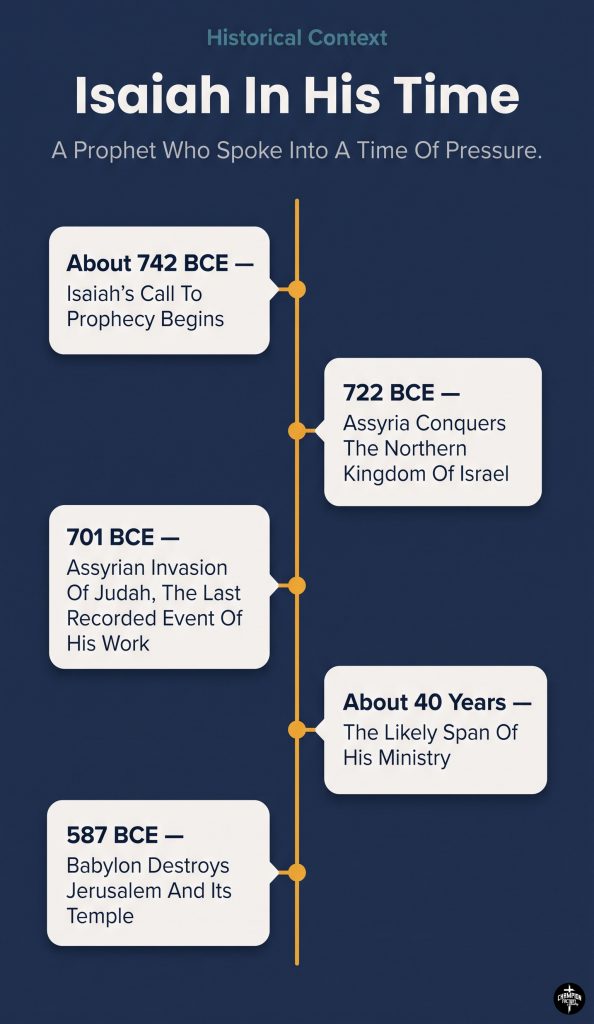
A prophet was someone who spoke for God, often calling people back to faith and right living. Isaiah filled that role for decades. According to Encyclopaedia Britannica, his call to prophecy came around 742 BCE. The latest event tied to his work is an Assyrian invasion in 701 BCE, which suggests his ministry may have spanned about forty years.
Isaiah appears to have lived in Jerusalem with access to the royal court. He advised kings during national crises, which gave his words real weight. He was married and had children, and at times he used ordinary parts of his own life to carry his message. That personal involvement kept his teaching grounded.
He described his calling as a vision in the temple. He saw the holiness of God, felt his own smallness, and then heard a question and gave a willing answer.
"Then I heard the voice of the Lord saying, Whom shall I send? And who will go for us? And I said, Here am I. Send me." (Isaiah 6:8, NIV)
"That single line shapes how we train young leaders. We do not wait until we feel ready. We say yes to God, then we grow into the work." Todd Medina, President and Founder
Isaiah did not step forward because the task looked easy. He answered because he trusted the One who called him.
What Was Happening During Isaiah's Time?
Isaiah lived in a tense and unstable period. Large empires threatened smaller nations, and the people of Judah feared for their future. Isaiah spoke into that fear. He warned leaders about injustice, and he pointed people toward trust in God rather than in armies or alliances.
To understand Isaiah, it helps to picture the pressure around him. The Assyrian Empire was expanding and conquering. As the World History Encyclopedia notes, Assyria destroyed the northern kingdom of Israel in 722 BCE. More than a century later, Babylon destroyed Jerusalem and its temple in 587 BCE.
These were not distant headlines for Isaiah's audience. They were threats to home, family, and survival. People wondered whether God had forgotten them.
In that climate, leaders felt strong pressure to form alliances and trust military power. Isaiah urged a different path. He told the truth about what was broken, and he called people to trust God instead of fear. A study guide from Yale Bible Study describes him as a trusted voice close to the center of power, which is part of why kings listened to him.
What Is the Book of Isaiah About?
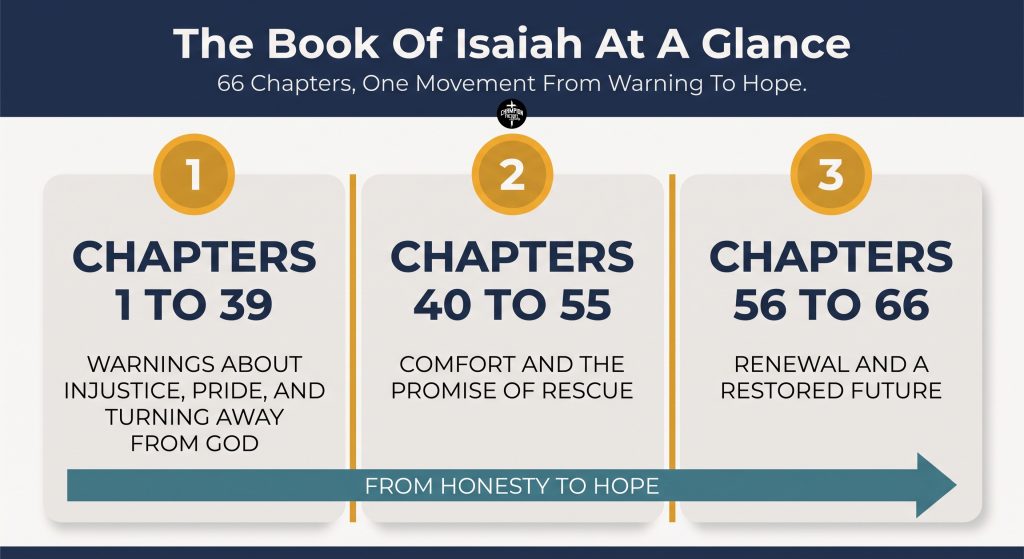
The book of Isaiah holds together two messages, an honest look at what is wrong and a strong promise of hope. It runs 66 chapters and stands as one of the longest prophetic books in the Bible. Readers often describe it in three parts that move from warning toward comfort and restoration.
The themes can feel large, so a simple map helps.
- Chapters 1 to 39 focus on warnings about injustice, pride, and turning away from God.
- Chapters 40 to 55 shift toward comfort and the promise of rescue.
- Chapters 56 to 66 look ahead to renewal and a restored future.
Several themes run through all three parts. Isaiah lifts up the holiness of God and his authority over every nation. He teaches that God stays in control even when events feel chaotic. He also speaks of a faithful remnant, a group God preserves through hard seasons. None of these themes leave readers in despair. They point toward healing.
One plain summary captures the whole book. The judgment of God names what is broken. The promise of God is to heal and save. That movement, honesty followed by hope, becomes clear in one of the book's most quoted lines.
"Comfort, comfort my people, says your God." (Isaiah 40:1, NIV)
After hard words, God speaks tenderness. That pattern shapes the entire book.
What Did Isaiah Say About a Coming Messiah?
Isaiah spoke about a coming king and servant who would bring justice, peace, and healing. Christians have long read these passages as pointing to Jesus. The most familiar include the promise of a child called Immanuel, a ruler named Prince of Peace, and a servant who suffers for others.
These promises gave a frightened people something to hold onto. They said clearly that God had not given up on the world.
A few of the best known passages appear below.
- Isaiah 7:14 promises a sign, a child called Immanuel, which means God with us. In its first setting, the name reassured a worried king that God was near.
- Isaiah 9:6 describes a child who will be called Wonderful Counselor, Mighty God, Everlasting Father, Prince of Peace.
- Isaiah 53 describes a servant who suffers on behalf of others.
The servant passage is tender and direct.
"But he was pierced for our transgressions, he was crushed for our iniquities. The punishment that brought us peace was on him, and by his wounds we are healed." (Isaiah 53:5, NIV)
These themes shaped Christian faith deeply. The early scholar Jerome described Isaiah as more an evangelist than a prophet, because his words pointed so clearly toward the gospel. Many readers have called Isaiah the Fifth Gospel for the same reason.
What Does Isaiah Teach About Justice and Caring for People?
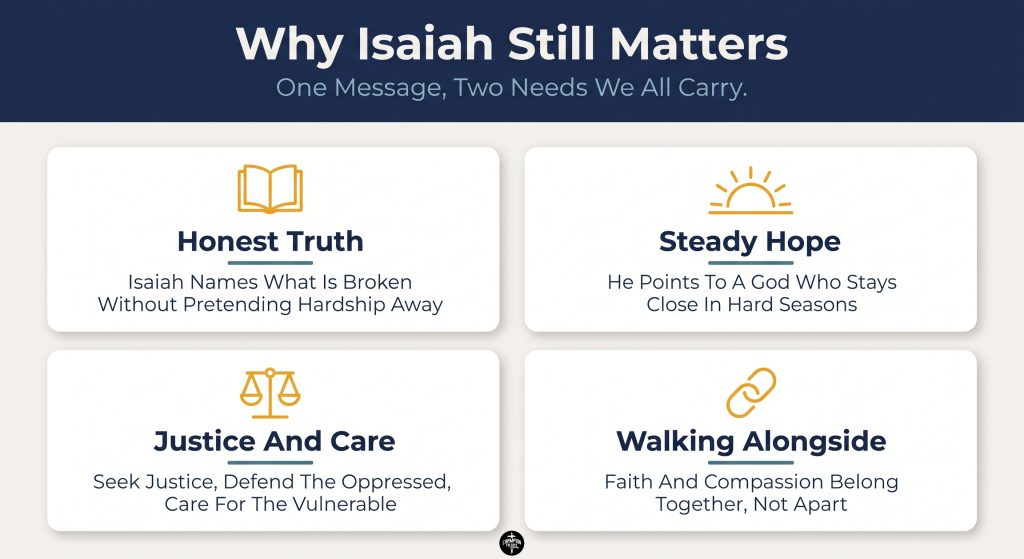
Isaiah teaches that real faith shows up in how we treat vulnerable people. He confronted leaders who ignored the poor, and he pressed his listeners to defend those who could not defend themselves. For Isaiah, worship and compassion belong together rather than apart.
This is one of the clearest and most practical parts of his message. Isaiah spoke up for the poor and the oppressed and challenged people in power who looked the other way. His call was direct.
"Learn to do right. Seek justice. Defend the oppressed. Take up the cause of the fatherless. Plead the case of the widow." (Isaiah 1:17, NIV)
That verse still gives compassion a clear shape. It points toward children, families, and anyone left without support. In Isaiah's world, defending the vulnerable meant protecting people who had no one to speak for them. The same need exists today.
Caring for vulnerable people sits at the heart of Champion Factory Ministry's work through mentorship, family support, and care outreach. Isaiah's example keeps that work honest. He names hard truths, then offers dignity and hope.
"When we sit with a child or a family, we hold the same two things Isaiah held. We tell the truth about what is hard, and we keep pointing to hope. People are never problems to manage. They are people to value." Art Montgomery, Global Evangelism Strategy Architect and Board Visionary Luminary
Why Isaiah's Message Still Matters Today
Isaiah still matters because his message meets two needs we all carry. It calls us to care for others with honesty and respect, and it offers steady hope when life feels heavy. That combination speaks to people walking through hard seasons and to people who want to serve well.
If you feel weary or afraid, Isaiah's words can steady you. They do not pretend hardship away. They point to a God who stays close.
"So do not fear, for I am with you. Do not be dismayed, for I am your God. I will strengthen you and help you. I will uphold you with my righteous right hand." (Isaiah 41:10, NIV)
Here are a few simple ways Isaiah's message can shape daily life.
- When you feel overwhelmed, return to passages of comfort like Isaiah 40 and 41 and read them slowly.
- When you want to help others, let Isaiah 1:17 guide you toward practical care for people who are struggling.
- When hope feels thin, remember that Isaiah held honesty and hope together, and you can too.
If you are facing fear, grief, or a crisis that feels like too much, please reach out to a trusted person or a qualified professional for support. Scripture can comfort you, and caring help from others matters too. Our ministry walks alongside people, and we also point them to trained professionals when that is the right step. You do not have to carry heavy things alone.
Carrying Isaiah's Hope Into Your Week
Isaiah gave a struggling people honest truth and steady hope. He named what was broken, called for justice and compassion, and pointed toward a future worth trusting. His message still works the same way today.
A simple next step is to read one short passage from Isaiah this week and sit with it for a few minutes. You might choose Isaiah 40:1 for comfort or Isaiah 1:17 for compassion. If his call to care for others stirs something in you, you can also explore ways to get involved and support this work in your own community.
FAQ
When did the prophet Isaiah live?
Isaiah served as a prophet in Judah during the eighth century BCE. His ministry likely began around 742 BCE and may have continued for about forty years.
What is the main message of the book of Isaiah?
Isaiah holds together two messages. He names injustice and calls people to change, and he promises comfort, restoration, and hope through God's faithfulness.
Why do Christians connect Isaiah to Jesus?
Christians have long read passages like Isaiah 7:14, 9:6, and 53 as pointing to Jesus. These verses describe a coming king and servant who brings peace and healing.
What does Isaiah say about helping the poor?
Isaiah teaches that faith and compassion belong together. In Isaiah 1:17 he calls people to seek justice, defend the oppressed, and care for vulnerable people.