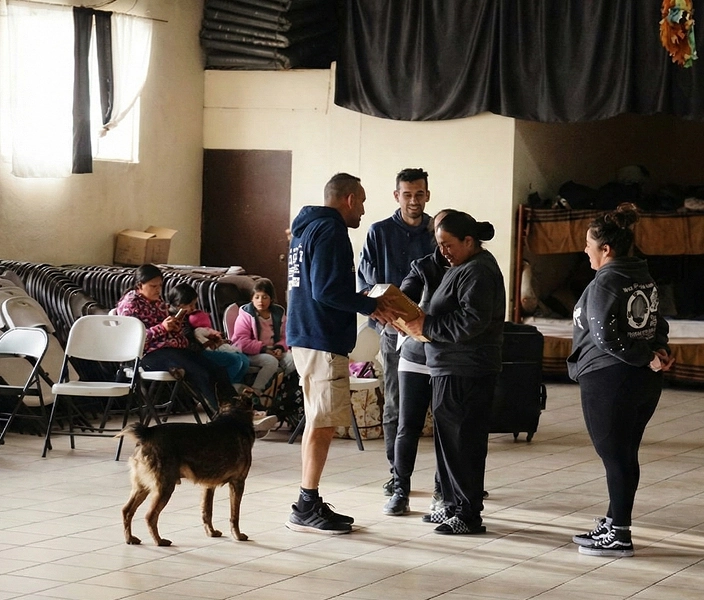





Most businesses want to do more than turn a profit. Many owners and leaders are actively looking for ways to give back to their communities in a way that reflects their values and produces real results. At the same time, faith based nonprofits like Champion Factory Ministry are doing work that goes beyond what their budgets alone can support.
This article explains how those two realities connect. You will learn what business partnerships with faith based nonprofits look like in practice, why both sides benefit, and how this kind of collaboration produces outcomes that neither a business nor a ministry could achieve on its own.
Why Working Together Produces Greater Results
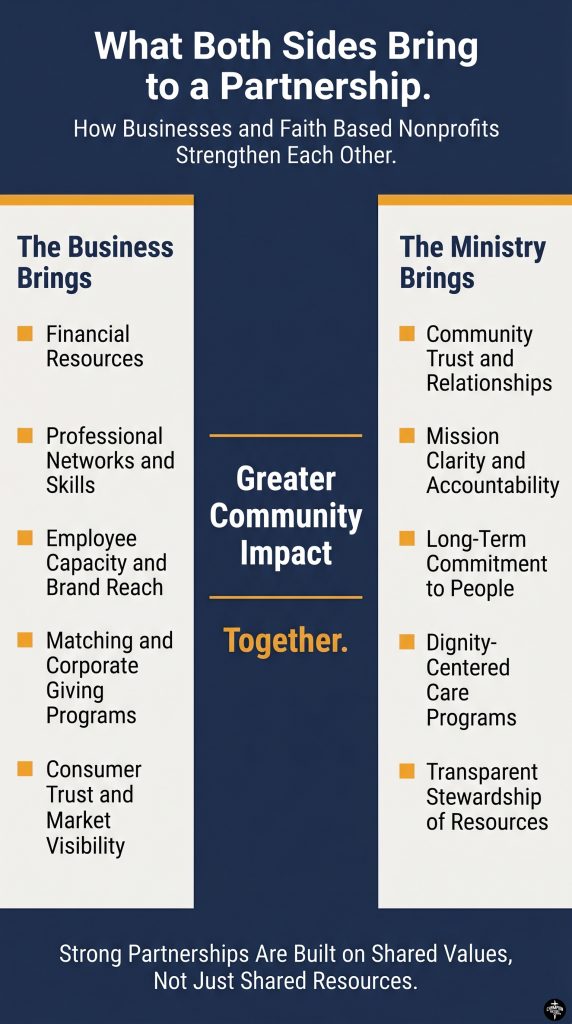
Two organizations working toward the same goal almost always accomplish more than one working alone. A business brings financial resources, professional networks, and employee capacity. A faith based nonprofit brings community trust, mission clarity, and deep relationships with the people it serves. When those strengths combine, the impact grows in real and measurable ways.
Scripture captures this plainly. Ecclesiastes 4:9-10 (NIV) says, "Two are better than one, because they have a good return for their labor: if either of them falls down, one can help the other up." That truth holds whether two individuals are working side by side or whether a business and a ministry are building something together in their community.
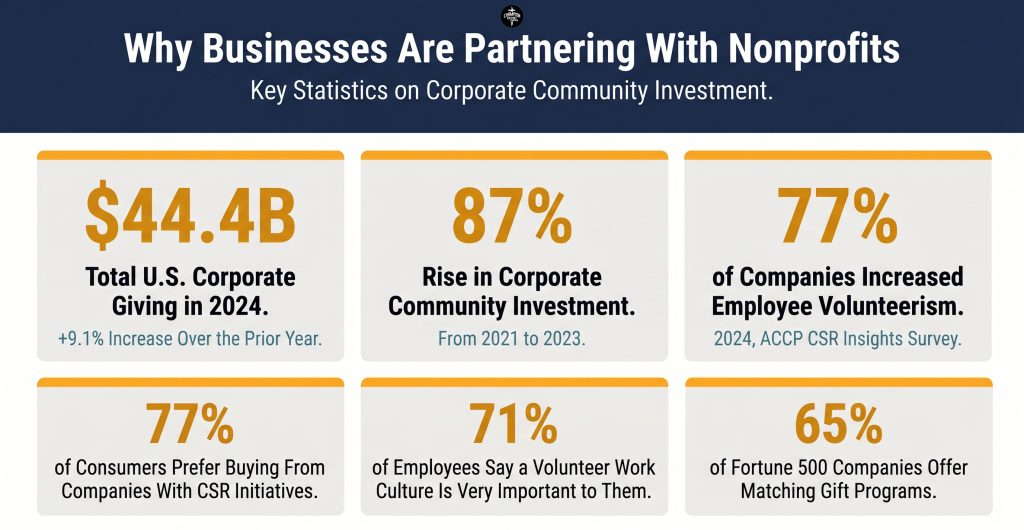
The data confirms the same thing. Corporate giving in the United States reached $44.4 billion in 2024, a 9.1% increase over the previous year, according to Giving USA data published by Business Initiative. Corporate investment in community and economic development programs rose 87% between 2021 and 2023, according to CECP's Giving in Numbers 2024 Edition. Businesses are actively searching for meaningful ways to invest in their communities. Faith based nonprofits that can articulate their mission clearly and demonstrate consistent impact are well positioned to become valued partners in that effort.
What Business Partnerships With Faith Based Nonprofits Look Like
A business partnership is not the same as a one-time donation. It is an ongoing relationship where both sides contribute and both sides benefit. Partnerships take several forms depending on what a business can offer and what the ministry most needs. The most effective ones grow over time through honest communication and shared purpose.
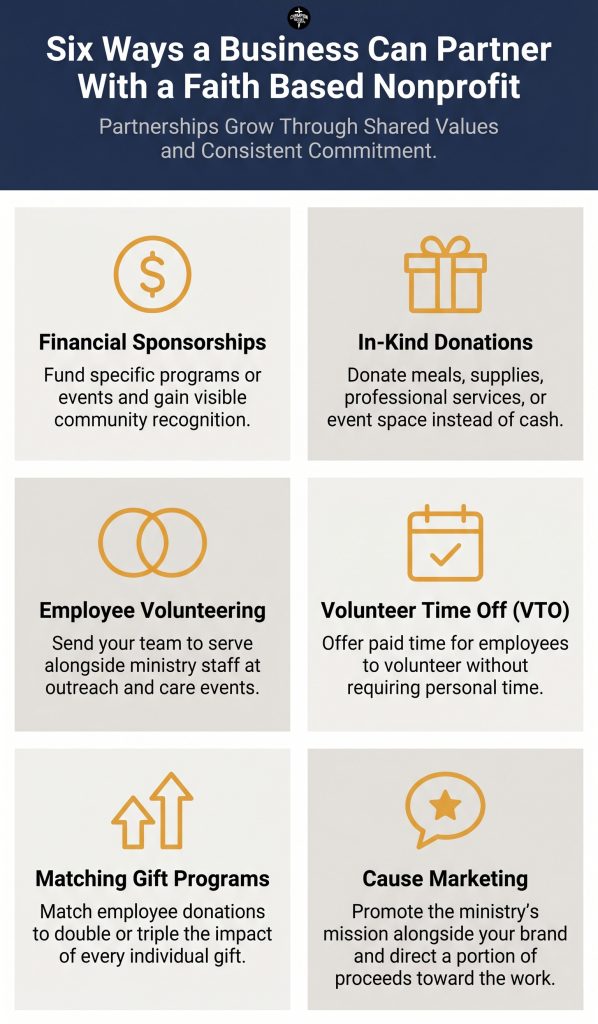
Here are the most common partnership types and what each one looks like in practice:
- Financial sponsorships: A business provides funding for a specific program or event. In return, it receives recognition and becomes a visible part of a community effort it can stand behind.
- In-kind donations: A business donates goods or services rather than cash. Examples include donated meals, office supplies, professional accounting services, or event space.
- Employee volunteering: Company employees give their time to serve alongside ministry staff. This might mean serving at a food outreach, supporting a family care event, or helping with logistics and setup.
- Volunteer Time Off (VTO): Many companies offer employees paid time off to volunteer. This allows deeper community involvement without requiring employees to give up personal time.
- Matching gift programs: Many companies match employee donations to nonprofits. Giving USA data shows that 65% of Fortune 500 companies offer matching gift programs, yet billions of dollars in eligible matches go unclaimed each year. Checking whether your company has a matching policy can significantly increase what your team is already giving.
- Cause marketing: A business promotes the ministry's mission alongside its own brand, sometimes directing a portion of proceeds toward the nonprofit during a defined campaign.
A business that sponsors a food outreach event extends the reach of dignified, practical care in the community. Those resources directly support real people and real needs.
"Most of our strongest business relationships started with a single conversation and a willingness to show up. We have seen local businesses go from one volunteer day to consistent, committed partners because they experienced the work firsthand." Robert Crouse, Community Liaison
What Businesses Gain From Partnering With a Faith Based Ministry
A business that partners with a faith based nonprofit builds a stronger team, earns deeper community trust, and connects its employees to work that carries real meaning. These benefits are consistent, measurable, and well documented. The returns extend well beyond a single donation.
According to ACCP's 2024 CSR Insights Survey, 77% of companies reported an increase in employee participation in volunteer opportunities in 2024. Andrea Wood, President and CEO of the Association of Corporate Citizenship Professionals, noted: "Companies with strong giving and volunteer programs have a clear edge in attracting and retaining purpose-driven talent. Survey data consistently shows that employees who volunteer report higher job satisfaction and a stronger connection to their employer."
The consumer side matters too. Research cited by Bonterra shows that 77% of consumers prefer buying from companies with visible CSR initiatives. And 71% of employees say that a workplace culture supporting volunteerism is very important to them.
Partnering with a ministry that does credible, consistent, community-rooted work gives a business an authentic connection to its community and a reason for employees and customers to feel proud of where their time and resources go.
What Makes a Faith Based Partnership Different
A faith based nonprofit operates from a specific set of values: dignity for every person served, long-term commitment to restoration, and care that extends well beyond a single transaction. When a business aligns with those values, the partnership carries a different kind of weight and tends to produce a different kind of result.
Most corporate giving programs connect businesses to services. A faith based ministry connects businesses to people. Specifically, to the long-term work of supporting families in difficulty, walking alongside individuals in recovery, and helping children grow up with stability and care.
The Bridgespan Group, a respected social sector research organization, has noted that successfully engaging with faith based organizations requires trusting the roles they play in their communities and building an honest, mutual relationship around shared motivations. That kind of relationship produces deeper engagement than a logo placement or a single donation can.
Matthew 5:16 (NIV) frames the opportunity well: "In the same way, let your light shine before others, that they may see your good deeds and glorify your Father in heaven." For a business whose leadership holds faith values, partnering with a ministry is a visible expression of what the business actually believes.
For businesses without a faith background, the partnership still holds genuine value. They are associating with an organization grounded in accountability, clear mission, and long-term community presence. Those qualities matter to any business looking for a partner worth trusting.
"We do not approach businesses as funding sources. We approach them as potential community allies who want their work to mean something beyond the bottom line. When that alignment is real, partnerships last." Art Montgomery, Global Evangelism Strategy Architect and Board Visionary
How Small and Local Businesses Can Get Involved
You do not need a corporate giving department or a large budget to make a meaningful difference. Small and local businesses are often the most consistent community partners a ministry can have. The relationships are real, the geography is shared, and the commitment runs deep. There are practical ways to get started at any scale.
Here are entry points for a business of any size:
- Start with a conversation. Reach out to the ministry directly to learn which programs could use support. A small business bringing meals to an outreach event or donating supplies to a family care program is a genuine and valuable contribution.
- Organize a volunteer day. Gather your team for a few hours of service. This requires no special program or matching fund. It requires a willing group of people and a team ready to put them to work in a meaningful way.
- Expand awareness. Share information about donation drives, upcoming events, or volunteer opportunities through your business's social media channels or email list. Expanding awareness costs nothing and creates real reach.
- Ask about matching gifts. If your business has a giving program, confirm whether donations to 501(c)(3) faith based nonprofits qualify. This can significantly increase the impact of what your employees are already contributing.
As one philanthropic researcher noted in a Bridgespan Group field report, "A lot of what we think of as the social sector in small towns happens through churches." Local faith based ministries often form the most consistent support network available for people in need. When a local business steps in to support that work, it invests directly in the stability of its own community.
How the Ministry Stewards Every Partnership
Champion Factory Ministry is a registered 501(c)(3) nonprofit. Every dollar and every donated resource goes directly toward programs that serve children, families, and individuals facing hardship. Businesses that partner with the ministry can trust that their investment is used with care, purpose, and full accountability to the community it serves.
The ministry approaches partnerships as relationships built on shared values and honest communication. Partners receive updates on how their contributions support specific programs, and the team welcomes questions at every step.
The work spans mentorship, food and essential care outreach, support for children and families, and recovery programs for individuals affected by difficult circumstances. Business partnerships help sustain and expand each of these areas. None of these programs replaces the role of licensed professionals. Where mental health care, legal support, or medical services are needed, the ministry actively encourages individuals to connect with appropriate qualified professionals.
"Every resource that comes through the ministry goes directly to the people we serve. That is a commitment we hold to without exception, and it is why partners stay with us over time." Art Montgomery, Global Evangelism Strategy Architect and Board Visionary
Proverbs 11:14 (ESV) says, "Where there is no guidance, a people falls, but in an abundance of counselors there is safety." Strong partnerships, honest accountability, and collaboration with community professionals are how the ministry continues to serve well over the long term.
Starting a Partnership That Makes a Real Difference
Families in your community are facing real hardship. Children need stable mentors. Individuals working toward recovery need practical support and consistent encouragement. The ministry shows up for those people, and it does that work better when businesses stand alongside it.
Business partnerships with faith based nonprofits work because they are built on something more than convenience. They are built on a shared belief that communities are worth investing in, that people facing difficulty deserve dignity and real care, and that no single organization can meet every need alone.
Hebrews 10:24 (NLT) captures the spirit of this: "Let us think of ways to motivate one another to acts of love and good works." That is the invitation at the heart of every partnership the ministry pursues.
If your business is ready to explore what a partnership could look like, contact the team to start the conversation. There is no minimum commitment and no formal CSR program required. What matters is a genuine willingness to show up for your community and the people in it.
To learn more about the work and who it serves, visit the programs page. To support the work directly, visit the donation page.
FAQ
What Is the Difference Between a Donation and a Partnership?
A donation is a single gift. A partnership is an ongoing relationship where both sides contribute resources and stay connected to the work over time. Partnerships tend to produce deeper impact because the commitment is consistent and the relationship builds on shared trust.
Do Businesses Need to Share Christian Values to Partner With the Ministry?
No. Businesses that want to invest meaningfully in their community are welcome to explore a partnership regardless of their faith background. What matters most is a shared commitment to serving people with dignity and a genuine interest in community impact.
Can Matching Gift Programs Apply to Faith Based Nonprofits?
Many corporate matching gift programs allow employees to direct matches to 501(c)(3) nonprofits, including faith based organizations. Check with your company's HR team or giving program coordinator to confirm whether the ministry qualifies under your employer's policy.
What Can a Small Business Realistically Contribute?
Small businesses can contribute in many practical ways, from organizing a team volunteer day to donating supplies or sharing ministry needs with their existing audience. Consistent presence and genuine relationship often matter more than a large financial gift.
How Does the Ministry Keep Partners Informed?
The ministry communicates with partners directly and shares updates on how contributions support specific programs. Partners are always welcome to ask questions and stay connected to the work their investment supports.