






Right now, millions of children and families across the United States face hunger, instability, and situations they did not choose. According to the USDA Economic Research Service, 14.1 million children lived in food-insecure households in 2024. Behind those numbers are real families who need more than a meal. They need stability, relationship, and a community that will stay with them.
Champion Factory Ministry exists to provide exactly that. Through faith-centered programs serving children, families, and individuals in crisis, the ministry brings practical care and lasting hope to those it serves. If you have wondered what your donation actually does, this article gives you a clear and honest answer.
The Scale of the Need in American Communities
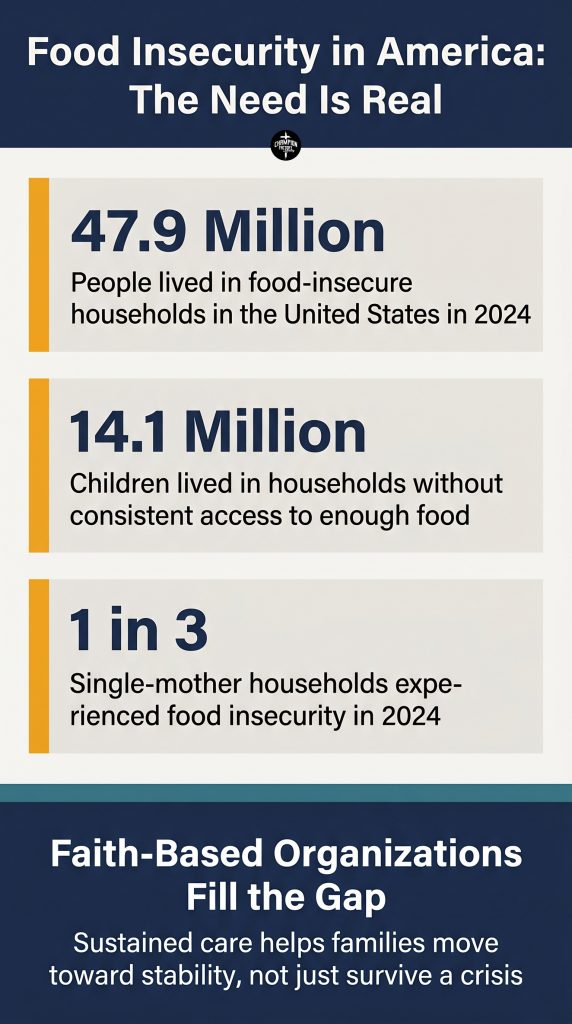
Millions of people across the United States face food insecurity, family hardship, and crisis situations that require sustained community support. The USDA reports that 47.9 million people lived in food-insecure households in 2024, and nearly one in five households with children experienced food insecurity that year. These are not isolated cases. They reflect a widespread reality that communities and faith-based organizations are actively working to address.
The data reveals specific patterns. About 36.8 percent of single-mother households experienced food insecurity in 2024, according to USDA figures. That is close to one in three families led by a single mother struggling to feed their children consistently.
Hardship also compounds over time. As United Way Bay Area has observed in its community research, poverty is rarely a single event. Its effects build across months and years, particularly when stable support is absent. Faith-based organizations fill a critical gap here. They bring practical care alongside genuine community, and they stay. That sustained presence is what makes the difference for families who need more than a one-time resource.

Where Your Donation Goes
A donation to the ministry directly supports four core program areas: food and essential care outreach, mentorship and spiritual guidance, support for children and families, and recovery support for individuals impacted by exploitation or personal crisis. Each program operates with a clear faith foundation and a firm commitment to the dignity of every person served.
Here is what that support looks like in practice:
- Food and essential care outreach: The ministry provides meals and essential supplies to individuals and families facing hardship. Scripture connects genuine faith to this kind of practical care. In Isaiah 58:6-7, God calls his people to share food with the hungry and to support those who are struggling.
- Mentorship and spiritual guidance: Volunteers and staff walk alongside children and youth in consistent, long-term relationships. This is an investment in a young person's future, not a short-term program.
- Support for children and families: The ministry offers practical resources and encouragement to families moving through difficult seasons. The goal is long-term stability, not emergency relief alone.
- Recovery support: For individuals affected by exploitation, unsafe situations, or personal crisis, the ministry provides a safe, supportive environment centered on healing and restoration. This support works alongside, not in place of, professional counseling and social services.
- Discipleship through Nourish: The Nourish program supports spiritual growth for individuals who want to deepen their faith and find grounding in their relationship with God.
"What we do here is about more than meeting immediate needs. We invest in the long-term stability and spiritual growth of real people who deserve consistent care and genuine community." Todd Medina, President & Founder, Champion Factory Ministry
Your donation funds the people, resources, and infrastructure that make each of these programs possible.
How Mentorship Changes Outcomes for Children Over Time
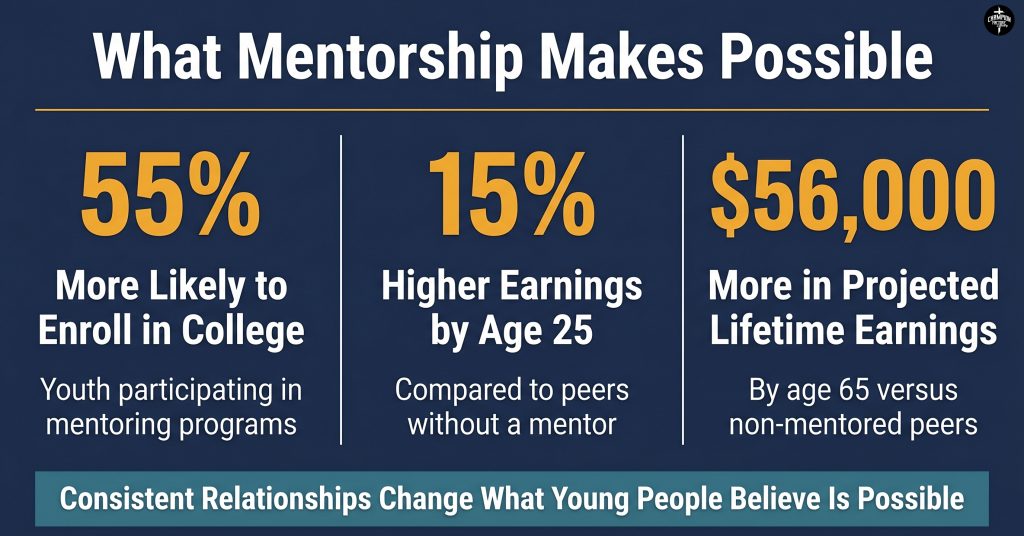
Consistent mentorship produces measurable, long-term improvements in young people's lives. A longitudinal study from Big Brothers Big Sisters of America found that mentored youth earned 15 percent more between the ages of 20 and 25, and were projected to earn $56,000 more by age 65 compared to peers without mentors. Research from MENTOR: The National Mentoring Partnership found that youth in mentoring programs are 55 percent more likely to enroll in college.
The benefits extend beyond income and education. Mentored young people show stronger engagement in school, better social and emotional development, and improved self-confidence. What drives these outcomes is the relationship itself. A caring adult showing up consistently over time changes what a young person believes is possible.
The ministry's mentorship work is rooted in this understanding. Mentors bring spiritual encouragement alongside practical guidance. They listen, pray, and stay present. That consistency builds trust, and trust creates the foundation for real growth.
Supporting Recovery and Restoration with Dignity
The ministry provides support for individuals affected by exploitation, unsafe situations, and personal crisis. This support is compassionate, trauma-informed, and centered on the dignity of each person served. The ministry's role is to walk alongside individuals in their recovery process, offering safe community and spiritual grounding.
The people the ministry serves are not defined by what happened to them. They are individuals healing, rebuilding, and moving forward. Recovery support focuses on three things:
- Creating a safe, stable environment where that process can begin
- Offering consistent encouragement and spiritual community
- Connecting people with appropriate professional resources, including licensed counselors and social services, when needed
The ministry does not position itself as a replacement for professional care. It functions as a supportive community that helps individuals find their way toward wholeness. If you or someone you know is in crisis, please reach out to a licensed counselor, social worker, or appropriate support service in addition to seeking community.
What the Bible Says About Giving to Those in Need
Scripture is clear that caring for people in genuine need is central to Christian faith. In Matthew 25:35-36, Jesus connects practical acts of compassion directly to faithfulness to him: feeding the hungry, welcoming the stranger, caring for the sick. Supporting this kind of work is one way to live out that calling in a concrete and sustained way.
Generosity in the Bible is not presented as a guilt obligation. In 2 Corinthians 9:7, Paul writes: "Each of you should give what you have decided in your heart to give, not reluctantly or under compulsion, for God loves a cheerful giver" (NIV). The call to give flows from faith, not pressure.
Proverbs 11:25 offers an encouraging truth about the nature of generosity: "A generous person will prosper; whoever refreshes others will be refreshed" (NIV). Giving is not only about what others receive. It is also about who we become in the process.
Why Consistent Giving Creates More Lasting Impact
One-time gifts meet immediate needs. Consistent, recurring giving enables the ministry to plan programs, retain trained staff, and serve more people over time. Long-term financial support is what allows relationships to develop, programs to mature, and communities to experience sustained change.
Research from the Lake Institute on Faith and Giving found that more than 95 percent of people of faith donated to a cause or organization in 2023, and 79 percent said their faith inspires them to give outside their own church. Faith communities are among the most consistently generous in the country. That generosity has the most lasting effect when it is sustained over time.
"Faithful giving over time is what makes transformation possible. The communities we serve need partners who stay, and consistent donors make that commitment real." Art Montgomery, Global Evangelism Strategy Architect & Board Visionary, Champion Factory Ministry
Becoming a monthly supporter means being part of the ongoing work, not just a single moment in it.
How to Begin Walking Alongside This Ministry
Donating to support this work is a decision to invest in people who need consistent, compassionate care. It is a partnership with a ministry that shows up for children, families, and individuals in crisis, week after week, with practical help and genuine faith.
Proverbs 19:17 offers a grounding perspective: "Whoever is kind to the poor lends to the Lord, and he will reward them for what they have done" (NIV). The call to give is a call to act on what you already believe.
Here are practical ways to get involved:
- Make a one-time gift to support an immediate need
- Set up a monthly recurring donation to provide sustained program support
- Volunteer your time and skills with a ministry program
- Pray for the ministry's staff, volunteers, and the people they serve
- Share the mission with your church, business, or community network
To learn more or to take the next step, visit the donate page or explore the ministry's full programs and impact at championfactoryministry.org.
FAQ
Where does my donation go?
Your gift supports food and essential care outreach, mentorship and spiritual guidance, support for children and families, recovery programs for individuals in crisis, and discipleship through the Nourish program.
Is Champion Factory Ministry a registered nonprofit?
Yes. The ministry is a faith-based nonprofit organization. Donations may be tax-deductible depending on your situation. Consult a tax professional for guidance specific to your circumstances.
Is it better to give once or set up a monthly donation?
Both make a difference. Monthly recurring donations give the ministry a stable funding base that supports consistent program delivery and long-term planning. If you are able, a recurring gift has the most sustained impact.
Does the ministry connect people with professional support services?
Yes. The ministry connects individuals with professional resources including licensed counselors and social services when needed. This support is a complement to, not a replacement for, professional care.