






If you have ever wondered whether to give to a faith-based charity or a general nonprofit, you are asking a good question. Both types of organizations serve real needs. Both can use your donation well. Choosing one does not mean dismissing the other.
What this article offers is a clear look at what makes a faith-based charity distinct, how that difference shows up in the work, and what to look for before you give. If your generosity is rooted in faith, understanding that distinction can help you give with more clarity and confidence. To see how faith-based support works in practice, our approach page walks through exactly that.
What Makes a Faith-Based Charity Different
A faith-based charity is a nonprofit whose mission, values, and programs are grounded in religious belief. In a Christian context, biblical principles shape not only what the organization does but how it does it. The work and the faith are not separate. That integration changes how staff approach people, how volunteers show up, and what long-term support looks like.
Most general nonprofits are built around outcomes. They identify a problem, measure results, and report impact. That model works. It produces real results and serves important needs across many communities.
A faith-based charity does those things too. It also operates from a different foundation. Service is not only a program. It is an act of love rooted in the belief that every person carries inherent dignity because they are made in the image of God.
That foundation changes the texture of the work. It shapes how a staff member sits with someone in a hard season. It shapes how a volunteer shows up at a food pantry week after week. It shapes how a ministry designs its rescue and recovery support.
"The faith is not something we add on top of the programs. It is the reason we show up at all, and it is what keeps us present when things are slow or hard." Todd Medina, President and Founder, Champion Factory Ministry

Jesus puts it plainly in Matthew 25:40: "Truly I tell you, whatever you did for one of the least of these brothers and sisters of mine, you did for me." For a faith-based organization, serving a person in hardship is a response to that call.
Holistic Care Means Serving the Whole Person
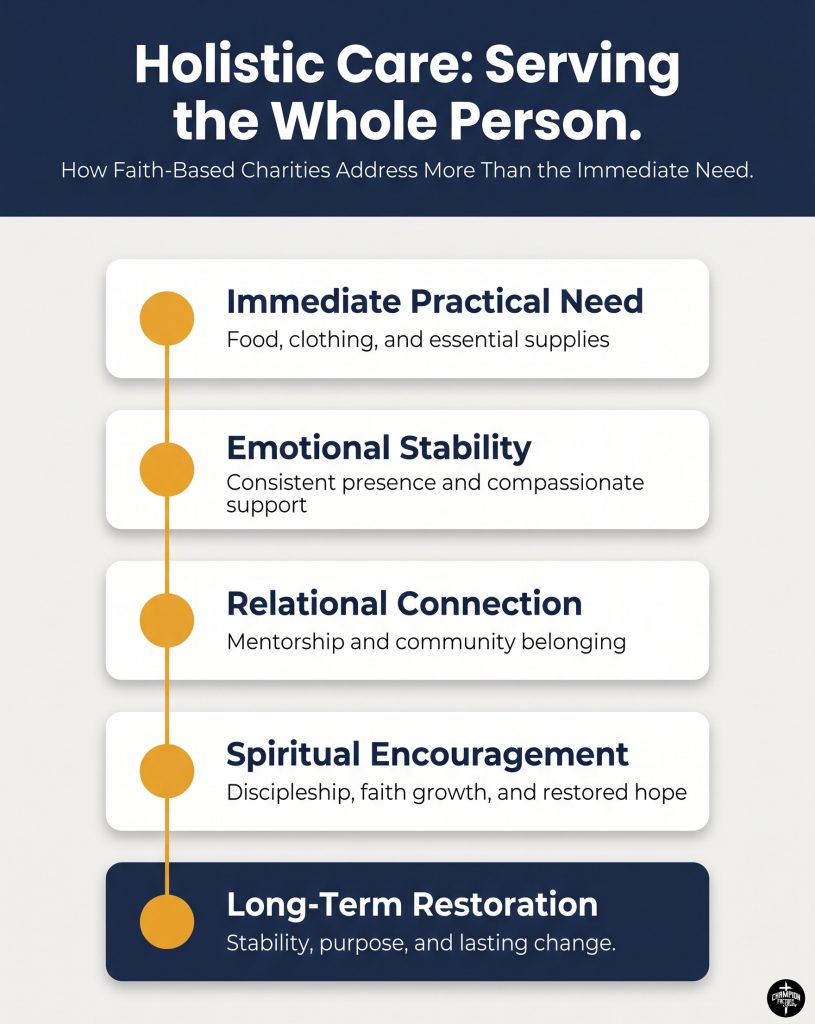
Holistic care means addressing the whole person, not just the immediate problem. A faith-based charity typically provides practical support alongside emotional, relational, and spiritual care. A food pantry may also offer mentorship. A recovery program may also offer discipleship. The goal is to walk with someone toward real stability and restored hope, not to resolve a crisis and move on.
Many general nonprofits focus well on specific, measurable services. That is appropriate for their model. Faith-based organizations often take a wider view.
At Champion Factory Ministry, food and essential care outreach is paired with ongoing relationship. The Nourish discipleship program addresses spiritual growth alongside practical stability. Mentorship creates consistency for children and families through a hard season, not only during it. These are part of the same commitment to seeing a person move toward wholeness.
This approach matters because hardship is rarely one problem in isolation. A family facing food insecurity may also be dealing with isolation, grief, or a loss of direction. Meeting the immediate need is a starting point, not the complete work.
Research from the Lake Institute on Faith and Giving at Indiana University confirms that faith communities are deeply embedded in practical service. In 2023, 82 percent of congregations ran programs such as food banks and clothing drives. That practical engagement is a foundation to build from.
"What we see again and again is that people do not just need a resource. They need someone to stay. That consistency is what changes the trajectory for a family." Robert Crouse, Community Liaison, Champion Factory Ministry
The Role of Volunteers and Community Roots
Faith-based charities draw heavily on volunteer networks rooted in local congregations. These volunteers respond to a sense of calling, not only a commitment to a cause. That motivation tends to produce consistency, depth of relationship, and long-term presence in the community.
According to data from the Corporation for National and Community Service, 68 percent of volunteers who serve weekly in the United States come from religious backgrounds. That is more than double the rate of secular volunteers.
This matters for donors because a strong volunteer base extends the reach of every dollar given. It also means that people receiving support are more likely to encounter consistent, caring relationships rather than unfamiliar faces rotating through a program.
Faith-based charities also tend to have roots that run deeper than a single program. Many are connected to congregations, church networks, and long-standing community relationships that existed before the program launched and will remain after any single crisis has passed. If you are ready to be part of that kind of community, our get involved page outlines how you can serve.
Accountability Standards Apply Here Too
Donating to a faith-based charity does not mean skipping due diligence. Reputable faith-based nonprofits are held to the same accountability standards as any other nonprofit. You can and should verify that an organization uses donations responsibly before you give.
Some donors assume that faith-based organizations are less transparent or harder to evaluate than larger secular nonprofits. That assumption is worth questioning. Many faith-based charities meet rigorous standards and submit to the same public reporting requirements as any 501(c)(3) organization.
Here are four practical steps to evaluate any charity before you give.
- Check Charity Navigator. This platform rates nonprofits on finance, accountability, and impact. A strong rating signals responsible stewardship.
- Review their Candid profile. Candid, formerly GuideStar, provides transparency ratings based on public disclosures. Research shows that nonprofits with a Candid Seal of Transparency raise, on average, 53 percent more in donations than those without one.
- Look at the BBB Wise Giving Alliance standards. The BBB Wise Giving Alliance evaluates charities against 20 criteria covering governance, results reporting, finances, and fundraising practices. These standards apply to faith-based and secular organizations alike.
- Read the annual report. A trustworthy organization will share clearly how donations are used and what impact they have produced.
Faith does not exempt an organization from accountability. It reinforces it. Stewardship is a biblical value. Proverbs 19:17 says, "Whoever is kind to the poor lends to the Lord, and he will reward them for what they have done." That connection carries responsibility on both sides.
A note on scope: Champion Factory Ministry walks alongside individuals and families as a consistent partner in their journey. The ministry does not replace professional services. Anyone who needs counseling, legal support, or medical care is encouraged to pursue those services. Ministry support and professional care work together.

Giving as an Act of Faith
For many donors, giving is an expression of belief. When you give to a faith-based charity whose values align with your own, your donation becomes a partnership in work you believe in, carried out by people motivated by the same source of hope.
The Philanthropy Roundtable has noted that across multiple studies, religious practice is the variable with the strongest and most consistent connection to generous giving. The Lake Institute on Faith and Giving found that 82 percent of people of faith agree that giving is a core tenet of their belief.
Giving, for most believers, is not separate from faith. It is part of it.
2 Corinthians 9:7 speaks directly to this: "Each of you should give what you have decided in your heart to give, not reluctantly or under compulsion, for God loves a cheerful giver." The posture of generosity is itself a spiritual act.
When you give to a faith-based charity, you are joining a community of people who believe that caring for children, families, and individuals in hardship is part of what it means to follow Jesus. That partnership holds meaning that a financial transaction alone cannot carry.
Long-Term Restoration Over One-Time Relief
Faith-based charities are often built for the long term. They are structured to walk alongside people through multiple seasons, building trust over time and providing consistent support that addresses more than an immediate need.
Deuteronomy 15:10-11 is clear on this: "For there will never cease to be poor in the land. Therefore I command you, 'You shall open wide your hand to your brother, to the needy and to the poor, in your land.'" The call is not occasional. It is ongoing.
Mentorship, discipleship, and recovery support are not one-time interventions. They require relationship, consistency, and time. Your donation supports that commitment, providing not only a moment of relief but a sustained presence in someone's life.
This is one of the clearest distinctions between a faith-based charity and a program-focused general nonprofit. General nonprofits do critical work. A faith-based charity operating from a genuine commitment to restoration tends to stay present past the point where a formal program ends. You can read real accounts of that long-term presence in our impact stories.
How to Choose a Faith-Based Charity You Can Trust
Choose a faith-based charity whose mission is specific, whose programs are clearly described, and whose accountability is easy to verify. Passion and faith matter. So does transparency. A trustworthy organization will welcome your questions and make it straightforward to understand how your gift is used.
Before you give, consider asking these questions.
- What does the organization actually do, and who does it serve?
- Is the mission focused and specific, or broad and general?
- Can you find their financial information through Charity Navigator or Candid?
- Does the organization clearly state that it works alongside professional services rather than replacing them?
- Does it describe the people it serves with dignity and respect?
When an organization answers these questions clearly and without pressure, that is a good sign. A ministry that is honest about what it does and does not do is one worth trusting.
Your Giving Reflects What You Believe
The decision to give is not small. It reflects what you value, who you trust, and what kind of change you want to see. For donors motivated by faith, giving to a charity that shares that foundation is a way of putting your resources behind your belief.
Faith-based charities and general nonprofits both serve important roles. If you are looking for an organization that brings practical help and spiritual care together, stays with people over time, and serves from a commitment to dignity and hope, a faith-based charity deserves a serious look.
To learn more about how Champion Factory Ministry serves children, families, and individuals in hardship, or to explore ways to give, volunteer, or partner with the ministry, visit our programs page or our donate page. Every gift is an act of partnership in work that matters.
FAQ
Is a faith-based charity accountable in the same way a secular nonprofit is?
Yes. Faith-based nonprofits registered as 501(c)(3) organizations must meet the same legal and financial reporting requirements as secular nonprofits. You can verify accountability through Charity Navigator, Candid, or the BBB Wise Giving Alliance before you give.
Does a faith-based charity only serve people who share its beliefs?
Not necessarily. Many faith-based charities serve people regardless of their faith background. The mission and motivation come from Christian belief, but support is offered to anyone who needs it, with dignity and without condition.
What does holistic care mean in practice?
Holistic care means addressing more than one dimension of a person's situation. Rather than only providing food or housing assistance, a holistic approach includes mentorship, recovery support, emotional encouragement, and spiritual care. The goal is to support the whole person, not only resolve a single presenting need.
How do I know if a faith-based charity uses donations responsibly?
Look the organization up on Charity Navigator, Candid, or the BBB Wise Giving Alliance. Review their annual report if one is available. A trustworthy charity will be transparent about how donations are used and what they produce.
Can giving to a faith-based charity be spiritually meaningful for the donor?
For many donors, giving to an organization whose values align with their faith carries personal and spiritual weight. Research from the Lake Institute on Faith and Giving found that 82 percent of people of faith consider giving a core part of their belief. For many, it is an act of faith.