






Most people have heard the word gluttony, but few churches talk about it openly. It tends to sit in the category of things Christians quietly wonder about without ever bringing into real conversation.
If you searched for what the Bible says about gluttony, you may be working through your own habits, looking for clarity on whether this is actually a sin, or trying to understand how grace and discipline fit together. This article walks through what Scripture teaches, answers the most common questions honestly, and offers a path forward rooted in grace, not shame.
What Is Gluttony According to the Bible?
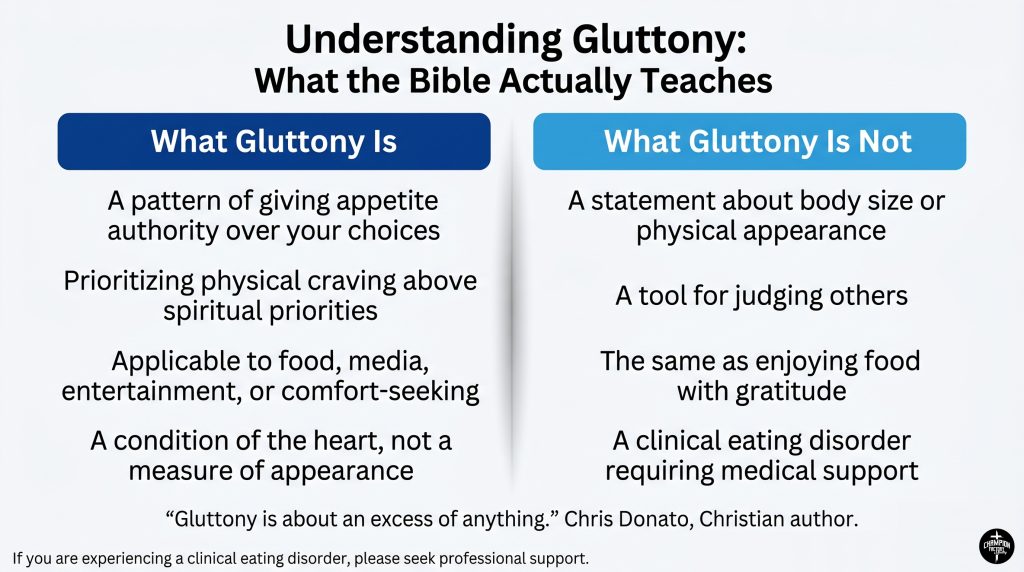
Gluttony is the habitual overindulgence in food, drink, or physical appetite to excess. In the Bible, the problem is not food itself but the pattern of giving appetite authority over your choices and priorities. It is a condition of the heart, not a measure of physical appearance or body size.
The Bible does not treat food as a threat. God instituted feasts in the Old Testament. Scripture describes the end of history as a great banquet. Jesus attended meals with all kinds of people and was even falsely accused of being a glutton because of how freely he shared table fellowship. Food is a good gift.
The concern Scripture raises is what happens when appetite takes the place of God. Proverbs 23:20-21 warns: "Do not join those who drink too much wine or gorge themselves on meat, for drunkards and gluttons become poor, and drowsiness clothes them in rags." The warning is about a pattern that leads toward drift and harm, not about a celebratory meal or a good dinner shared with people you love.
Christian author Chris Donato puts the definition in helpful terms: "Two mistakes accompany most discussions on gluttony. The first is that it only pertains to those with a less than shapely waistline; the second is that it always involves food. In reality, it can apply to toys, television, entertainment, sex, or relationships. It is about an excess of anything."
That broader definition removes a common source of misdirected shame and opens the conversation to the real issue: what we allow to rule our desires.
Does the Bible Call Gluttony a Sin?
Yes. The Bible does not use a single sentence that says "gluttony is a sin," but the pattern of teaching across both testaments makes the spiritual concern clear. Gluttony is treated alongside drunkenness, rebellion, and idolatry. The core reason it matters is that it reflects a pattern of placing physical appetite above faithfulness to God.
Deuteronomy 21:20 links gluttony with stubbornness and rebellion. Philippians 3:19 warns of those "whose god is their stomach," describing people whose appetites have become their functional priority. That is not a statement about physical appearance. It is a statement about where authority lives in a person's life.
At the same time, the Bible never presents this teaching as a tool for judging other people. Jesus warned sharply against that kind of comparison. The biblical concern about gluttony is an invitation to personal examination, not a standard for measuring others.
One important note: if you are experiencing a clinical struggle with food, including binge eating disorder, anorexia, bulimia, or compulsive emotional eating that feels out of your control, those are real conditions that deserve real professional support. This article addresses the spiritual and biblical dimension of appetite. It is not medical guidance or clinical care. The National Alliance for Eating Disorders offers support and resources if you need that kind of help.
Is It Wrong to Enjoy Food?
No. The Bible consistently presents food as a good gift from God. Eating with gratitude is not a sin. The distinction Scripture draws is between gratitude and excess: receiving a gift with appreciation versus allowing that gift to become an appetite that shapes and controls your life.
Ecclesiastes 9:7 says: "Go, eat your food with gladness and drink your wine with a joyful heart, for God has already approved what you do." First Timothy 4:4-5 adds that everything God created is good and is to be received with thanksgiving.
The biblical picture of food is generous and celebratory. What God cautions against is the slow drift into excess and the habit of reaching for food to fill needs that food cannot actually meet.
Kimberly Taylor, founder of Take Back Your Temple and a faith-based teacher featured in Charisma Magazine and on CBN, describes emotional eating as a signal of inner strain rather than a failure of discipline. That framing matters. When food becomes a way to manage pain, loneliness, or anxiety, the deeper need is not more willpower. It is healing, connection, and honest engagement with what is actually going on inside.
The question worth asking is not whether you enjoy eating. It is whether food, or any other appetite, has begun to occupy a place in your life that belongs to something more.
Gluttony Is Bigger Than What Is on Your Plate
The Bible's concern about gluttony is about the pattern of giving any appetite too much authority over your choices. That includes food, but it also includes the pull toward media, entertainment, distraction, or comfort-seeking when those things begin to crowd out rest, relationships, and spiritual priorities.
This matters because it widens the conversation. Some people who never struggle with food recognize the same pattern in other areas. Hours of scrolling that leave you feeling empty. Entertainment that has become an escape. The constant pull toward stimulation or distraction.
Proverbs 25:28 uses a vivid image: "A person without self-control is like a city with broken-down walls." A city without walls has no defense. It is open to whatever comes through the gate. The image is not shaming. It is honest. When we give every appetite what it wants, we gradually lose the capacity to resist the next pull.
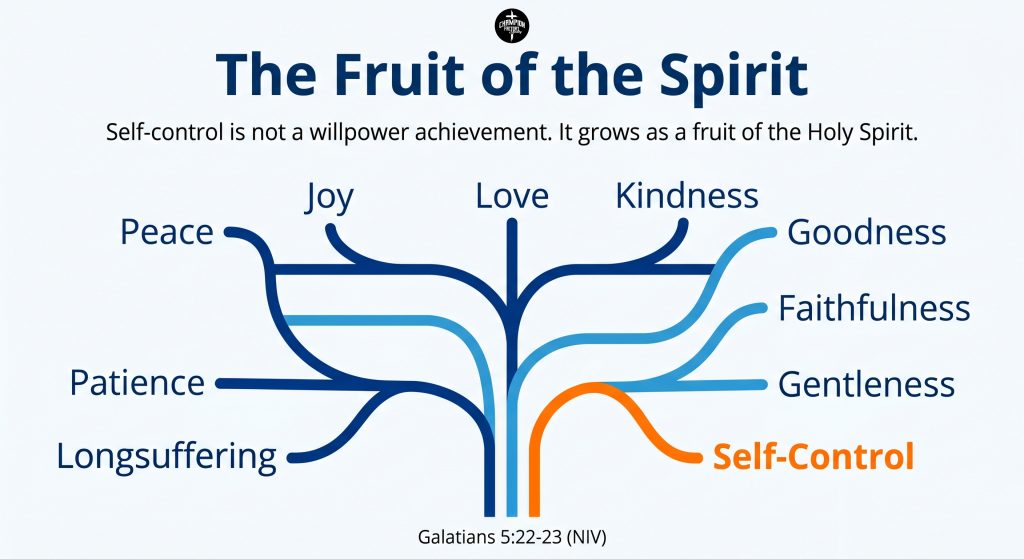
The Greek word for self-control in the New Testament is egkrateia. It carries the meaning of strength, dominion, and Spirit-empowered discipline over desires that would otherwise run unchecked. That word appears in Galatians 5 as a fruit of the Holy Spirit. It is not about gritting your teeth. It is about character that forms over time through genuine life with God.
What the Bible Says About Self-Control
Self-control is listed in Galatians 5:22-23 as a fruit of the Holy Spirit, alongside love, joy, peace, patience, kindness, goodness, faithfulness, and gentleness. This means self-control is not primarily a willpower achievement. It is a character quality that develops through real relationship with God and through the ongoing work of spiritual formation.
Most people approach self-control as a personal project. Try harder. Set stricter rules. Build better systems. Those efforts have a place, but the Bible locates the root of self-control in something deeper.
The Biblical Counseling Coalition, a respected faith-based resource for pastoral and counseling practice, describes self-control this way: its intent is flourishing, not punishment. The work of the Spirit in producing self-control is part of God's restoration of a person toward the life they were designed to live.
Second Peter 1:5-6 places self-control in a sequence of growth: add to your faith goodness, and to goodness knowledge, and to knowledge self-control. It is part of a larger journey of formation. It does not appear fully formed. It develops over time as a person grows in their walk with God.
First Corinthians 6:19-20 offers the clearest motivating picture: "Do you not know that your bodies are temples of the Holy Spirit, who is in you, whom you have received from God? You are not your own; you were bought at a price. Therefore honor God with your bodies." That is not a threat. It is an identity statement. The call to steward your body and your appetites flows from who you are, not from fear of judgment.
How to Grow in Self-Control Through Faith
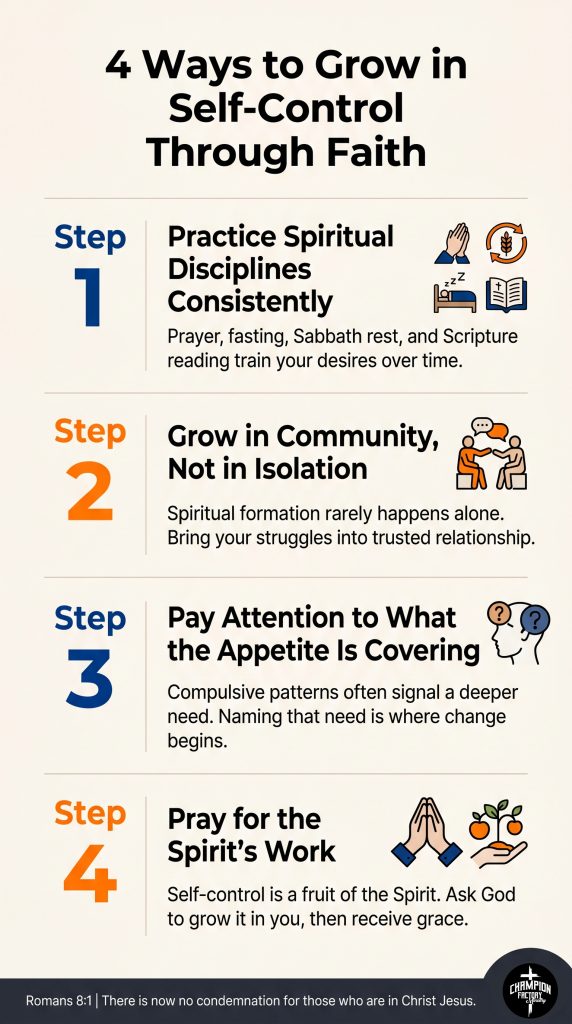
Growing in self-control is a spiritual process that happens over time through disciplines, community, and dependence on God. It does not develop through effort alone. It builds through consistent, intentional habits that keep your life oriented around God's presence rather than your own appetites.
Here are practical, faith-grounded ways to begin.
Practice Spiritual Disciplines Consistently
Spiritual disciplines train your desires over time. Prayer, fasting, Sabbath rest, Scripture reading, and quiet reflection work together to reorient your heart away from appetite-driven living and toward dependence on God.
Fasting is a direct practice of releasing appetite's grip. Jesus assumed his followers would fast (Matthew 6:16-17). The purpose is not discomfort for its own sake. It is the practiced habit of saying with your body what you believe in your heart: that God is enough, and that physical appetite does not have the final word.
Grow in Community, Not in Isolation
Self-control rarely develops in isolation. The Bible places spiritual formation consistently inside community. Honest conversation, shared prayer, mutual accountability, and genuine encouragement are all means of grace.
If you are working through a pattern of overindulgence, bring it into relationship rather than managing it privately. A trusted friend, a discipleship group, a mentor, or a spiritual director can offer the kind of presence and perspective that willpower alone cannot provide.
"We have seen this at Champion Factory Ministry over and over. The people who make lasting progress are not always the ones who tried the hardest. They are the ones who stopped trying alone and started growing alongside others."
Todd Medina, President and Founder, Champion Factory Ministry
Pay Attention to What the Appetite Is Covering
When an appetite feels compulsive or hard to slow down, it is worth asking what need it is trying to meet. Stress, loneliness, grief, and anxiety can all drive us toward comfort-seeking patterns. Naming the deeper need is not an excuse for excess. It is often the beginning of real and lasting change.
If the pattern feels persistent and difficult to manage on your own, professional support is appropriate and wise. Faith and counseling work together well. Reaching out for help is not a failure of faith. It is often an act of courage.
Pray for the Spirit's Work, Not Just Better Results
Because self-control is a fruit of the Spirit, prayer is not secondary to the process. It is central to it. Ask God to develop this quality in you over time. Acknowledge honestly where appetite has held too much authority. Receive grace rather than condemnation.
Romans 8:1 holds firm throughout this conversation: "There is now no condemnation for those who are in Christ Jesus." That verse does not excuse harmful patterns. It establishes the ground on which real change becomes possible.
A Word for Anyone Who Feels Ashamed
If you came to this article already carrying shame about your habits, hear this clearly: the Bible's teaching on gluttony is not a weapon. It is an invitation. God's aim is not to condemn you but to walk with you toward freedom. Shame does not produce lasting change. Grace does.
"The gospel has never been in the business of shaming people into change. It calls people into something better, and that changes everything about how we approach a conversation like this one."
Art Montgomery, Global Evangelism Strategy Architect, Champion Factory Ministry
New Life Ministries, a licensed Christian counseling ministry, names something important: healing starts not with shame, but with grace. That is also where this article wants to leave you.
The struggle with appetite is one of the most common human experiences. It cuts across every background, every season of life, and every kind of person. You are not uniquely broken. You are human, and the same God who invites honest examination also extends steady, patient grace to everyone in the process.
The path forward is not perfect discipline. It is honest relationship with God, honest community with other people, and the slow, steady work of the Holy Spirit shaping your life over time.
Hunger, Wholeness, and the Next Step Forward
Food is a gift. Appetite is part of being human. The question the Bible raises is not whether you enjoy eating but what you are truly hungry for and what you allow to hold authority over your life.
Gluttony, in its deepest biblical sense, is the pattern of filling a deeper hunger with something that cannot satisfy it. Self-control is the Spirit-empowered capacity to live differently, through a life increasingly shaped by God's grace and presence rather than rigid rules or personal willpower.
At Champion Factory Ministry, we believe that real nourishment is both practical and spiritual. Our Nourish discipleship program walks people through spiritual formation in community, building the whole person from the inside out. If you are looking for a place to grow in faith alongside others, we would be glad to have you.
You can also learn more about our food and essential care outreach, which serves families and individuals in our community with dignity and practical support. Or explore how to get involved with the ministry directly.
The next step does not have to be complicated. Pray. Reach out. Start an honest conversation. You do not have to work through this alone.
Frequently Asked Questions
Is Gluttony About Body Weight or Physical Appearance?
No. The Bible's teaching on gluttony is about appetite and what holds authority over your choices. It is not a statement about body size or physical appearance. Anyone can struggle with patterns of excess. Anyone can grow in self-control. Neither is tied to how a person looks.
What Is the Difference Between Gluttony and an Eating Disorder?
Gluttony is a spiritual and moral concept describing an appetite given too much authority in a person's life. Eating disorders, including binge eating disorder, anorexia, and bulimia, are clinical conditions with complex medical, psychological, and emotional dimensions. They require professional support alongside spiritual care. If you are experiencing a clinical eating disorder, reach out to the National Alliance for Eating Disorders for guidance.
How Do I Know If I Struggle With Gluttony?
A useful question to bring to prayer is this: Is this appetite shaping my choices, my peace, or my relationship with God in ways I would not choose? Gluttony is less about a specific behavior and more about the pattern of what holds authority in your life. Honest prayer and trusted community can help you discern that with clarity and grace.
Can Christians Enjoy Food Without Sinning?
Yes. The Bible consistently celebrates food as a good gift from God. Enjoying a meal with gratitude is not a sin. The concern Scripture raises is about excess and what we allow to rule our lives, not about the enjoyment of what God has generously provided.
What Does It Mean That Self-Control Is a Fruit of the Spirit?
It means self-control is not primarily a willpower achievement. It is a character quality that develops through genuine relationship with God, regular spiritual disciplines, and life in community with other believers. You do not produce it on your own. You cooperate with the Holy Spirit as it grows in you over time.