






Many Christians feel discouraged when self-control does not come easily. You try to change a habit, hold your tongue, or resist a temptation, and you fall short again. It is easy to wonder if something is wrong with your faith or your character.
This article walks through what the Bible actually means by temperance, why it matters for everyday life, and how grace and practical steps work together. You will find scripture, honest encouragement, and guidance you can use starting today.
What Does Biblical Temperance Actually Mean?
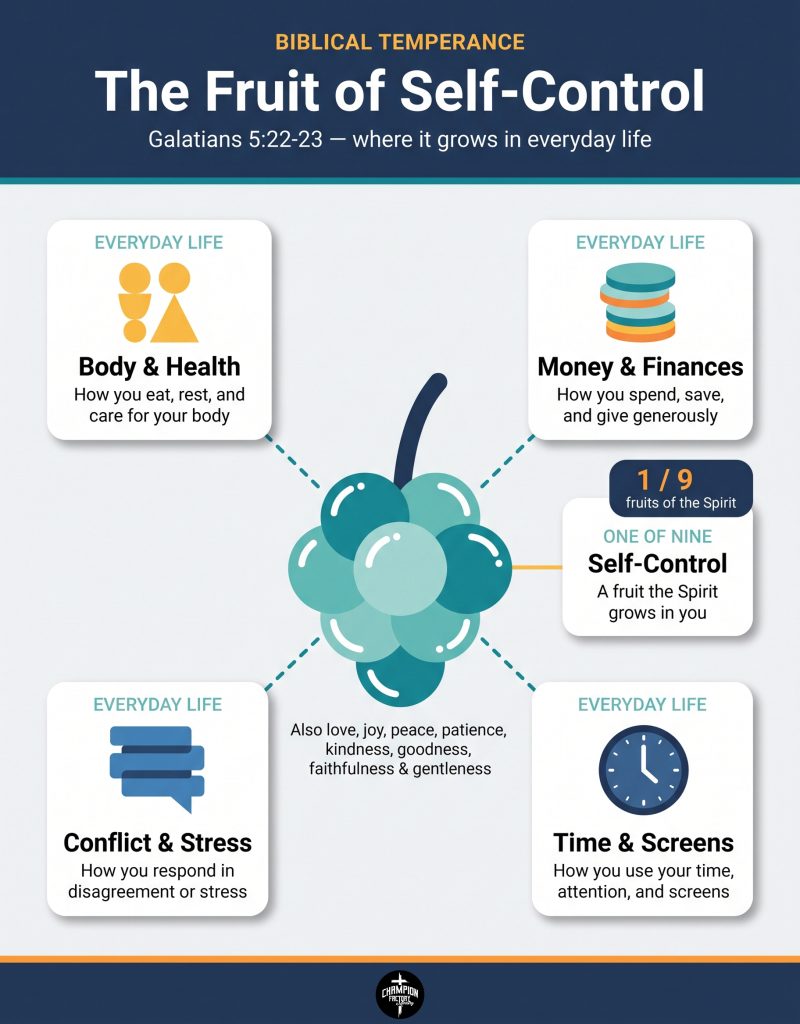
Temperance is the Bible's word for self-control, the inward strength to bring your desires, words, and actions under the Holy Spirit's guidance instead of letting impulse lead. It comes from the Greek word egkrateia, meaning restraint over one's own passions, and it applies to far more than alcohol.
The word temperance shows up in older Bible translations like the King James Version, which can make it feel unfamiliar today. Many people hear the word and think only of the historic temperance movement against alcohol. Scripture uses it much more broadly.
Temperance touches areas like:
- How you eat and care for your body
- How you spend and save money
- How you respond in conflict or under stress
- How you use your time, attention, and screens
Galatians 5:22 to 23 lists self-control among the fruit of the Spirit, alongside love, joy, peace, patience, kindness, goodness, faithfulness, and gentleness. That placement matters. Self-control sits in the same list as love and peace, qualities every Christian is meant to grow into over time.
Is Self-Control a Fruit of the Spirit or Just Willpower?
Self-control is named in scripture as a fruit the Holy Spirit produces in a believer's life, not a trait some people are simply born with. Modern research uses a similar idea, describing willpower as the ability to resist short term temptation for a long term goal, but studies also show that willpower alone tends to run out.
The American Psychological Association describes willpower as functioning like a limited resource that can be depleted through the day. That matches what most people experience. You can hold firm all morning and still slip by evening, not because you are weak, but because effort alone has limits.
This is where the biblical picture offers something different. Self-control as a fruit of the Spirit is not something you manufacture through sheer determination. It grows as you stay connected to God, the way fruit grows on a healthy branch. Effort still matters, but it works alongside the Spirit rather than instead of Him.
"Grace does not remove the need for practice. It gives us a reason to keep practicing." Todd Medina, President & Founder
What Happens When Self-Control Is Missing?
Proverbs 25:28 compares a person without self-control to a city whose walls are broken through, open to harm from every direction. This image is not meant to shame anyone. It shows why self-control matters, protecting your peace, your relationships, and your walk with God.
A city without walls in the ancient world had no real defense. Proverbs uses that picture to show how a lack of self-control leaves a person exposed, not because they are a bad person, but because nothing is guarding the gate.
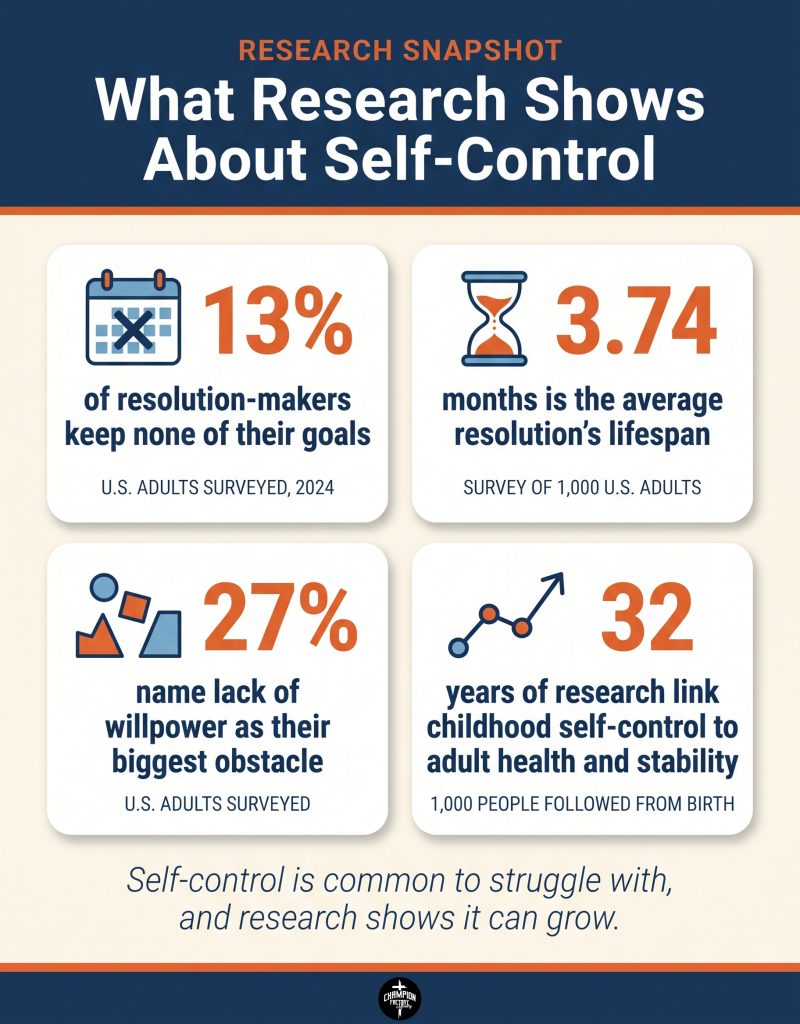
If this feels familiar, you are not alone. Pew Research Center reports that most Americans who set New Year's resolutions struggle to keep them, and a meaningful share keep none at all. Struggling with self-control is a common human experience, not a personal failure unique to you.
"In the outreach work I lead, the families who build the most stability are rarely the ones with the most willpower. They are the ones with the most support." Art Montgomery, Global Evangelism Strategy Architect & Board Visionary Luminary
How Do Grace and Effort Work Together?
Self-control does not mean earning God's approval through willpower. Titus 2:11 to 12 says it is God's grace itself that teaches believers to live self-controlled lives. Effort still has a place, but it flows out of what God has already done, not out of trying to prove your worth.
This balance matters because it is easy to lean too far in either direction. Leaning too hard into effort can slide into legalism, a rigid rule-keeping approach that replaces grace with self-reliance. Leaning too far the other way can slide into passivity, waiting for change to happen without any real participation.
Titus 2:11 to 12 holds both together. Grace comes first. Grace then trains and equips you to live differently. You are not earning your way into God's favor through discipline. You are responding to favor you already have.
A Simple Way to Hold This Together
- Grace is the foundation. It comes first and does not depend on your performance.
- Effort is the response. It shows up as you cooperate with what the Spirit is already doing.
- Neither one replaces the other. Both work together over time.
How Can You Grow in Self-Control as a Christian?
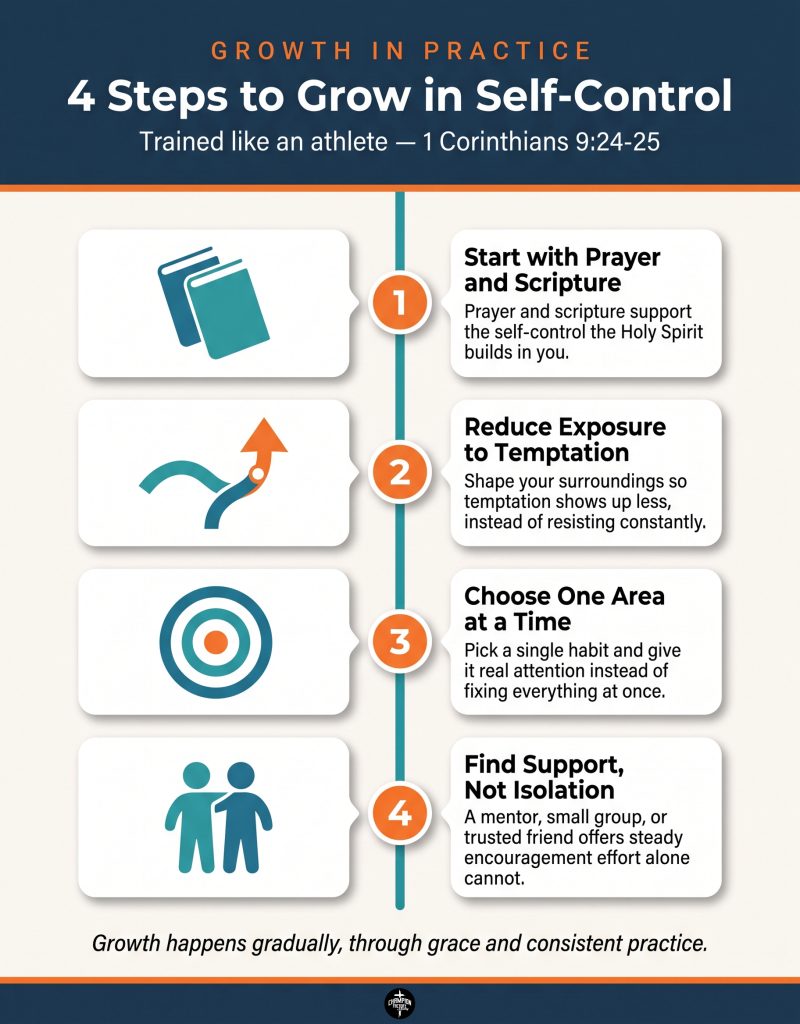
Growing in self-control looks more like training than willpower. First Corinthians 9:24 to 25 compares the Christian life to an athlete's disciplined training toward a lasting prize. Real growth combines spiritual practice with practical structure, built through small steps rather than overnight change.
Practical Steps That Support Growth
- Start with prayer and scripture. Research published in Psychological Bulletin found that practices like prayer and worship may support the kind of self-regulation self-control depends on.
- Reduce unnecessary exposure to temptation. Malte Friese, a social psychologist at Saarland University, found that people strong in self-control usually are not relying on constant resistance. They shape their environment so temptation shows up less often, a finding reported by ScienceNews.
- Choose one area at a time. Trying to fix everything at once usually backfires. Pick a single habit and give it real attention.
- Find support instead of going it alone. A mentor, a small group, or a trusted friend can offer the kind of steady encouragement that individual effort cannot.
If willpower has felt like a tank that keeps running dry, it may help to picture it differently. Krishna Savani, a psychology researcher at Nanyang Technological University, suggests thinking of willpower less like fuel that runs out and more like a battery that recharges with the right support and mindset, an idea explored by Positive Psychology. For Christians, that recharge comes through the Spirit, through prayer, and through consistent practice over time.
"Across every culture we serve, the same pattern holds. People grow fastest in self-control when someone else is walking with them." Art Montgomery, Global Evangelism Strategy Architect & Board Visionary Luminary
Where Does Self-Control Show Up in Everyday Life?
Self-control shapes far more of daily life than obvious moments of temptation. It shows up in how you manage money, respond in conflict, care for your body, and use your time and attention. Recognizing these everyday moments helps you see growth as a whole life project.
Common areas where self-control plays a quiet, daily role include:
- Finances, such as spending, saving, and generosity
- Relationships, including how you respond in disagreement or frustration
- Food and rest, including how you care for your physical health
- Screens and media, including how you spend unstructured time
- Words, including what you say when you are tired or upset
Seeing self-control this broadly can feel encouraging. Growth in one area often strengthens others, since the same Spirit is at work across every part of your life.
You Are Not Meant to Grow in This Alone
Self-control is not a test you pass or fail on your own. It is a fruit that grows through grace, steady practice, and support from others. Longitudinal research from the Dunedin Multidisciplinary Health and Development Study found that people whose self-control improved over time saw better outcomes than their earlier scores alone would have predicted. Change is possible, and it tends to happen gradually, not all at once.
If your struggle with self-control connects to something deeper, such as addiction or a mental health concern, please reach out to a licensed counselor or medical professional alongside any spiritual support you seek. Faith and professional care can work well together, and neither one is meant to carry the weight alone.
"We see this in every mentorship relationship we support. Growth in self-control almost always starts with someone else showing up first." Todd Medina, President & Founder
Champion Factory Ministry walks alongside people building these habits through community and consistent support, including mentorship relationships and the Nourish discipleship program. If you would like encouragement on this journey, you are welcome to connect with our team.
FAQ
Does biblical temperance only refer to alcohol?
No. Temperance is an older Bible translation word for self-control, and it applies broadly to areas like food, money, relationships, and how you use your time.
Is self-control the same thing as willpower?
Not exactly. Willpower is a psychological term for resisting short-term temptation, while biblical self-control is described as fruit the Holy Spirit produces as you grow in faith.
What if I keep struggling with self-control?
Struggling is common and does not mean you are failing spiritually. Growth tends to happen gradually through grace, consistent practice, and support from others.
How can I start growing in self-control this week?
Choose one area to focus on, add a simple spiritual practice like prayer or scripture reading, and consider inviting a trusted friend or mentor to support you along the way.