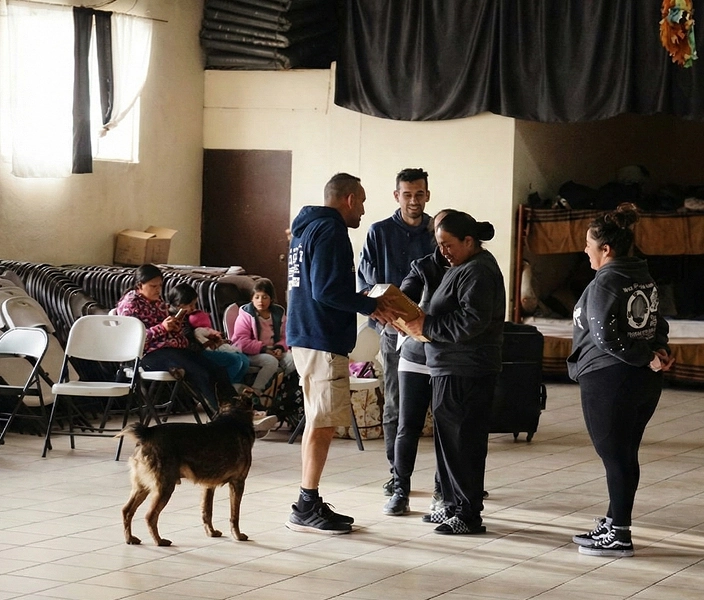






Many people want to serve in a church or ministry but are not sure where to begin. According to Lifeway Research, about two in three churchgoers say they did not volunteer for a church or charity in the previous year, even though many genuinely want to. The reasons are understandable. Some feel they do not have enough time. Others wonder whether they are qualified. Some simply do not know what is available or how to ask.
This guide is for anyone at any stage of faith who wants to take a first practical step. Whether you are a longtime church member, a newer attendee, or someone just beginning to explore faith-based community, there is a meaningful place for you to start.
Why Serving in a Church or Ministry Is Worth Your Time
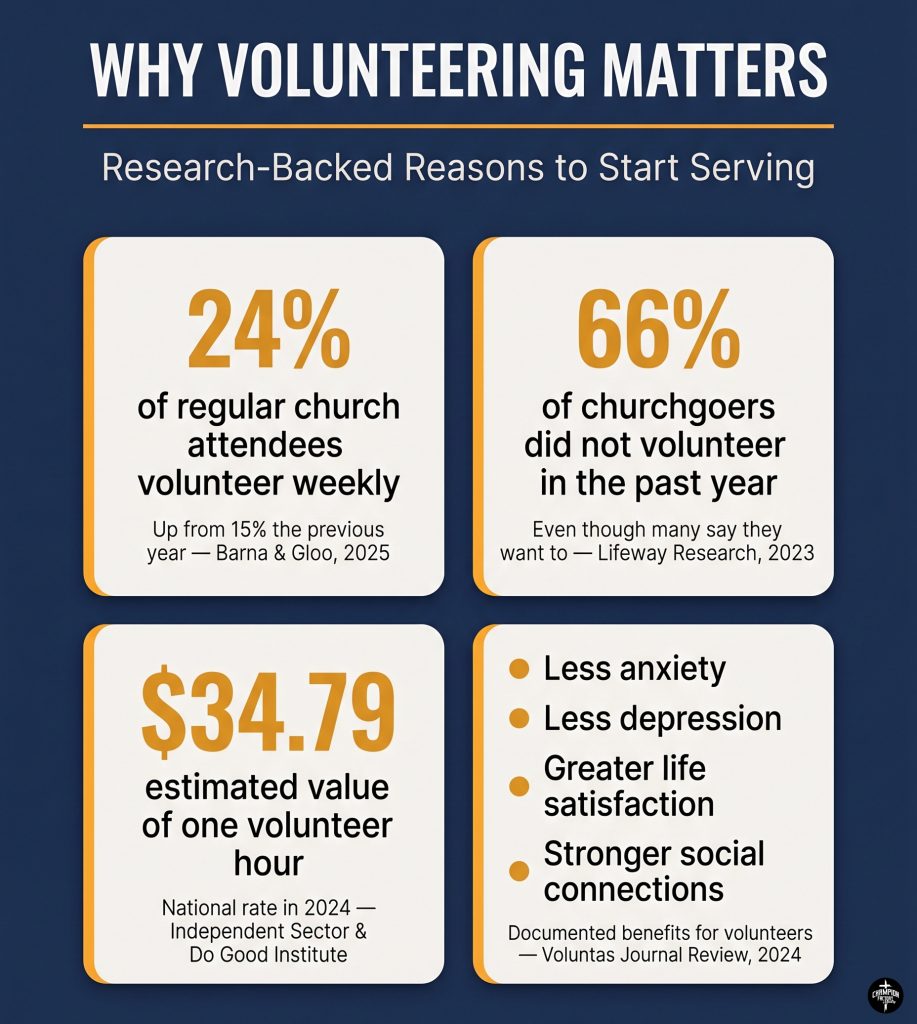
Volunteering in a church or ministry connects you to something larger than the task itself. Research consistently shows that people who volunteer regularly report lower rates of anxiety and depression, stronger social connections, and a greater sense of purpose. When that service is rooted in faith, those benefits tend to run deeper.
Todd Adkins, director of Lifeway Leadership, puts it plainly: "You can't grow into spiritual maturity apart from using your gifts for service in Christ." A review published in the journal Voluntas examined 28 studies and found that volunteering produced measurable benefits across social, mental, and physical health, with religious volunteering and altruistic motivations producing the most consistent results across all 28 studies reviewed.
According to Barna Group and Gloo's State of the Church 2025 report, weekly church volunteering has risen to 24% of regular attendees, up from 15% the previous year. Younger adults are leading that growth, with Gen Z adults volunteering at a weekly rate of 21% and Millennials at 19%. The need for willing, consistent volunteers continues to grow across faith communities nationwide.
The value of that time is measurable as well. According to Independent Sector and the Do Good Institute at the University of Maryland, a single volunteer hour was valued at $34.79 nationally in 2024. What that number cannot capture is what happens relationally and spiritually when someone chooses to show up week after week for people who need them.
Before You Choose a Role, Start with Your Gifts
The best place to start is not a sign-up sheet. It is a quiet question: what has God placed in you that could serve others? As 1 Peter 4:10 says, "Each of you should use whatever gift you have received to serve others, as faithful stewards of God's grace in its various forms." Every volunteer role calls on something specific, and matching your gifts to a role makes service more meaningful and more sustainable.
Romans 12:6-7 reinforces this: "We have different gifts, according to the grace given to each of us. If your gift is prophesying, then prophesy in accordance with your faith; if it is serving, then serve." A church or ministry needs administrators as much as it needs teachers. It needs people who welcome guests with warmth as much as it needs people who sort donated goods in a back room.
To help identify your gifts before you start:
- Reflect on what you naturally enjoy doing and where you feel most energized.
- Notice the moments in your life when helping someone felt natural rather than forced.
- Ask a pastor, ministry leader, or trusted friend what strengths they observe in you.
- Consider taking a spiritual gifts assessment. Many churches and faith organizations offer free tools to help you identify your areas of strength and calling.
"I've seen volunteers arrive uncertain of what they have to give and find a natural fit within their first month. The role often reveals itself once you start showing up." — Troy Rallings, Global Sports & Physical Education Director
30 Practical Ways to Volunteer in a Church or Ministry
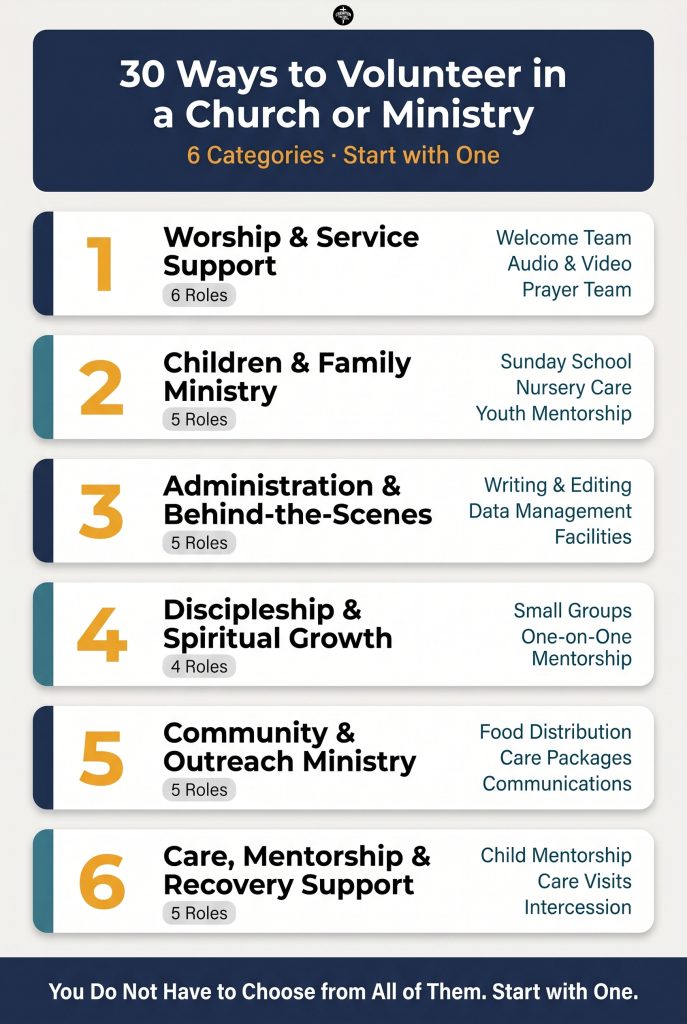
Churches and ministries need volunteers across a wide range of roles. Most do not require formal credentials, platform experience, or years of church history. Whether you prefer people-facing service or quiet support work, the opportunities are broad. The 30 roles below are organized into six categories. You do not need to choose from all of them. Start with one.
Worship and Service Support
These roles focus on the weekly rhythm of gathered worship. They are often the most visible point of entry for new volunteers.
- Serve on a welcome team. Greet people as they arrive, help newcomers find their way, and create a warm first impression for visitors.
- Join the parking and arrival team. Help guide vehicles, assist families with children, and keep arrivals organized and calm.
- Volunteer on the worship music team. If you sing or play an instrument, connect with the worship leader to find out what is needed.
- Help run audio, video, or live stream technology during services. Many churches depend heavily on technical volunteers to support both in-person and online gatherings.
- Assist with set-up and tear-down before and after services. This role requires no specific experience and is almost always short on help.
- Join the prayer team. Participate in weekly or monthly intercession for the congregation, the community, and the ministry's ongoing work.
Children and Family Ministry
Working with children and families is one of the most common starting points for church volunteers. It is also one of the most consistent needs in most congregations.
- Teach or assist in Sunday school or children's church. Volunteers help lead age-appropriate lessons, engage children in discussion, and support the lead teacher.
- Serve in the nursery or infant care area during services. Families depend on trusted volunteers in this role so parents can participate fully in worship.
- Volunteer during Vacation Bible School or special children's events. These require extra hands for a limited window and offer a natural entry point for newer volunteers.
- Support youth group as a mentor or small group leader. This is a relational role that involves showing up consistently, listening well, and guiding younger people in faith and daily life.
- Help coordinate family-oriented events and programs. Planning, communication, and logistics support are needed for nearly every family ministry event.
Note: Roles involving children typically require a background screening. This is a standard safety practice that protects both children and volunteers, and is a normal part of onboarding in reputable ministries.
Administration and Behind-the-Scenes Support
Not every volunteer role is visible. Many of the most consistent contributions happen off the platform and out of the spotlight.
- Help with written communications, newsletters, or bulletin preparation. Many ministries need writers and editors on a regular basis. If you have that background, reach out directly.
- Assist with data management or contact record keeping. Administrative volunteers help ministries stay organized and run programs effectively.
- Support the finance or bookkeeping team. For volunteers with accounting or financial backgrounds, this is a high-value role that directly supports ministry operations.
- Help maintain the building, grounds, or facilities. Painting, cleaning, lawn care, and basic repairs keep ministry spaces safe, welcoming, and functional.
- Volunteer in a resource library, media center, or materials distribution role. Organizing and distributing materials helps programs run reliably week after week.
Discipleship and Spiritual Growth
Discipleship is both a personal practice and a communal one. These roles are about walking alongside others in faith, not just facilitating programs.
- Lead or host a small group or Bible study. You do not need to be a theologian. You need to be willing to gather people, create space for honest conversation, and guide discussion with care.
- Serve as a one-on-one mentor or discipleship partner to a newer believer. This is a simple, relational commitment: show up, listen, and share what your own faith has taught you.
- Help with adult faith formation classes or training programs. Many churches offer structured spiritual growth programs that need support facilitators and coordinators.
- Participate in or support a structured discipleship program. At Champion Factory Ministry, the Nourish program provides an opportunity to engage in spiritual growth through community, alongside others on that journey.
Community and Outreach Ministry
These roles extend service beyond the church building into the broader community. James 1:27 describes faith in action as looking after those who are in genuine need, and outreach ministry puts that into practice in concrete, practical ways.
- Volunteer at food distribution events or a food pantry. This is one of the most accessible starting points for new volunteers. It requires presence, reliability, and a welcoming attitude.
- Help deliver meals or essential care packages to families in need. This role puts you in direct, personal contact with families and individuals who benefit from both the practical support and the presence of someone who took time to come.
- Support neighborhood or community outreach events. Help with set-up, connect with community members, and represent the ministry with care and consistency.
- Coordinate or assist with donation drives for clothing, food, or household goods. Organizing donated items for distribution is the kind of practical work that makes outreach programs function at scale.
- Contribute digital or communications skills. Photography, graphic design, social media, and writing are needed to share what the ministry does and help community members find the support available to them.
"The volunteers who make the deepest impact in our outreach work are not always the most experienced. They are the ones who ask good questions and come back the following week." — Robert Crouse, Community Liaison
Care, Mentorship, and Recovery Support
Hebrews 10:24-25 calls believers to "spur one another on toward love and good deeds." These roles do exactly that. They are relational, long-term, and grounded in dignity and consistent presence.
- Become a mentor to a child or young person through a structured program. Mentors provide consistent relationship, encouragement, and a stable adult presence. Training and support are provided before you begin. You can learn more about our mentorship programs if this role resonates with you.
- Serve as a care visitor to homebound, elderly, or isolated individuals. Simple presence, conversation, and practical help can make a real difference for people who rarely have someone come to them.
- Support recovery and restoration programs through relational presence. Volunteers in this area are not trained counselors. They are consistent, caring people who show up. Ministry staff provide structure, training, and supervision throughout.
- Serve in a pastoral care or hospitality support role. This might involve supporting a bereavement care team, helping families through practical transitions, or assisting pastoral staff with ongoing care coordination.
- Join a prayer and intercession team for individuals and families in need. Prayer is one of the most faithful and consistent forms of service available to any volunteer.
"The children in our programs can tell quickly whether someone plans to keep showing up. Reliability matters more than experience when it comes to mentorship." — Troy Rallings, Global Sports & Physical Education Director
Note: Roles that involve serving people in recovery, crisis, or other vulnerable situations are always led by trained ministry staff. Volunteers receive orientation and support before engaging in these areas. If you are personally going through a difficult season, please speak with a pastor or licensed counselor before taking on a care-facing role. Seeking your own support first is not a barrier to future service. It is a wise foundation for it.
You Do Not Need to Be Perfect to Start
Many people stay on the sidelines because they believe volunteering requires credentials, a polished faith, or a fully open schedule. None of that is true. Scott McConnell, executive director of Lifeway Research, put it well: "The easiest way to serve others is when a charity or group organizes the effort. They recognize the need, come up with a plan and often gather needed resources. You just have to show up."
That is the real starting point: showing up. Most churches and ministries provide orientation, training, and ongoing support for volunteers. You do not arrive alone or without guidance.
A few things worth knowing before you begin:
- You do not need to be a member of a specific church to volunteer in most settings. Many ministries welcome community members.
- Faith background matters less than willingness. Most ministry leaders care more about a servant heart than a long history of church attendance.
- Your everyday skills, whether that is cooking, driving, organizing, listening, or basic repair work, have genuine value in a ministry setting.
Galatians 5:13 offers a grounding frame: "Serve one another humbly in love." Humility here does not mean hiding. It means starting where you are, with what you have, for the benefit of the person in front of you.
How to Serve Without Burning Out
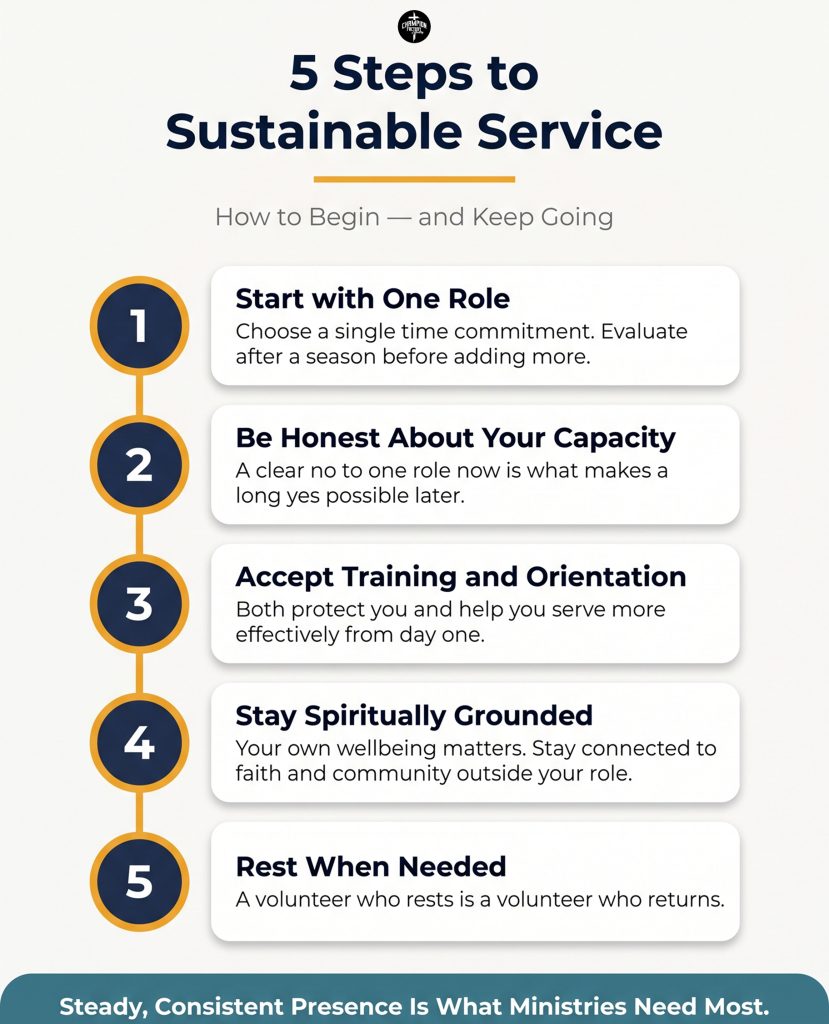
Burnout is one of the most common reasons people step away from volunteering. It is also one of the most preventable. The key is starting with one clear commitment and evaluating before adding more. Sustainable service requires honest self-awareness and a ministry culture that values steady, long-term presence over short-term enthusiasm.
Research from Pepperdine University on church volunteer burnout found that effective programs must be built relationally and around realistic commitment structures. The goal is consistent service over time, not a short burst of effort followed by exhaustion and withdrawal.
Practical steps for sustainable volunteering:
- Start with one role and one time commitment. Evaluate after a season before adding more.
- Be honest with yourself and with ministry leaders about your capacity. Saying no to one role now is often what makes a long yes possible later.
- Accept training and orientation. Both protect you and help you serve more effectively.
- Stay connected to a faith community and personal spiritual practices outside of your volunteer role. Your own wellbeing matters.
- Take breaks when needed. A volunteer who rests is a volunteer who returns.
One research synthesis on volunteer sustainability noted: "The volunteer who protects their own wellbeing is not selfish. They are maintaining the capacity to show up next week, and the week after." That kind of steady, consistent presence is what ministries and the people they serve need most.
Where to Go from Here
Volunteering in a church or ministry is not about having the right credentials or the most open calendar. It is about bringing what you have to a need that is already in front of you.
Start with one honest question: where do I already notice a need? If you see the welcome team stretched thin on a busy morning, that is a signal. If you feel drawn to food distribution, mentorship, or prayer support, that is a starting point worth paying attention to.
Then take one action. Speak to a ministry leader. Attend a volunteer information session. Fill out an interest form or reach out to our team. Show up once and see how it goes.
At Champion Factory Ministry, we walk alongside children, families, and individuals who need practical care, relational consistency, and hope that comes from faithful presence over time. If that kind of service resonates with you, we invite you to explore where your gifts might fit within our programs and outreach work.
Whatever step you take, you do not have to take it perfectly. You just have to take it.
Frequently Asked Questions
Do I Need to Be a Church Member to Volunteer?
Most churches and ministries welcome volunteers from the broader community. Membership is rarely a requirement for entry-level service roles. Ask a ministry leader about their specific process and what getting started looks like for someone in your situation.
What If I Am Not Sure My Faith Is Strong Enough to Serve?
You do not need to have all the answers to show up for others. Many volunteers begin serving before they feel fully settled in their faith, and for many, the act of serving has become part of how faith has grown over time. Talk honestly with a ministry leader about where you are and what feels right.
What Roles Exist for People Who Prefer Not to Work with Children?
Many volunteer roles have nothing to do with children. Administrative support, facilities maintenance, communications, prayer teams, adult mentorship, outreach coordination, and care visitation are all meaningful options. Most ministries have more behind-the-scenes needs than visible platform roles.
Is It Safe to Volunteer in Roles That Serve Vulnerable People?
Reputable ministries follow clear screening and training protocols for any role involving vulnerable individuals. Volunteers do not work alone or without supervision in these areas. Background checks, orientation, and ongoing staff support are standard practice. Ask any ministry you are considering how they train and support their volunteers before you begin.
How Much Time Does Volunteering Typically Require?
This varies by role. Some positions ask for a few hours once or twice a month. Others involve a consistent weekly commitment. Most ministry leaders would rather have a volunteer who commits reliably to two hours than someone who signs up for eight and steps away within a month. Starting small is wise, and you can grow your commitment from there.
What If I Am Going through a Hard Season Right Now?
There is no shame in waiting until you have more stability before taking on a care-facing volunteer role. If you are going through grief, recovery, or a personal crisis, please speak with a pastor, counselor, or trusted professional first. Many ministries offer care and support for people in difficult seasons, and receiving that support is not a barrier to eventually offering it to others.