






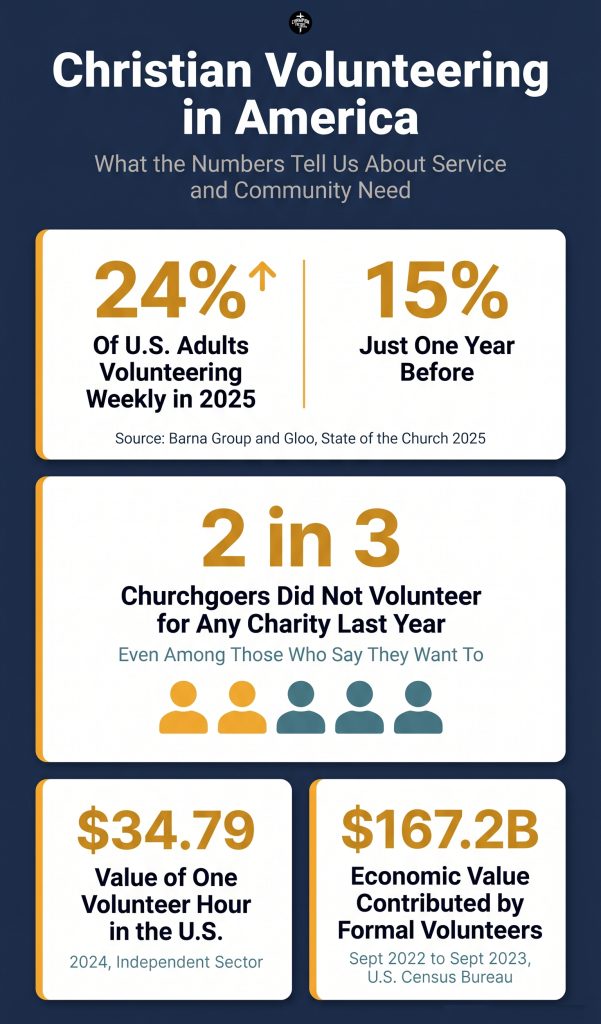
More people are ready to serve than ever. According to Barna Group and Gloo's State of the Church 2025 report, weekly church volunteering rose to an estimated 24% of U.S. adults in early 2025, up from 15% just one year before. That growth reflects something real: a rising desire among Christians to act on their faith through service to those around them.
But desire and action are not the same thing. Lifeway Research found that two in three churchgoers have not volunteered for any charity in the past year, even when they say they want to. This article is for that person. It covers what volunteer opportunities at faith-based organizations actually look like, what the community need is right now, and how to take a concrete first step that fits where you are.
Why Consistent Presence Creates More Change Than a Single Act of Service
Christian volunteering creates lasting community impact when it is built on relationship and consistency rather than good intentions alone. Showing up one time can meet an immediate need. Showing up repeatedly, for the same people, over an extended period, builds the kind of trust and stability that allows real change to take root. Most communities do not lack helpers who appear once. They lack people who stay.
Galatians 6:2 frames this simply: "Carry each other's burdens, and in this way you will fulfill the law of Christ." Carrying a burden is not a one-time transaction. It is an ongoing practice of remaining present in someone else's life.
Research on youth mentoring supports what faith communities have long understood. The Office of Juvenile Justice and Delinquency Prevention notes that mentoring improves self-esteem, academic achievement, and peer relationships in young people while reducing substance misuse and delinquent behavior. Studies consistently show that longer, well-supported mentoring relationships produce better outcomes than short or informal ones. Duration is what makes the difference.
The same principle holds across every area of community service. Whether you are helping a family access food each week, walking alongside someone in recovery, or supporting a young person through a difficult season, your continued presence carries weight that a single visit cannot replicate.
What Real Need Looks Like in Communities Right Now
Food insecurity, family instability, and a shortage of consistent caring adult presence are not distant problems. They affect millions of households across every type of community in the United States. Understanding the scale of that need helps volunteers see their service as a direct and timely response to something real and urgent.
According to the U.S. Department of Agriculture's Household Food Security report for 2024, about 18.4% of households with children experienced food insecurity that year. That represents 14.1 million children who did not have consistent access to enough nutritious food. Single-mother households faced the highest rate at 36.8%.
Jesus addressed this kind of need directly: "For I was hungry and you gave me something to eat, I was thirsty and you gave me something to drink, I was a stranger and you invited me in" (Matthew 25:35, NIV). Food outreach is a lived expression of what the gospel looks like in a neighborhood.
Beyond food, many children and young people carry their days without a reliable, caring adult consistently in their life. Many families face hardship with little or no community surrounding them. Volunteers who show up regularly in structured roles help address those gaps in ways that programs and services alone cannot.
Types of Christian Volunteer Opportunities That Create Real Impact
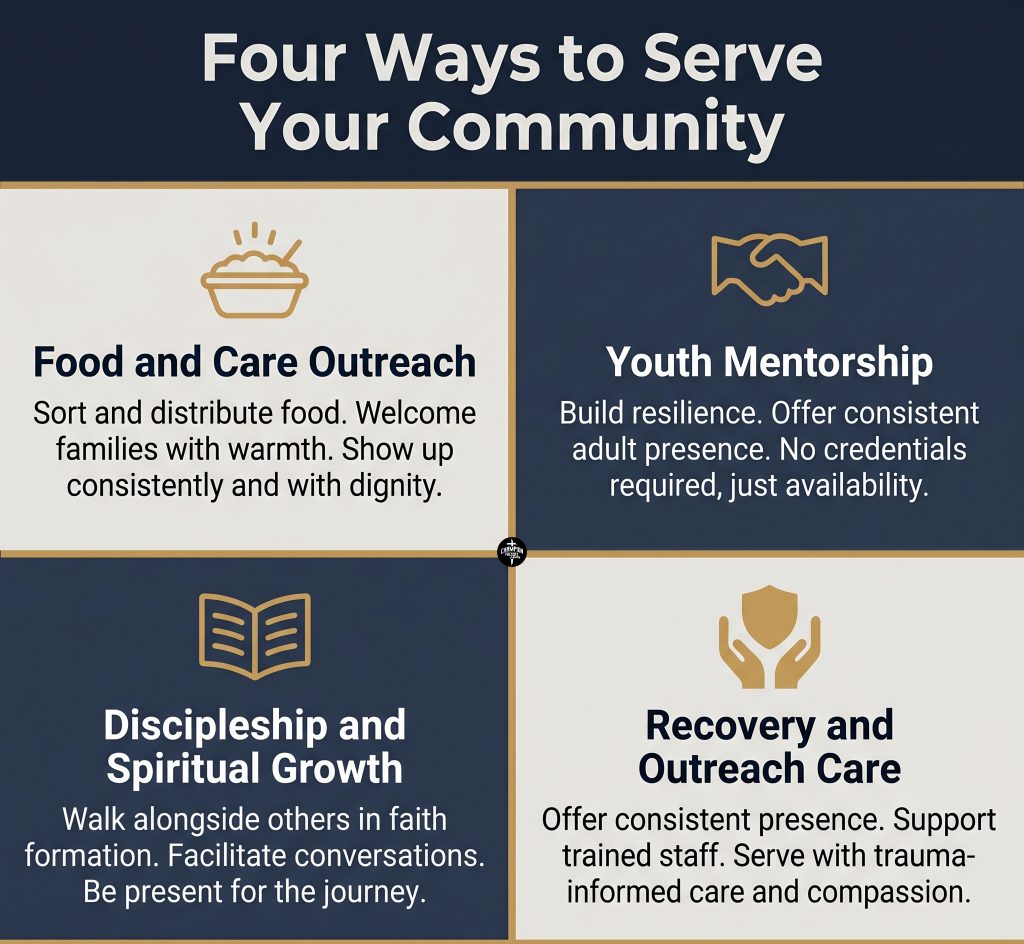
Faith-based volunteer opportunities range from direct care and food distribution to youth mentoring, discipleship support, and care for individuals in difficult or unsafe circumstances. The most effective roles share one characteristic: they connect the volunteer to people in a consistent, relational way rather than through a single interaction. The right role depends on your available time, your natural strengths, and the type of service you feel drawn toward.
Here are the most meaningful opportunities available through a community-focused faith ministry.
Food and Essential Care Outreach
Food distribution and care outreach place volunteers directly at the point of need. In these roles, you help sort and distribute food, welcome families with warmth and consistency, and offer dignified care to people managing tight and often unpredictable circumstances. This work requires reliability more than specialized skill. Showing up on the same day, treating every person who arrives with the same respect, and staying familiar to the families you serve over time is what makes this kind of outreach more than a transaction.
Youth Mentorship and Support
Mentoring a young person is one of the highest-impact choices a volunteer can make. Consistent adult mentors help children and teenagers build resilience, develop healthy relationships, and find a sense of direction during formative years. This kind of support matters most for young people facing hardship who may not have a stable adult consistently invested in their growth. No professional credentials are required. Availability, patience, and follow-through are what count.
"In sports, we often talk about the coaches who changed someone's life. That impact rarely came from a single conversation. It came from someone who showed up to every practice." Troy Rallings, Global Sports & Physical Education Director
Discipleship and Spiritual Growth
Discipleship-focused programs like our Nourish discipleship community bring people together around spiritual formation and personal growth. Volunteers in these spaces help facilitate conversations, offer encouragement, and walk alongside others through longer personal journeys. This kind of service is quieter than food distribution, and it shapes people deeply. It requires emotional steadiness, genuine care, and a willingness to be present for someone else's process at whatever pace that takes.
Recovery and Outreach Care
Some volunteer roles involve coming alongside individuals who have experienced trauma, hardship, or unsafe situations. These positions are always structured, supervised by trained staff, and guided by trauma-informed practices. Volunteers in this area do not provide counseling, case management, or clinical services. They offer consistent presence and practical support as part of a larger team that includes professional partners.
If you or someone you know is facing a personal crisis, please reach out to a licensed counselor, a local crisis helpline, or a trusted mental health professional. Volunteer presence is one meaningful layer of support within a broader system of care.
1 Peter 4:10 captures the breadth of what healthy community requires: "Each of you should use whatever gift you have received to serve others, as faithful stewards of God's grace in its various forms." Every role described above calls on different strengths. All of them are needed.
How Serving Others Shapes the Person Who Serves
Volunteers gain as much as the people they serve. Research consistently shows that those who give their time regularly experience lower rates of depression, stronger social connections, and greater life satisfaction. The act of showing up for others is one of the most direct paths toward a grounded and connected life.
According to research cited by the Royal Voluntary Service, only 9% of active volunteers reported feeling lonely often or always, compared to 13% of non-volunteers. That difference reflects the natural result of building relationships around shared purpose and consistent service.
Independent Sector and the Do Good Institute at the University of Maryland estimate that one volunteer hour in the United States was worth $34.79 in 2024, an increase that outpaced the general inflation rate of 2.9% for the year. Nathan Dietz, Research Director at the Do Good Institute, noted that the contributions of volunteers are more valuable today than ever before.
This is more than an economic measure. It is a signal that volunteer time carries real weight in communities that depend on it, and real benefit back to the person giving it.
How to Find a Volunteer Opportunity That Fits Your Life
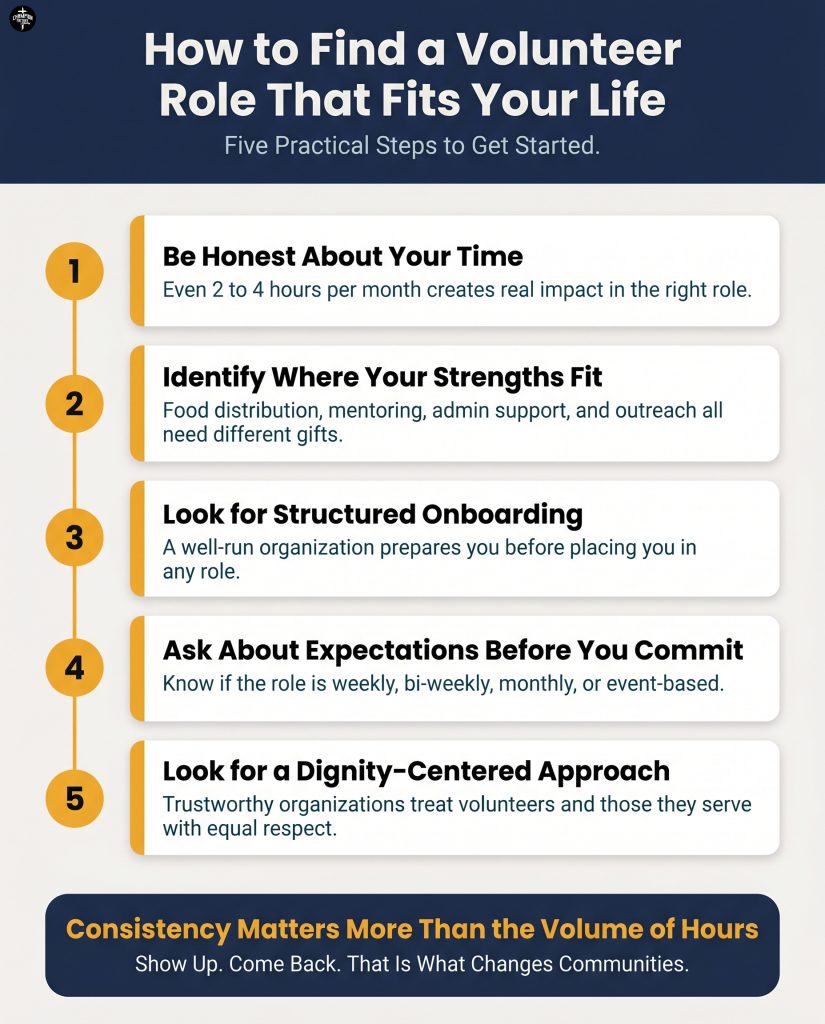
The best volunteer match combines your honest available time, your natural strengths, and an organization whose values and practices you trust. Starting with those three factors makes the decision much clearer and increases the chance that you will stay engaged over time. You do not need to take on every kind of service. You need to find the one or two roles where you can show up consistently and well.
Scott McConnell, Executive Director of Lifeway Research, offers a useful frame: the simplest way to start serving is to find an organization that has already identified the need, built a plan, and prepared a path for volunteers. Your job is to show up.
"People often ask what skills they need before they can volunteer. Most of the time, the answer is availability. Families and young people need adults who come back." Robert Crouse, Community Liaison
Here are practical steps to get there.
- Be honest about your time. Even two to four hours per month makes a meaningful contribution in the right role.
- Identify where your strengths fit. Food distribution, one-on-one conversation, working with children, administrative support, and physical labor all represent real and distinct volunteer needs in most ministries.
- Look for structured onboarding. A well-run organization will prepare you before placing you in any role.
- Ask about expectations before you commit. Know whether the role is weekly, bi-weekly, monthly, or event-based.
- Look for a dignity-centered approach. Trustworthy organizations treat both the people they serve and the volunteers alongside them with consistency and respect.
Roles that involve children, youth, or individuals in sensitive care situations typically require a background check and an orientation session. This is a good sign. It means the organization takes the safety and wellbeing of the people it serves seriously.
To learn more about what serving looks like at Champion Factory Ministry, visit our get involved page or explore the programs and areas of care that our volunteers help support.
Stepping Into Service: What Happens When You Say Yes
Christian volunteering is not a seasonal program or a casual addition to an already full life. It is a practice of showing up, over time, for people who are carrying more than they can carry alone. The need is documented. The impact is real. And the call to serve is not reserved for a specific personality type, skill set, or season of life.
Ephesians 2:10 says we are "created in Christ Jesus to do good works, which God prepared in advance for us to do." That is not a call to have everything figured out before you start. It is a call to availability.
If you are ready to take a next step, we would love to connect with you. Learn more about our mission and reach out through our contact page. Every volunteer role at Champion Factory Ministry is built around relationship, dignity, and a long-term commitment to helping people find stability and restored hope.
FAQ
Do I need experience or a specific background to volunteer?
Most volunteer roles at community-focused ministries do not require prior experience. A well-run organization will provide orientation and training before placing you in any role. What matters most is reliability, genuine care, and a willingness to stay consistent over time.
What if I can only commit a few hours per month?
A few hours per month still creates meaningful impact, especially in consistent roles like food outreach or youth mentoring. Many ministries offer flexible scheduling that fits around work and family life. Showing up reliably over time matters more than the total volume of hours.
How do I know if a volunteer organization is trustworthy?
Look for a clear mission, structured volunteer training, background screening requirements for roles involving vulnerable populations, and transparency about how the organization operates. A responsible organization will be open about what volunteers do, how they are supported, and what boundaries exist to protect the people it serves.
Is volunteer service at a Christian nonprofit only for people of strong faith?
No. Most faith-based nonprofits welcome volunteers who are committed to serving others with dignity and care, regardless of where they are in their personal faith journey. If the mission resonates and you are willing to work within the organization's values, that is a meaningful and welcome place to start.