




Most people have seen giving that did not hold. A meal was served, a box was delivered, and the need returned the next week. That pattern is not a failure of generosity. It is a gap in structure. Lasting change requires more than a single act of giving. It requires a model.
Faith-based ministries are built around that model. This article explains what a faith-based community support model actually includes, why each component matters, and what separates this kind of work from short-term relief. Whether you are a donor, a volunteer, a potential partner, or someone trying to understand what this work looks like in practice, this article is for you. Learn more about how Champion Factory Ministry approaches this work.
What Is a Faith-Based Community Support Model?
A faith-based community support model is a coordinated set of programs, relationships, and values that a ministry uses to serve people over time. It is not a single service or event. It is an intentional structure built around the whole person, grounded in biblical convictions, and sustained through community. The goal is not to manage need but to walk alongside people as they move toward stability, growth, and restored hope.
The word "model" matters here. A model means there is a plan, a process, and a purpose behind the work. It means the ministry has thought carefully about what people need, in what order, and through what kinds of relationships.
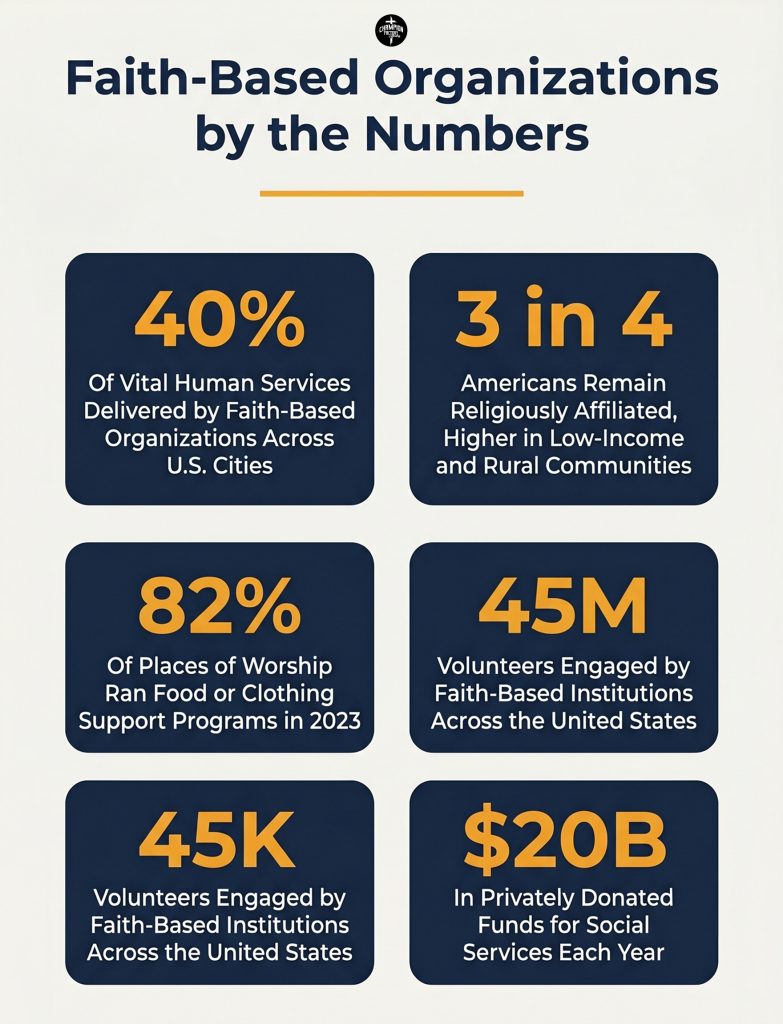
According to research from the Bridgespan Group, faith-based organizations deliver 40 percent of vital human services across representative U.S. cities. That is not a marginal contribution. It is a central pillar of how communities survive hardship. And yet, most people could not describe what makes that work effective or lasting.
The answer starts with structure.
"When we talk about impact, we are really talking about faithfulness over time. A model gives you the framework to stay consistent when the work gets hard." Art Montgomery, Global Evangelism Strategy Architect and Board Visionary Luminary, Champion Factory Ministry
Why Faith-Based Support Is Different from One-Time Charity
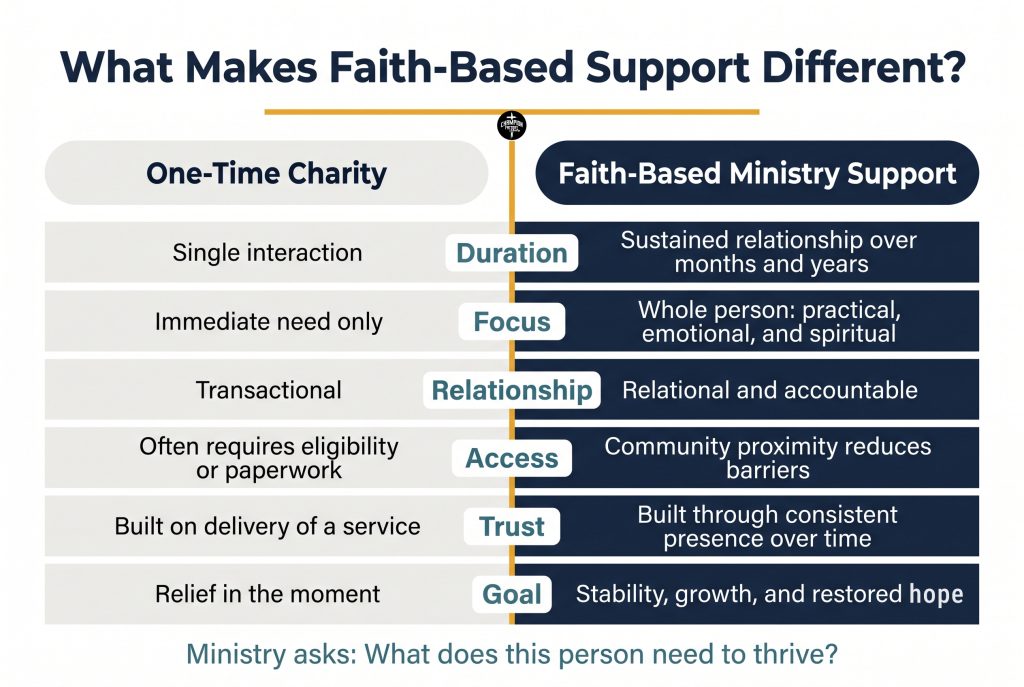
Faith-based support differs from one-time charity in three core ways: it is relational, it is sustained, and it addresses the whole person. A food pantry visit provides nutrition for a day. A ministry relationship provides accountability, encouragement, and connection over months and years. That relational layer is what creates conditions for lasting change.
Charity asks, "What does this person need right now?" Ministry asks, "What does this person need to thrive?"
The difference in that question changes everything about how care is delivered.
The U.S. Substance Abuse and Mental Health Services Administration (SAMHSA) notes that faith and community leaders are often the first point of contact when individuals and families face mental health challenges or traumatic events. People turn to faith communities before they turn to formal systems. That reflects trust built through consistent presence over time.
The Prevention Technology Transfer Center, a SAMHSA-funded national training network, states it directly: faith-based groups bring something unique to the table, and that something is trust.
Trust is built through proximity, consistency, and genuine care. Faith-based ministries that serve their own communities hold a real advantage here, because they are already present. They know the neighborhood, the families, and the patterns of need before a crisis happens.
"What I see again and again is that people come through the door because someone they already trusted told them this was a safe place. That kind of referral only happens when a ministry has been showing up for a long time." Robert Crouse, Community Liaison, Champion Factory Ministry
The Core Components of an Effective Ministry Support Model
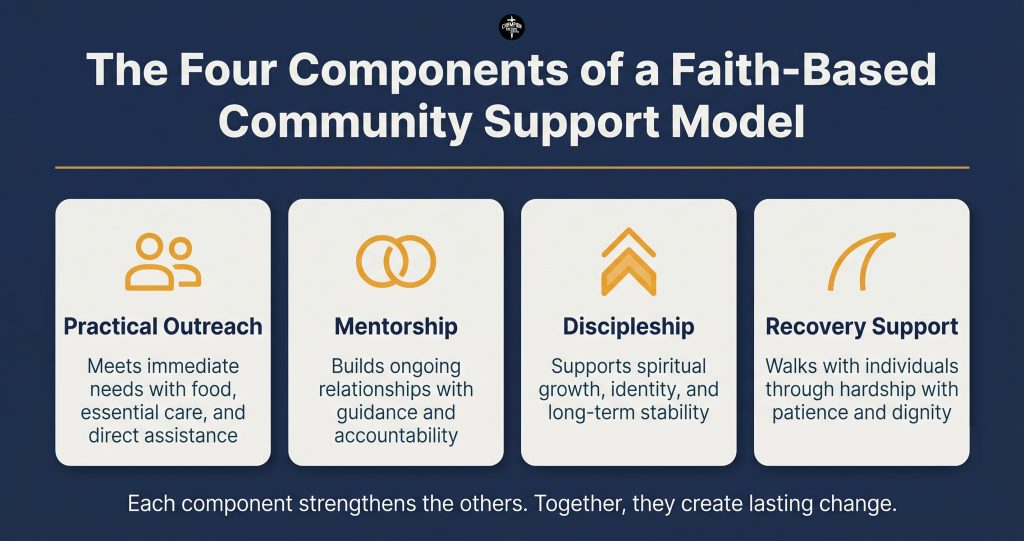
An effective faith-based support model includes four interconnected components: practical outreach to meet immediate needs, mentorship to sustain ongoing relationships, discipleship for spiritual growth, and recovery support for individuals walking through hardship. These components work together. Removing any one of them weakens the whole.
Here is what each component does and why it belongs in the model.
Practical Outreach
This is the visible front door of ministry. Food distribution, essential care programs, and direct assistance meet immediate needs with dignity. Scripture frames this kind of work as foundational. Isaiah 58:6-7 (NIV) describes God's call to share food with the hungry and provide for those in need, presenting practical care as an expression of faithfulness, not an optional addition to ministry.
According to the Lake Institute on Faith and Giving at Indiana University, 82 percent of places of worship engaged in support programs such as food banks and clothing assistance in 2023. Learn more about how this kind of direct care works in practice through the Food and Essential Care Outreach program.
Mentorship
Mentorship transforms a one-time connection into an ongoing relationship. A mentor provides guidance, accountability, and consistent encouragement. For someone working through instability, that relationship can be the difference between moving forward and returning to the same patterns.
Galatians 6:2 (ESV) says, "Bear one another's burdens, and so fulfill the law of Christ." Mentorship is the practical expression of that call. It asks the mentor to show up not once but repeatedly, and to stay invested in outcomes over time. See how faith-based mentorship is structured to build those lasting relationships.
Discipleship
Discipleship addresses spiritual growth and identity. It works through questions like: Who am I? What do I believe? How do I live in a way that reflects those beliefs? Structured discipleship programs create space for people to grow in faith, build community, and develop a foundation that supports long-term stability.
Spiritual growth is not a detour from practical support. For many people, it is the most stabilizing part of the journey. The Nourish Discipleship and Spiritual Growth program is built around exactly this kind of intentional, ongoing faith development.
Recovery Support
Recovery support serves individuals moving through or beyond a period of crisis, addiction, exploitation, or profound hardship. This component requires patience, consistency, and careful attention to dignity. The path for someone in recovery is not linear, and a responsible ministry does not present it as though it is.
SAMHSA has actively partnered with more than 800 faith-based community organizations through its substance use prevention and mental health programming since 1993. Federal agencies recognize that recovery support in faith settings reaches people who may not engage with clinical systems.
Ministry recovery support complements, but does not replace, professional counseling, medical care, or legal services. If you or someone you know needs professional support, please reach out to a licensed provider or contact SAMHSA's National Helpline at 1-800-662-4357, available 24 hours a day.
What Whole-Person Care Looks Like in Practice
Whole-person care means attending to a person's practical, emotional, and spiritual needs together rather than treating each one separately. A ministry that feeds someone but ignores their grief, or addresses their faith but not their housing instability, has not yet reached the whole person. Effective ministry holds all three dimensions in view at the same time.
This approach is sometimes called holistic ministry. Research from the RAND Corporation confirms that faith communities provide access to social networks, food, health care, and educational and employment opportunities in ways other institutions cannot easily replicate. The network itself is part of the care.
In practice, whole-person care looks like this:
- A family receives food assistance and is also connected to a mentor who checks in regularly to support their longer-term stability.
- A person in recovery receives spiritual direction and is also encouraged to engage with a licensed counselor for clinical support.
- A child receives educational encouragement and is also connected to consistent adults in the community who invest in their growth over time.
None of these combinations stand alone. They work together because people do not live in compartments. The Support for Children and Families program reflects this integrated approach for some of the most vulnerable members of any community.
Jesus summarized the relational heart of this approach in Matthew 22:37-39 (NIV) when he named loving God and loving your neighbor as the two greatest commandments. Whole-person care is one way that second commandment takes practical shape in ministry.
"The most effective moments I have seen happen when practical help and spiritual encouragement arrive together. One without the other tends to leave a gap." Art Montgomery, Global Evangelism Strategy Architect and Board Visionary Luminary, Champion Factory Ministry
How Trauma-Informed Care Protects Dignity in Ministry
Trauma-informed care is an approach that recognizes how past harm can affect a person's ability to trust, engage, and heal. In a ministry context, it means approaching every person with patience, avoiding assumptions about what someone has experienced, and creating an environment where they feel safe. It is not a clinical program. It is a commitment to how the ministry shows up.
Many individuals who seek support from faith-based ministries have experienced significant hardship. Some have faced abuse, exploitation, or profound loss. A ministry that does not account for the impact of those experiences can cause additional harm without intending to.
SAMHSA's framework for trauma-informed approaches identifies six guiding principles: safety, trustworthiness, peer support, collaboration, empowerment, and cultural humility. These principles apply equally well to how a volunteer greets someone at the door, how a mentor conducts a check-in, or how a ministry communicates about the people it serves.
The Rescue and Recovery program reflects this commitment for individuals impacted by trafficking, exploitation, or unsafe situations. The language used, the care taken, and the pace of relationship all reflect an understanding that restoration takes time and that dignity must be protected throughout.
For anyone working through crisis or trauma, professional support is an important part of the path forward. Ministry care and clinical care work best together.
"You can always tell when a ministry is truly trauma-informed. The pace slows down. The staff listen more than they talk. People feel that, and it changes what they are willing to share." Robert Crouse, Community Liaison, Champion Factory Ministry
What Donors and Partners Should Look for in a Credible Ministry
A credible faith-based ministry is transparent about what it does, honest about what it cannot do, and committed to the long-term well-being of the people it serves. Donors and partners should look for clear program descriptions, responsible language about outcomes, evidence of sustained relationships, and alignment with ethical standards for serving people in vulnerable situations.
Casey Family Programs, one of the largest child welfare organizations in the United States, notes that faith-based organizations are well-positioned to partner with child protection agencies because they bring community trust, local presence, and a mission aligned with family strengthening.
Before investing your support, consider these markers of a credible ministry:
- Programs that address multiple dimensions of need, not just one area.
- Language that reflects dignity and avoids sensationalism.
- A clear statement that ministry support complements professional services rather than replacing them.
- Evidence of sustained, ongoing relationships rather than one-time events.
- Financial transparency appropriate to a registered nonprofit.
According to the Bridgespan Group, giving to religiously affiliated organizations represents nearly one-third of all charitable giving in the United States, and roughly a third of the 50 largest nonprofits in the country carry a faith orientation. Faith-based ministry is a central part of how communities care for one another.
Micah 6:8 (NIV) calls believers to act justly, love mercy, and walk humbly. A ministry that takes those words seriously will reflect them in how it operates, how it communicates, and how it treats the people in its care.
Taking a Next Step with Faith-Based Ministry Work
Faith-based community support models are built on participation. They do not run on programs alone. They run on people who are willing to show up consistently and give from their time, resources, and relationships.
Here are practical ways to engage.
If you are a donor, consider giving to ministries that demonstrate long-term commitment to the people they serve. Sustained funding allows ministries to build the kind of relationships that create real change over time. You can support this work through a gift that goes directly toward programs serving children, families, and individuals in need.
If you are a volunteer, look for opportunities that involve ongoing presence rather than single events. Mentorship, consistent outreach, and regular support are where volunteer investment is felt most deeply. See what it looks like to get involved and serve alongside the ministry.
If you are a church or community partner, consider how your congregation's resources and relationships could extend the reach of an existing ministry. Cross-sector partnerships multiply what either organization could accomplish alone. Learn more about how to partner with the ministry to serve your community.
If you are someone looking for support, know that a ministry grounded in these values will meet you with dignity, patience, and care. You do not have to have everything in order to take the next step.
FAQ
What is a faith-based community support model?
A faith-based community support model is a structured approach to serving people in need that combines practical care, mentorship, discipleship, and recovery support. It is grounded in biblical values and designed to create lasting change rather than short-term relief.
How is faith-based support different from government assistance?
Faith-based support is relational and whole-person focused. Where government programs often address one specific need, ministries build ongoing relationships that attend to practical, emotional, and spiritual dimensions together. Trust and community proximity also allow faith-based organizations to reach people who may not engage with formal systems.
What does trauma-informed care mean in a ministry context?
In ministry, trauma-informed care means approaching every person with patience and dignity, recognizing that past experiences of harm can affect how someone trusts or engages. It is a commitment to creating a safe environment, not a clinical designation. SAMHSA outlines six principles that guide this approach: safety, trustworthiness, peer support, collaboration, empowerment, and cultural humility.
Does faith-based support replace professional counseling or medical care?
No. Faith-based ministry complements professional services but does not replace them. Ministries can provide encouragement, connection, and spiritual care. For mental health, medical, legal, or clinical needs, professional help is essential. SAMHSA's National Helpline at 1-800-662-4357 is a confidential resource available 24 hours a day.
How do I know if a ministry is credible?
Look for clear program descriptions, transparent finances, language that reflects dignity rather than sensationalism, and evidence that the ministry builds sustained relationships rather than one-time events. A credible ministry is honest about what it cannot do and encourages professional support where appropriate.
How can I get involved with Champion Factory Ministry?
You can support the work through giving, volunteering, or partnering as a church or organization. Visit the get involved page to explore current needs and opportunities.