





Most ministries start with the same approach to volunteers. Someone sees a need, asks a few trusted people to help, and the same small group handles most of the work week after week. It works until it does not. When that group burns out or steps back, the program stalls and the people it serves feel the gap.
A structured volunteer strategy changes that. It creates a sustainable path for people to serve in roles that fit them, stay long enough to build something meaningful, and grow in the process. This guide walks through every stage of building that kind of program, from how you recruit and onboard volunteers to how you prevent burnout and keep people engaged over the long term.
Ministry Volunteers Are Driven by More Than Availability
Ministry volunteers carry a different kind of motivation than general nonprofit volunteers. Research consistently shows that people who serve through faith-based organizations are most often motivated by a sense of divine calling. They give their time because they believe they are meant to. A volunteer strategy that treats this calling as a management problem will miss the point. One that honors it will build something lasting.
Research published by the University of Pennsylvania School of Social Policy and Practice describes faith as one of the most prominent drivers of volunteer motivation. Researcher Heidi Unruh writes that faith-based volunteers serve "because their faith directs them to care about others and to seek justice." A 2025 study from Grand Canyon University found that a sense of calling or divine obligation is the most consistently identified motivating factor among people who volunteer through faith communities.
This matters for how you design your program. When volunteers feel seen as people answering a call, they stay longer, serve more fully, and bring a continuity to the work that is hard to replicate with frequent turnover.
Scott Thumma, principal researcher for the Exploring the Pandemic Impact on Congregations study at the Hartford Institute for Religion Research, put it plainly: "Congregations run on volunteers." That holds true for outreach-focused nonprofits as much as it does for Sunday morning programs.
"When I sit down with a potential volunteer, I'm trying to understand what they care about and where they feel called. That conversation shapes everything that follows." Robert Crouse, Community Liaison
Start your strategy by understanding who your volunteers are and what brought them to your ministry. Build a program that honors that.
Match Volunteers to Roles That Fit Their Gifts
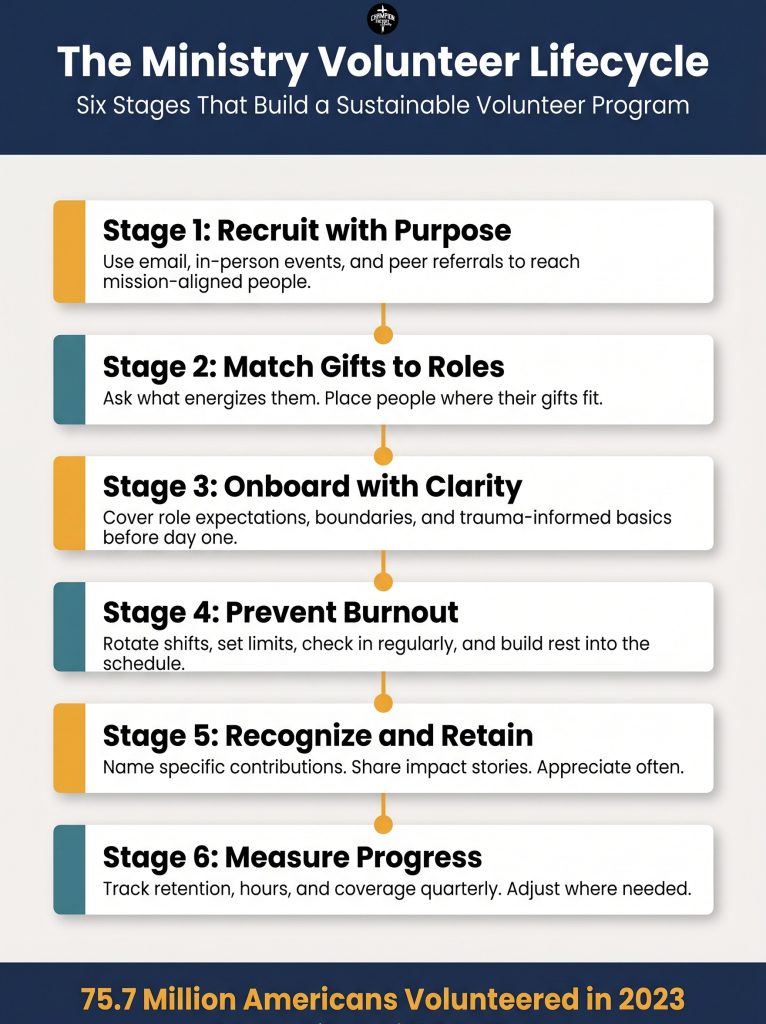
The strongest volunteer programs place people in roles that align with how they are wired to serve. This is both a practical decision and a theological one. When a volunteer operates in a role that fits their gifts, they serve with more confidence, contribute more effectively, and stay committed longer.
Romans 12:6 puts it directly: "In his grace, God has given us different gifts for doing certain things well" (NLT). First Peter 4:10 builds on that: "Each of you should use whatever gift you have received to serve others, as faithful stewards of God's grace in its various forms" (NIV).
Gift-based role matching does not require a formal spiritual assessment for every person who wants to help. It starts with a simple conversation.
How to Assess Gifts and Interests Before Placing Volunteers
- Ask new volunteers what kinds of work they enjoy and where they feel most capable.
- Ask what kind of service drains them versus what gives them energy.
- Share clear descriptions of available roles and let them respond to what fits.
- Start with a shorter-term commitment so both parties can assess the fit before formalizing anything.
For programs that serve people in sensitive or high-need situations, including mentorship, food and care outreach, and recovery support, this step carries extra weight. Volunteers placed in emotionally demanding roles without preparation or personal fit often struggle and step away. Placing the right person in the right role protects both the volunteer and the people they serve.
Build a Recruitment Strategy That Reaches the Right People
Informal word-of-mouth recruitment reaches the same small circle every time. A structured approach expands that circle with purpose. The goal is to recruit volunteers who are genuinely aligned with the mission and equipped to serve in the roles that need them most.
According to the 2025 Nonprofit Communications Trends Report, email is the top recruitment channel, with more than 80 percent of nonprofits rating it as somewhat or very effective. In-person events and your ministry's website also play a significant role in connecting with people who are ready to serve.
Here is a practical recruitment approach for ministry programs:
- Send a specific volunteer opportunity to your existing supporter base by email at least once per quarter.
- Share volunteer needs during in-person events, services, and community gatherings.
- Keep your website's volunteer or get-involved page current with open roles and simple application instructions.
- Invite current volunteers to share their experience with people in their network. Peer referrals consistently bring in motivated candidates.
- Partner with local churches, community groups, and organizations that share your values to cross-promote service opportunities.
"Some of our most committed volunteers came through church partnerships and personal referrals from people already serving. When someone feels connected before they ever start, they are far more likely to stay." Robert Crouse, Community Liaison
As of 2025, 24 percent of regular church attendees volunteer weekly through their churches, up from 15 percent in 2024. There is real momentum behind faith-driven service right now. A focused recruitment strategy helps your ministry connect with people who are already looking for a place to give their time.
Onboard Every Volunteer with Clarity and Care
Good onboarding gives volunteers what they need before their first shift. It answers practical questions, introduces the ministry's values, and prepares each person for the specific role they will fill. Volunteers who go through a clear onboarding process feel more confident, make fewer errors, and are more likely to return.
Ephesians 4:11-12 frames the leadership responsibility well. Leaders exist "to equip the saints for the work of ministry, for building up the body of Christ" (ESV). That equipping function is exactly what onboarding is. It is preparation, not paperwork.
What to Cover in a Volunteer Orientation
- The ministry's mission, values, and core programs
- The volunteer's specific role, including what they are responsible for and what falls outside their scope
- Who they report to and how to ask for help or raise concerns
- Policies related to confidentiality, safety, and appropriate boundaries with the people served
- Background check requirements and any other screening steps, especially for roles involving children, minors, or individuals in vulnerable situations
For volunteers who will serve in outreach, mentorship, or recovery-support programs, orientation should also include a foundational introduction to trauma-informed communication. Volunteers do not need clinical training, but they do need to understand how to engage with dignity, respect privacy, and recognize when a situation requires professional staff support. Volunteers are not a substitute for licensed counselors, medical professionals, or social workers. Their role is to extend care and presence, and good onboarding makes that boundary clear from the start.
Consider pairing new volunteers with an experienced volunteer or staff member for their first few shifts. Early connection builds belonging, reduces anxiety, and helps new volunteers settle into their roles with confidence.
Prevent Burnout Before It Drains Your Program
Volunteer burnout is one of the most common and most preventable problems in ministry programs. It happens when the same people carry too much for too long without adequate rest, recognition, or support. The solution is building a program that actively cares for the people who serve.
Ministry consultant Jason Young describes the standard well: "An invitation to serve should be an invitation to a fuller life, one of abundance and an easy yoke. And the systems we create, or don't, make all the difference."
Research from ChurchTrac identifies overcommitment and poor role matching as the leading causes of burnout in ministry volunteer settings. Volunteers placed in roles that do not fit their availability or skills are significantly more likely to disengage. The same research notes that volunteers who are growing spiritually are more likely to stay committed to their roles over time.
Practical ways to prevent burnout in your program:
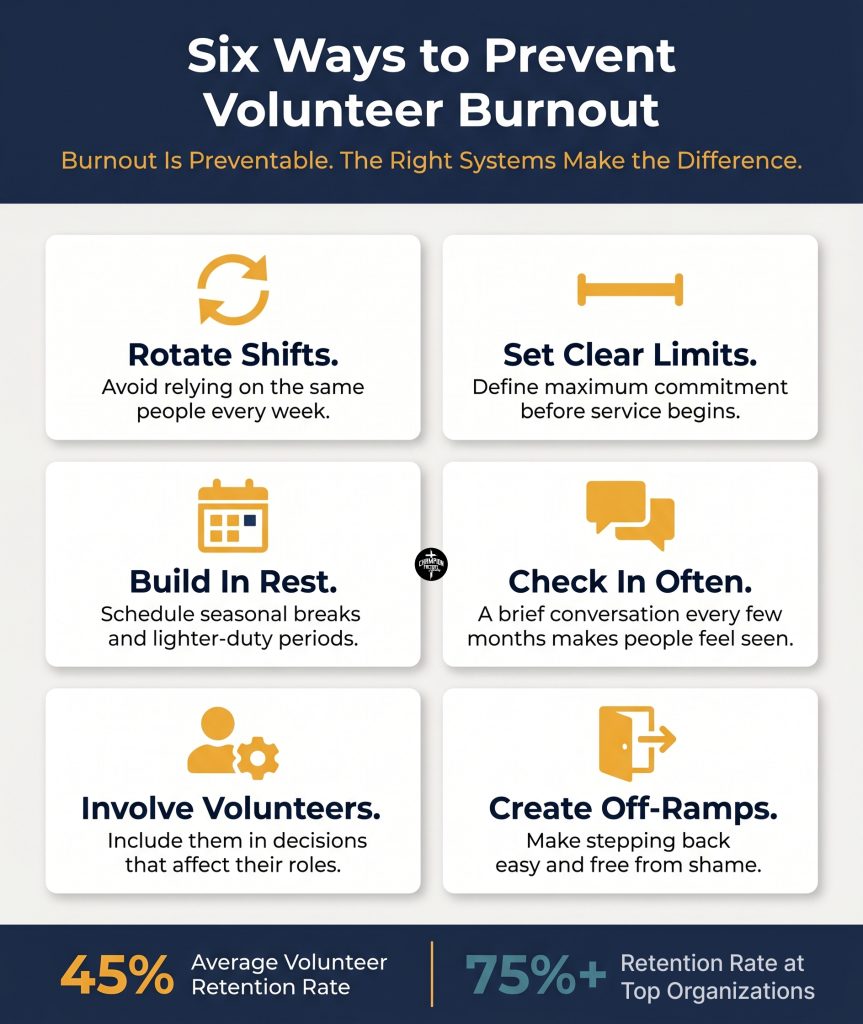
- Rotate volunteers across shifts rather than relying on the same people every week.
- Set a clear maximum time commitment expectation before someone begins serving.
- Build rest into the schedule. Seasonal breaks and lighter-duty periods give volunteers time to recharge.
- Check in regularly. A brief one-on-one conversation every few months tells a volunteer that someone is paying attention to how they are doing, not just whether they showed up.
- Involve volunteers in decisions that affect their roles. People who feel heard stay longer than people who feel used.
- Create a clear, shame-free pathway for volunteers to step back or shift roles when they need to. Transitions handled with grace keep the door open for future service.
For roles that involve emotionally demanding work, including serving individuals and families facing hardship, ministry leaders should check in on the whole person. If a volunteer is struggling with what they are experiencing, connecting them with pastoral care or a professional counselor is appropriate and responsible. Volunteers should never be expected to absorb ongoing difficulty without support.
"A volunteer who feels unseen or overextended will rarely say so. They will simply stop coming. Building regular check-ins into our process changed how long people stayed and how well they served." Art Montgomery, Global Evangelism Strategy Architect and Board Member
Keep Volunteers Engaged and Recognized Throughout Their Journey
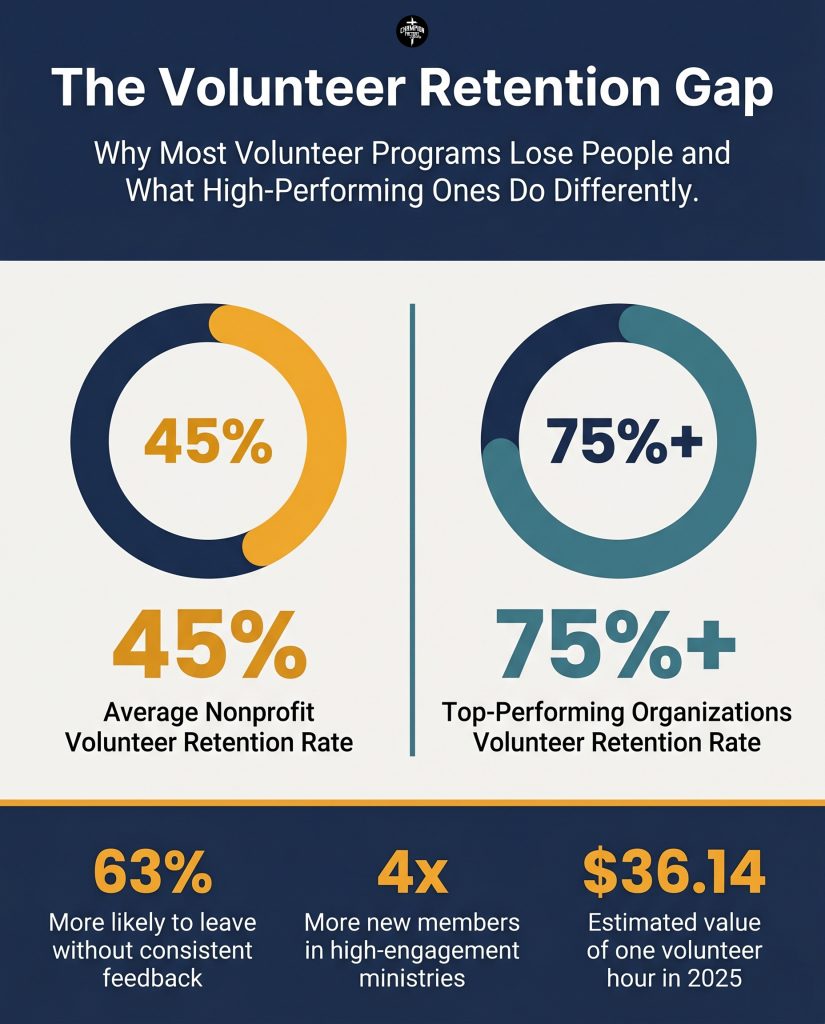
Volunteer retention does not happen by accident. Research cited by VolunteerHub found that volunteers who receive low-quality feedback are 63 percent more likely to leave their organizations than those who receive consistent, high-quality feedback. Recognition and communication are foundational to a healthy program.
The average nonprofit retains about 45 percent of volunteers year over year. Top-performing organizations achieve retention rates of 75 percent or higher. That gap represents people who felt valued enough to stay.
VolunteerHub's research frames it clearly: "Retention is not an event; it is a system." The work of keeping a volunteer engaged begins the moment they sign up and continues through every interaction they have with the ministry.
Practical ways to build a strong retention culture:
- Thank volunteers by name, specifically, and often. Generic appreciation is better than nothing. Specific appreciation is far more effective.
- Share stories of impact. When a volunteer can connect their service to a real outcome, their sense of purpose grows.
- Create opportunities for volunteers to grow within the program, whether through expanded responsibility, mentoring newer volunteers, or involvement in planning.
- Conduct brief check-ins after someone's first few shifts. The early weeks are when most volunteers decide whether they will stay.
- Send a simple annual acknowledgment, a letter, a card, or a personal message, that recognizes the time and commitment a volunteer has given over the year.
Research also shows that ministries and churches with strong volunteer engagement attract four times more new members than those relying on informal participation. A program that keeps people engaged grows the ministry in more ways than one.
Measure What Matters So the Program Can Keep Improving
A volunteer program that runs without any tracking cannot improve and cannot demonstrate its impact to donors, partners, or leadership. You do not need complex software to measure program health. You need a few consistent data points and the discipline to review them regularly.
Start with these core metrics:
- Total active volunteers per month
- Average number of shifts served per volunteer
- Volunteer retention rate from one year to the next
- Total volunteer hours contributed and their estimated economic value
- Program areas where volunteer coverage is low or where turnover is highest
Track these numbers at least quarterly. When you see a drop in retention in a specific program area, investigate before the loss becomes permanent. When a team is performing well, ask what is working and apply it elsewhere.
The Independent Sector estimates the value of a volunteer hour at $36.14 in 2025. According to AmeriCorps and the U.S. Census Bureau, more than 75.7 million Americans formally volunteered in 2023, contributing 4.99 billion hours with an estimated economic value of $167.2 billion. Ministries that document their volunteer impact clearly can tell a credible story to the people who support them.
When board members and donors can see volunteer hours alongside program outcomes, it becomes much easier to make the case for investing in the program. Numbers reflect effort. Documentation shows what that effort produces.
A Volunteer Program That Grows People as It Serves Them
The strongest ministry volunteer programs do two things at once. They extend the ministry's reach into the community, and they help the people serving grow in their faith, skills, and sense of purpose along the way. That combination is what sets a ministry volunteer program apart from a general operational model.
Colossians 3:23 offers a grounding principle for both volunteers and leaders: "Whatever you do, work at it with all your heart, as working for the Lord, not for human masters" (NIV). That posture, serving from genuine calling rather than obligation, is what a well-built volunteer strategy makes possible.
"The goal was never to have enough people to run the programs. The goal is for people to come alive in their service. When that happens, the programs run better and the mission goes deeper." Art Montgomery, Global Evangelism Strategy Architect and Board Member
If you are ready to strengthen or formalize your volunteer program, begin with the foundation. Define your roles clearly. Assess your current volunteers honestly. Build an onboarding process that prepares people well. Check in consistently. And treat every volunteer as someone the ministry is also serving.
To learn more about how Champion Factory Ministry serves families, individuals, and communities through practical care and discipleship, explore our programs and impact here. If you are ready to take a step toward serving, find out how to get involved.
Frequently Asked Questions
What Is a Ministry Volunteer Strategy?
A ministry volunteer strategy is a structured plan for recruiting, onboarding, placing, retaining, and supporting volunteers within a faith-based organization. It creates a sustainable system where people serve from their gifts, receive the preparation and support they need, and stay engaged over time.
How Do We Find Volunteers Who Are Aligned with Our Mission?
Start by sharing your mission clearly and specifically in every recruitment effort. Use email, your website, and in-person gatherings to describe what volunteers will do and why it matters. People who feel connected to the purpose before they apply are far more likely to stay.
How Can We Prevent Burnout in Emotionally Demanding Volunteer Roles?
Rotate volunteers regularly, set clear boundaries on time commitment, and build regular check-ins into your schedule. For roles that involve serving people in crisis or recovery, provide a foundational orientation on trauma-informed communication and ensure volunteers understand that they are not expected to carry clinical responsibilities. Pair them with staff support and give them a clear, grace-filled path to rest when they need to. If a volunteer is struggling emotionally with what they are experiencing, connecting them with a professional counselor or pastoral care is appropriate and encouraged.
What Should a Volunteer Orientation Include?
A solid orientation covers the ministry's mission and values, the volunteer's specific role and responsibilities, confidentiality and safety policies, who to contact for support, and any required screening steps. For sensitive roles, include a brief introduction to trauma-informed communication and appropriate professional boundaries.
How Do We Know If Our Volunteer Program Is Working?
Track a small set of consistent metrics: active volunteer count, average shifts per volunteer, retention rate year over year, and total hours contributed. Review them quarterly. If retention is dropping in a specific area, investigate and adjust. If a team is performing well, identify what is working and apply it across other parts of the program.