






Something has drawn you toward serving. Maybe it is a growing sense that your time and energy belong somewhere they can do real good. Maybe you have watched someone else give their Saturdays to a ministry and felt something stir. Whatever brought you here, you are asking a practical question: what does this actually look like before you begin?
This article gives you a clear and honest picture of what to expect, from the moment you express interest through your first few shifts. Understanding the process ahead of time removes uncertainty and lowers the barrier to showing up. You will leave with enough information to take the first step with confidence.
Why People Choose to Serve at a Ministry
Most people who volunteer at a faith-based organization are drawn by something deeper than a general desire to help. Research published in the Interdisciplinary Journal of Research on Religion found that 93 percent of adult volunteers at a Christian nonprofit were primarily motivated by religious faith. That kind of motivation tends to outlast initial enthusiasm and sustain people through seasons when the work is demanding.
The Bible gives a clear model for this kind of service. In Mark 10:45 (ESV), Jesus said, "For even the Son of Man came not to be served but to serve, and to give his life as a ransom for many." That example shapes the way many Christians understand what it means to give their time to others. Service, in that frame, is a response to what God has already given.
If you feel drawn to serve, that desire is worth taking seriously. The practical steps in this article are the path from that feeling to real and consistent action.

What the Application and Screening Process Looks Like
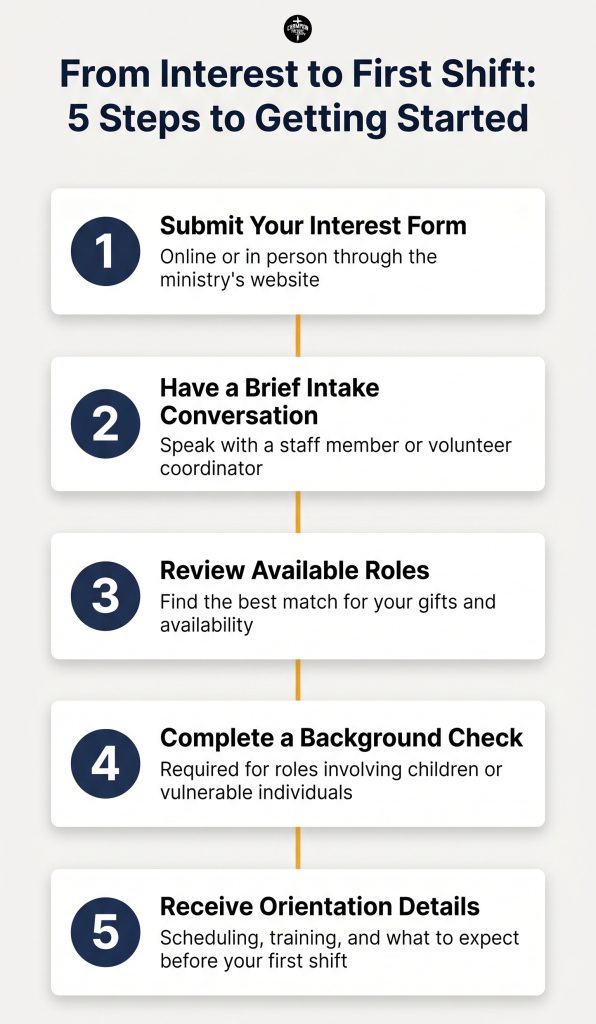
Expect a clear, structured process before your first shift. Most ministries ask prospective volunteers to complete an interest form, have a brief conversation with a staff member or volunteer coordinator, and, for roles involving children or individuals in vulnerable situations, complete a background check. This process is not designed to create distance. It is how the ministry establishes a foundation of trust and safety for everyone involved.
According to VolunteerHub's guide to volunteer screening, 77 percent of nonprofits in the United States work directly with vulnerable populations, including children, families, and individuals with disabilities. The National Council of Nonprofits recognizes background checks as a standard risk management practice, noting that the duty of care extends to every person a volunteer interacts with. More than 75 percent of nonprofits that conducted volunteer background checks in 2024 reported feeling their environments were safer as a result.
If you have not encountered formal screening before, a background check may feel unexpected. It is not a judgment. It is a consistent standard applied to everyone serving in certain roles, and it protects both the people the ministry serves and the volunteers themselves.
Here is what the process typically looks like from beginning to end:
- Submit a volunteer interest form through the ministry's website or in person
- Have a brief intake conversation with a staff member or volunteer coordinator
- Review available roles and discuss which is the best match for your gifts and availability
- Complete a background check if your role involves direct contact with children or vulnerable individuals
- Receive information about orientation, scheduling, and what to expect before your first shift
"The screening process is one of the ways we take care of everyone at once. When volunteers know what to expect going in, they feel welcomed rather than screened. That trust starts before the first shift." Robert Crouse, Community Liaison
Taking this process seriously tells the ministry you are ready to serve as a trustworthy and accountable member of the team.
What Orientation and Training Actually Include
You will not be placed in a role and left to figure it out on your own. Ministry orientation is designed to give you a clear understanding of the organization's mission, the people it serves, the expectations for your role, and the guidelines that shape how volunteers engage. Most ministries also include a shadow period, where a new volunteer observes alongside an experienced one before taking on any independent responsibility.
Orientation is not a formality. Volunteer management expert Tobi Johnson, who helps nonprofits build strong volunteer programs through Volunteer Nation, notes that "the time you invest in training up front will reduce retraining, confusion, and lost productivity later." For a ministry working with vulnerable populations, that principle carries extra weight. Volunteers who understand the mission and the culture before they arrive are better prepared to serve well from the start.
A typical orientation session at a faith-based nonprofit covers:
- The ministry's mission, values, and core programs
- Who is served and how dignity shapes every interaction
- Your specific role, including what it does and what it does not include
- Safety, conduct, and confidentiality guidelines
- Who to contact during and after your shifts with questions or concerns
The shadow period that follows orientation gives you a chance to see the work in practice before stepping into it yourself. You observe. You ask questions. You begin to understand what a steady week of service actually looks like. When your first real shift arrives, you will have context and some familiarity to draw from.
How Much Time Ministry Volunteering Requires
Time commitments vary by role and ministry. Some positions ask for a set shift each week, while others involve monthly involvement or support during specific events. There is no single answer, but the starting point is simple: ask for specifics before you commit, and be honest about what you can give reliably over the next several months.
Uncertainty about time is one of the most common reasons people delay serving. Research from Double the Donation found that 49 percent of individuals say work commitments are their biggest barrier to volunteering. That concern is legitimate and worth addressing before it becomes a reason to stay home.
A sustainable commitment serves everyone better than an ambitious one that runs out of steam after a few months. Most volunteer programs lose people in the gap between signing up and completing their first shift, and again between the first and third shift. Starting with a commitment that fits your real schedule is one of the simplest ways to set yourself up to stay.
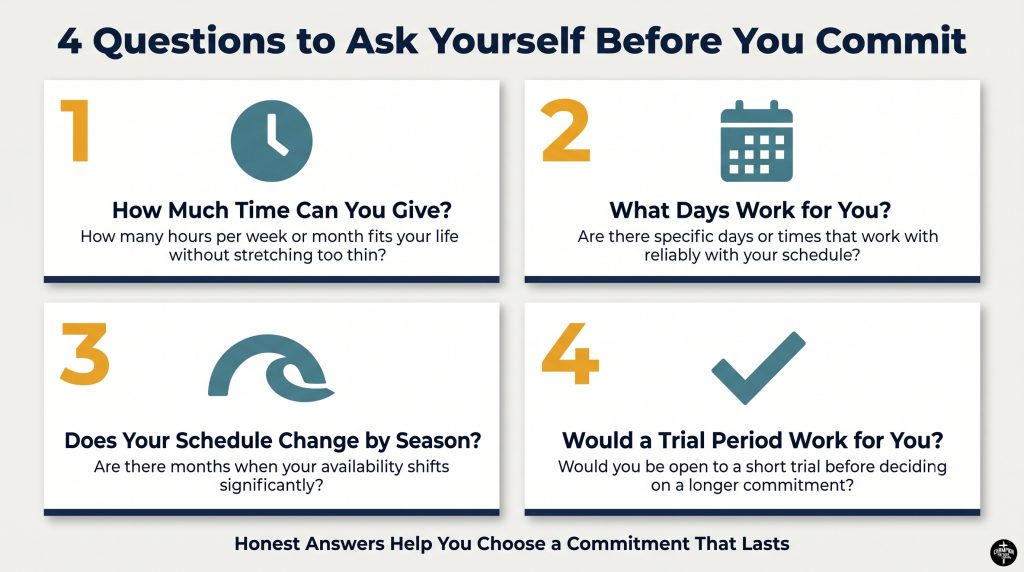
Before your intake conversation, ask yourself:
- How many hours per week or month can you give without stretching too thin?
- Are there specific days or times that work reliably with your schedule?
- Are there seasons in the year when your availability changes significantly?
- Would you be open to a short trial commitment before deciding on something longer?
Clear answers here make your intake conversation more productive for both you and the ministry.
Serving Alongside People in Difficult Situations
Some ministry roles involve working alongside people facing serious hardship. That might mean children who need consistent, caring adults in their lives. It might mean families working toward stability. It might mean individuals taking steps toward recovery after a difficult season. You will not be asked to provide counseling, clinical services, or crisis intervention. Your role is to offer steady, dignified presence, guided by the training you receive.
Ministries that serve vulnerable populations use a trauma-informed approach in their programs and in volunteer preparation. Trauma-informed care means understanding that many of the people served carry experiences that shape how they receive help and how they respond to others. Volunteers are trained to lead with care, to follow the ministry's guidelines, and to maintain appropriate boundaries at all times.
A few things worth holding clearly before you begin:
- Your role is to show up consistently and treat people with dignity. It is not to fix, rescue, or intervene beyond your role.
- Ministry staff will support you when difficult situations arise. You will not face hard moments alone.
- Some shifts will feel meaningful and clear. Others may leave you carrying something heavier than you expected.
- If you are processing difficult emotions after a shift, speaking with a ministry contact is a healthy first step. If those feelings persist or feel overwhelming, connecting with a counselor or mental health professional is the appropriate and wise thing to do. Ministry service does not replace professional support, and seeking that support is never a sign of weakness.
Champion Factory Ministry serves children, families, and individuals seeking stability, care, and restored hope. Every program is built around dignity and long-term relationship. Volunteers who step into that work are never expected to carry it alone.
How to Find the Role That Fits You
Ministry works best when a volunteer's gifts, availability, and the demands of the role are well matched. You do not need to default to whatever position has an open slot. Most ministries will have a genuine conversation with you about what you are good at, where your energy tends to go, and what kind of work feels meaningful. That conversation is the starting point for a sustainable experience.
First Peter 4:10 (NIV) speaks to this directly: "Each of you should use whatever gift you have received to serve others, as faithful stewards of God's grace in its various forms." Every person brings something specific to a role. A ministry is stronger when that specificity is recognized and put to use.
"When someone is in the right role, you notice it quickly. They bring energy to the work instead of running out of it. The conversation about fit is worth having honestly from the start." Troy Rallings, Global Sports & Physical Education Director
A few practical steps for finding the right fit:
- Be specific and honest about your skills, interests, and limits during your intake conversation
- Ask if you can shadow a current volunteer in a role before committing to it
- If a role feels like a poor fit after a few shifts, tell your ministry contact. That honesty benefits the ministry as much as it benefits you.
- Give yourself a few weeks before drawing firm conclusions. Early discomfort is not the same as a bad match.
Good ministries want volunteers who are genuinely engaged. Finding the right role protects both you and the people you serve alongside.
Getting Through the Early Weeks of Serving
The first few shifts of ministry service often feel uncertain and a bit awkward. That is completely normal. Research on volunteer behavior shows that most programs lose people in the gap between signing up and completing their first shift, and again between the first and third shift. Pushing through that initial adjustment period is one of the most important things a new volunteer can do.
Most volunteers report that clarity and confidence grow with each shift. The faces become familiar. The role starts to feel more natural. The mission becomes more concrete as you see it close up.
Galatians 6:9 (ESV) offers a grounded word for this season: "And let us not grow weary of doing good, for in due season we will reap, if we do not give up." The call is not to feel certain from the start. It is to keep showing up.
For the moments when the work feels small or unnoticed, Colossians 3:23-24 (NLT) reframes the effort: "Work willingly at whatever you do, as though you were working for the Lord rather than for people. Remember that the Lord will give you an inheritance as your reward, and that the Master you are serving is Christ."
"The volunteers who stay are the ones who keep coming back even when they are still figuring things out. In our youth programs, it is usually around week three or four that kids start to trust a new face. Consistency does more than talent." Troy Rallings, Global Sports & Physical Education Director
A few things that help during the early weeks:
- Prioritize consistency over performance. Showing up matters more than doing everything perfectly.
- Build at least one genuine relationship with a fellow volunteer or staff member
- Check in with your coordinator after your first few shifts and share how it is going
- Ask questions freely. The people around you were new once too.
Your First Step Is Closer Than It Feels
The path to ministry service is clear. You express interest, have an honest conversation about fit, complete any required screening, go through orientation, and show up for your first shift. The ministry will guide you through each step. You do not need to have everything figured out before you begin.
What you need is a genuine desire to serve, a willingness to prepare, and an honest sense of what you can give. The training will equip you for the details. The community of staff and fellow volunteers will be alongside you.
If you are ready to take that step, explore volunteer opportunities at Champion Factory Ministry and find out which roles are currently open. You can also learn more about the Nourish discipleship program if you are looking for a place to grow in faith alongside others who serve.
FAQ
Do I Need a Background Check to Volunteer?
Not every role requires one. Positions that involve direct contact with children, individuals in recovery, or other vulnerable populations typically do. Your ministry contact will clearly explain what applies to your specific role before you move forward.
How Much Time Do I Need to Commit Each Week?
That depends on the role. Many positions involve a regular shift of two to four hours per week. Others are monthly or event-based. Ask for specific details before committing so you can choose a level of involvement that fits your real schedule and capacity.
What If My Role Does Not Feel Like the Right Fit?
Tell your ministry contact. A healthy organization will work with you to find a better match rather than keep you in a role that is not working for either side. Be honest early rather than quietly stepping back.
Do I Need Prior Ministry or Volunteer Experience?
Most roles do not require prior experience. What matters more is a genuine desire to serve, a willingness to follow the ministry's guidelines, and the ability to show up consistently over time.
Will I Work Directly With People Who Are in Crisis?
That depends on your specific role. Some positions involve direct interaction with people in difficult circumstances. Others are more operational or behind the scenes. Your role description and orientation will make this clear before your first shift. No volunteer is expected to provide counseling, clinical care, or crisis intervention services.