





Many people have encountered faith language their whole lives. They have seen mission statements on church signs, heard talks about serving the poor, and watched collection drives come and go. What is harder to find is a ministry that lives differently, week after week, in the lives of real families.
This article looks at what faith in action genuinely means at the ministry level, not as a theological concept but as a daily practice. It explains what distinguishes lasting, dignity-centered support from short-term charity, and why that difference matters for families, communities, donors, and volunteers who want to invest in something that lasts.
What Faith in Action Actually Means
Faith in action is the visible, practical expression of Christian belief through consistent service to others. It is grounded in the biblical truth that belief alone is not enough. When a ministry puts faith into action, it does not just announce care. It delivers it, day after day, in ways that treat every person as fully human and fully worthy of dignity.
James 2:14-17 (NIV) makes this plain: "What good is it, my brothers and sisters, if someone claims to have faith but has no deeds? Suppose a brother or a sister is without clothes and daily food. If one of you says to them, 'Go in peace; keep warm and well fed,' but does nothing about their physical needs, what good is it? In the same way, faith by itself, if it is not accompanied by action, is dead."
This passage does not describe faith and service as two separate callings. It treats action as the natural overflow of genuine belief. Feeding families, mentoring children, supporting survivors, and walking with individuals toward stability is not separate from faith. It is faith, made visible.
"Real evangelism strategy starts with presence, not programs. You have to show up before anything else matters." Art Montgomery, Global Evangelism Strategy Architect and Board Visionary Luminary
What Real Ministry Support Looks Like for Families
Faith-driven ministry serves families by addressing the full picture of a family's needs, not one isolated gap at a time. That includes practical care like food access and essential supplies, relational support through mentorship and community, and spiritual encouragement that keeps hope alive over the long term. The goal is to help families build stability and move forward.
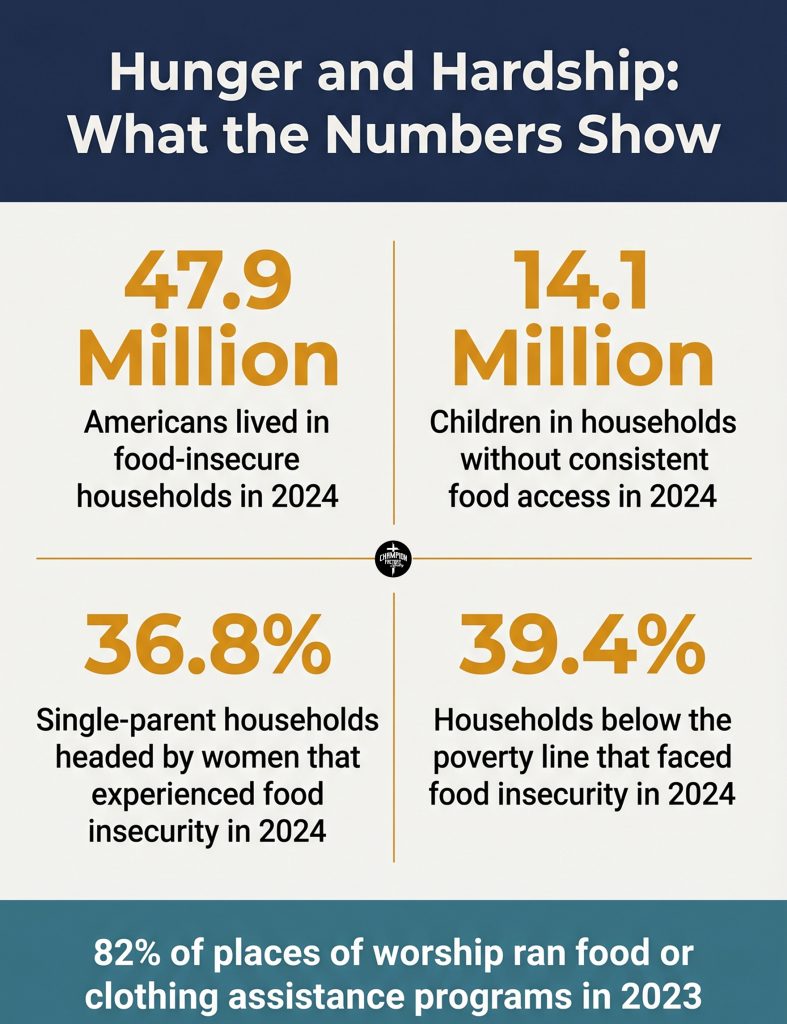
The need is real and wide. According to the USDA Economic Research Service, approximately 47.9 million Americans lived in food-insecure households in 2024. More than 14 million children lived in households without consistent access to enough nutritious food. These are not abstract numbers. They represent families in neighborhoods across every region.
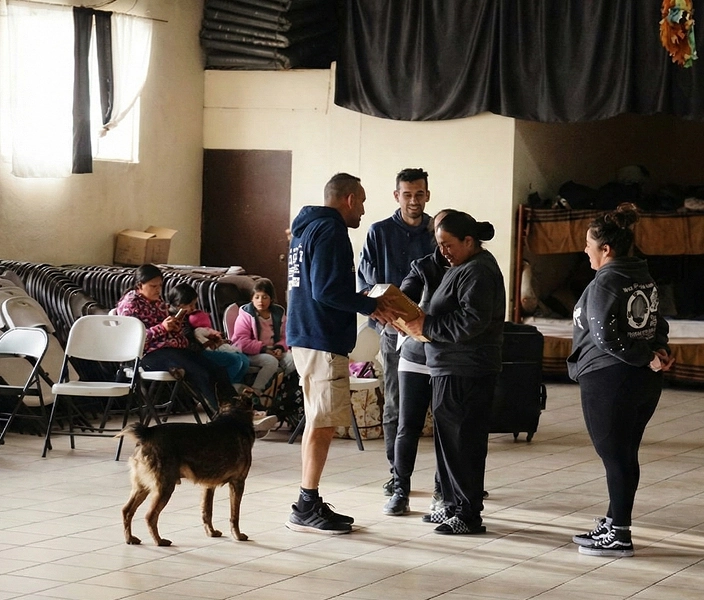
A ministry that practices faith in action responds to this not with a single handout but with presence. It builds relationships with families over time. It learns names. It offers food outreach that creates genuine connection alongside practical care. It pairs that support with mentorship that gives children a trusted adult who keeps showing up.
"What I see in the communities we serve is that families do not just need a resource. They need someone who remembers their name the next time they come back." Robert Crouse, Community Liaison
Matthew 25:35 (NIV) captures this calling directly: "For I was hungry and you gave me something to eat, I was thirsty and you gave me something to drink, I was a stranger and you invited me in." Serving a family well means meeting them where they are and staying there.
Why Sustained Presence Changes What Ministry Can Accomplish
A single act of charity can meet an immediate need. Sustained ministry presence changes what a family believes is possible. When a ministry stays, it builds the kind of trust that allows people to move from hardship to stability. That consistency is what separates faith in action from occasional service.
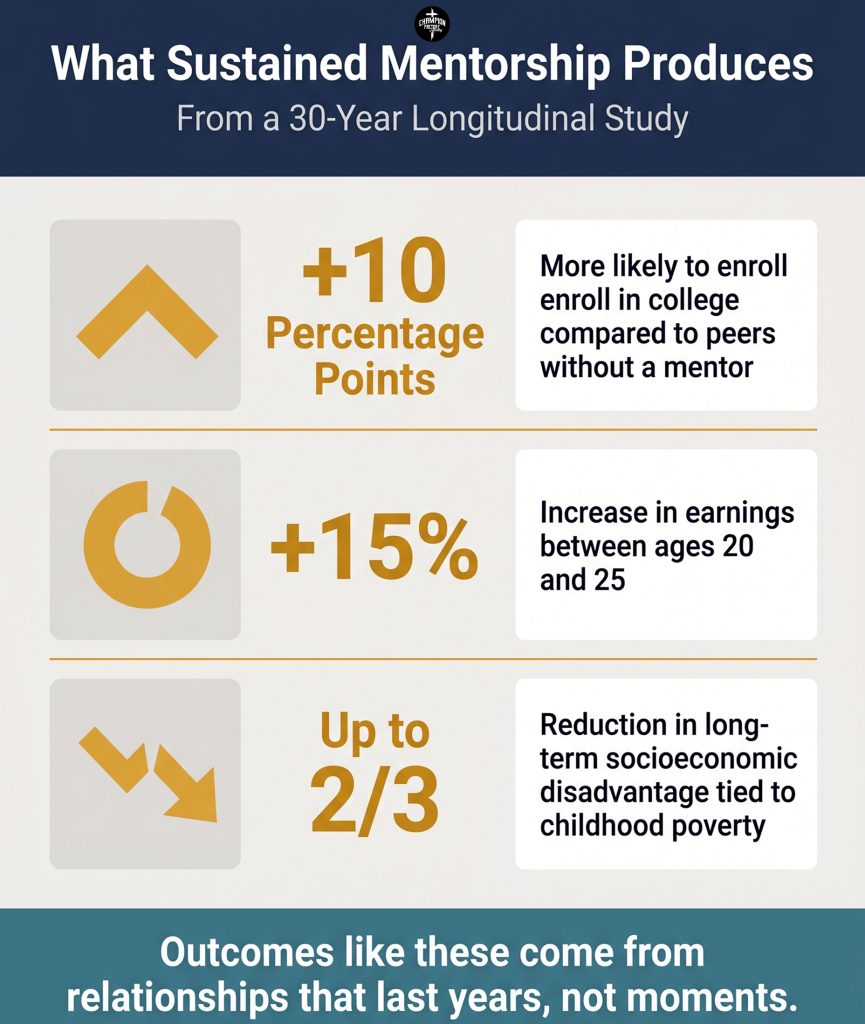
Research consistently confirms this. A 30-year longitudinal study by Big Brothers Big Sisters of America found that mentored youth were 10 percentage points more likely to enroll in college than peers without a mentor. The same research found that sustained mentorship can reduce up to two-thirds of the long-term socioeconomic disadvantage tied to childhood poverty. Those outcomes do not come from a single conversation. They come from a trusted adult who chooses to remain present through difficult seasons.
Galatians 6:2 (NIV) puts it plainly: "Carry each other's burdens, and in this way you will fulfill the law of Christ." Burden-carrying is not a one-time event. It is an ongoing commitment.
Champion Factory Ministry approaches community support this way. Mentorship, food and essential care outreach, discipleship through the Nourish program, and recovery support are connected expressions of a ministry that commits to the long term, not separate programs running in isolation.
How a Ministry Serves People With Dignity
Dignity-centered ministry sees people as whole human beings first. It does not treat anyone as a case to process or a statistic to manage. It approaches every person, every family, every child with respect for their full humanity. This commitment shapes how care is delivered, not just what is delivered.
This matters most when a ministry serves individuals who have experienced serious harm. The ministry walks alongside children and families in difficult circumstances, and in some cases with individuals who have survived exploitation or unsafe situations. The Polaris Project reported more than 8,000 contacts from trafficking survivors seeking safety or support in 2024 alone. People in these situations need care that honors their courage and does not reduce their experience to a label.
Dignity-centered service looks like this in practice:
- Asking what a family needs rather than assuming.
- Offering support without conditions, shame, or pressure.
- Following trauma-informed practices that protect people's sense of safety.
- Pointing individuals toward professional counseling, legal support, or medical care when those services are what the situation calls for.
Proverbs 31:8-9 (NIV) calls believers to "speak up for those who cannot speak for themselves, for the rights of all who are destitute." Speaking up means creating spaces where people feel seen, safe, and respected.
If you or someone you know needs immediate support, the National Human Trafficking Hotline is available 24 hours a day at 1-888-373-7888. Confidential support is available by phone, text, and online chat. The ministry's care is not a replacement for professional counseling or legal services. It actively encourages individuals and families to access those resources whenever they are needed.
How Donors, Volunteers, and Partners Are Part of This Work
Faith in action is not only the work of ministry staff. It is the collective expression of everyone who gives time, resources, or partnership to sustain the work. Donors, volunteers, and organizational partners make it possible for a ministry to stay present in communities over the long term. When you give or serve, you are part of what faith in action means.
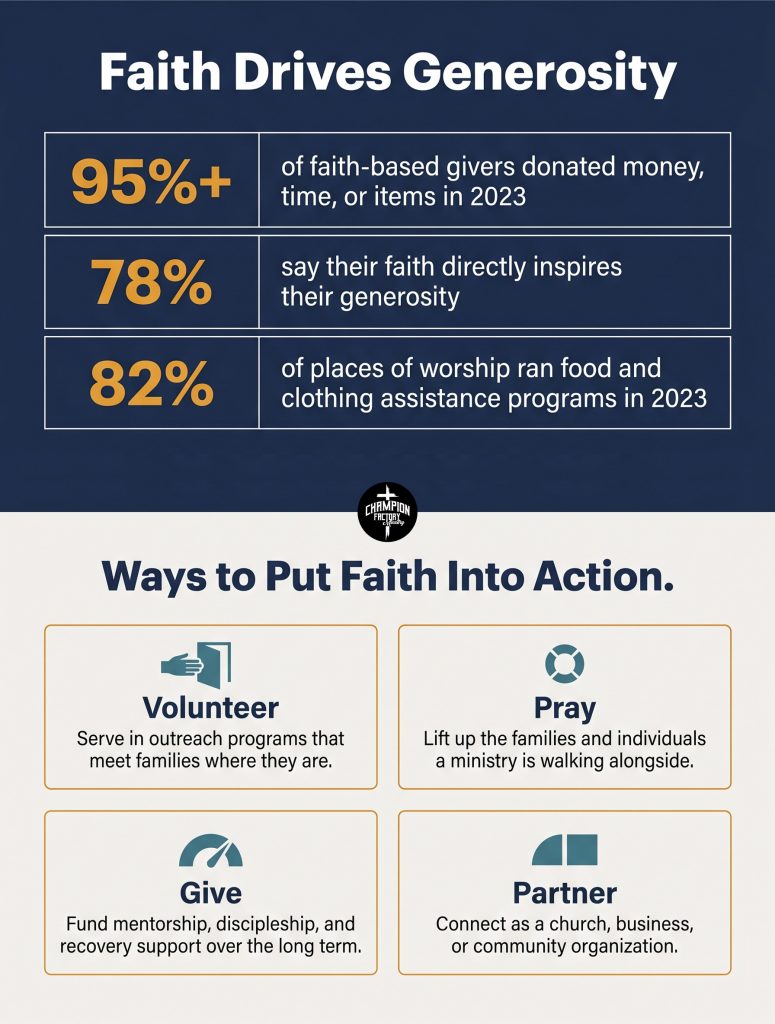
Research from the Lake Institute on Faith and Giving found that more than 95 percent of faith-based givers donated money, time, or items in 2023, with 78 percent saying their faith directly inspires their generosity. In that same year, 82 percent of places of worship engaged in programs addressing primary community needs like food and clothing. Faith-driven generosity is active, motivated, and looking for places where it can do lasting good.
Romans 12:13 (NIV) gives a clear direction: "Share with the Lord's people who are in need. Practice hospitality." This invitation is extended to everyone, not only those called to full-time ministry.
There are practical ways to respond:
- Volunteer directly with outreach programs that serve food and essential care to families.
- Pray consistently for the individuals and families a ministry is walking alongside.
- Give financially to fund mentorship, discipleship, and recovery support that requires sustained resources.
- Partner as a church, business, or community organization to extend the reach of dignity-centered care.
If you want to learn more, visit the get involved page. Volunteers, donors, and partners who are committed to lasting community impact are welcome.
Moving Forward Together, One Family at a Time
Faith in action is not measured by the number of events a ministry holds or the number of boxes distributed in a month. It is measured by whether families are in a stronger, safer place because a ministry chose to stay. That kind of change is slow, and it is not done alone. It requires people who believe the work is worth doing over time.
The ministry exists to provide practical care, spiritual encouragement, and relational support to children, families, and individuals walking through hardship. Every meal shared, every mentorship relationship built, and every step toward recovery reflects a faith that moves into the world with purpose.
If this resonates with you, learn more about Champion Factory Ministry's programs and causes and find out how you can be part of this work in your community.
FAQ
What Does Faith in Action Mean for a Ministry?
For a ministry, faith in action means delivering consistent, dignity-centered care to families and individuals in need. It is grounded in the biblical call to serve others as a direct and natural expression of belief, not as a separate obligation layered on top of it.
How Is Long-Term Ministry Different From One-Time Charity?
One-time charity meets a single immediate need. Long-term ministry builds relationships, provides sustained support, and walks alongside individuals and families toward stability over time. The trust that comes from staying makes a different kind of change possible.
Can Mentorship From a Ministry Really Make a Lasting Difference?
Research says yes. A 30-year longitudinal study found that mentored youth were significantly more likely to attend college and experienced measurably higher earnings in adulthood. Mentorship produces lasting outcomes because it is relational and consistent, not because it is a single moment of help.
How Does Champion Factory Ministry Support Families?
Champion Factory Ministry provides food and essential care outreach, mentorship, discipleship through the Nourish program, and recovery support for individuals and families facing hardship. The ministry treats every person with dignity and is committed to walking alongside them toward lasting restoration.
What If Someone Needs Professional Support Beyond What the Ministry Provides?
The ministry actively encourages individuals and families to access professional counseling, medical care, and legal services when those needs arise. If someone needs immediate help, the National Human Trafficking Hotline is available at 1-888-373-7888.