






Many Christians have had the experience of sitting in a service or listening to a podcast and sensing that something is not quite right. The message sounds confident. The speaker seems genuine. But something in the teaching does not line up with what they know from Scripture.
This article offers a practical framework for recognizing false teaching. It is not designed to make you suspicious of every pastor or teacher you encounter. It is designed to give you clear, biblically grounded tools so you can evaluate what you hear with wisdom and grow in your faith with confidence.
What False Teaching Is (and What It Is Not)
False teaching is doctrine or spiritual guidance that distorts, contradicts, or misapplies biblical truth in ways that mislead or harm believers. It is not the same as honest disagreement over how a Bible passage is interpreted. Christians hold different views on secondary matters while still standing faithfully on the core of the gospel. The real question is whether a teaching distorts who God is, what salvation means, or how believers are called to live.
Understanding this distinction matters. Overcalling every disagreement as heresy causes unnecessary harm and division. At the same time, staying silent about genuine error allows it to spread unchecked.
The Apostle Paul addressed this directly in Galatians 1:6-9, expressing urgent concern about a gospel that had been distorted, not simply reinterpreted. His point was clear: some changes to the message of Christ are not variations. They are departures.
False teaching appears across a spectrum. Some distortions target core doctrine, such as the nature of Christ or the meaning of salvation. Others work through manipulation, shaping how people give, trust, or relate to spiritual authority. Both deserve attention.
Why False Teaching Is Harder to Spot Today
Social media and online platforms have made it possible for anyone to teach religious content to millions of people, often without pastoral accountability or theological training. At the same time, personal Bible reading among Americans has declined sharply, leaving many believers less prepared to evaluate what they hear.
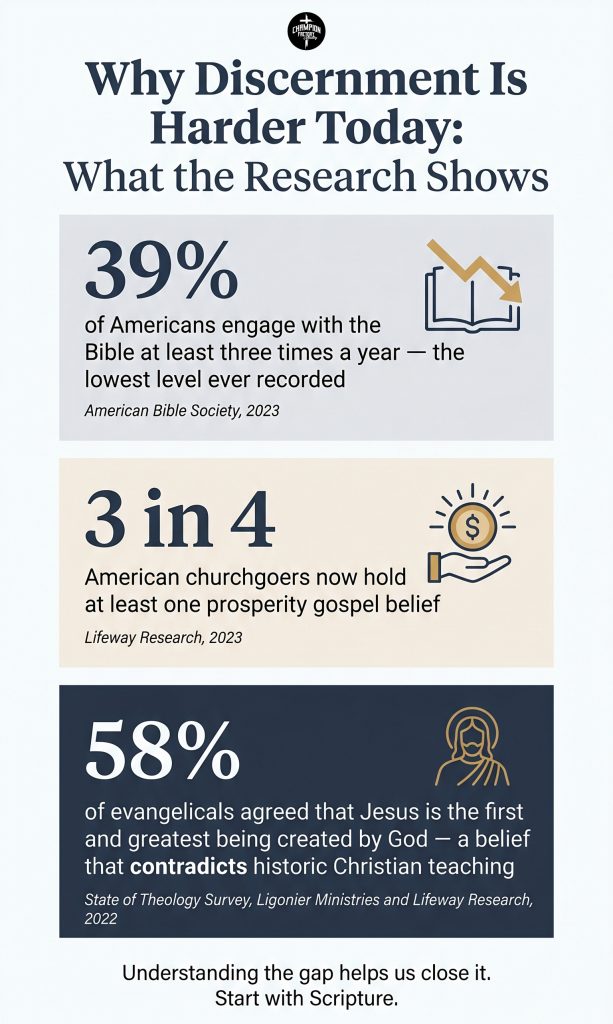
According to the American Bible Society's State of the Bible research, Bible use among Americans dropped from 50 percent to 40 percent in a single year between 2021 and 2022, the largest single-year decline in the study's 13-year history. By 2023, only 39 percent of Americans reported engaging with the Bible at least three times a year.
That decline has measurable consequences. The 2022 State of Theology survey by Ligonier Ministries and Lifeway Research found that 58 percent of evangelicals agreed that Jesus is the first and greatest being created by God, a position that contradicts the historic Christian understanding of Christ's divinity. In the same survey, 65 percent of evangelicals agreed that everyone is born innocent in the eyes of God, which conflicts with the biblical teaching on original sin.
These are not fringe findings. They reflect what happens when outside voices shape belief more than Scripture does.
The Digital Shift
Before the internet, most Christians received teaching primarily through their local church, where teachers were known, accountable, and embedded in community. Today, a single podcaster or social media personality can reach more listeners in a week than most pastors reach in a lifetime.
That reach is not automatically harmful. But it does require that listeners bring more discernment to what they consume, not less.
The Test Jesus Gave: Look at the Fruit
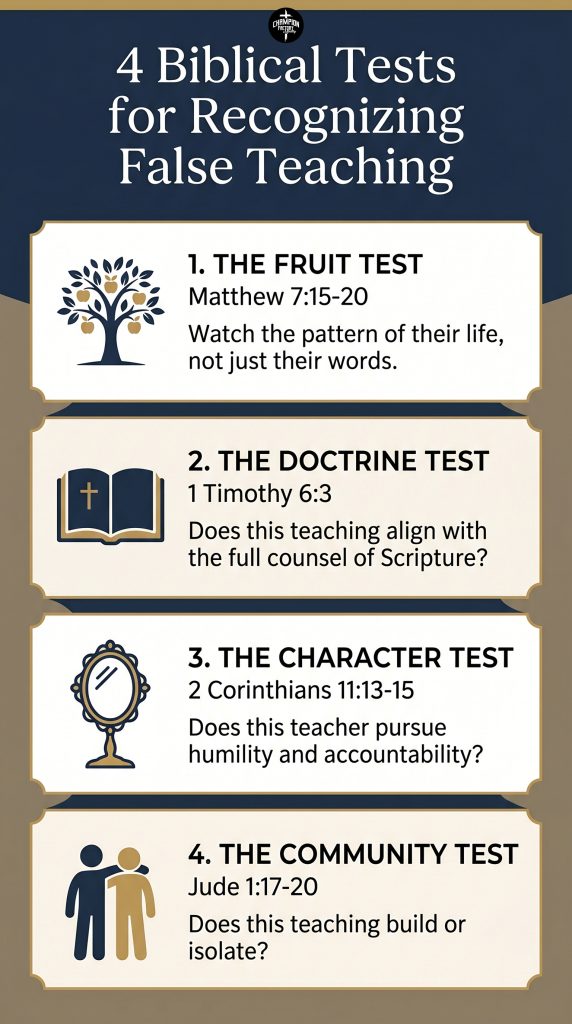
Jesus did not tell his followers to evaluate teachers primarily by their confidence, their popularity, or the size of their platform. In Matthew 7:15-20, he pointed to fruit. That means the consistent pattern of a teacher's life, how they treat people, whether they pursue humility and accountability, and whether their teaching leads others toward genuine faithfulness and growth.
This is often called the fruit test, and it shifts the central question from "does this sound right?" to "what does this produce in the people who follow it?"
A teacher who delivers accurate doctrine while building a culture of financial dependence, emotional control, or spiritual fear is not bearing good fruit. The pattern of a ministry matters, not only the content of its sermons.
Paul reinforced this in 2 Corinthians 11:13-15, noting that false teachers rarely announce themselves. They present as sincere and credible. That is part of what makes discernment necessary.
Signs to Watch for in a Teacher's Character
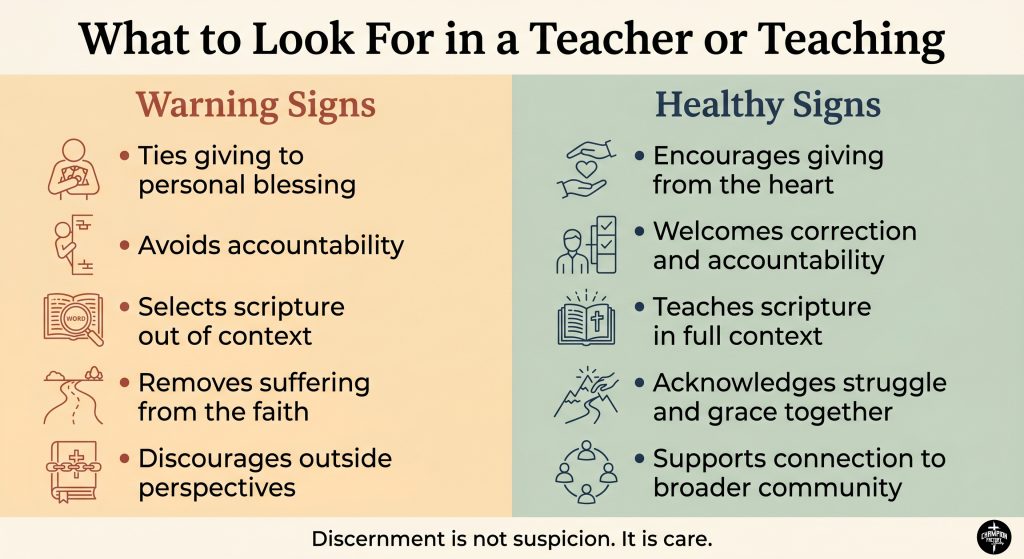
- A consistent pattern of avoiding accountability or deflecting honest correction
- Financial appeals that tie giving directly to personal blessing or spiritual favor
- Relational control or subtle pressure that discourages outside perspectives
- Dismissal of other believers, churches, or voices that raise thoughtful concerns
- A lifestyle that contradicts the humility and service taught in Scripture
No single sign on this list is a definitive verdict. A pattern across multiple areas deserves serious and prayerful attention.
Warning Signs in What Is Actually Being Taught
Beyond a teacher's character, specific doctrinal patterns signal that a teaching has drifted from biblical truth. The most statistically documented example in modern American Christianity is the prosperity gospel, the belief that financial success and physical health are direct rewards for faith, and that giving to a ministry is a transaction that obligates God to bless you in return.
Christian ethicist David W. Jones, writing for The Gospel Coalition, outlined five theological errors at the core of prosperity gospel teaching. Among them: the idea that faith is a self-generated force that produces material results, and that prayer is a tool to compel God to act on your behalf. His point is direct: when this framework shapes a community's belief, grace becomes irrelevant and God becomes a system to be managed.
According to Lifeway Research, about three out of four American churchgoers now reflect at least one prosperity gospel belief. The share of Christians who believe their church encourages giving in order to receive blessings from God rose from 38 percent in 2017 to 52 percent in 2023.
Other Doctrinal Warning Signs
- Teaching that replaces the full counsel of Scripture with selected verses taken out of context
- Claims that true faith always produces health, wealth, or immediate answered prayer
- Presentations of God that emphasize personal entitlement rather than grace
- Theology that removes suffering, self-denial, or sacrifice from the Christian life entirely
- Teaching about Jesus that conflicts with his full humanity and full divinity as affirmed in historic Christian confession
Why Your Bible Reading Is Your Best Defense
The clearest pattern in theological research is that people who engage personally and consistently with Scripture hold more biblically grounded beliefs. You do not need a seminary degree to develop strong discernment. But you do need regular, personal time in the Bible, not as an occasional reference tool, but as a steady practice that shapes how you think and what you recognize.
John Piper, addressing the question of how to identify false teaching, offered a reframe worth holding onto. He encouraged believers not to set the bar so low that they only stop listening when a teacher is clearly and undeniably false. His guidance was to seek out teachers who are God-centered, Christ-exalting, Bible-saturated, and Spirit-dependent, and to let that standard shape their media diet, not only their church attendance.
A few practical habits that build discernment over time:
- Read the Bible in full passages and books, not only isolated verses
- Study the context of a passage before applying it to a specific situation
- Use a trusted study Bible or commentary when something is unclear
- Work through books that deal directly with sound doctrine, including Galatians, 1 Timothy, 2 Peter, 1 John, and Jude
- Ask a pastor or mature believer to walk through difficult passages with you
How to Respond When Something Feels Off
Recognizing false teaching does not require a public confrontation or an immediate decision to leave a church. Discernment is a personal practice first. It begins with bringing your concern to God, checking what you heard against the whole of Scripture, and seeking counsel from a trusted pastor or mature believer before taking further action.
Responding well matters as much as recognizing the problem. Rushing to judgment can cause real harm. So can staying silent when genuine error is causing damage to the people around you.
Here are practical steps to take when something concerns you:
- Write down specifically what was taught and what concerns you about it.
- Look up the relevant scripture passages in full context, not only the ones the teacher cited.
- Bring your question to a pastor, elder, or mature believer you trust.
- If the concern involves a public figure or widely distributed content, look for responsible assessments from credible theological organizations.
- If the concern is ongoing within a local church, request a conversation with leadership before making a decision to leave.
"We have sat with people who came to us hurt and confused after receiving teaching that promised far more than the gospel ever offered. Getting clear on what the Bible actually says is one of the most practical forms of care we know." Todd Medina, President and Founder, Champion Factory Ministry
At Champion Factory Ministry, our Nourish discipleship program exists to walk alongside people growing in faith, including those working through difficult questions about teaching they have encountered.
If the concern involves spiritual abuse, manipulation, or harm to yourself or others, you do not have to handle that alone. Trusted counselors, pastors, and support communities are available to help.
You Do Not Have to Navigate This Alone
Biblical discernment grows stronger in community. Research consistently shows that people embedded in a local church and studying Scripture alongside other believers develop stronger theological grounding than those who learn in isolation. If discernment feels difficult right now, that is a signal to move toward community, not away from it.
Jude, writing to early believers who were already encountering false teachers in their own communities, did not tell them to withdraw and study alone. He called them to build themselves up in the faith, to pray, and to stay connected to those who could encourage and correct them.
"In every ministry setting I have seen, false teaching finds its way in most easily when people are separated from community and disconnected from Scripture. Discernment and belonging go together." Art Montgomery, Global Evangelism Strategy Architect, Champion Factory Ministry
Discernment is not about becoming suspicious of everyone around you. It is about building a foundation of truth strong enough to stand when something tries to lead you away from it. That foundation is built in Scripture, in prayer, and in the company of people who love God and love you well.
A Clear Foundation Is Worth Pursuing
Recognizing false teaching is not an act of cynicism. It is an act of care, for yourself and for the people around you who are shaped by what they hear and believe.
The framework is not complicated. Watch the fruit. Know the Scripture. Stay in community. Bring your questions to people who are trustworthy. Genuine faith does not depend on manipulation, financial pressure, or distorted promises.
If you are in a season where questions about teaching or spiritual guidance feel heavy, you are not alone. We encourage you to reach out to a pastor, a trusted believer, or a ministry community that can walk alongside you. Connect with Champion Factory Ministry to learn more about how we support individuals and families growing in faith.
FAQ
Is it false teaching if my pastor interprets a verse differently than I do?
Not necessarily. Christians have always held different views on secondary doctrinal matters, such as worship practices, end-times theology, or church structure. False teaching involves distortions of core Christian belief, such as the nature of Christ or the meaning of salvation. Honest disagreement on interpretation is not the same as departing from the gospel.
What is the prosperity gospel?
The prosperity gospel is the belief that financial success and physical health are direct rewards from God for faith, giving, or positive confession. Theologians across denominational lines identify it as a distortion of the biblical gospel because it frames the relationship between God and humanity as a transaction rather than a relationship grounded in grace.
How do I evaluate a teacher I only follow online?
Look at the pattern of their ministry over time. Check whether their teaching is grounded in the full counsel of Scripture or in selected passages taken out of context. Consider whether they are accountable to a local church or theological community. Notice whether their content encourages your growth in God or builds dependence on them personally.
What should I do if I think my church is teaching something wrong?
Start by checking your concern against Scripture in full context. Then bring the question to a pastor or elder you trust, approaching with humility and a desire for clarity. If the concern is serious and leadership is unresponsive, seeking counsel from a trusted outside pastor or ministry leader is a wise next step.
Can a teacher spread false doctrine without realizing it?
Yes. Some false teaching is deliberate deception. But much of it spreads through misunderstanding, inadequate biblical training, or cultural influence that gradually shifts a teacher's framework without their awareness. A sincere person who is teachable and accountable will respond to honest correction. Resistance to any correction or accountability is a separate and more serious concern.