






Wars, natural disasters, and a constant stream of alarming headlines can leave anyone wondering if the end times have arrived. That feeling is common. It is not a sign of weak faith. It is a normal response to an unsettled world.
This article looks at what the Bible actually says about the end times, what current research shows about how many people ask this same question, and how to respond with steady, practical faith instead of fear. You will also find guidance for supporting a loved one who feels anxious about this topic.
What Does The Bible Actually Say About The End Times
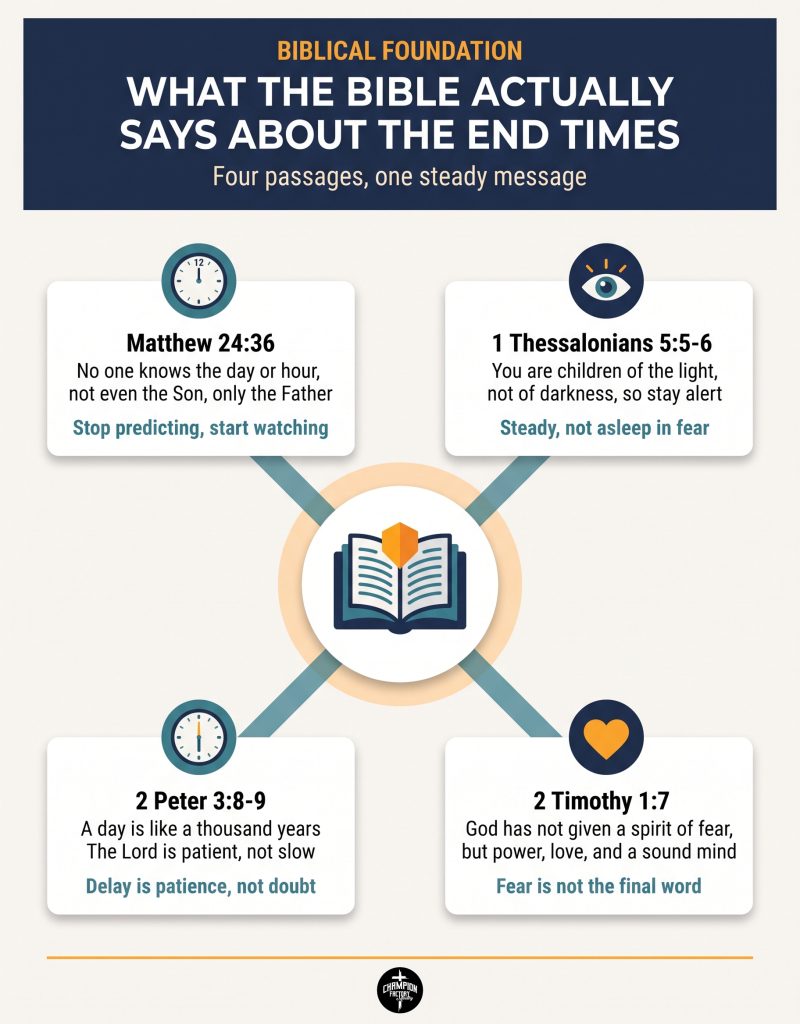
The Bible teaches that only God knows when Christ will return. In Matthew 24:36, Jesus says no one knows the day or hour of his coming, not even the angels or the Son himself. Scripture calls believers to stay watchful and ready rather than predict a date. The focus is not on solving a timeline. It is on living faithfully today.
Jesus made this point directly. Matthew 24:36 (NIV) records his words plainly: "But about that day or hour no one knows, not even the angels in heaven, nor the Son, but only the Father." A few verses later, in Matthew 24:42 (NIV), he gives the response he actually wants from his followers: "Therefore keep watch, because you do not know on what day your Lord will come."
That shift matters. The Bible does not answer the question of "when" with a date. It answers with an instruction. Stay ready. Stay faithful. Stay watchful. That instruction holds true no matter what season you are living in.
Why Are So Many People Asking This Question Right Now
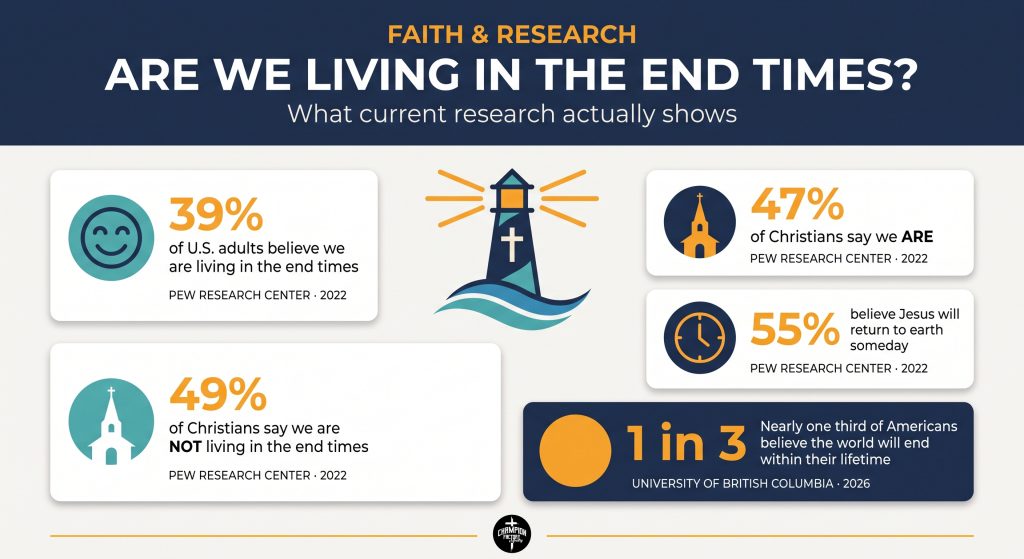
You are not alone in wondering about this. Nearly four in ten American adults believe we are living in the end times, and nearly half of Christians agree, according to Pew Research Center. This is not a fringe question. It is one of the most common faith questions in America today.
Among Christians, 47 percent say we are living in the end times, including majorities within the historically Black Protestant tradition and the evangelical Protestant tradition. Meanwhile, 49 percent of Christians say we are not. Both groups include sincere, faithful believers.
This is also an active area of academic study. Recent psychology research from the University of British Columbia found that nearly one third of Americans surveyed believe the world will end within their lifetime. Researcher Matthew Billet has noted that this belief is far more common than most people assume and that it shapes how people respond to real world problems.
"This question comes up in almost every outreach conversation I have, in nearly every country we work in. People are not usually looking for more speculation. They are looking for something steady to hold on to." Art Montgomery, Global Evangelism Strategy Architect & Board Visionary Luminary
If you have wondered about this, you are asking a question that millions of others, including many faithful Christians, are asking too.
A Common Misconception
Believing we are living in the end times is not the same as fear or despair. Many Christians hold this belief while still living with hope, purpose, and everyday joy.
Why Do Christians See The End Times Differently
Christians do not need to agree on every detail of the end times to share the same hope. Some believe conditions will worsen before Christ returns. Others believe it is impossible to know what will happen before he comes. The core promise, that Jesus is coming back, is far more certain than any interpretation of the details.
Pew Research Center's survey found that among Americans who expect Jesus to return, premillennial views are more common than postmillennial views, 20 percent compared with 3 percent, while about a third say it is simply impossible to know what will happen beforehand. These differences reflect sincere study, not a lack of faith.
Theologians have long cautioned against turning these differences into predictions. Peter Sherlock, a theology professor at Charles Sturt University, has pointed out that readers of apocalyptic scripture are often tempted to decode symbolic patterns into specific dates, a pattern that history has repeatedly shown to be unreliable, as reported by PJ Media.
This ministry does not take a position on these contested details. What matters most is not which view a believer holds. It is whether that belief leads to steady faith or to fear.
How Can You Respond To Unsettling News Without Living In Fear
Fear does not have to be your default response to unsettling news. Scripture consistently pairs warnings about hard times with a call to peace, not panic. What can feel like delay is actually God's patience, and believers are called to stay alert without falling into anxiety.
Second Peter 3:8-9 (NIV) puts this plainly: "But do not forget this one thing, dear friends: With the Lord a day is like a thousand years, and a thousand years are like a day. The Lord is not slow in keeping his promise, as some understand slowness. Instead he is patient with you, not wanting anyone to perish, but everyone to come to repentance."
First Thessalonians 5:5-6 (NIV) adds a clear picture of what steady faith looks like day to day: "You are all children of the light and children of the day. We do not belong to the night or to the darkness. So then, let us not be like others, who are asleep, but let us be alert and self-controlled."
A few practical habits can help:
- Limit how much time you spend on speculative content about the end times, especially on social media
- Ground your understanding in scripture itself rather than headlines or online predictions
- Bring your questions to a pastor, mentor, or trusted community instead of carrying them alone
If fear about the future feels like a bigger struggle for you personally, our article on what it means to fear God well offers a helpful next step.
What Does Scripture Call You To Do While You Wait
The Bible does not call believers to predict the future. It calls them to live faithfully in the present. Whether or not you believe the end is near, scripture points to the same daily response: watchfulness, prayer, love for others, and steady trust in God's timing.
Practical Steps For Today
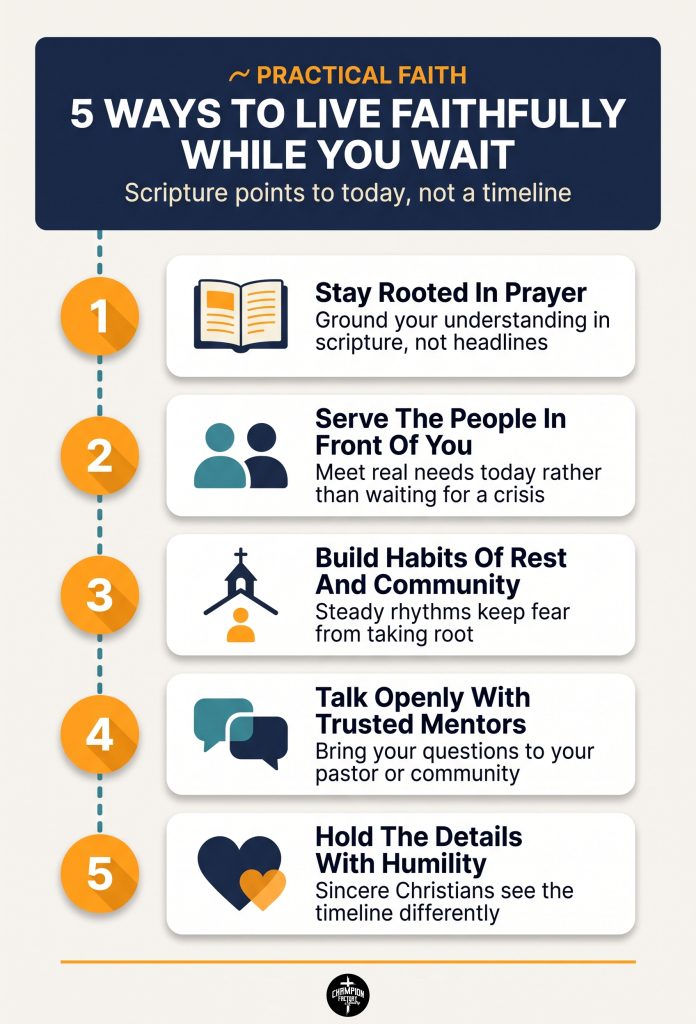
- Stay rooted in prayer and scripture rather than headlines or online speculation
- Serve the people in front of you today instead of waiting for a future crisis to act
- Build habits of rest and community that keep fear from taking root
- Talk openly with your pastor, mentor, or church community about your questions
- Hold your view on the details with humility, since sincere Christians disagree
Second Timothy 1:7 (NKJV) offers a fitting encouragement for this kind of daily faithfulness: "For God has not given us a spirit of fear, but of power and of love and of a sound mind."
"I have watched people carry real anxiety about the future until they finally bring it into community instead of holding it alone. That is where the shift happens. Our Nourish track exists for exactly that moment." Todd Medina, President & Founder
Champion Factory Ministry's Nourish discipleship track exists to help believers build this kind of steady, practical faith, season after season, regardless of what the news cycle brings.
How Can You Support A Family Member Who Feels Anxious About The End Times
If someone you love feels afraid about the end times, your calm presence matters more than having every answer. Listen first. Take their concern seriously without feeding it. Then gently point them back to what scripture actually says about hope rather than fear.
A few ways to help well:
- Ask open, caring questions instead of correcting them right away
- Share a specific, relevant scripture, such as 2 Timothy 1:7, instead of a long argument
- Avoid dismissing their concern as silly or overblown, since that can shut down honest conversation
When To Seek Additional Support
If a loved one's fear becomes constant, disrupts their sleep, or affects daily life, encourage them to talk with a pastor or a licensed counselor. This ministry offers mentorship and spiritual encouragement, but it does not replace professional mental health care when that level of support is needed.
Steady Hope For Uncertain Days
No one knows the day or hour of Christ's return. That was true for the first Christians, and it remains true today. What every generation of believers has been able to know is the character of the One who is returning: patient, faithful, and worthy of trust.
If this topic has stirred up questions or worry, that is a normal and honest place to start. The next step is simple. Bring those questions into community rather than carrying them alone. Champion Factory Ministry exists to walk alongside people through exactly these seasons of uncertainty, through mentorship, discipleship, and practical care.
If you would like to connect with that community or support this work, you can get involved today.
FAQ
Does the Bible give a specific date for the end times?
No. Matthew 24:36 says no one knows the day or hour, not even Jesus in his earthly ministry. Any teaching that names a specific date should be treated with caution.
Why do Christians disagree about the end times?
Sincere believers interpret prophetic scripture differently. Christ's return is not in question among Christians. The exact timeline and sequence of events is understood differently across traditions.
Is it normal to feel anxious about the end times?
Yes. Recent research shows this is a widely shared concern, and scripture speaks directly to this fear in passages like 2 Timothy 1:7.
What should I do if I think we are living in the end times?
Focus on what scripture calls for in every season: staying watchful, praying, serving others, and living out ordinary faithfulness rather than trying to predict what happens next.