






Questions about death rarely come from idle curiosity. They usually come from grief, fear, or a loved one's diagnosis. If you are searching for what the Bible actually says about death, you may be carrying something heavy right now.
This article walks through what scripture teaches about death, resurrection, judgment, and heaven. It stays close to what the Bible clearly says, while leaving room for the parts God has not fully explained. You will find comfort here, not just information.
What Happens to a Believer Immediately After Death
The Bible teaches that death is not the end for a believer in Jesus. It marks a transition into God's presence, though scripture does not spell out every detail of that transition. Christians throughout history have held slightly different views on the exact timing and experience between death and final resurrection. What remains constant is this. A person who trusts in Jesus is never separated from God's love, in life or in death.
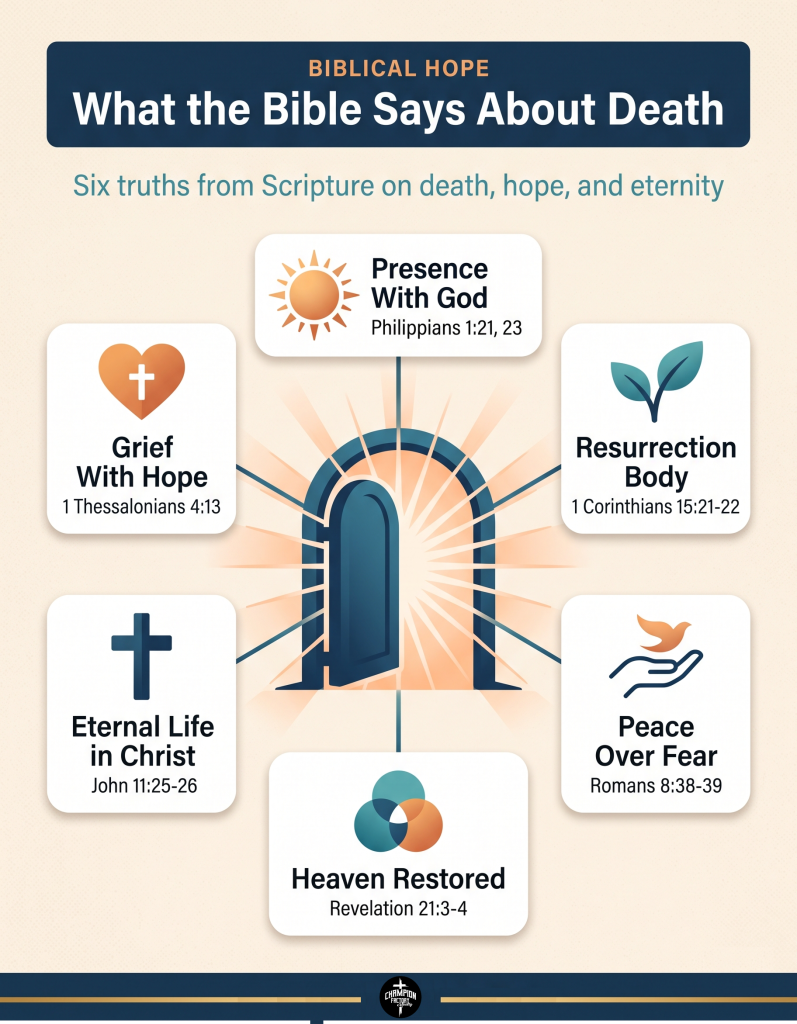
The apostle Paul wrote from a place of real hardship. He said, "For to me, to live is Christ and to die is gain" (Philippians 1:21, NIV). He continued, "I desire to depart and be with Christ, for that is better by far" (Philippians 1:23, NIV). Paul was not describing a formal doctrine. He was expressing deep confidence that death could not take away his relationship with God.
Jesus offered a similar promise to his followers before his own death. He said, "My Father's house has many rooms. If that were not so, would I have told you that I am going there to prepare a place for you" (John 14:2, NIV). That promise still stands for anyone who trusts him today.
Does the Bible Promise a Resurrection Body
Yes. The Bible teaches that death is not the final state for the body. It points to a future resurrection, where believers receive new, imperishable life through Christ. This is one of the clearest and most consistently taught promises in scripture, and it forms the foundation of Christian hope.
Paul explained the connection this way. "For since death came through a man, the resurrection of the dead comes also through a man. For as in Adam all die, so in Christ all will be made alive" (1 Corinthians 15:21 to 22, NIV). Later in the same letter, Paul writes with confidence rather than fear. "Where, O death, is your victory. Where, O death, is your sting. But thank God. He gives us the victory over sin and death through our Lord Jesus Christ" (1 Corinthians 15:55, 57, NIV).
This teaching matters because it shifts the focus from loss to renewal. The Bible does not describe death as the erasure of a person. It describes death as something Jesus has already defeated.
What the Bible Says About Grief and Loss
The Bible never asks believers to skip grief. It teaches that grief is real and expected, even for those who trust fully in God's promises. Faith does not remove sorrow. It offers comfort without asking you to hide it.
Paul wrote to a grieving community with gentleness, not correction. "We do not want you to be uninformed about those who sleep in death, so that you do not grieve like the rest of mankind, who have no hope" (1 Thessalonians 4:13, NIV). Notice what Paul does not say. He does not say do not grieve. He says grieve with hope rather than without it.
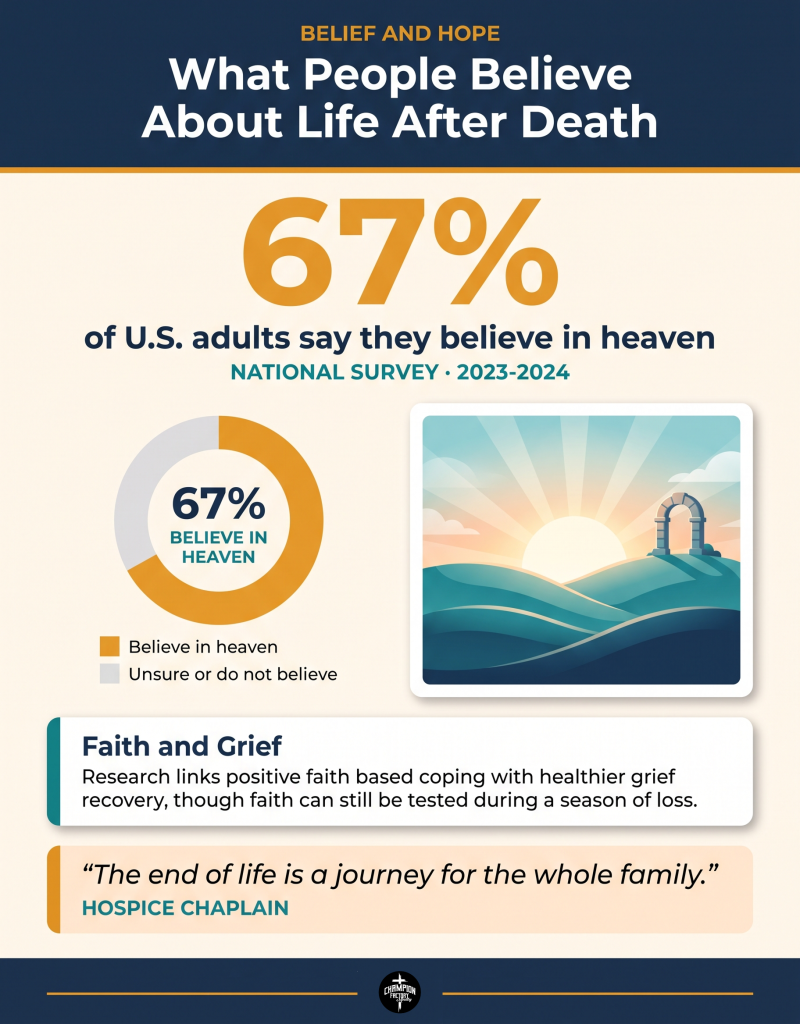
This distinction matters. Research on bereavement backs this up. Studies on religious coping after loss have found that leaning on faith is often linked to healthier grieving, though the same research shows grief can also strain a person's faith for a season. Both experiences are normal.
"We walk with families through loss often in our discipleship work. People do not need to be told to stop grieving. They need someone willing to sit with them in it." Todd Medina, President and Founder
If you are grieving right now, consider these steps.
- Give yourself permission to feel sadness without guilt
- Talk to someone you trust instead of carrying grief alone
- Reach out to a pastor, counselor, or grief support group if the weight feels too heavy to carry by yourself
- Use scripture as a source of comfort, not a timeline for how fast you should heal
Grief that feels unusually heavy or prolonged deserves professional support alongside faith. A counselor or grief specialist can help in ways that complement, not replace, your walk with God.
What Determines a Person's Eternal Destiny
According to the Bible, a person's eternal destiny is tied to their response to Jesus Christ, not to their own effort or good works. This is one of the most important and most reassuring teachings in scripture.
Jesus described himself as the source of resurrection and life. "I am the resurrection and the life. The one who believes in me will live, even though they die, and whoever lives by believing in me will never die" (John 11:25 to 26, NIV). Judgment is real in the Bible, but it is never presented as random or unfair. It is connected to a person's relationship with Jesus.
"The message we carry around the world is the same one that answers this question. It is Jesus, not human effort, that secures our hope beyond death." Art Montgomery, Global Evangelism Strategy Architect
This is a sacred and sometimes painful topic, especially for those wondering about a loved one's eternal destiny. The Bible does not give believers the authority to determine where another person stands with God. That belongs to God alone. If this question weighs on you, a conversation with a pastor or trusted spiritual mentor can offer more personal guidance than any single article.
What Heaven Is Like According to the Bible
The Bible describes heaven as a place of restored relationship with God, free from suffering, where believers are fully known and fully loved. Scripture does not give a detailed blueprint of heaven. It gives a picture of what will finally be made right.
One of the clearest pictures comes from Revelation. "God's dwelling place is now among the people, and he will dwell with them. He will wipe every tear from their eyes. There will be no more death or mourning or crying or pain, for the old order of things has passed away" (Revelation 21:3 to 4, NIV). This is not a vague image. It is a specific promise of comfort, presence, and healing.
It is worth noting how many people already sense that something like this exists. According to Pew Research Center, 67 percent of American adults say they believe in heaven. The Bible offers something more specific than a general hope. It offers a person, Jesus, who makes that hope possible.
How to Find Peace with the Fear of Death
The Bible does not shame people for fearing death. It offers a way to face that fear honestly, rooted in the security of God's love. Fear around death is common and human. Scripture meets that fear with reassurance rather than judgment.
Paul wrote one of the most comforting passages in the Bible on this exact topic. "Neither death nor life, neither angels nor demons, neither the present nor the future, nor any powers, neither height nor depth, nor anything else in all creation, will be able to separate us from the love of God that is in Christ Jesus our Lord" (Romans 8:38 to 39, NIV).
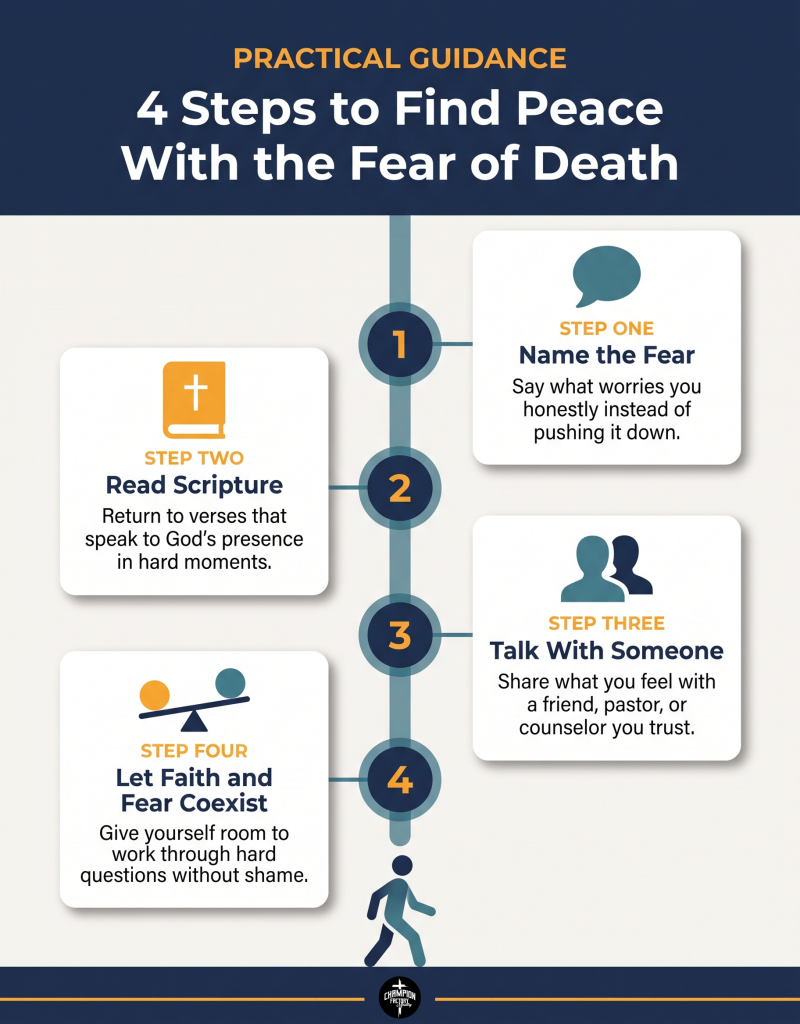
A few practical steps can help when fear feels heavy.
- Name the fear honestly instead of pushing it down
- Read scripture that speaks directly to God's presence in hard moments
- Talk with someone you trust, whether a friend, pastor, or counselor
- Remember that fear and faith can coexist while you work through hard questions
As Rev. Gregg TeBeest, a hospice chaplain, said in a recent interview, "The end of life is a journey for the whole family." That truth applies just as much to fear as it does to loss. You are not meant to carry it alone.
Where Your Hope Can Rest Today
Death raises real questions, and the Bible does not avoid them. It points again and again to Jesus as the answer to fear, grief, and uncertainty about what comes next. The Bible does not end with despair. It ends with resurrection.
If you are grieving, afraid, or simply looking for clear answers, you do not have to sort through this alone. Champion Factory Ministry's Nourish discipleship ministry exists to walk alongside people through seasons like this, offering community, mentorship, and spiritual encouragement grounded in scripture. If you would like support or simply someone to talk to, we would be honored to connect with you.
FAQ
What happens to a Christian right after they die?
The Bible teaches that a believer is never separated from God's love, in life or in death. Christians hold slightly different views on the exact details of that transition, but the promise of God's presence stays constant.
Is it okay to grieve if I believe in heaven?
Yes. The Bible does not ask believers to avoid grief. It encourages grieving with hope rather than grieving alone.
Does the Bible say I should be afraid of dying?
No. Scripture acknowledges that fear around death is common, and it offers reassurance that God's love holds firm through it, as described in Romans 8:38 to 39.
Does the Bible promise a physical resurrection?
Yes. Passages like 1 Corinthians 15:21 to 22 teach that believers will receive new, imperishable life through Christ's resurrection.